
Anti-Premature Skin Aging Activities of Peptides from Black Soldier Fly (Hermetia illucens L.) Larvae: In vitro Analysis and Network Pharmacology
DOI:
https://doi.org/10.48048/tis.2026.13375Keywords:
Cytoprotection, Hermetia illucens larvae, Microbial modulation, Network pharmacology, Peptide, Skin aging, Cytoprotection, Hermetia illucens larvae, Microbial modulation, Network pharmacology, Peptide, Skin agingAbstract
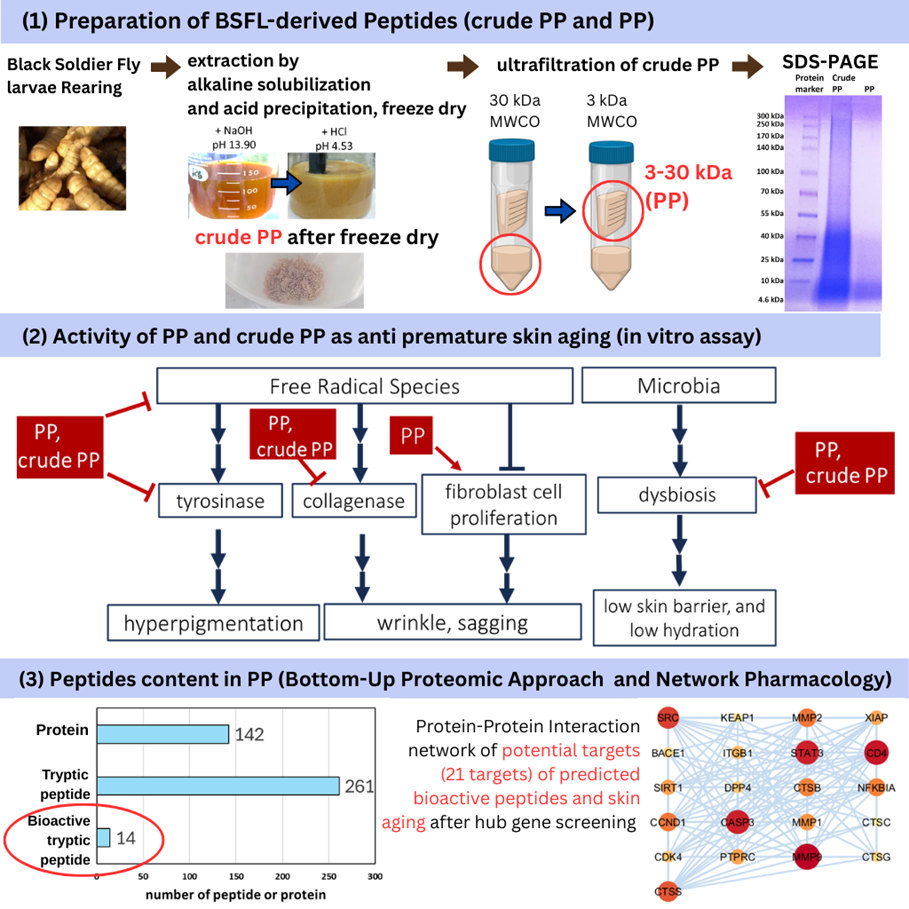
Environmental factors and modern lifestyles contribute to premature skin aging, with an increasing number of young adults exhibiting it in subtropical and tropical regions. Bioactive peptides derived from Hermetia illucens L. larvae (black soldier fly larvae, BSFL) have been reported to exhibit antioxidant and antimicrobial activities; however, no study has comprehensively evaluated BSFL-derived peptides within a defined molecular weight range using an integrated in vitro and network pharmacology framework to address multiple mechanisms of premature skin aging. This study aims to extract, fractionate, and characterize peptides from BSFL, specifically targeting bioactivities relevant to premature skin aging in vitro. The peptides were isolated via alkaline solubilization and acid precipitation, followed by ultrafiltration, resulting in a peptide fraction with molecular weights of 3 to 30 kDa (PP). The bioactivities of PP were assessed using total antioxidant capacity, anti-tyrosinase, anti-collagenase, cytoprotection, and microbial modulation assays. Results indicated that the PP exhibited significantly enhanced antioxidant activity, tyrosinase inhibition, NIH/3T3 fibroblast proliferation, and protection of fibroblast from oxidative damage compared to crude protein extract (crude PP). Both PP and crude PP exhibited collagenase inhibition and microbial modulation activities against Corynebacterium glutamicum, a microbial genus model associated with skin aging, and Staphylococcus epidermidis, a beneficial bacterium found on skin. Among 261 tryptic peptides detected in PP by a bottom-up proteomic approach using LC-HRMS, 14 peptides were predicted to be biologically active by network pharmacology analysis. Network pharmacology analysis also predicted that the bioactive tryptic peptides target key proteins involved in skin aging, mainly MMP9, STAT3, and CASP3, which may support anti-collagenase and fibroblast proliferation assays. The results indicate that BSFL-derived peptides exhibit in vitro activities relevant to processes implicated in premature skin aging. These findings support further mechanistic validation in human cellular or tissue models to clarify their biological significance and potential application in skin-related formulations.
HIGHLIGHTS
- Peptides from Hermetia illucens larvae (BSFL) with molecular weights ranging from 3 to 30 kDa (PP) demonstrate potent antioxidant, antityrosinase, and anticollagenase activities, indicating the potency to donate electrons to reactive molecules, and bind to the tyrosinase and collagenase.
- The BSFL-derived PP promotes fibroblast proliferation and protects cells from oxidative stress.
- The BSFL-derived PP selectively modulated a simplified genus-level skin microbiota model, reducing the growth of Corynebacterium glutamicum as a representative of Corynebacterium while preserving Staphylococcus epidermidis.
- LC-HRMS identified 261 tryptic peptides in the BSFL-derived PP, of which 14 peptides were predicted bioactive peptides according to network pharmacology analysis.
- Network pharmacology analysis revealed that predicted bioactive peptides targeting key skin aging-related proteins mainly MMP9, STAT3, CASP3.
GRAPHICAL ABSTRACT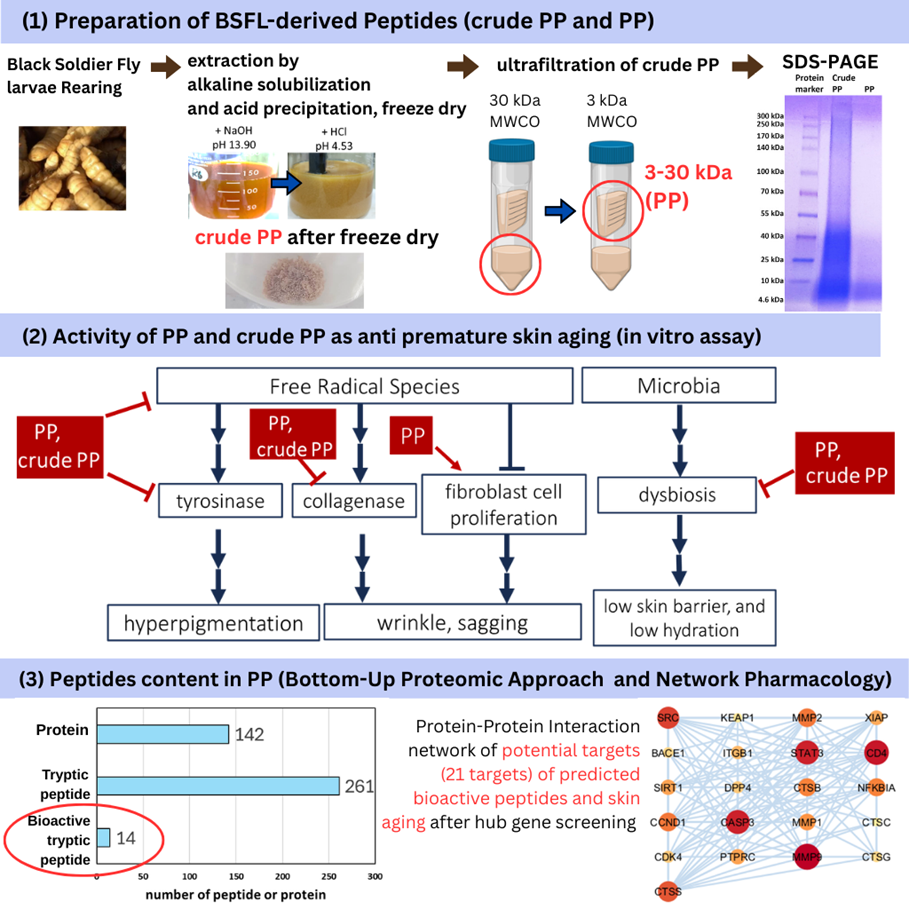
Downloads
References
C Parrado, S Mercado-Saenz, A Perez-Davo, Y Gilaberte, S Gonzalez and A Juarranz. Environmental stressors on skin aging. Mechanistic Insights. Frontiers in Pharmacology 2019; 10, 759.
R Oizumi, Y Sugimoto and H Aibara. The Potential of exercise on lifestyle and skin function: Narrative review. JMIR Dermatology 2024; 7, e51962.
Z Peng, B Chen, Q Zheng, G Zhu, W Cao, X Qin and C Zhang. Ameliorative Effects of Peptides from the Oyster (Crassostrea hongkongensis) protein hydrolysates against UVB-induced skin photodamage in mice. Marine Drugs 2020; 18(6), 288.
HR Kim, DH Jeong, S Kim, SW Lee, HS Sin, KY Yu, SI Jeong and SY Kim. Fermentation of blackberry with L. plantarum JBMI F5 enhance the protection effect on UVB-mediated photoaging in human foreskin fibroblast and hairless mice through regulation of MAPK/NF-κB signaling. Nutrients 2019; 11(10), 2429.
HS Han, JS Shin, DB Myung, HS Ahn, SH Lee, HJ Kim and KT Lee. Hydrangea serrata (Thunb.) Ser. extract attenuate UVB-induced photoaging through MAPK/AP-1 inactivation in human skin fibroblasts and hairless mice. Nutrients 2019; 11(3), 533.
A Darawsha, A Trachtenberg, J Levy and Y Sharoni. The protective effect of carotenoids, polyphenols, and estradiol on dermal fibroblasts under oxidative stress. Antioxidants 2021; 10(12), 2023.
JH Kim, HD Jeong, MJ Song, DH Lee, JH Chung and ST Lee. SOD3 suppresses the expression of MMP-1 and increases the integrity of extracellular matrix in fibroblasts. Antioxidants 2022; 11(5), 928.
Y Wang, MM Hao, Y Sun, LF Wang, H Wang, YJ Zhang, HY Li, PW Zhuang and Z Yang. Synergistic promotion on tyrosinase inhibition by antioxidants. Molecules 2018; 23(1), 106.
S Katiyar, D Yadav and SK Singh. Markers of oxidative stress and tyrosinase activity in melasma patients: A biochemical investigation. Current Protein and Peptide Science 2024; 25(2), 183-188.
R Jugé, P Rouaud‐Tinguely, J Breugnot, K Servaes, C Grimaldi, MP Roth, H Coppin and B Closs. Shift in skin microbiota of Western European women across aging. Journal of Applied Microbiology 2018; 125(3), 907-916.
MHY Leung, D Wilkins and PKH Lee. Insights into the pan-microbiome: Skin microbial communities of Chinese individuals differ from other racial groups. Scientific Reports 2015; 5(1), 11845.
B Howard, CC Bascom, P Hu, RL Binder, G Fadayel, TG Huggins, BB Jarrold, R Osborne, HL Rocchetta, D Swift, JP tiesman, Y Song, Y Wang, K wehmeyer, AB Kimball and RJ Isfort. Aging-associated changes in the adult human skin microbiome and the host factors that affect skin microbiome composition. Journal of Investigative Dermatology 2022; 142(7), 1934-1946.
C Sun, G Hu, L Yi, W Ge, Q Yang, X Yang, Y He, Z Liyu and WH Chen. Integrated analysis of facial microbiome and skin physio-optical properties unveils cutotype-dependent aging effects. Microbiome 2024; 12(1), 163.
Y Jung, I Kim, DR Jung, JH Ha, EK Lee, JM Kim, JY kim, JH Jang, JT Bae, JH Shin and YS Cho. Aging-induced changes in cutibacterium acnes and their effects on skin elasticity and wrinkle formation. Microorganisms 2024; 12(11), 2179.
S Iglesia, T Kononov and AS Zahr. A multi‐functional anti‐aging moisturizer maintains a diverse and balanced facial skin microbiome. Journal of Applied Microbiology 2022; 133(3), 1791-1799.
F Mei, J Liu, J Wu, Z Duan, M Chen, K Meng, S Chen, X Shen, G Xia and M Zhao. Collagen peptides isolated from salmo salar and tilapia nilotica skin accelerate wound healing by altering cutaneous microbiome colonization via upregulated NOD2 and BD14. Journal of Agricultural and Food Chemistry 2020; 68(6), 1621-1633.
J Mu, Q Lin, S Wang, M Chen, J Wang, Y Chen, Y Li and Y Liang. TNF-α modulation by rice bran peptides: Implications for gut microbiota stability and cognitive health in aging. Npj Biofilms and Microbiomes 2025; 11(1), 195.
MG Claros, M Lequio, S Cheli, AB Garlatti, N Cecilia, L Juarez, M Bittar, MJ Leiva, ML Hernandez, JM Márquez, G Babaracco and SL Mercier. A cross-sectional epidemiological study conducted in Argentina to evaluate the impact of the exposome on skin aging. Journal of Cosmetic Dermatology 2023; 22(12), 3459-3469.
JY Ng, H Zhou, T Li and FT Chew. Comparisons between wrinkles and photo-ageing detected and self-reported by the participant or identified by trained assessors reveal insights from Chinese individuals in the Singapore/Malaysia Cross-sectional Genetics Epidemiology Study (SMCGES) cohort. Journal of Physiological Anthropology 2024; 43(1), 14.
AC Green, MCB Hughes, P McBridea and A Fourtanier. Factors Associated with premature skin aging (photoaging) before the age of 55: A population-based study. Dermatology 2011; 222(1), 74-80.
SH Zyoud, T Ahmada nd SW Al-Jabi. Mapping the global research landscape: A bibliometric analysis of clinical trials on skin aging - trends, innovations, and research gaps. Aesthetic Plastic Surgery 2025; 49(17), 5055-5058.
R Tenchov, JM Sasso, X Wang and QA Zhou. Antiaging strategies and remedies: A landscape of research progress and promise. ACS Chemical Neuroscience 2024; 15(3), 408-446.
M Lau, J Mineroff Gollogly, JY Wang and J Jagdeo. Cosmeceuticals for antiaging: A systematic review of safety and efficacy. Archives of Dermatological Research 2024; 316(5), 173.
PLM Alves, V Nieri, F de C Moreli, E Constantino, J de Souza, Y Oshima-Franco and D Grotto. Unveiling New horizons: Advancing technologies in cosmeceuticals for anti-aging solutions. Molecules 2024; 29(20), 4890.
W Klinngam, A Chaiwichien, S Osotprasit, U Ruktanonchai, M Kanlayavattanakul, N Lourith, A Wongrakpanich, V Teeranachaideekul and T Iempridee. Longevity cosmeceuticals as the next frontier in cosmetic innovation: a scientific framework for substantiating product claims. Frontiers in Aging 2025; 6, 1586999.
M Tomas, D Günal-Köroğlu, S Kamiloglu, T Ozdal and E Capanoglu. The state of the art in anti-aging: Plant-based phytochemicals for skin care. Immunity & Ageing 2025; 22(1), 5.
H Wang, J Zheng, S Cao and J Lv. Research on the mechanisms of plant bioactive metabolites in anti-skin aging and future development prospects. Frontiers in Pharmacology 2025; 16, 1673075.
JE Aguilar-Toalá, A Hernández-Mendoza, AF González-Córdova, B Vallejo-Cordoba and AM Liceaga. Potential role of natural bioactive peptides for development of cosmeceutical skin products. Peptides 2019; 122, 170170.
A Pintea, A Manea, C Pintea, RA Vlad, M Bîrsan, P Antonoaea, EM Rédai and A Ciurba. Peptides: Emerging candidates for the prevention and treatment of skin senescence: A review. Biomolecules 2025; 15(1), 88.
MS Ferreira, MC Magalhães, JM Sousa-Lobo and IF Almeida. Trending anti-aging peptides. Cosmetics 2020; 7(4), 91
Z Xia, W Liu, F Zeng, S Kang, J Li, W Xu, P Tang, X Zheng, D Li, X Yang, Q Sheng and X Li. Systematic evaluation and identification of anti-inflammatory and anti-aging ginseng peptides for skincare applications. Cosmetics 2025; 12(2), 85.
SA Siddiqui, B Ristow, T Rahayu, NS Putra, NW Yuwono, K Nisa, B Mategako, S Smetana, M Saki, A Nawaz and A Nagdalian. Black soldier fly larvae (BSFL) and their affinity for organic waste processing. Waste Management 2022; 140, 1-13.
S Ebeneezar, D Linga Prabu, CS Tejpal, NS Jeena, R Summaya, S Chandrasekar, P Sayooj and P Vijayagopal. Nutritional evaluation, bioconversion performance and phylogenetic assessment of black soldier fly (Hermetia illucens, Linn. 1758) larvae valorized from food waste. Environmental Technology & Innovation 2021; 23, 101783.
Saputra and YN Lee. Nutrition composition of commercial full-fat and defatted black soldier fly larvae meal (Hermetia illucens) as a potential protein resource for aquafeeds. Biodiversitas 2023; 24(9), 4877-4884.
JA Khan, X Guo, R Pichner, K Aganovic, V Heinz, C Hollah, SV Miert, GR Verheyan, A Juadjur and KU Rehman. Evaluation of nutritional and techno-functional aspects of black soldier fly high-protein extracts in different developmental stages. Animal 2025; 19(4), 101463.
J Lu, Y Guo, A Muhmood, B Zeng, Y Qiu, P Wang and L Ren. Probing the antioxidant activity of functional proteins and bioactive peptides in Hermetia illucens larvae fed with food wastes. Scientific Reports 2022; 12(1), 2799.
M Firmansyah and MY Abduh. Production of protein hydrolysate containing antioxidant activity from Hermetia illucens. Heliyon 2019; 5(6), e02005.
SI Park, JW Kim and SM Yoe. Purification and characterization of a novel antibacterial peptide from black soldier fly (Hermetia illucens) larvae. Developmental and Comparative Immunology 2015; 52(1), 98-106.
T Pimchan, A Hamzeh, P Siringan, K Thumanu, Y Hanboonsong and J Yongsawatdigul. Antibacterial peptides from black soldier fly (Hermetia illucens) larvae: Mode of action and characterization. Scientific Reports 2024; 14(1), 26469.
DH Lee, KB Chu, HJ Kang, SH Lee and FS Quan. Peptides in the hemolymph of Hermetia illucens larvae completely inhibit the growth of Klebsiella pneumonia in vitro and in vivo. Journal of Asia-Pacific Entomology 2020; 23(1), 36-43.
SI Park and SM Yoe. Defensin-like peptide3 from black soldier fly: Identification, characterization, and key amino acids for anti-Gram-negative bacteria. Entomological Research 2017; 47(1), 41-47.
X Xiaoyan, S Hongxia, G Jiamin, C Huicheng, L Ye and X Qiang. Antimicrobial peptide HI-3 from Hermetia illucens alleviates inflammation in lipopolysaccharide-stimulated RAW264.7 cells via suppression of the nuclear factor kappa-B signaling pathway. Microbiology and Immunology 2023; 67(1), 32-43.
D Sandakila, GD Hadi, R Gultom, S Samalele and RA Nugroho. Ethanolic extract of black soldier fly (Hermetia illucens L.) larvae for wound healing in mice (Mus musculus L.). Aceh Journal of Animal Science 2024; 9(3), 119-127.
CS Wu, SS Wang, DY Wu and W Gu. Modified poly(ε-caprolactone) with larvae protein environmentally friendly nanofiber: Assessment of interface properties and characterization. Express Polymer Letters 2024; 18(8), 835-850.
VA Duong and H Lee. Bottom-up proteomics: Advancements in sample preparation. International Journal of Molecular Sciences 2023; 24(6), 5350.
T Puopolo, NP Seeram and C Liu. Chloroform/methanol protein extraction and in-solution trypsin digestion protocol for bottom-up proteomics analysis. Bio-Protocol 2024; 14(16), e5055.
JM Burkhart, C Schumbrutzki, S Wortelkamp, A Sickmann and RP Zahedi. Systematic and quantitative comparison of digest efficiency and specificity reveals the impact of trypsin quality on MS-based proteomics. Journal of Proteomics 2012; 75(4), 1454-1462.
JV Olsen, SE Ong and M Mann. Trypsin cleaves exclusively c-terminal to arginine and lysine residues. Molecular & Cellular Proteomics 2004; 3(6), 608-614.
S Sedláčková, M Hubálek, V Vrkoslav, M Blechová, P Kozlík and J Cvačka. Positive effect of acetylation on proteomic analysis based on liquid chromatography with atmospheric pressure chemical ionization and photoionization mass spectrometry. Molecules 2023; 28(9), 3711.
MS Mansuri, S Bathla, TT Lam, AC Nairn and KR Williams. Optimal conditions for carrying out trypsin digestions on complex proteomes: From bulk samples to single cells. Journal of Proteomics 2024; 297, 105109.
D Purcell, MA Packer and M Hayes. Identification of bioactive peptides from a laminaria digitata protein hydrolysate using in silico and in vitro methods to identify angiotensin-1-converting enzyme (ACE-1) Inhibitory peptides. Marine Drugs 2023; 21(2), 90.
ER Coscueta, P Batista, JEG Gomes, R da Silva and MM Pintado. Screening of novel bioactive peptides from goat casein: In silico to in vitro validation. International Journal of Molecular Sciences 2022; 23(5), 2439.
D Szklarczyk, K Nastou, M Koutrouli, R Kirsch, F Mehryary, R Hachilif, D Hu, ME Peluso, Q Huang, T Fang, NT Doncheva, S Pyysalo, P Bork, LJ Jensen and CV Mering. The STRING database in 2025: Protein networks with directionality of regulation. Nucleic Acids Research 2025; 53(D1), D730-D737.
RA Nugroho, R Aryani, EH Hardi, H Manurung, R Rudianto and WN Jati. Fermented palm kernel waste with different sugars as substrate for black soldier fly larvae. Global Journal of Environmental Science and Management 2024; 10(2), 503-516.
B Hoc, G Noël, J Carpentier, F Francis and RC Megido. Optimization of black soldier fly (Hermetia illucens) artificial reproduction. Plos One 2019; 14(4), e0216160.
R Aryani, R Rosnadia, I Irma, H Manurung, R Rudianto and R Nugroho. Biochemical and immune modulation in mice fed defatted black soldier fly (Hermetia illucens L.) larvae meal. Tropical Journal of Natural Product Research 2025; 9(7), 3067-3075.
JH Xu, S Xiao, JH Wang, B Wang, YX Cai and WF Hu. Comparative study of the effects of ultrasound-assisted alkaline extraction on black soldier fly (Hermetia illucens) larvae protein: Nutritional, structural, and functional properties. Ultrasonics Sonochemistry 2023; 101, 106662.
F Namjoyan, A Jahangiri, ME Azemi and H Mousavi. Inhibitory effects of Urginea maritima (L.) baker, Zhumeria majdae Rech. F. and Wendelbo and Physalis divaricata D. Don ethanolic extracts on mushroom tyrosinase. Pharmaceutical Sciences 2016; 22(2), 81-86.
S Sen, S Ghosh, S De, P Basak, P Maurye, NK Jana and TK Mandal. Immunomodulatory and antimicrobial non-mulberry Antheraea mylitta silk fibroin accelerates in vitro fibroblast repair and regeneration by protecting oxidative stress. RSC Advances 2021; 11(31), 19265-19282.
H Ardalani, S Anam, KJK Kromphardt, D Staerk and KT Kongstad. Coupling microplate-based antibacterial assay with liquid chromatography for high-resolution growth inhibition profiling of crude extracts: Validation and proof-of-concept study with Staphylococcus aureus. Molecules 2021; 26(6), 1550.
K Praseatsook, A Vachiraarunwong, S Taya, P Setthaya, K Sato, H Wanibuchi, R Wongpoomchai, P Dejkriengkraikul, M Gi and S Yodkeree. Anticancer and antioxidant effects of bioactive peptides from black soldier fly larvae (Hermetia illucens). Nutrients 2025; 17(4), 645.
J Pan, H Xu, M Dabbour, B Kumah Mintah, W Chen, F Yang, Z Zhang, Y Cheng, C Dai, R He and H Ma. Effect of alkaline pH-shifting process on extraction rate, structural, and functional properties of black soldier fly (Hermetia illucens) larvae protein. LWT 2023; 185, 115180.
L Miron, G Montevecchi, G Bruggeman, LI Macavei, L Maistrello, A Antonelli and M Thomas. Functional properties and essential amino acid composition of proteins extracted from black soldier fly larvae reared on canteen leftovers. Innovative Food Science and Emerging Technologies 2023; 87, 103407.
B Zozo, M Wicht and J van Wyk. Effect of alkaline extraction-isoelectric precipitation and salt-assisted extraction on physicochemical and techno-functional properties of black soldier fly larvae proteins. Applied Sciences 2024; 14(24), 11485.
Z Chang, B Fu, M Li, S Cheng and M Du. Advancements in identification of low-molecular-weight peptides in food protein hydrolysates. Food Frontiers 2025; 6(5), 2144-2164.
N Landi, A Clemente, PV Pedone, S Ragucci and A Di Maro. An updated review of bioactive peptides from mushrooms in a well-defined molecular weight range. Toxins 2022; 14(2), 84.
D Zhu, X Huang, F Tu, C Wang and F Yang. Preparation, antioxidant activity evaluation, and identification of antioxidant peptide from black soldier fly (Hermetia illucens L.) larvae. Journal of Food Biochemistry 2020; 44(5), e13186.
L Meng, D Yu, J Lin, Y Hu, N Peng and S Zhao. Structural characterization, HepG2 cell cytoprotective ability, and antioxidant mechanism of novel antioxidant peptides identified from black soldier fly larvae (Hermetia illucens L.). Food Chemistry 2025; 463, 141462.
MP Germanò, F Cacciola, P Donato, P Dugo, G Certo, V D’Angelo, L Mondello and A Rapisarda. Betula pendula leaves: Polyphenolic characterization and potential innovative use in skin whitening products. Fitoterapia 2012; 83(5), 877-882.
B Gąsowska-Bajger and H Wojtasek. Epigallocatechin and epigallocatechin-3-gallate are not inhibitors of tyrosinase. Bioorganic & Medicinal Chemistry Letters 2024; 113, 129976.
I Kubo, QX Chen and K Nihei. Molecular design of antibrowning agents: Antioxidative tyrosinase inhibitors. Food Chemistry 2023; 81(2), 241-247.
M Taheri, F Seirafianpour, A Fallahian, A Hosseinzadeh, RJ Reiter and S Mehrzadi. Exploring melatonin’s signalling pathways in the protection against age-related skin deterioration. Pharmacological Reports 2025; 77(2), 375-391.
S Lee, BH Kim, YJ Choi, DW Kim, E Cho, M Kang, D Kim, J Pyo and KS Kang. Inhibition of TNF-α-induced collagen degradation and oxidative damage by Centipeda minima and Brevilin A in human dermal fibroblasts. Current Issues in Molecular Biology 2025; 47(5), 376.
S Pientaweeratch, V Panapisal and A Tansirikongkol. Antioxidant, anti-collagenase and anti-elastase activities of Phyllanthus emblica, Manilkara zapota and silymarin: An in vitro comparative study for anti-aging applications. Pharmaceutical Biology 2016; 54(9), 1865-1872.
YC Loo, HC Hu, SY Yu, YH Tsai, M Korinek, YC Wu, FR Chang and YJ Chen. Development on potential skin anti-aging agents of Cosmos caudatus Kunth via inhibition of collagenase, MMP-1 and MMP-3 activities. Phytomedicine 2023; 110,154643.
W Xue, X Liu, X., W Zhao and Z Yu. Identification and molecular mechanism of novel tyrosinase inhibitory peptides from collagen. Journal of Food Science 2022; 87(6), 2744-2756.
M Dymek, D Warszycki, S Podlewska and E Sikora. Novel tripeptides as tyrosinase inhibitors: In silico and in vitro approaches. International Journal of Molecular Sciences 2024; 25(24), 13509.
PG Yap and CY Gan. Multifunctional tyrosinase inhibitor peptides with copper chelating, UV-absorption and antioxidant activities: Kinetic and docking studies. Foods 2021; 10(3), 675.
A Sargsyan, H Hakobyan, Z Mardiyan, S Jamharyan, A Dadayan, T Sargsyan and N Hovhannisyan. Modeling, synthesis and in vitro screening of unusual amino acids and peptides as protease inhibitors. Journal of Chemical Technology and Metallurgy 2023; 58(3), 615-620.
GR Rama, LFSM Timmers and CFV de Souza. In silico strategies to predict anti-aging features of whey peptides. Molecular Biotechnology 2024; 66(9), 2426-2440.
K Yeerong, P Chantawannakul, S Anuchapreeda, S Wangtueai and W Chaiyana. Optimization of hydrolysis conditions, isolation, and identification of biologically active peptides derived from acheta domesticus for antioxidant and collagenase inhibition. Antioxidants 2024; 13(3), 367.
N Talachi, E Afzal, M Nouri, S Abroun, M Zarrabi and H Jahandar. Protective effect of human amniotic membrane extract against hydrogen peroxide-induced oxidative damage in human dermal fibroblasts. International Journal of Cosmetic Science 2023; 45(1), 73-82.
N Zhu, R Liu, M Xu and Y Li. The potential of bioactive fish collagen oligopeptides against hydrogen peroxide-induced NIH/3T3 and HUVEC damage: The involvement of the mitochondria. Nutrients 2024; 16(7), 1004.
N Zhu, MH Xu and Y Li. Bioactive oligopeptides from ginseng (Panax ginseng Meyer) suppress oxidative stress-induced senescence in fibroblasts via NAD+/SIRT1/PGC-1α signaling pathway. Nutrients 2022; 14(24), 5289.
ME Giordano, F Lionetto and MG Lionetto. Impact of polyethylene terephthalate nanoplastics (PET) on fibroblasts: A study on NIH-3T3 cells. Frontiers in Physiology 2025; 16, 1580682.
P Branco, EM Maurício, A Costa, D Ventura, C Roma-Rodrigues, MP Duarte, AR Fernandes and C Prista. Exploring the multifaceted potential of a peptide fraction derived from Saccharomyces cerevisiae metabolism: Antimicrobial, antioxidant, antidiabetic, and anti-inflammatory properties. Antibiotics 2023; 12(8), 1332.
B Masoumifeshani, AA Kenari, I Sottorff, M Crüsemann and JA Moghaddam. Identification and evaluation of antioxidant and anti-aging peptide fractions from enzymatically hydrolyzed proteins of Spirulina platensis and Chlorella vulgaris. Marine Drugs 2025; 23(4), 162.
R Herman, S Meaden, M Rudden, R Cornmell, HN Wilkinson, MJ Hardman, AJ Wilkinson, B Murphy and GH Thomas. Revealing the diversity of commensal corynebacteria from a single human skin site. mSystems 2025; 10(10), e00459-25.
MG Jensen, L Svraka, E Baez, M Lund, A Poehlein and H Brüggemann. Species- and strain-level diversity of Corynebacteria isolated from human facial skin. BMC Microbiology 2023; 23(1), 366.
JH Kim, SM Son, H Park, BK Kim, IS Choi, H Kim and CS Huh. Taxonomic profiling of skin microbiome and correlation with clinical skin parameters in healthy Koreans. Scientific Reports 2021; 11(1), 16269.
T Myers, A Bouslimani, S Huang, ST Hansen, C Clavaud, A Azouaoui, A Ott, A Gueniche, C Bouez, Q Zheng, L Aguilar, R Knight, M Moreau and SJ Song. A multi-study analysis enables identification of potential microbial features associated with skin aging signs. Frontiers in Aging 2024; 4, 1304705.
KY Hsin, S Ghosh and H Kitano. Combining machine learning systems and multiple docking simulation packages to improve docking prediction reliability for network pharmacology. Plos One 2013; 8(12), e83922.
C Mooney, NJ Haslam, G Pollastri and DC Shields. Towards the improved discovery and design of functional peptides: Common features of diverse classes permit generalized prediction of bioactivity. Plos One 2012; 7(10), e45012.
MJ Keiser, BL Roth, BN Armbruster, P Ernsberger, JJ Irwin and BK Shoichet. Relating protein pharmacology by ligand chemistry. Nature Biotechnology 2007; 25(2), 197-206.
D Grissa, A Junge, TI Oprea and LJ Jensen. Diseases 2.0: A weekly updated database of disease-gene associations from text mining and data integration. Database 2022; 2022, baac019.
M Ashtiani, A Salehzadeh-Yazdi, Z Razaghi-Moghadam, H Hennig, O Wolkenhauer, M Mirzaie and M Jafari. A systematic survey of centrality measures for protein-protein interaction networks. BMC Systems Biology 2018; 12(1), 80.
SR Van Doren. Matrix metalloproteinase interactions with collagen and elastin. Matrix Biology 2015; 44-46, 224-231.
T Shirogane, T Fukada, JMM Muller, DT Shima, M Hibi and T Hirano. Synergistic Roles for Pim-1 and c-Myc in STAT3-mediated cell cycle progression and antiapoptosis. Immunity 1999; 11(6), 709-719.
S McComb, PK Chan, A Guinot, H Hartmannsdottir, S Jenni, MP Dobay, JP Bourquin and BC Bornhauser. Efficient apoptosis requires feedback amplification of upstream apoptotic signals by effector caspase-3 or -7. Science Advances 2019; 5(7), eaau9433.
Y Song, S Chen, L Li, Y Zeng and X Hu. The hypopigmentation mechanism of tyrosinase inhibitory peptides derived from food proteins: An overview. Molecules 2022; 27(9), 2710.
Y Lu, KF Tonissen and G Di Trapani. Modulating skin colour: Role of the thioredoxin and glutathione systems in regulating melanogenesis. Bioscience Reports 2021; 41(5), BSR20210427.
D Pujimulyani, CL Suryani, A Setyowati, RAS Handayani, S Arumwardana, W Widowati and A Maruf. Cosmeceutical potentials of Curcuma mangga Val. extract in human BJ fibroblasts against MMP1, MMP3, and MMP13. Heliyon 2020; 6(9), e04921.
W Choi, HS Kim, SH Park, D Kim, YD Hong, JH Kim and JY Cho. Syringaresinol derived from Panax ginseng berry attenuates oxidative stress-induced skin aging via autophagy. Journal of Ginseng Research 2022; 46(4), 536-542.
T Tanigawa, S Kanazawa, R Ichibori, T Fujiwara, T Magome, K Shingaki, S Miyata, Y Hata, K Tomita, K Matsuda, T Kubo, M Tohyama, K Yano and K Hosokawa. (+)-Catechin protects dermal fibroblasts against oxidative stress-induced apoptosis. BMC Complementary and Alternative Medicine 2014; 14(1), 133.
HJ Cho, JA Hwang, EJ Yang, EC Kim, JR Kim, SY Kim, YZ Kim, SC Park and YS Lee. Nintedanib induces senolytic effect via STAT3 inhibition. Cell Death & Disease 2022; 13(9), 760.
J Zhang, H Yu, MQ Man and L Hu. Aging in the dermis: Fibroblast senescence and its significance. Aging Cell 2024; 23(2), e14054.
GH Kim and BM Kim. In vitro and in silico evaluation of a novel multifunctional cyclic peptide with antioxidant, tyrosinase-inhibitory, and extracellular matrix-modulating activities. International Journal of Molecular Sciences 2025; 26(22), 10878.
B Xu, Y Wang, L Zha, M Chen, P Yu, Q Dong, O Suwantong and Y Zhao. Novel antioxidant peptides from hydrolyzed proteins of Volvariella volvacea: Purification, characterization and protective effects on H₂O₂-induced human skin fibroblasts. Food Bioscience 2025; 64, 105825.
Published
How to Cite
Issue
Section
License
Copyright (c) 2026 Walailak University

This work is licensed under a Creative Commons Attribution-NonCommercial-NoDerivatives 4.0 International License.





