
Modulation of Potassium Ion Transport in Mitochondria by Kaempferol and Its Glycosides
DOI:
https://doi.org/10.48048/tis.2026.13296Keywords:
Liver mitochondria, mitoKATP, ATP, Mg2 , valinomycin, kaempferol and its glycosidesAbstract
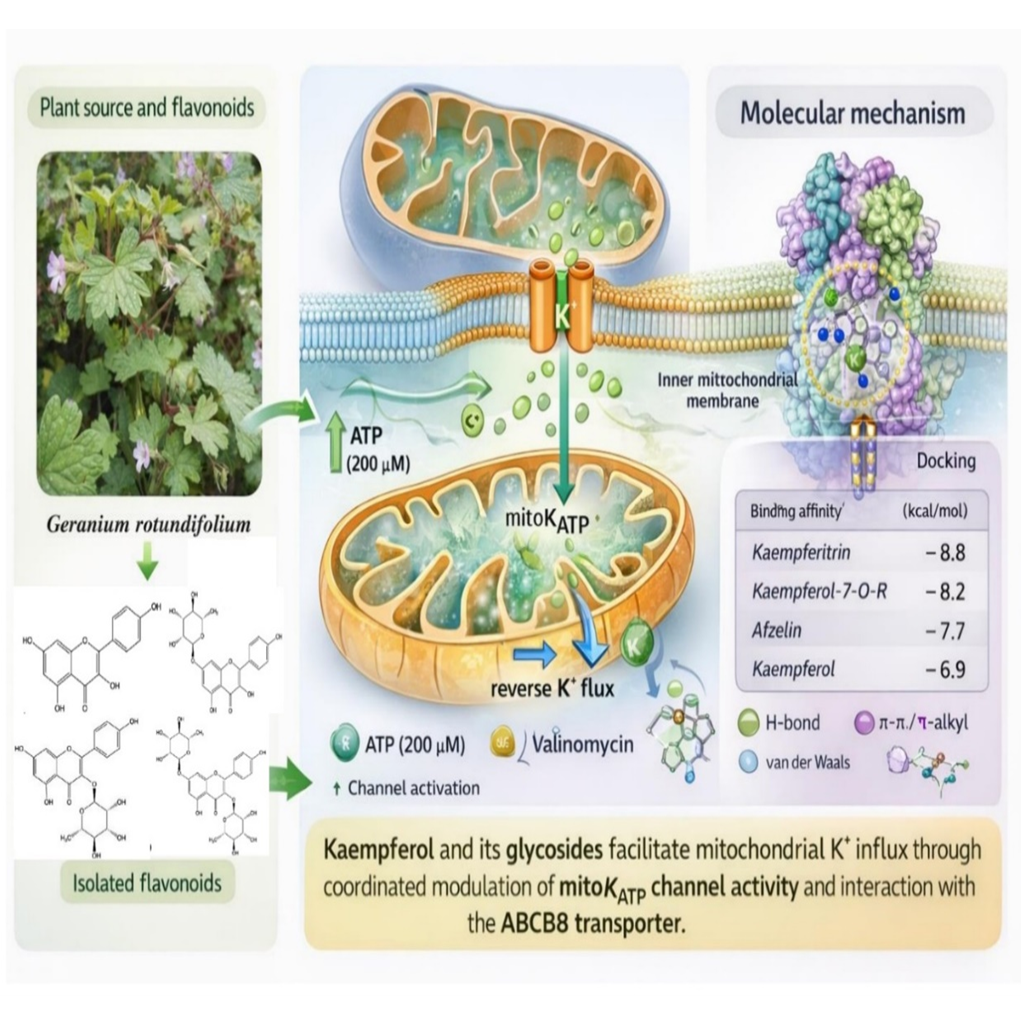
Several types of potassium channels are embedded in the inner mitochondrial membrane and play a crucial role in cellular function. Among them, the ATP-sensitive potassium channel located in the mitochondrial inner membrane (mitoKATP) is known to protect organs and tissues from ischemia-reperfusion injury. In recent years, increasing attention has been devoted to investigating the effects of flavonoids-widely distributed plant-derived secondary metabolites-on various physiopathological processes occurring in the organism. Accordingly, the present study examined the effects of kaempferol and its glycosides isolated from Geranium rotundifolium on mitochondrial ATP-sensitive potassium channel activity in an ATP- and Mg2+-dependent manner, as well as their influence on K+ ion transport. At a constant ATP concentration of 200 μM, kaempferol and its glycosides activated mitoKATP activity in a dose-dependent manner, with their effectiveness decreasing in the following order: kaempferol > kaempferitrin > kaempferol-7-O-rhamnoside > afzelin. At lower ATP concentrations, kaempferol induced weaker channel activation; however, increasing ATP levels enhanced the degree of mitoKATP activation by kaempferol. Simultaneously, increasing the concentration of Mg2+ ions resulted in a reduction of kaempferol-induced mitoKATP activation. In the presence of the K+ ionophore valinomycin, kaempferol more effectively counteracted the succinate-driven reverse K+ influx into the mitochondrial matrix compared to other flavonoids. To gain mechanistic insight at the molecular level, in silico docking analysis was performed using the human mitochondrial ATP-binding cassette transporter ABCB8. The docking results revealed stable binding of kaempferol and its glycosides within the ligand-recognition cavity of ABCB8, with binding energies ranging from –6.9 to –8.8 kcal/mol, and indicated a higher affinity of glycosylated flavonoids compared to the aglycone. These interactions were stabilized by hydrogen bonding and hydrophobic contacts with key transmembrane residues, suggesting a potential modulatory role of flavonoids on mitochondrial transport processes. In conclusion, kaempferol and its glycosides may provide protective effects against ischemia-reperfusion injury in the liver and other organs under various stress conditions by modulating the activity of mitoKATP and regulating K+ ion transport.
HIGHLIGHTS
- The activity of the mitoKATP channel in the presence of kaempferol and its glycosides was investigated. It was found that these flavonoids increase mitoKATP channel activity in a dose-dependent manner under conditions where Mg2+ and ATP are present.
- In the presence of the K+ ionophore valinomycin, kaempferol more effectively counteracted the succinate-driven reverse K+ influx into the mitochondrial matrix compared to other flavonoids.
- Docking simulations revealed stable binding of afzelin, kaempferol, kaempferitrin, and kaempferol-7-O-rhamnoside within the ligand-recognition cavity of ABCB8, with binding energies ranging from –6.9 to –8.8 kcal/mol.
- This indicates that kaempferol and its glycosides, by interacting with the mitoKATP channel, protect against ischemia-reperfusion, at that restore mitochondrial and cellular function.
GRAPHICAL ABSTRACT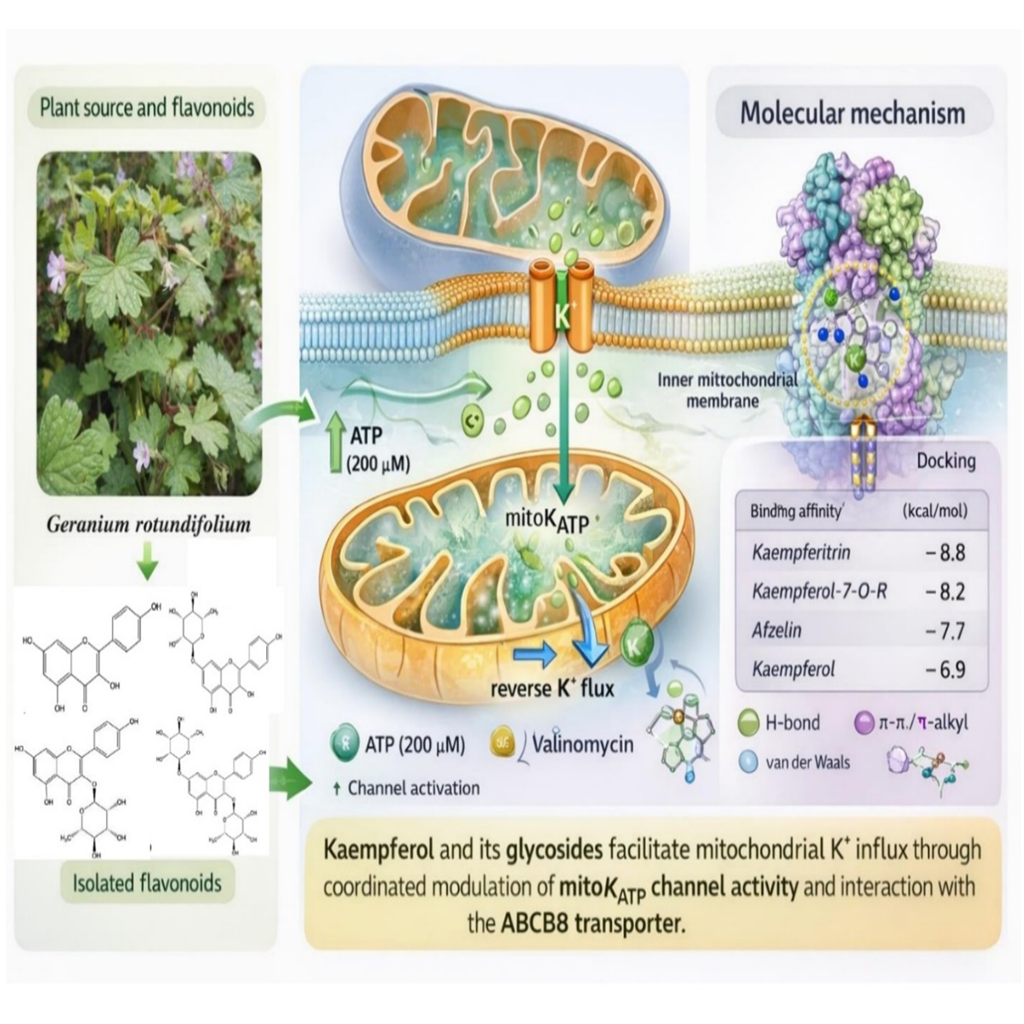
Downloads
References
M Krajewska, A Szewczyk, B Kulawiak and P Koprowski. Pharmacological characterization of a recombinant mitochondrial ROMK2 potassium channel expressed in bacteria and reconstituted in planar lipid bilayers. Membranes 2023; 13(3), 360.
I Inoue, H Nagase, K Kishi and T Higuti. ATP-sensitive K+ channel in the mitochondrial inner membrane. Nature 1991; 352(6332), 244-247.
A Paggio, V Checchetto, A Campo, R Menabo, G Di Marco, F Di Lisa, I Szabo, R Rizzuto and D De Stefani. Identification of an ATP-sensitive potassium channel in mitochondria. Nature 2019; 572(7771), 609-613.
M Slocinska, J Lubawy, W Jarmuszkiewicz and G Rosinski. Evidences for an ATP-sensitive potassium channel (KATP) in muscle and fat body mitochondria of insect. Journal of Insect Physiology 2013; 59(11), 1125-1132.
D Pastore, M Soccio, M Laus and D Trono. The uniqueness of the plant mitochondrial potassium channel. BMB Reports 2013; 46(8), 391-397.
M Laskowski, B Augustynek, P Bednarczyk, M Zochowska, J Kalisz, B O’Rourke, A Szewczyk and B Kulawiak. Single-channel properties of the ROMK-pore-forming subunit of the mitochondrial ATP-sensitive potassium channel. International Journal of Molecular Sciences 2019; 20(21), 5323.
PB Palacio, GC de Freitas Soares, GMB Lima, PLO Cunha, ALN Varela and HT Facundo. Competitive interaction between ATP and GTP regulates mitochondrial ATP-sensitive potassium channels. Chemico-Biological Interactions 2023; 381, 110560.
IN Man’kovskaia, VI Nosar, OS Gorbacheva, OA Gonchar, BL Gavenauskas, LV Bratus and GD Mironova. The effect of uridine on the endurance of animals with different resistance to physical stress: The role of mitochondrial ATP-dependent potassium channel. Biofizika 2014; 59(5), 941-945.
IB Krylova, EN Selina, VV Bulion, OM Rodionova, NR Evdokimova, NV Belosludtseva, MI Shigaeva and GD Mironova. Uridine treatment prevents myocardial injury in rat models of acute ischemia and ischemia/reperfusion by activating the mitochondrial ATP-dependent potassium channel. Scientific Reports 2021; 11(1), 16999.
Y Nakagawa, M Yoshioka, Y Abe, H Uchinami, T Ohba, K Ono and Y Yamamoto. Enhancement of liver regeneration by adenosine triphosphate-sensitive K+ channel opener (diazoxide) after partial hepatectomy. Transplantation 2012; 93(11), 1094-1100.
MA Nogueira, AM Coelho, SN Sampietre, RA Patzina, F Pinheiro da Silva, LA D'Albuquerque and MC Machado. Beneficial effects of adenosine triphosphate-sensitive K+ channel opener on liver ischemia/reperfusion injury. World Journal of Gastroenterology 2014; 20(41), 15319-15326.
WU Koh, J Kim, J Lee, GW Song, GS Hwang, E Tak and JG Song. Remote ischemic precondition¬ing and diazoxide protect from hepatic ischemic reperfusion injury by inhibiting HMGB1-induced TLR4/MyD88/NF-κB signaling. International Journal of Molecular Sciences 2019; 20(23), 5899.
SV Murzaeva, SP Belova, EI Lezhnev, LD Luk’yanova and GD Mironova. Effects of flavonoid-containing preparation Extralife on hydrogen peroxide production and functioning of mitochondrial ATP-dependent potassium channel. Bulletin of Experimental Biology and Medicine 2013; 155(6), 767-770.
LM Meng, HJ Ma, H Guo, QQ Kong and Y Zhang. The cardioprotective effect of naringenin against ischemia-reperfusion injury through activation of ATP-sensitive potassium channel in rat. Canadian Journal of Physiology and Pharmacology 2016; 94(9), 973-978.
M Rameshrad, SF Omidkhoda, BM Razavi and H Hosseinzadeh. Evaluating the possible role of mitochondrial ATP-sensitive potassium channels in the cardioprotective effects of morin in the isolated rat heart. Life Sciences 2021; 264, 118659.
M Richter-Laskowska, P Trybek, DV Delfino and A Wawrzkiewicz-Jalowiecka. Flavonoids as modulators of potassium channels. International Journal of Molecular Sciences 2023; 24(2), 1311.
UG Gayibov, EJ Komilov, RN Rakhimov, NA Ergashev, NG Abdullajanova, MI Asrorov and TF Aripov. Influence of new polyphenol compound from Euphorbia plant on mitochondrial function. Journal of Microbiology, Biotechnology and Food Sciences 2019; 8(4), 1021-1025.
DK Muratova, NA Ergashev, AV Shkinev, MI Asrarov and UK Kurbanov. Effect of songorine on the activity of ATP-dependent K+ channels and the state of megapore in rat liver mitochondria. Ek¬sperimental’naya i Klinicheskaya Farmakologiya 2023; 84(4), 12-15.
M Akter, MS Parvin, MM Hasan, MAA Rahman and ME Islam. Anti-tumor and antioxidant activity of kaempferol-3-O-alpha-L-rhamnoside (Afzelin) isolated from Pithecellobium dulce leaves. BMC Complementary Medicine and Therapies 2022; 22(1), 169.
KM Alharthy, S Rashid, HS Yusufoglu, SI Alqasoumi, MA Ganaie and A Alam. Neuroprotective potential of Afzelin: A novel approach for alleviating catalepsy and modulating Bcl-2 expression in Parkinson’s disease therapy. Saudi Pharmaceutical Journal 2024; 32(2), 101928.
F Alrumaihi, SA Almatroodi, HOA Alharbi, WM Alwanian, FA Alharbi, A Almatroudi and AH Rahmani. Pharmacological potential of kaempferol, a flavonoid in the management of pathogenesis via modulation of inflammation and other biological activities. Molecules 2024; 29(9), 2007.
W Alam, H Khan, MA Shah, O Cauli and L Saso. Kaempferol as a dietary anti-inflammatory agent: Current therapeutic standing. Molecules 2020; 25(18), 4073.
J Cao, Y Wang, S Hu, Y Ding, Q Jia, J Zhu and H An. Kaempferol ameliorates secretagogue-induced pseudo-allergic reactions via inhibiting intracellular calcium fluctuation. Journal of Pharmacy and Pharmacology 2020; 72(9), 1221-1231.
F Hua, P Zhou, PP Liu and GH Bao. Rat plasma protein binding of kaempferol-3-O-rutinoside from Lu’an GuaPian tea and its anti-inflammatory mechanism for cardiovascular protection. Journal of Food Biochemistry 2021; 45(7), e13749.
F Hua, JY Li, M Zhang, P Zhou, L Wang, TJ Ling and GH Bao. Kaempferol-3-O-rutinoside exerts cardioprotective effects through NF-κB/NLRP3/Caspase-1 pathway in ventricular remodeling after acute myocardial infarction. Journal of Food Biochemistry 2022; 46(10), e14305.
F Kabeer, S Anjum, AA Behan, M Usman, NY Khan, M Azeem, HMU Din, MA Arshad, S Nazir, S Cheng and JA Buzdar. Kaempferol alleviates cypermethrin induced reproductive toxicity in rats via Nrf2-mediated antioxidant and apoptotic regulation with histopathological evidence: In vivo and in silico study. Journal of Molecular Histology 2025; 56(5), 278.
K Kayumov, L Kuchkarova, T Dura-Trave, S Petrenko, N Ergashev, J Abdurakhmonov, R Achilov, S Khan, V Pulatova and M Ernazarov. Immunomodulatory and histoprotective effects of luteolin and related flavonoids in autoimmune thyroiditis: Evidence from a rat model. Trends in Sciences 2025; 22(12), 10981.
S Kaur, P Mendonca and KFA Soliman. The anticancer effects and therapeutic potential of kaempferol in triple-negative breast cancer. Nutrients 2024; 16(15), 2392.
C Luo, J Yan, Y Shen, Z Sun and X Xiao. Kaempferol attenuates oxidative stress-induced injury in gastric mucosal cells by activating Nrf2/GPX4 axis to inhibit ferroptosis. Immunity, Inflammation and Disease 2026; 14(2), e70352.
DK Patel. Pharmacological activities and therapeutic potential of kaempferitrin in medicine for the treatment of human disorders: A review of medicinal importance and health benefits. Cardiovascular & Hematological Disorders-Drug Targets 2021; 21(2), 104-114.
S Sugita, Y Matsuo, M Ishida, Y Uehara, Y Eguchi, Y Denda, K Nonoyama, H Murase, T Kato, K Saito, T Sato, Y Yamakawa, H Sagawa, R Ogawa, H Takahashi, A Mitsui and S Takiguchi. Kaempferol inhibits MMP-1-mediated migration and invasion in gemcitabine-resistant pancreatic cancer cells. Nutrients 2026; 18(3), 380.
RRP Kampa, A Sek, P Bednarczyk, A Szewczyk, V Calderone and L Testai. Flavonoids as new regulators of mitochondrial potassium channels: Contribution to cardioprotection. Journal of Pharmacy and Pharmacology 2023; 75(4), 466-481.
A Kicinska and W Jarmuszkiewicz. Flavonoids and mitochondria: Activation of cytoprotective pathways? Molecules 2020; 25(13), 3060.
N Ergashev, Kh Sayfieva, R Makhmudov and M Asrarov. Effect of polyphenols isolated from Plantago major L. and Plantago lanceolata L. on mitochondrial permeability transition pore in rat liver. Trends in Sciences 2024; 21(7), 7661.
C Watters. A one-step biuret assay for protein in the presence of detergent. Analytical Biochemistry 1978; 88(2), 695-698.
OB Vadzuk and SO Kosterin. Diazoxide-induced mitochondrial swelling in the rat myometrium as a consequence of the activation of the mitochondrial ATP-sensitive K+-channel. Ukrainian Biochemi¬cal Journal 2008; 80(5), 45-51.
NV Khmil, AA Mosencov, MI Shigaeva and GD Mironova. A comparison of methods for estimat¬ing the activity of the ATP-sensitive potassium channel in mitochondria based on the effect of ATP. Biophysics 2019; 64(5), 751-754.
GF Azzone, S Massair and T Pozzan. Mechanism of active shrinkage in mitochondria. II. Coupling between strong electrolyte fluxes. Biochimica et Biophysica Acta 1976; 423(1), 27-41.
P Bezerra Palacio, AM Brito Lucas, J Varlla de Lacerda Alexandre, PL Oliveira Cunha, YI Ponte Viana, AC Albuquerque, AL Nunes Varela and HT Facundo. Pharmacological and molecular docking studies reveal that glibenclamide competitively inhibits diazoxide-induced mitochondrial ATP-sensitive potassium channel activation and pharmacological preconditioning. European Journal of Pharmacology 2021; 908, 174379.
S Morota, S Piel and MJ Hansson. Respiratory uncoupling by increased H+ or K+ flux is beneficial for heart mitochondrial turnover of reactive oxygen species but not for permeability transition. BMC Cell Biology 2013; 14, 40.
DD Lofrumento, G La Piana, V Palmitessa, DI Abbrescia and NE Lofrumento. Stimulation by pro-apoptotic valinomycin of cytosolic NADH/cytochrome c electron transport pathway-Effect of SH reagents. The International Journal of Biochemistry & Cell Biology 2016; 76, 12-18.
M Aldakkak, DF Stowe, Q Cheng, WM Kwok and AK Camara. Mitochondrial matrix K+ flux independent of large-conductance Ca2+-activated K+ channel opening. American Journal of Physiology-Cell Physiology 2010; 298(3), C530-C541.
AD Costa, CL Quinlan, A Andrukhiv, IC West, M Jaburek and KD Garlid. The direct physiological effects of mitoK(ATP) opening on heart mitochondria. American Journal of Physiology-Heart and Circulatory Physiology 2006; 290(1), H406-H415.
J Matejikova, J Kucharska, M Pinterova, D Pancza and T Ravingerova. Protection against ischemia-induced ventricular arrhythmias and myocardial dysfunction conferred by preconditioning in the rat heart: Involvement of mitochondrial K(ATP) channels and reactive oxygen species. Physiological Research 2009; 58(1), 9-19.
ES Kharechkina, AB Nikiforova and AG Kruglov. Regulation of mitochondrial permeability transition pore opening by monovalent cations in liver mitochondria. International Journal of Molecular Sciences 2023; 24(11), 9237.
P Nizinski, A Krajewska, T Oniszczuk, B Polak and A Oniszczuk. Hepatoprotective effect of kaempferol: A review. Molecules 2025; 30(9), 1913.
MA Ibrahim, SA Abdel-Gaber, EF Amin, SA Ibrahim, RK Mohammed and AM Abdelrahman. Molecular mechanisms contributing to the protective effect of levosimendan in liver ischemia-reperfusion injury. European Journal of Pharmacology 2014; 741, 64-73.
O Rodrigues Pereira, JDC Serna, CC Caldeira da Silva, H Camara, SD Kodani, WT Festuccia, YH Tseng and AJ Kowaltowski. Mitochondrial ATP-sensitive K+ channels (MitoKATP) regulate brown adipocyte differentiation and metabolism. American Journal of Physiology-Cell Physiology 2025; 329(2), C574-C584.
HC Chang, JS Shapiro, X Jiang, G Senyei, T Sato, J Geier, KT Sawicki and H Ardehali. Augmenter of liver regeneration regulates cellular iron homeostasis by modulating mitochondrial transport of ATP-binding cassette B8. eLife 2021; 10, e65158.
Y Ichikawa, M Bayeva, M Ghanefar, V Potini, L Sun, RK Mutharasan, R Wu, A Khechaduri, T Jairaj Naik and H Ardehali. Disruption of ATP-binding cassette B8 in mice leads to cardiomyopathy through a decrease in mitochondrial iron export. Proceedings of the National Academy of Sciences 2012; 109(11), 4152-4157.
S Li, Y Ren, X Lu, Y Shen and X Yang. Cryo-EM structure of human ABCB8 transporter in nucleotide binding state. Biochemical and Biophysical Research Communications 2021; 557, 187-191.
Y Ichikawa, M Ghanefar, M Bayeva, R Wu, A Khechaduri, SV Naga Prasad, RK Mutharasan, TJ Naik and H Ardehali. Cardiotoxicity of doxorubicin is mediated through mitochondrial iron accumulation. The Journal of Clinical Investigation 2014; 124(2), 617-630.
Published
How to Cite
Issue
Section
License
Copyright (c) 2026 Walailak University

This work is licensed under a Creative Commons Attribution-NonCommercial-NoDerivatives 4.0 International License.





