
The Restorative Role of Flavonoids in Immunological, Antioxidant, and Microbiota Mechanisms of Autoimmune Thyroiditis
DOI:
https://doi.org/10.48048/tis.2026.12516Keywords:
Autoimmune thyroiditis, Flavonoids, Luteolin, Quercetin, Dihydroquercetin, Oxidative stress, GPX1, Microbiota, Thyroid hormones, ImmunomodulationAbstract
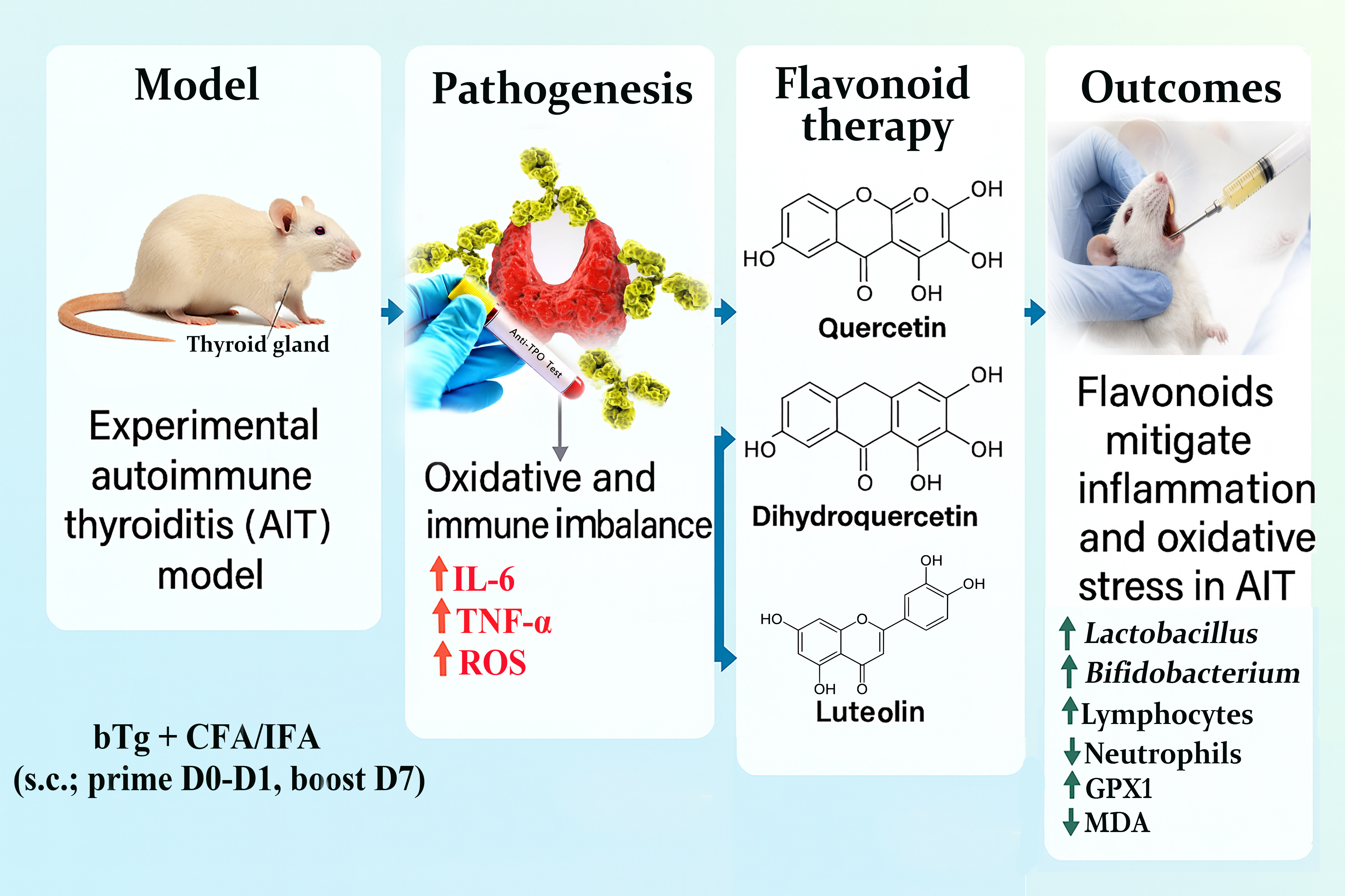
Autoimmune thyroiditis is a multifactorial endocrine disorder characterized by chronic immune-mediated inflammation, oxidative imbalance, and disruption of gut microbiota homeostasis. These pathological processes lead to thyroid hormone deficiency, metabolic dysfunction, and systemic immune polarization. The present study aimed to evaluate the immunological, antioxidant, and microbiota-corrective effects of three plant-derived flavonoids - quercetin, dihydroquercetin (taxifolin), and luteolin - in an experimental rat model of autoimmune thyroiditis. Thyroid hormone concentrations (T3, T4, and fT3), antioxidant enzyme activity (GPX1), macro- and microelement balance (Ca²⁺, Mg²⁺, Fe, K⁺ and P), and intestinal bacterial composition were analyzed to assess the extent of restoration. Autoimmune thyroiditis caused a pronounced decrease in thyroid hormone levels (T3 −66.5%, T4 −66.7% and fT3 −39.5%) and GPX1 activity (−59.1%), along with disturbances in essential macro- and microelements and microbiota composition. Flavonoid treatment markedly ameliorated these impairments: luteolin restored T3 and T4 levels to near-physiological values and normalized GPX1 activity by 93.6% of the control. Quercetin and dihydroquercetin showed moderate but significant improvements in antioxidant and endocrine parameters. Additionally, flavonoid supplementation rebalanced the gut microbiota, increasing beneficial taxa (Lactobacillus, Bifidobacterium and Faecalibacterium prausnitzii) while reducing pathogenic species (Escherichia coli, Streptococcus and Fusobacterium). Collectively, the findings demonstrate that natural flavonoids exert a potent corrective influence on immune, redox, and microbiota disturbances in autoimmune thyroiditis. Among them, luteolin exhibited the strongest integrative effect, suggesting its potential as a promising adjunctive therapy to conventional treatment in thyroid autoimmune diseases.
HIGHLIGHTS
- Autoimmune thyroiditis induced severe endocrine, oxidative, and microbiota disturbances in rats.
- Dietary flavonoids significantly restored thyroid hormone homeostasis and antioxidant defense.
- Luteolin exhibited the strongest integrative effects on GPX1 activity and immune modulation.
- Flavonoid treatment rebalanced gut microbiota by increasing beneficial and reducing pathogenic taxa.
- Natural flavonoids represent promising functional agents for correcting immune-redox-microbiota dysregulation in AIT.
GRAPHICAL ABSTRACT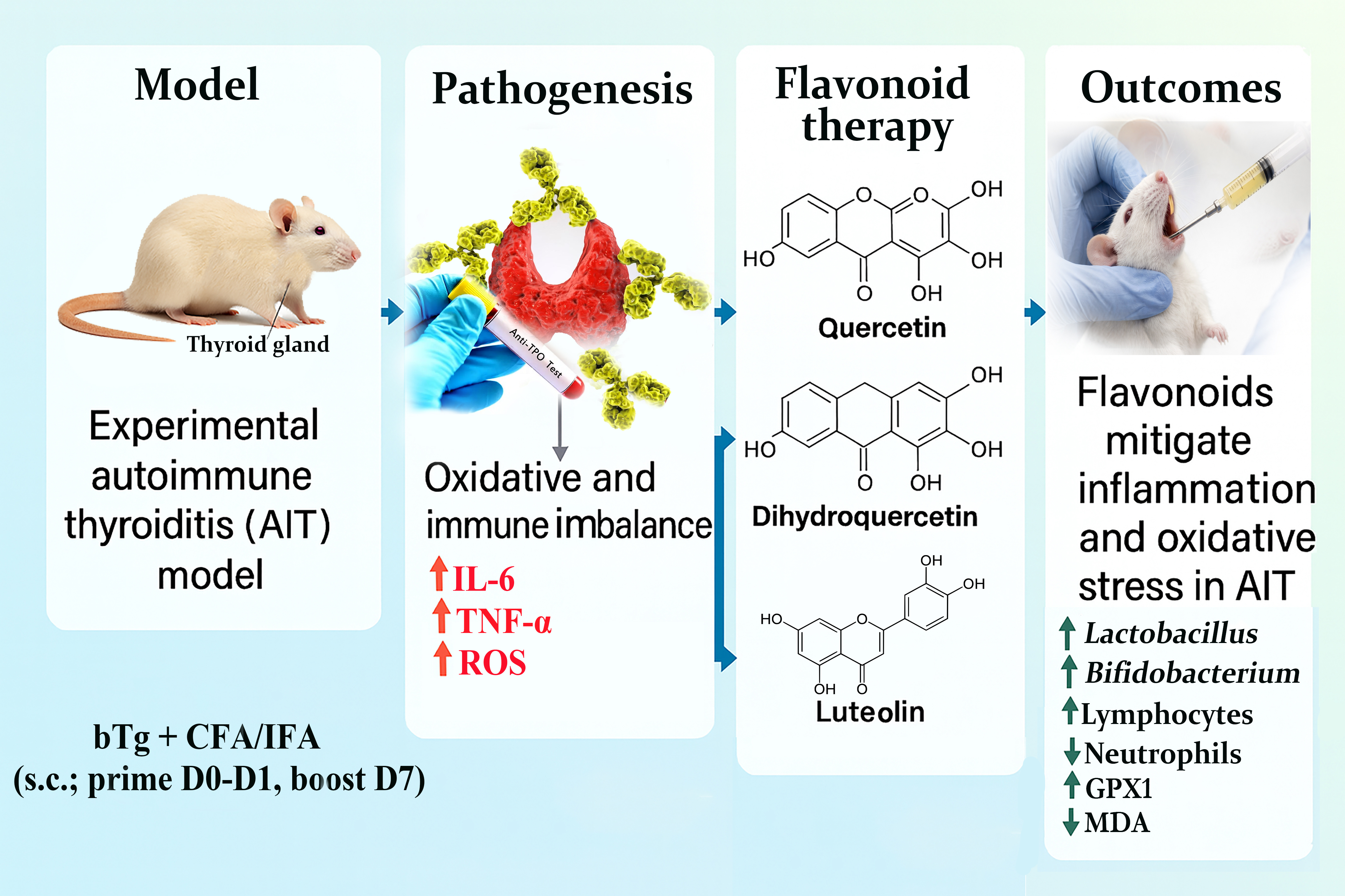
Downloads
References
N Sawicka-Gutaj, D Gruszczyński, N Zawalna, K Nijakowski, I Muller, T Karpiński, M Salvi and M Ruchała. Microbiota alterations in patients with autoimmune thyroid diseases: A systematic review. International Journal of Molecular Sciences 2022; 23(21), 13450.
J Liu, X Qin, B Lin. J Cui, J Liao, F Zhang and Q Lin. Analysis of gut microbiota diversity in Hashimoto’s thyroiditis patients. BMC Microbiology 2022; 22(1), 318.
S Yu, B Yu, L Cong, Z Xiaodan and Z Le. The impact of gut microbiota on autoimmune thyroiditis and relationship with pregnancy outcomes: A review. Frontiers in Cellular and Infection Microbiology 2024; 14, 1361660.
K Yan, X Sun, C Fan, X Wang and H Yu. Unveiling the role of gut microbiota and metabolites in autoimmune thyroid diseases: Emerging prspectives. International Journal of Molecular Sciences 2024; 25(20), 10918.
I Stramazzo, S Capriello, S Filardo, M Centanni and C Virili. Microbiota and thyroid disease: An updated systematic review. Advances in Microbiology, Infectious Diseases and Public Health 2023; 17, 125-144.
J Knezevic, C Starchl, AT Berisha and K Amrein. Thyroid-gut-axis: How does the microbiota influence thyroid function? Nutrients 2020; 12(6), 1769.
AA Abed, A Naweedullah, S Uzma, S Ransherjit, RS Farhad, FM Jawad, FNU Raheela, W Radeyah, GS Mujahid, A Kiran, A Moiz, TD Boakye, S Haider, D Ayusha, HM Sheheryar and TA Subhan. Exploring the role of gut microbiota in autoimmune thyroid disorders: A systematic review and meta-analysis. Frontiers in Endocrinology 2023; 14, 1238146.
X Zhu, C Zhang, S Feng, R He and S Zhang. Intestinal microbiota regulates the gut-thyroid axis: The new dawn of improving Hashimoto thyroiditis. Clinical and Experimental Medicine 2024; 24(1), 39.
OD Frenț, L Stefan, CM Morgovan, N Duteanu, IL Dejeu, E Marian, L Vicaș and F Manole. A systematic review: Quercetin-secondary metabolite of the flavonol class, with multiple health benefits and low bioavailability. International Journal of Molecular Sciences 2024; 25(22), 12091.
P Shen, W Lin, X Deng, X Ba, L Han, Z Chen, K Qin, Y Huang and S Tu. Potential implications of quercetin in autoimmune diseases. Frontiers in Immunology 2021; 12, 689044.
C Giuliani, GD Dalmazi, I Bucci and G Napolitano. Quercetin and thyroid. Antioxidants 2024; 13(10), 1202.
LS Kuchkarova, KY Kayumov, NA Ergashev and GT Kudeshovа. Effect of quercetin on the intestinal carbohydrases activity in the offspring of the lead intoxicated mother. Journal of Natural Remedies 2024; 24(2), 391-396.
YM Kong. Experimental autoimmune thyroiditis in the mouse. Current Protocols in Immunology 2007; 78(1), 15-17.
K Kayumov, LS Kuchkarova, T Durá-Travé, S Petrenko, N Ergashev, J Abdurakhmonov, R Achilov, S Khan, V Pulatova and M Ernazarov. Immunomodulatory and histoprotective effects of luteolin and related flavonoids in autoimmune thyroiditis: Evidence from a rat model. Trends in Sciences 2025; 22(12), 10981.
TE Chang, JC Luo, UC Yang, YH Huang, MC Hou and FY Lee. Fecal microbiota profile in patients with inflammatory bowel disease in Taiwan. Journal of the Chinese Medical Association 2021; 84(6), 580-587.
L Palkova, A Tomova, G Repiska, K Babinska, B Bokor, I Mikula and K Soltys. Evaluation of 16S rRNA primer sets for characterisation of microbiota in paediatric patients with autism spectrum disorder. Scientific Reports 2021; 11(1), 6781
RH Dahal, S Kim, YK Kim, ES Kim and J Kim. Insight into gut dysbiosis of patients with inflammatory bowel disease and ischemic colitis. Frontiers in Microbiology 2023; 14(1), 1174832.
N Xia, G Chen, M Liu, X Ye, Y Pan, J Ge, Y Mao, H Wang, J Wang and S Xie. Anti-inflammatory effects of luteolin on experimental autoimmune thyroiditis in mice. Experimental and Therapeutic Medicine 2016; 12(6), 4049-4054.
RM Ruggeri, A CampennÌ, G Giuffrida, M Casciaro, MC Barbalace, S Hrelia, F Trimarchi, ÒS Cannav and S Gangemi. Oxidative stress as a key feature of autoimmune thyroiditis: An update. Minerva Endocrinologica 2020; 45(4), 326-344.
A Hosseinzade, O Sadeghi, A Naghdipour Biregani, S Soukhtehzari, GS Brandt and A Esmaillzadeh. Immunomodulatory effects of flavonoids: Possible induction of T CD4+ regulatory cells through suppression of mTOR pathway signaling activity. Frontiers in Immunology 2019; 10, 51.
Published
How to Cite
Issue
Section
License
Copyright (c) 2025 Walailak University

This work is licensed under a Creative Commons Attribution-NonCommercial-NoDerivatives 4.0 International License.





