
Phytochemical Profile and In Vitro Antioxidant, Anti-Inflammatory, Antidiabetic, and Antibacterial Activities of Nauclea orientalis Stem Bark Extracts
DOI:
https://doi.org/10.48048/tis.2026.13244Keywords:
Nauclea orientalis, Antibacterial, Antidiabetic, Anti-inflammatory, AntioxidantAbstract
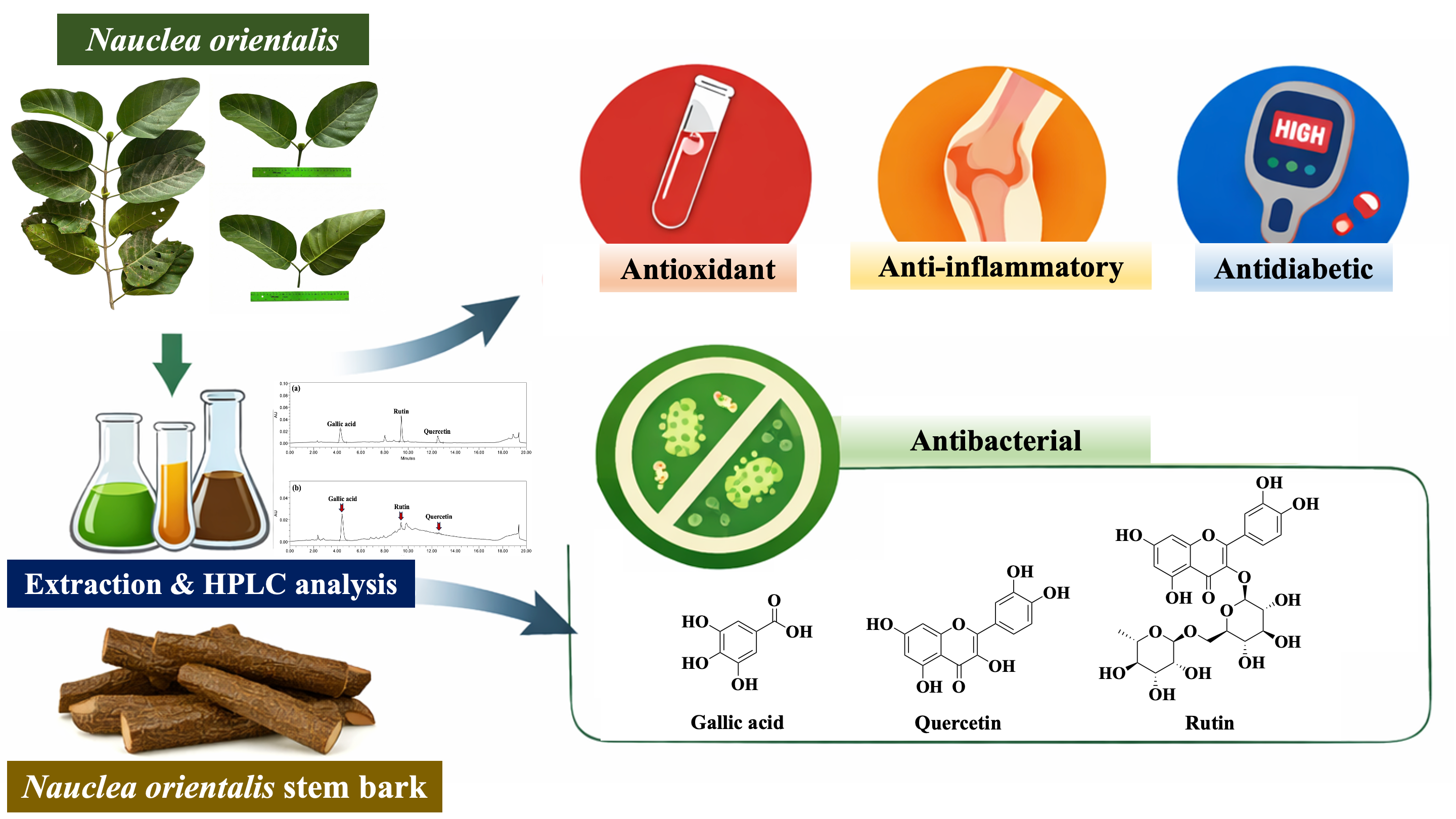
Nauclea orientalis, locally known as Gao Vang in Vietnam, is widely distributed in Southeast Asia and has been traditionally used in ethnomedicine to treat fever, inflammation, and skin disorders. Although phytochemical investigations of Nauclea species and the Rubiaceae family have been reported, studies systematically linking polyphenol-enriched fractions with multiple bioactivities remain limited. This study aimed to determine the total polyphenol and flavonoid contents and to evaluate the antioxidant, anti-inflammatory, antidiabetic, and antibacterial activities of different extracts of N. orientalis, including ethanol extract, hexane, ethyl acetate, and dichloromethane fractions. Among the tested extracts, the ethyl acetate fraction exhibited the highest total polyphenol and flavonoid contents. Consistently, this fraction showed strong antioxidant activity, with IC50 values ranging from 31.63 ± 0.40 to 54.61 ± 0.72 µg/mL across representative radical scavenging assays, comparable to trolox. In addition, notable anti-inflammatory activity was observed through inhibition of nitric oxide scavenging capacity, with IC50 values of 84.96 ± 1.48 µg/mL, along with superior protective effects in red blood cell membrane stabilization and protein denaturation models. This fraction also demonstrated significant antidiabetic potential through effective inhibition of α-amylase and α-glucosidase, as well as pronounced antibacterial activity. High-performance liquid chromatography analysis qualitatively identified gallic acid, quercetin, and rutin as representative constituents. Overall, these findings highlight the ethyl acetate fraction of N. orientalis as a source with multifunctional bioactivities, providing new pharmacological insight beyond previously reported phytochemical studies of this genus.
HIGHLIGHTS
- Nauclea orientalis stem bark is rich in polyphenols and flavonoids
- The ethyl acetate fraction shows strong in vitro antioxidant activity
- Notable anti-inflammatory effects are observed via NO and protein assays
- The extract inhibits α-amylase and α-glucosidase, indicating antidiabetic potential
- HPLC identifies gallic acid, quercetin, and rutin as key compounds
GRAPHICAL ABSTRACT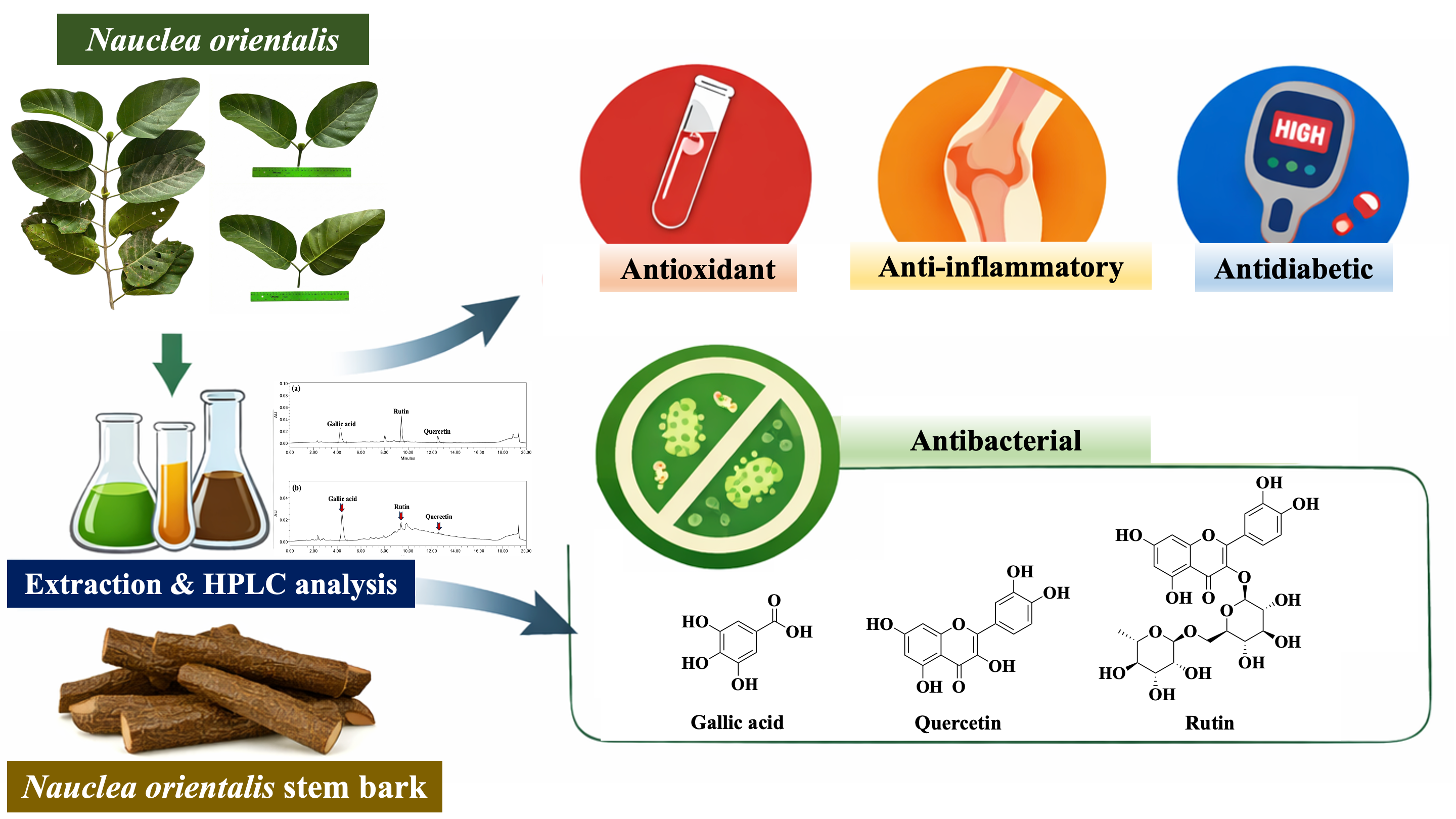
Downloads
References
CKT Duc, NT Tuan, TC Linh, HVT Luong and DT Pham. Optimization of ultrasound-assisted extraction of Ehretia asperula leaves with antioxidant and anti-diabetic activities and assessment of the process environmental impacts. Sustainable Chemistry and Pharmacy 2025; 45, 102039.
N Chandimali, SG Bak, EH Park, HJ Lim, YS Won, EK Kim, SI Park and SJ Lee. Free radicals and their impact on health and antioxidant defenses: A review. Cell Death Discovery 2025; 11, 19.
ME Kim and JS Lee. Advances in the regulation of inflammatory mediators in nitric oxide synthase: Implications for disease modulation and therapeutic approaches. International Journal of Molecular Sciences 2025; 26(3), 1204.
NK Bhol, MM Bhanjadeo, AK Singh, UC Dash, RR Ojha, S Majhi, AK Duttaroy and AB Jena. The interplay between cytokines, inflammation, and antioxidants: Mechanistic insights and therapeutic potentials of various antioxidants and anti-cytokine compounds. Biomedicine & Pharmacotherapy 2024; 178, 117177.
CKT Duc, DT Pham, HBL Nguyen and CL Chan. Evaluation of phytochemical screening, ‘Antibacterial, Antioxidant, Anti-Inflammatory, and Antidiabetic Activities’ of sequentially extracted ixora duffii leaves extract. Trends in Sciences 2025; 22(7), 10028.
A Caturano, M Rocco, G Tagliaferri, A Piacevole, D Nilo, GD Lorenzo, I Iadicicco, M Donnarumma, R Galiero, C Acierno, C Sardu, V Russo, E Vetrano, C Conte, R Marfella, L Rinaldi and FC Sasso. Oxidative stress and cardiovascular complications in Type 2 Diabetes: From pathophysiology to lifestyle modifications. Antioxidants (Basel) 2025; 14(1), 72.
K Ogurtsova, JDR Fernandes, Y Huang, U Linnenkamp, L Guariguata, NH Cho, D Cavan, JE Shaw and LE Makaroff. IDF Diabetes Atlas: Global estimates for the prevalence of diabetes for 2015 and 2040. Diabetes Research and Clinical Practice 2017; 128, 40-50.
SA Antar, NA Ashour, M Sharaky, M Khattab, NA Ashour, RT Zaid, EJ Roh, A Elkamhawy and AA Al-Karmalawy. Diabetes mellitus: Classification, mediators, and complications; A gate to identify potential targets for the development of new effective treatments. Biomedicine & Pharmacotherapy 2023; 168, 115734.
B Gieroba, A Kryska and A Sroka-Bartnicka. Type 2 diabetes mellitus - conventional therapies and future perspectives in innovative treatment. Biochemistry and Biophysics Reports 2025; 42, 102037.
H Ribeiro, I Rodrigues, L Napoleão, L Lira, D Marques, M Veríssimo, JP Andrade and M Dourado. Non-steroidal anti-inflammatory drugs (NSAIDs), pain and aging: Adjusting prescription to patient features. Biomedicine & Pharmacotherapy 2022; 150, 112958.
S Liu, J Liu, Y Wang, F Deng and Z Deng. Oxidative stress: Signaling pathways, biological functions, and disease. MedComm 2025; 6(7), 70268.
Z Zhang, HN ElSohly, MR Jacob, DS Pasco, LA Walker and AM Clark. New indole alkaloids from the bark of Nauclea orientalis. Journal of Natural Products 2001; 64(8), 1001-1005.
T Kanchanapoom, P Sahakitpichan, N Chimnoi, C Petchthong, W Thamniyom, P Nangkoed and S Ruchirawat. Monoterpene alkaloid glycosides from the leaves of Nauclea orientalis. Phytochemistry Letters 2021; 41, 83-87.
CKT Duc, TC Linh, NQC Thanh, PQ Nhien, DTX Trang, LT Danh and NT Tuan. Isolation and evaluation of the antioxidant capacity of compounds from Ehretia asperula Zoll. & Moritzi. Indonesian Journal of Chemistry 2024; 24(4), 1206-1217.
LC Tran, CKT Duc, TT Nguyen, DT Pham, DT Luu, TTP Truong and TTX Dai. Anti-inflammatory and antioxidant properties of endophytic bacteria isolated from Paramignya trimera: Detection and identification of bioactive compounds. Journal of Biologically Active Products from Nature 2025; 15(4), 432-454.
TC Linh, DT Pham, DV Mai, NHB Lieu, PK Dinh and CKT Duc. Investigating the in vitro anti-obesity activity of the ultrasonic-assisted extraction process of alkaloid- rich extract from Mansoa alliacea flowers using response surface methodology. Natural Resources for Human Health 2025; 5(3), 265-278.
LTM Ngan, JK Moon, JH Kim, T Shibamoto and YJ Anh. Growth-inhibiting effects of Paeonia lactiflora root steam distillate constituents and structurally related compounds on human intestinal bacteria. World Journal of Microbiology and Biotechnology 2012; 28, 1575-1583.
JE Lee, JTM Jayakody, JI Kim, JW Jeong, KM Choi, TS Kim, C Seo, I Azimi, J Hyun and B Ryu. The influence of solvent choice on the extraction of bioactive compounds from asteraceae: A comparative review. Foods 2024; 13(19), 3151.
E Gil-Martín, T Forbes-Hernández, A Romero, D Cianciosi, F Giampieri and M Battino. Influence of the extraction method on the recovery of bioactive phenolic compounds from food industry by-products. Food Chemistry 2022; 378, 131918.
D Palaiogiannis, T Chatzimitakos, V Athanasiadis, E Bozinou, DP Makris and SI Lalas. Successive solvent extraction of polyphenols and flavonoids from Cistus creticus L. Leaves. Oxygen 2023; 3, 274-286.
D Ciupei, A Colişar, L Leopold, A Stănilă and ZM Diaconeasa. Polyphenols: From classification to therapeutic potential and bioavailability. Foods 2024; 13(24), 4131.
M Rudrapal, SJ Khairnar, J Khan, AB Dukhyil, MA Ansari, MN Alomary, FM Alshabrmi, S Palai, PK Deb and R Devi. Dietary polyphenols and their role in oxidative stress-induced human diseases: Insights into protective effects, antioxidant potentials and mechanism(s) of action. Frontiers in Pharmacology 2022; 13, 806470.
JM Al-Khayri, GR Sahana, P Nagella, BV Joseph, FM Alessa and MQ Al-Mssallem. Flavonoids as potential anti-inflammatory molecules: A review. Molecules 2022; 27(9), 2901.
N Yahfoufi, N Alsadi, M Jambi and C Matar. The Immunomodulatory and anti-inflammatory role of polyphenols. Nutrients 2018; 10(11), 1618.
A Kulkarni, CC Kulkarni, SR Pradeep, J Poyya, AK Kudva, V Radhakrishnan and AS Khandagale. Role of anti-inflammatory and antioxidant properties of natural products in curing cardiovascular diseases. Current Issues in Molecular Biology 2025; 47(11), 955.
K Jomova, SY Alomar, R Valko, J Liska, E Nepovimova, K Kuca and M Valko. Flavonoids and their role in oxidative stress, inflammation, and human diseases. Chemico-Biological Interactions 2025; 413, 111489.
M Krawczyk, I Burzynska-Pedziwiatr, LA Wozniak and M Bukowiecka-Matusiak. Impact of polyphenols on inflammatory and oxidative stress factors in diabetes mellitus: Nutritional antioxidants and their application in improving antidiabetic therapy. Biomolecules 2023; 13(9), 1402.
D de Paulo Farias, FF de Araújo, IA Neri-Numa and GM Pastore. Antidiabetic potential of dietary polyphenols: A mechanistic review. Food Research International 2021; 145, 110383.
E Barber, MJ Houghton and G Williamson. Flavonoids as human intestinal α-Glucosidase inhibitors. Foods 2021; 10(8), 1939.
F Shahidi and R Danielski. Review on the role of polyphenols in preventing and treating Type 2 Diabetes: Evidence from in vitro and in vivo studies. Nutrients 2024; 16(18), 3159.
CL Tran, VM Do, VT Huynh, XN Hong and KTD Chong. Optimization of polyphenol extraction conditions from rhizomes of Curcuma zedoaria with antioxidant, anti-inflammatory and anti-diabetic activities in vitro. Trends in Sciences 2024; 21(9), 8544.
R Suručić, M Travar, TK Vasović, JR Selgrad, L Suručić, M Momčilović, MP Stojiljković and R Škrbić. In vitro and in silico analysis of differential antibacterial activity of pomegranate polyphenols against gram-positive and gram-negative bacteria. Antibiotics 2025; 14(9), 912.
Y Liu, J Zhu, Z Liu, Y Zhi, C Mei and H Wang. Flavonoids as promising natural compounds for combating bacterial infections. International Journal of Molecular Sciences 2025; 26(6), 2455.
LD Rossi, G Rocchetti, L Lucini and A Rebecchi. Antimicrobial potential of polyphenols: Mechanisms of action and microbial responses—a narrative review. Antioxidants 2025; 14(2), 200.
B Badhani, N Sharma and R Kakkar. Gallic acid: A versatile antioxidant with promising therapeutic and industrial applications. RSC Advances 2015; 5(32), 27540-27557.
M Hadidi, R Liñán-Atero, M Tarahi, MC Christodoulou and F Aghababaei. The potential health benefits of gallic acid: Therapeutic and food applications. Antioxidants 2024; 13(8), 1001.
EJ Carrillo-Martinez, FY Flores-Hernández, AM Salazar-Montes, HF Nario-Chaidez and LD Hernández-Ortega. Quercetin, a Flavonoid with great pharmacological capacity. Molecules 2024; 29(5), 1000.
A Ganeshpurkar and AK Saluja. The pharmacological potential of rutin. Saudi Pharmaceutical Journal 2017; 25(2), 149-164.
Y Tian, S Zhou, R Takeda, K Okazaki, M Sekita and K Sakamoto. Anti-inflammatory activities of amber extract in lipopolysaccharide-induced RAW 264.7 macrophages. Biomedicine & Pharmacotherapy 2021, 141, 111854.
YF Zeng, J Lee, YX Si, L Yan, TR Kim, GY Qian, ZR Lü, ZM Ye and SJ Yin. Inhibitory effect of Zn2+ on α-glucosidase: Inhibition kinetics and molecular dynamics simulation. Process Biochemistry 2012 47(12), 2510-2517.
TC Linh, CKT Duc, NT Tuan and DTX Trang. Study on the toxicity and in vitro and in vivo antidiabetic activities of Miliusa velutina stem bark ethanolic extract. Phytomedicine Plus 2025; 5(4), 100879.
CKT Duc, NT Tuan, TC Linh, HVT Luong and DT Pham. Sustainable recovery of cellulose from lotus seedpods: Integrating process optimization and environmental-preliminary economic analysis. Bioresource Technology 2026, 441, 133603.
Published
How to Cite
Issue
Section
License
Copyright (c) 2026 Walailak University

This work is licensed under a Creative Commons Attribution-NonCommercial-NoDerivatives 4.0 International License.





