
Evaluation of Phytochemical Screening, ‘Antibacterial, Antioxidant, Anti-Inflammatory, and Antidiabetic Activities’ of Sequentially Extracted Ixora duffii Leaves Extract
DOI:
https://doi.org/10.48048/tis.2025.10028Keywords:
Antibacterial, Antioxidant, Anti-inflammatory, Antidiabetic, Ixora duffii, MIC, MBCAbstract
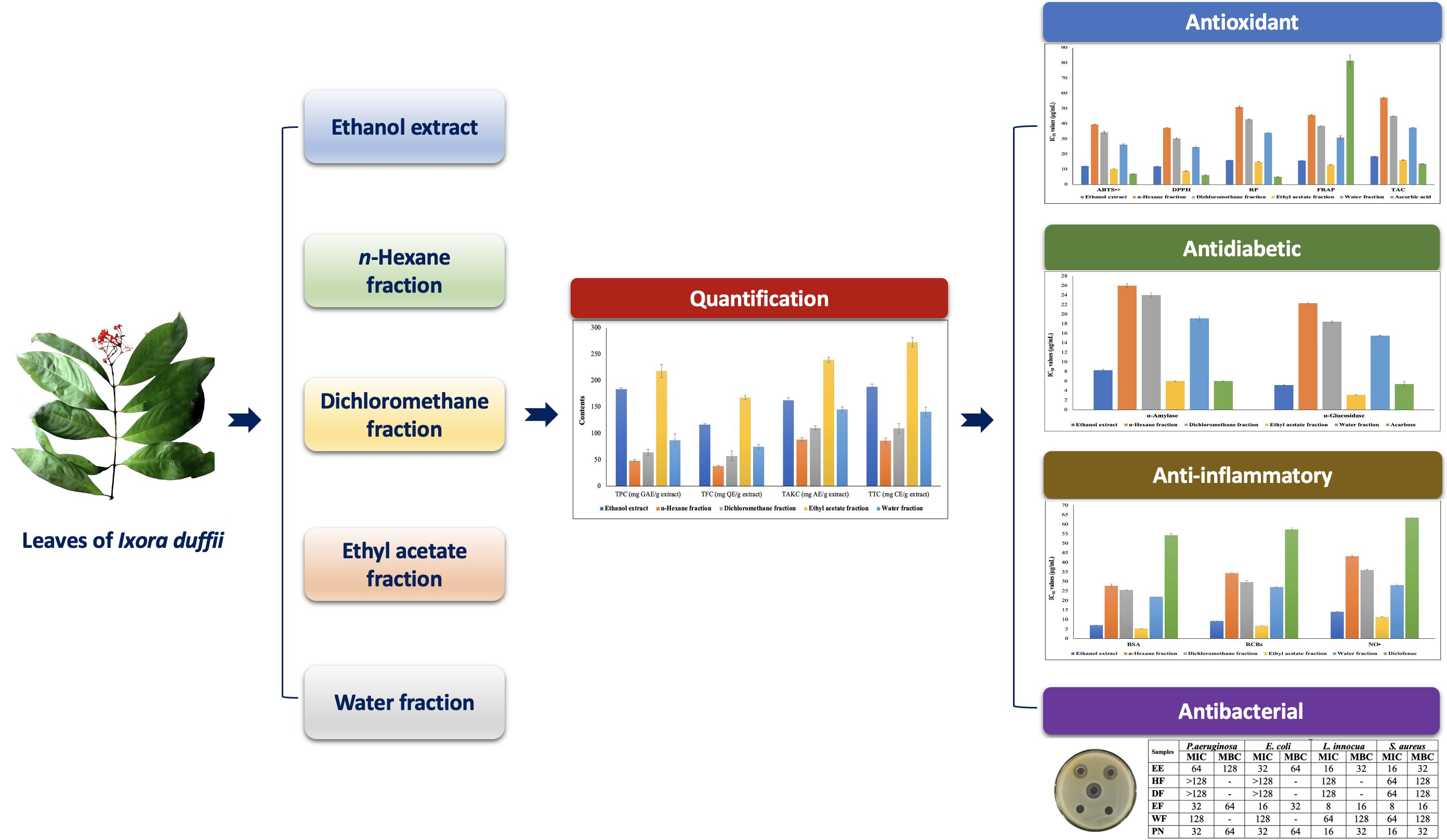
Identifying its bioactive compounds is essential for understanding its therapeutic potential. The increasing prevalence of antibiotic resistance, inflammation-related diseases, and diabetes underscores the need for effective natural alternatives. Ixora duffii, a medicinal plant from the Rubiaceae family commonly used in traditional Vietnamese medicine, has not been evaluated its biological activities. Therefore, this study was conducted to investigate the antibacterial, antioxidant, anti-inflammatory, and antidiabetic activity of the ethanol, n-hexane, dichloromethane, ethyl acetate, and water extracts of I. duffii leaves. The antioxidant activity was assessed by methods of ABTS+, DPPH, RP, FRAP, and TAC. Anti-inflammatory effect was assessed by assays of protecting red blood cell membranes (RBCs), inhibiting denaturation of bovine serum albumin (BSA), inhibiting nitric oxide (NO). Antidiabetic efficacy was assessed by the inhibitory assays on 2 enzymes of α-amylase, α-glucosidase. Antibacterial activity was determined based on the diameter of the inhibition zone, minimum inhibitory concentration (MIC), minimum bactericidal concentration (MBC) against 4 strains of Gram-negative, Gram-positive bacteria (Listeria innocua, Staphylococcus aureus, Psedomonas aeruginosa, and Escherichia coli). The results showed that I. duffii leaf extracts had good activity in all tests. The ethyl acetate fraction (EF) exhibited the lowest IC50 values in antioxidant, antidiabetic, and anti-inflammatory tests, ranging from 5.15 ± 0.06 to 66.22 ± 0.40 µg/mL. EF inhibited Gram-positive bacteria more effectively than Gram-negative bacteria, with antibacterial zone diameters ranging from 9.13 ± 0.31 to 26.83 ± 0.76 mm, MIC and MBC values ranging from 8 to 32 and 16 to 64 µg/mL. The I. duffii leaves extracts’ effects were linked to their polyphenol, flavonoid, alkaloid, tannin contents. These findings point to the possible use of I. duffii leaves as a natural antioxidant, antidiabetic, anti-inflammatory, and antibacterial agents.
HIGHLIGHTS
- The chemical composition and biological activity of Ixora duffii, a medicinal plant that is frequently employed in folk medicine of Vietnam, have not been the subject of any specific research.
- The preliminary examination of the chemical composition of Ixora duffii leaves, as well as their antibacterial, antioxidant, anti-inflammatory, and antidiabetic effects in vitro.
- The leaves of Ixora duffii have significant antibacterial, antioxidant, anti-inflammatory, and antidiabetic qualities in vitro because to the presence of alkaloids, tannins, polyphenols, flavonoids.
- The research findings indicated that extracts exhibit strong antibacterial, antioxidant, anti-inflammatory, and antidiabetic effects.
- The findings suggest that Ixora duffii possesses potential as a natural antibacterial, antioxidant, anti-inflammatory and antidiabetic agent.
GRAPHICAL ABSTRACT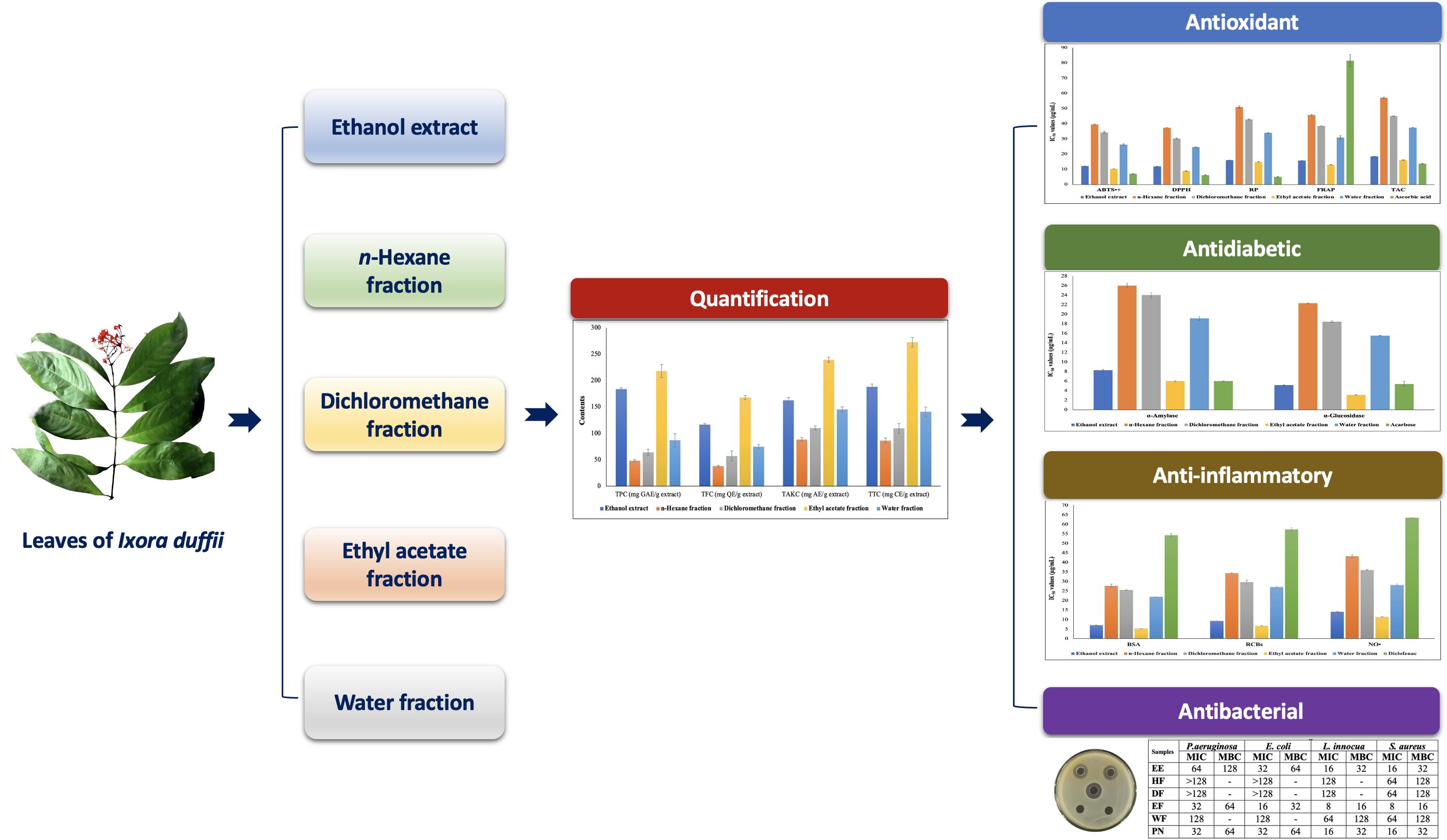
Downloads
References
JH Bae, KD Han, SH Ko, YS Yang, JH Choi, KM Choi, H Kwon and KC Won. Diabetes fact sheet in Korea 2021. Diabetes & Metabolism Journal 2022; 46(3), 417-426.
H Kashtoh and K Baek. New insights into the latest advancement in α-amylase inhibitors of plant origin with anti-diabetic effects. Plants 2023; 12(16), 2944.
CL Tran, VM Do, VT Huynh, XN Hong and KTD Chong. Optimization of polyphenol extraction conditions from rhizomes of curcuma zedoaria with antioxidant, anti-inflammatory and anti-diabetic activities in vitro. Trends in Sciences 2024; 21(9), 8544.
WAH Hegazy, AAH Rajab, ASA Lila and HA Abbas. Anti-diabetics and antimicrobials: Harmony of mutual interplay. World Journal of Diabetes 2021; 12(11), 1832-1855.
M Halim and A Halim. Commentary: The effects of inflammation, aging, and oxidative stress on the pathogenesis of type II diabetes. Journal of Health Care and Research 2020; 1(2), 119-124.
R Ramamoorthy, M Muthalagu, S Andra, B Ravichandran and M Narayanasamy. Investigation on antimicrobial, antioxidant and cytotoxicity properties of triple bark extract formulated using traditional medicinal plants. SN Applied Sciences 2019; 1, 772.
FC Sasso, V Simeon, R Galiero, A Caturano, LD Nicola, P Chiodini, L Rinaldi, T Salvatore, M Lettieri, R Nevola, C Sardu, G Docimo, G Loffredo, R Marfella, LE Adinolfi, R Minutolo and NID-2 study group Investigators. The number of risk factors not at target is associated with cardiovascular risk in a type 2 diabetic population with albuminuria in primary cardiovascular prevention. Post-hoc analysis of the NID-2 trial. Cardiovascular Diabetology 2022; 21(1), 235.
AK Shrivastava, M Keshari, M Neupane, S Chaudhary, PK Dhakal, L Shrestha, A Palikhey, CK Yadav, G Lamichhane, MU Shekh and RK Yadav. Evaluation of antioxidant and anti-inflammatory activities, and metabolite profiling of selected medicinal plants of Nepal. Journal of Tropical Medicine 2023; 2023(1), 6641018.
M Wronka, J Krzeminska, E Młynarska, J Rysz and B Franczyk. The Influence of lifestyle and treatment on oxidative stress and inflammation in diabetes. International Journal of Molecular Sciences 2022; 23(24), 15743.
H Yousef, AH Khandoker, SF Feng, C Helf and HF Jelinek. Inflammation, oxidative stress and mitochondrial dysfunction in the progression of type II diabetes mellitus with coexisting hypertension. Frontiers in Endocrinology 2023; 14, 1173402.
B Sadeghi-Nejad and J Saki. Effect of aqueous allium cepa and ixora brachiata root extract on leishmania major promastigotes. Jundishapur Journal of Natural Pharmaceutical Products 2014; 9(2), e15442.
H Muhammad, M Qasim, A Ikram, MA Versiani, IA Tahiri, K Yasmeen, MW Abbasi, M Azeem, ST Ali and B Gul. Antioxidant and antimicrobial activities of Ixora coccinea root and quantification of phenolic compounds using HPLC. South African Journal of Botany 2020; 135, 71-79.
OO Ogbole, A Nkumah, TE Akinleye, FE Olisaedu and AF Attah. Evaluation of multifunctional activity of bioactive peptide fractions from the leaves of Nauclea diderrichii (De Wild. and T. Durand) Merrill and Ixora brachypoda DC. Phytomedicine Plus 2021; 1(1), 100019.
A Chaterjee, D Chaterjee, M Ghosh, P Dagur, J Kaur, NK Rangra, S Dey, A Mondal, A Ghosh and P Behera. Phytochemical screening and anti-inflammatory, antioxidant, and antimicrobial investigations on extracts of ixora javanica. Matrix Science Pharma 2023; 7(2), 43-51.
T Sharma, R Gamit, R Acharya and VJ Shukla. Quantitative estimation of total tannin, alkaloid, phenolic, and flavonoid content of the root, leaf, and whole plant of Byttneria herbacea Roxb. AYU 2023; 42(3), 143-147.
CKT Duc, TC Linh, NQC Thanh, PQ Nhien, DTX Trang, LT Danh and NT Tuan. Isolation and evaluation of the antioxidant activity of compounds from ehretia asperula zoll. & moritzi. Indonesian Journal of Chemistry 2024; 24(4), 1206.
I Gulcin and SH Alwasel. DPPH radical scavenging assay. Processes 2023; 11(8), 2248.
MN Wickramaratne, JC Punchihewa and DBM Wickramaratne. In-vitro alpha amylase inhibitory activity of the leaf extracts of Adenanthera pavonina. BMC Complementary Medicine and Therapies 2016; 16, 466.
ZD Kifle, SG Debeb and YM Belayneh. In vitro α-amylase and α-glucosidase inhibitory and antioxidant activities of the crude extract and solvent fractions of hagenia abyssinica leaves. BioMed Research International 2021; 2021(1), 6652777.
M Shah, Z Parveen and MR Khan. Evaluation of antioxidant, anti-inflammatory, analgesic and antipyretic activities of the stem bark of Sapindus mukorossi. BMC Complementary Medicine and Therapies 2017; 17(1), 526.
LTM. Ngan, J Moon, J Kim, T Shibamoto and Y Anh. Growth-inhibiting effects of Paeonia lactiflora root steam distillate constituents and structurally related compounds on human intestinal bacteria. World Journal of Microbiology and Biotechnology 2012; 28(4), 1575-1583.
D Aryal, S Joshi, NK Thapa, P Chaudhary, S Basaula, U Joshi, D Bhandari, HM Rogers, S Bhattarai, KR Sharma, BP Regmi and N Parajuli. Dietary phenolic compounds as promising therapeutic agents for diabetes and its complications: A comprehensive review. Food Science & Nutrition 2024; 12(5), 3025-3045.
LFMD Melo, VGQ Aquino-Martins, APD Silva, HAO Rocha and KC Scortecci. Biological and pharmacological aspects of tannins and potential biotechnological applications. Food Chemistry 2023; 414, 135645.
S Parham, AZ Kharazi, HR Bakhsheshi-Rad, H Nur, AF Ismail, S Sharif, S Rama Krishna and F Berto. Antioxidant, antimicrobial and antiviral properties of herbal materials. Antioxidants 2020; 9(12), 1309.
SH Hassanpour and A Doroudi. Review of the antioxidant potential of flavonoids as a subgroup of polyphenols and partial substitute for synthetic antioxidants. Avicenna Journal of Phytomedicine 2023; 13(4), 354-376.
VS Gontijo, TCD Souza, IA Rosa, MG Soares, MAD Silva, W Vilegas, C Viegas and MHD Santos. Isolation and evaluation of the antioxidant activity of phenolic constituents of the Garcinia brasiliensis epicarp. Food Chemistry 2012; 132(3), 1230-1235.
T Behl, A Gupta, M Albratty, A Najmi, AM Meraya, HA Alhazmi, MK Anwer, S Bhatia and SG Bungau. Alkaloidal phytoconstituents for diabetes management: Exploring the unrevealed potential. Molecules 2022; 27(18), 5851.
A Bouyahya, A Balahbib, A Khalid, HA Makeen, HA Alhazmi, M Albratty, A Hermansyah, LC Ming, KW Goh and NE Omari. Clinical applications and mechanism insights of natural flavonoids against type 2 diabetes mellitus. Heliyon 2024; 10(9), e29718.
S Singh, A Bansal, V Singh, T Chopra and J Poddar. Flavonoids, alkaloids and terpenoids: A new hope for the treatment of diabetes mellitus. Journal of Diabetes & Metabolic Disorders 2022; 21(1), 941-950.
JI Mechanick, A Marchetti, R Hegazi and O Hamdy. Diabetes-specific nutrition formulas in the management of patients with diabetes and cardiometabolic risk. Nutrients 2020; 12(12), 3616.
A Caturano, MD Angelo, A Mormone, V Russo, MP Mollica, T Salvatore, R Galiero, L Rinaldi, E Vetrano, R Marfella, M Monda, A Giordano and FC Sasso. Oxidative stress in type 2 diabetes: Impacts from pathogenesis to lifestyle modifications. Current Issues in Molecular Biology 2023; 45(8), 6651-6666.
M Kalaskar, V Redasani, M Ayyanar, M Ghante, S Firke, K Agrawal, V Ghawate, S Surana, S Alarifi, R Chikhale and S Gurav. Isolation and characterization of anti-inflammatory compounds from ficus microcarpa L.f. stem bark. Plants 2023; 12(18), 3248.
AA Krishna, BL Abhirami, MB Bashi, R Jaice, ARM Jasim and A Kumaran. Identification and anti-inflammatory activity of flavonoids from Cardiospermum halicacabum in murine RAW 264.7 macrophage-A bioassay-guided approach. Food Bioscience 2024; 61, 104510.
RIG Holt, CS Cockram, RCW Ma and AOY Luk. Diabetes and infection: Review of the epidemiology, mechanisms and principles of treatment. Diabetologia 2024; 67(7), 1168-1180.
JR Simonsen, V Harjutsalo, A Jarvinen, J Kirveskari, C Forsblom, P Groop and M Lehto. Bacterial infections in patients with type 1 diabetes: A 14-year follow-up study. BMJ Open Diabetes Research & Care 2015; 3(1), e000067.
N Heredia and S Garcia. Animals as sources of food-borne pathogens: A review. Animal Nutrition 2018; 4(3), 250-255.
SYC Tong, JS Davis, E Eichenberger, TL Holland and VG Fowler. Staphylococcus aureus Infections: Epidemiology, pathophysiology, clinical manifestations, and management. Clinical Microbiology Reviews 2015; 28(3), 603661.
CS Makade, PR Shenoi, BA Bhongade, SA Shingane, PC Ambulkar and AM Shewale. Estimation of MBC: MIC ratio of herbal extracts against common endodontic pathogens. Journal of Pharmacy and Bioallied Sciences 2024; 16(2), S1414-S1416.
R Mogana, A Adhikari, MN Tzar, R Ramliza and C Wiart. Antibacterial activities of the extracts, fractions and isolated compounds from Canarium patentinervium Miq. against bacterial clinical isolates. BMC Complementary Medicine and Therapies 2020; 20, 55.
D Poljuha, B Sladonja, I Sola, M Senica, M Uzelac, R Veberic, M Hudina, IM Famuyide, JN Eloff and M Mikulic-Petkovsek. LC–DAD–MS phenolic characterisation of six invasive plant species in croatia and determination of their antimicrobial and cytotoxic activity. Plants 2022; 11(5), 596.
J Huang, M Zaynab, Y Sharif, J Khan, R Al-Yahyai, M Sadder, M Ali, SR Alarab and S Li. Tannins as antimicrobial agents: Understanding toxic effects on pathogens. Toxicon 2024; 247, 107812.
NF Shamsudin, QU Ahmed, S Mahmood, SA Ali Shah, A Khatib, S Mukhtar, MA Alsharif, H Parveen and ZA Zakaria. Antibacterial effects of flavonoids and their structure-activity relationship study: A comparative interpretation. Molecules 2022; 27(4), 1149.
S Sun, Z Liu, M Lin, N Gao and X Wang. Polyphenols in health and food processing: Antibacterial, anti-inflammatory, and antioxidant insights. Frontiers in Nutrition 2024; 11, 1456730.
Y Yan, X Li, C Zhang, L Lv, B Gao and M Li. Research progress on antibacterial activities and mechanisms of natural alkaloids: A review. Antibiotics 2021; 10(3), 318.
L Mira, MT Fernandez, M Santos, R Rocha, MH Florencio and KR Jennings. Interactions of flavonoids with iron and copper ions: A mechanism for their antioxidant activity. Free Radical Research 2002; 36(11), 1199-1208.
S Farooq, Z Ngaini and NA Mortadza. Microwave-assisted synthesis and molecular docking study of heteroaromatic chalcone derivatives as potential antibacterial agents. Bulletin of the Korean Chemical Society 2020; 41(9), 918-924.
T Okuda and H Ito. Tannins of constant structure in medicinal and food plants—hydrolyzable tannins and polyphenols related to tannins. Molecules 2011; 16(3), 2191-2217.
AK Farha, Q Yang, G Kim, H Li, F Zhu, H Liu, R Gan and H Corke. Tannins as an alternative to antibiotics. Food Bioscience 2020; 38, 100751.
W Chi, Y Jiang, J Hu and J Pan. Cytotoxic and antibacterial aspidofractinine alkaloids from Kopsia hainanensis. Fitoterapia 2018; 130, 259-264.
Published
How to Cite
Issue
Section
License
Copyright (c) 2025 Walailak University

This work is licensed under a Creative Commons Attribution-NonCommercial-NoDerivatives 4.0 International License.





