
Antidiabetic and Renoprotective Potential of Sand Sea Cucumber (Holothuria Scabra) Extract in Streptozotocin-Induced Male Rats
DOI:
https://doi.org/10.48048/tis.2026.13192Keywords:
Holothuria scabra, Diabetes mellitus, Diabetic nephropathy, Pancreatic islets, Kidney histology, StreptozotocinAbstract
Introduction: Chronic hyperglycemia in diabetes mellitus promotes progressive renal injury leading to diabetic nephropathy. This study evaluated the antidiabetic and renoprotective effects of the ethanolic extract of Holothuria scabra in streptozotocin-induced diabetic rats. Methods: Twenty-five male rats were divided into five groups (n = 5). Diabetes was induced in the rats with streptozotocin (55 mg/kg), and then treated orally for 28 days with H. scabra ethanolic extract (200 or 400 mg/kg) or metformin. Fasting blood glucose, serum creatinine and urea levels, and histopathological changes in pancreatic and renal tissues were evaluated. Results: Diabetic rats developed sustained hyperglycemia, weight loss, and marked renal structural damage. Treatment with H. scabra ethanolic extract at 200 mg/kg significantly reduced fasting blood glucose (p < 0.001), serum creatinine (p < 0.05), and renal histological injury scores (p < 0.001) compared with untreated diabetic controls. Pancreatic islet morphology showed partial improvement; however, islet number and area were not significantly restored. Phytochemical screening identified flavonoids, saponins, and steroidal compounds. Conclusion: The ethanolic extract of H. scabra exerts integrated antidiabetic and renoprotective effects at 200 mg/kg dose. These benefits likely result from functional metabolic regulation rather than structural regeneration of pancreatic islets. The findings highlight H. scabra as a promising marine-derived candidate for adjunctive diabetes management. Further mechanistic and dose-optimization investigations are warranted.
HIGHLIGHTS
- Ethanolic extract of Holothuria scabra showed significant antidiabetic and renoprotective potential in streptozotocin-induced diabetic male rats, as shown by reductions in fasting blood glucose and creatinine serum levels.
- Histopathological analysis revealed better preservation of pancreatic islets, improved pancreatic tissue architecture, and reduced renal damage scores following treatment with ethanolic extract of Holothuria scabra.
- Ethanolic extract of Holothuria scabra at a dose of 200 mg/kg showed greater improvement in fasting blood glucose and creatinine serum reduction, as well as histopathological improvement in the kidneys and pancreas.
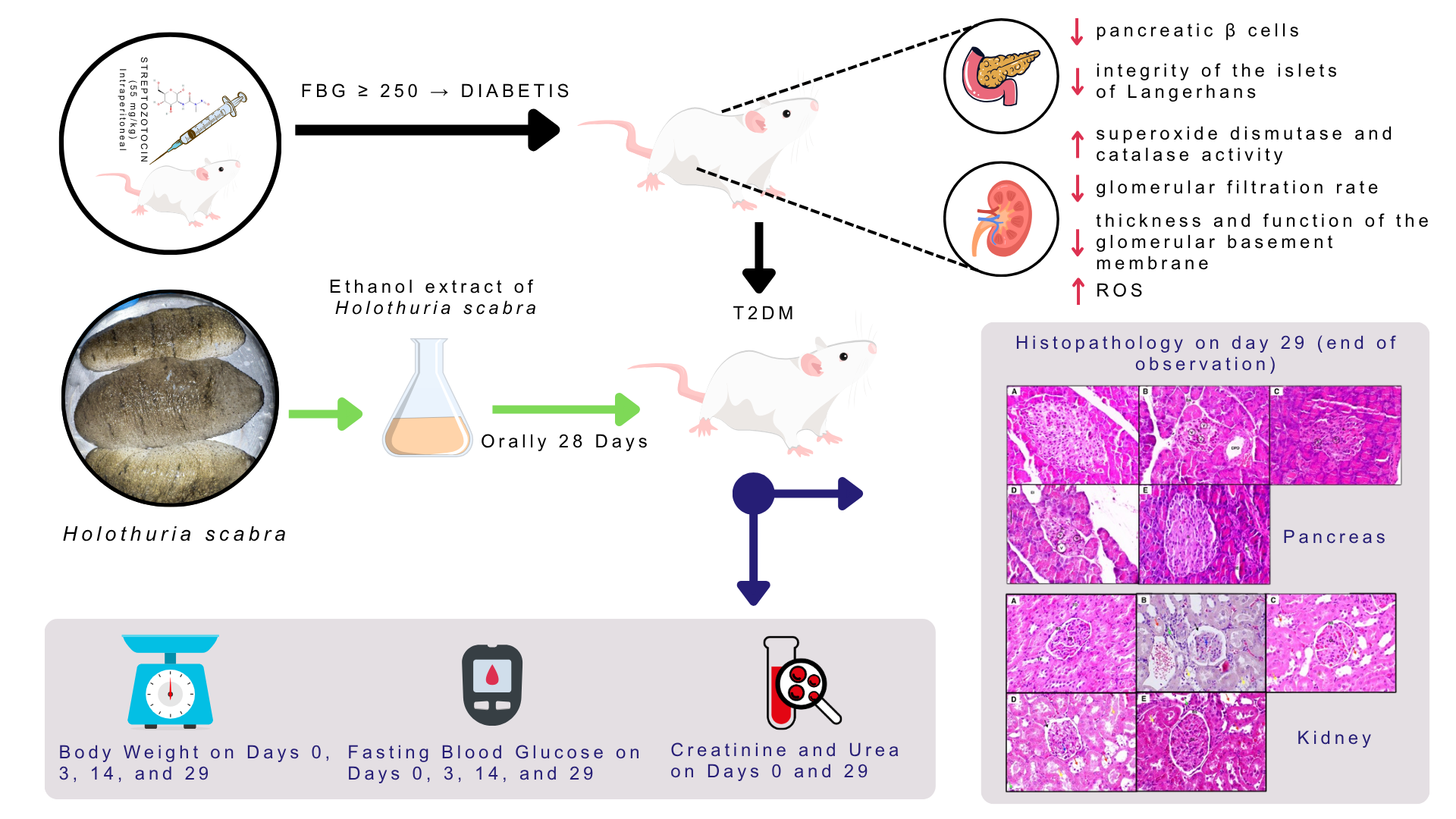
GRAPHICAL ABSTRACT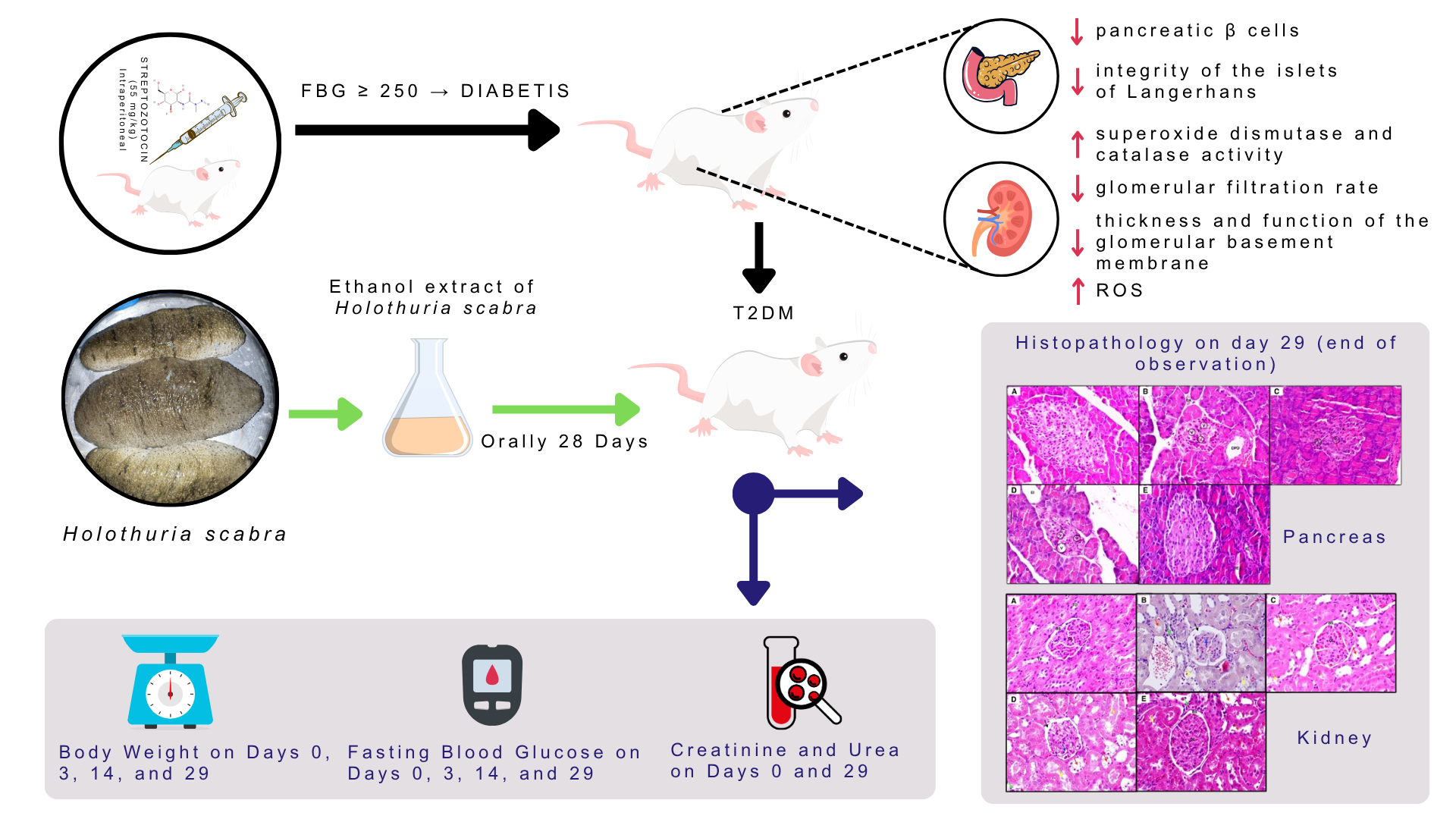
Downloads
References
AME Elkhalifa, M Nazar, SI Ali, I Khursheed, S Taifa, MA Mir, IH Shah, M Malik, Z Ramzan, S Ahad, N Bashir, E Elamin, EA Bazie, EM Ahmed, MM Alruwaili, AW Baltoyour, AS Alarfaj, IA Al Bataj, AMA Arabe and SU Nabi. Novel therapeutic agents for management of diabetes mellitus: A hope for drug designing against Diabetes Mellitus. Life 2024; 14(1), 99.
H Sun, P Saeedi, S Karuranga, M Pinkepank, K Ogurtsova, BB Duncan, C Stein, A Basit, JCN Chan, JC Mbanya, ME Pavkov, A Ramachandaran, SH Wild, S James, WH Herman, P Zhang, C Bommer, S Kuo, EJ Boyko and DJ Magliano. IDF Diabetes Atlas: Global, regional and country-level diabetes prevalence estimates for 2021 and projections for 2045. Diabetes Research and Clinical Practice 2022; 183, 109119.
Y Luo, W Zhang and G Qin. Metabolomics in diabetic nephropathy: Unveiling novel biomarkers for diagnosis (Review). Molecular Medicine Reports 2024; 30(3), 156.
P Paul, L Chacko, TK Dua, P Chakraborty, U Paul, VV Phulchand, NK Jha, SK Jha, R Kandimalla and S Dewanjee. Nanomedicines for the management of diabetic nephropathy: Present progress and prospects. Frontiers in Endocrinology 2023; 14, 1236686.
G Hou, Y Dong, Y Jiang, W Zhao, L Zhou, S Cao and W Li. Immune inflammation and metabolic interactions in the pathogenesis of diabetic nephropathy. Frontiers in Endocrinology 2025; 16, 1602594.
Y Ratan, A Rajput, A Pareek, A Pareek and G Singh. Comprehending the role of metabolic and hemodynamic factors alongside different signaling pathways in the pathogenesis of diabetic nephropathy. International Journal of Molecular Sciences 2025; 26(7), 3330.
J Jin and M Zhang. Exploring the role of NLRP3 inflammasome in diabetic nephropathy and the advancements in herbal therapeutics. Frontiers in Endocrinology 2024; 15, 1397301.
MF Nisar, M Li J Xu and C Wan. Anti-diabetic effects of marine natural products through redox modulation via Nrf2/HO-1 cytoprotective pathways. Frontiers in Marine Science 2024; 11, 1438955.
DAAS Laksemi, PAA Damayanti, IM Sudarmaja, IK Tunas, LPR Sundari, NL Rustini and PIB Apsari. In-vivo antimalarial activity of Holothuria scabra simplicia in Plasmodium berghei-infected mice. Universa Medicina 2024; 43, 195-201.
S Xia, M Li, T Shen, Y Gao, X Ma and X Yuan. Chapter 5 - Sea cucumbers in Chinese daily life. In: A Mercier, JF Hamel, AD Suhrbier and CM Pearce (Eds.). The World of Sea Cucumbers. Elsevier, Amsterdam, 2024, p. 65-75.
TL Wargasetia, H Ratnawati, N Widodo and MH Widyananda. Antioxidant and anti-inflammatory activity of sea cucumber (Holothuria Scabra) active compounds against KEAP1 and iNOS protein. Bioinformatics and Biology Insights 2023; 17, 1-10.
JF Hamel, I Eeckhaut, C Conand, J Sun, G Caulier and A Mercier. Global knowledge on the commercial sea cucumber Holothuria scabra. Advances in Marine Biology 2022; 91, 1-286.
OC Eleazu, KC Eleazu, S Chukwuma and UN Essien. Review of the mechanism of cell death resulting from streptozotocin challenge in experimental animals, its practical use and potential risk to humans. Journal of Diabetes and Metabolic Disorder 2013; 12, 60.
A Ghasemi and S Jeddi. Streptozotocin as a tool for induction of rat models of diabetes: A practical guide. EXCLI Journal 2023; 22, 274-294.
A Fiqardina, YY Djabir, A Santoso, SN Salsabil and I Ismail. The nephroprotective effect of clove oil (Oleum caryophylli) against levofloxacin toxicity in rats. Iranian Journal of Toxicology 2022; 16, 27-34.
K Godlewska, P Pacyga, A Najda and I Michalak. Investigation of chemical constituents and antioxidant activity of biologically active plant-derived natural products. Molecules 2023; 28, 5572.
L Maheshwaran, L Nadarajah, SPNN Senadeera, CB Ranaweera, AK Chandana and RN Pathirana. Phytochemical testing methodologies and principles for preliminary screening/ qualitative testing. Asian Plant Research Journal 2024; 12(5), 11-38.
A Alqethami and AY Aldhebiani. Medicinal plants used in Jeddah, Saudi Arabia: Phytochemical screening. Saudi Journal Biological Sciences 2021; 28(1), 805-812.
L Traore, YA Bekro, JL Pirat, and JA Mamyrbekova. Study of crude extracts from Cassia sieberiana root bark and Khaya grandifoliola trunk bark: Phytochemical screening, quantitative analysis and radical scavenging activity. International Journal of Current Pharmaceutical Research 2015; 7(3), 22-26.
MB Ekong, FN Odinukaeze, AC Nwonu, CC Mbadugha, and AA Nwakanma. Brain activities of streptozotocin-induced diabetic wistar rats treated with gliclazide: Behavioural, biochemical and histomorphology studies. IBRO Neuroscience Reports 2022; 12, 271-279.
D Cheng, B Liang and Y Li. Antihyperglycemic effect of Ginkgo biloba extract in streptozotocin-induced diabetes in rats. Biomed Research Internasional 2013; 2013(7), 162724.
AD Anugrah, A Asmara, Y Leman and YY Djabir. Sandfish (Holothuria scabra) ethanolic extract mitigates ethylene glycol-induced acute kidney injury in rats. Natural Resources for Human Health 2025; 5, 300-309.
S Usman, RI Juhardi, SA Iraekawati, NY Linthin, A Arsyad and YY Djabir. Protective effects of astaxanthin on triple whammy-induced acute kidney injury via antioxidant, anti-inflammatory and anti-apoptotic mechanisms. Trends in Sciences 2026; 23(2),11484.
YY Djabir; H Hardi, H Setiawati, S Lallo, Risfah Yulianty, MH Cangara and H Veni. Artocarpus altilis leaf extract protects pancreatic islets and improves glycemic control in alloxan-induced diabetic rats. Journal of Reports in Pharmaceutical Sciences 2021; 10(1), 87-92.
AKS Brito, AVS Mendes, BT Acha, ASSS Oliveira, JL Macedo, AS Cruzio, MDG Prianti, RR Abreu, M Lucarini, A Durazzo, MDCC Martins and DDR Arcanjo. Experimental models of type 2 diabetes mellitus induced by combining hyperlipidemic diet (HFD) and streptozotocin administration in rats: An integrative review. Biomedicines 2025; 13(5), 1158.
S Lenzen. The mechanisms of alloxan- and streptozotocin-induced diabetes. Diabetologia 2008; 51(2), 216-226
W Fang, X Yuan, W Li, S Seery, G Chen, Z Cai, Z Huang, X Wang, W Wu, Z Chen, Y Li, S Wu and Y Chen. Excessive weight gain onset-age and risk of developing diabetes mellitus: A large, prospective Chinese cohort study. Frontier in Endocrinology 2023; 14, 1281203.
A El Barky, SA Hussein, AAE Alm-Eldeen, A Hafez and TM Mohamed. Diabetes management saponins and their potential role in diabetes mellitus. Diabetes Management 2017; 7(1), 148-158.
YE Puspitasari, E Tuenter, K Foubert, H Herawati, A Hariati, A Aulanni’am, L Pieters, TD Bruyne and N Hermans. Saponin and fatty acid profiling of the sea cucumber Holothuria atra, α-Glucosidase inhibitory activity and the identification of a novel triterpene glycoside. Nutrients 2023; 15, 1-20.
A Hossain, D Dave and F Shahidi. Antioxidant Potential of sea cucumbers and their beneficial effects on human health. Marine Drugs 2022; 20, 521.
RF Sinuhaji, S Ramadhani, VK Setiawan and U Baroroh. Targeting diabetes with flavonoids from Indonesian medicinal plants: A review on mechanisms and drug discovery. Naunyn Schmiedebergs Arch Pharmacol 2025; 398, 11683-11703.
M Li, X Chi, Y Wang, S Setrerrahmane, W Xie and H Xu. Trends in insulin resistance: Insights into mechanisms and therapeutic strategy. Signal Transduction and Targeted Therapy 2022; 7, 216.
L Yang, J Wang, RA Cheke and S Tang. A Universal delayed difference model fitting dose-response curves. Dose Response 2021; 19(4), 1-18.
Published
How to Cite
Issue
Section
License
Copyright (c) 2026 Walailak University

This work is licensed under a Creative Commons Attribution-NonCommercial-NoDerivatives 4.0 International License.





