
Protective Effects of Astaxanthin on Triple Whammy-Induced Acute Kidney Injury via Antioxidant, Anti-inflammatory and Anti-Apoptotic Mechanisms
DOI:
https://doi.org/10.48048/tis.2026.11484Keywords:
Astaxanthin, Triple Whammy, Nephroprotective, Acute Kidney Injury, Molecular Docking, Astaxanthin, Triple Whammy, Nephroprotective, Acute Kidney Injury, Molecular Docking, 1,1-diphenyl-2-picrylhydrazylAbstract
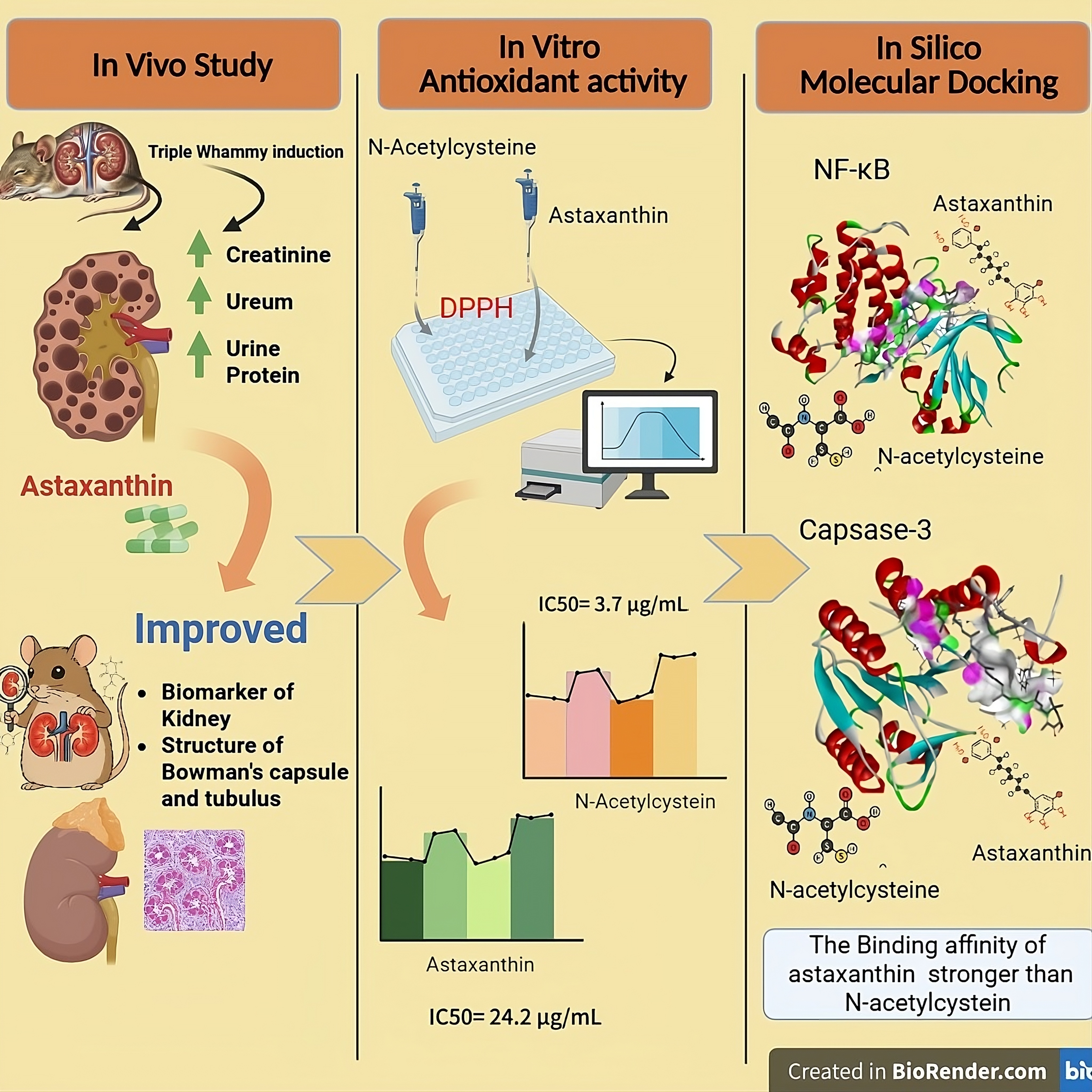
The triple whammy combination (diuretics, ACE inhibitors, and NSAIDs) can cause acute kidney injury (AKI). Astaxanthin is known for its antioxidant, anti-inflammatory, and anti-apoptotic properties, which may offer nephroprotection. This study aimed to evaluate the prophylactic effect of astaxanthin in a triple whammy-induced AKI rat model. Thirty rats were divided into 6 groups: Normal control, triple whammy (negative control), N-acetylcysteine (positive control), and 3 astaxanthin-treated groups (0.4, 1.6 and 2.4 mg/kg body weight). Oral treatment was given for 7 days before the administration of the triple whammy combination for 2 days. Blood and urine samples were collected to assess renal biomarkers, and histopathological evaluation was performed. Antioxidant activity was tested using the DPPH radical scavenging assay. Molecular docking was used to analyze astaxanthin’s binding affinity to inflammatory (NF-κB) and apoptotic (caspase-3) targets. Triple whammy administration significantly increased serum creatinine, urea, proteinuria, and histological damage. Astaxanthin, especially at 1.6 mg/kg, significantly reduced these biomarkers and improved renal structure compared to both negative and N-acetylcysteine-treated groups. DPPH assay showed strong antioxidant activity for both astaxanthin (IC₅₀ = 24.2 µg/mL) and N-acetylcysteine (IC₅₀ = 3.7 µg/mL). In silico analysis demonstrated higher binding affinity of astaxanthin to caspase-3 (–7.5 kcal/mol) and NF-κB (–6.6 kcal/mol) than N-acetylcysteine. In conclusion, astaxanthin demonstrates superior nephroprotective efficacy, as evidenced by improved renal biomarkers and histological structure, potent antioxidant capacity, and strong predicted interactions with key inflammatory and apoptotic targets. These findings highlight astaxanthin’s potential as a promising prophylactic agent against AKI, warranting further mechanistic and translational studies.
HIGHLIGHTS
- Astaxanthin, particularly at 1.6 mg/kg, significantly reduced serum creatinine and urea levels in a rat model of “triple whammy”-induced kidney injury.
- Astaxanthin demonstrated potent free radical scavenging activity in DPPH assay (IC₅₀ = 24.2 µg/mL).
- Molecular docking revealed that astaxanthin has higher binding affinities to caspase-3 and NF-κB than N-acetylcysteine, suggesting potential to modulate apoptosis and inflammation.
GRAPHICAL ABSTRACT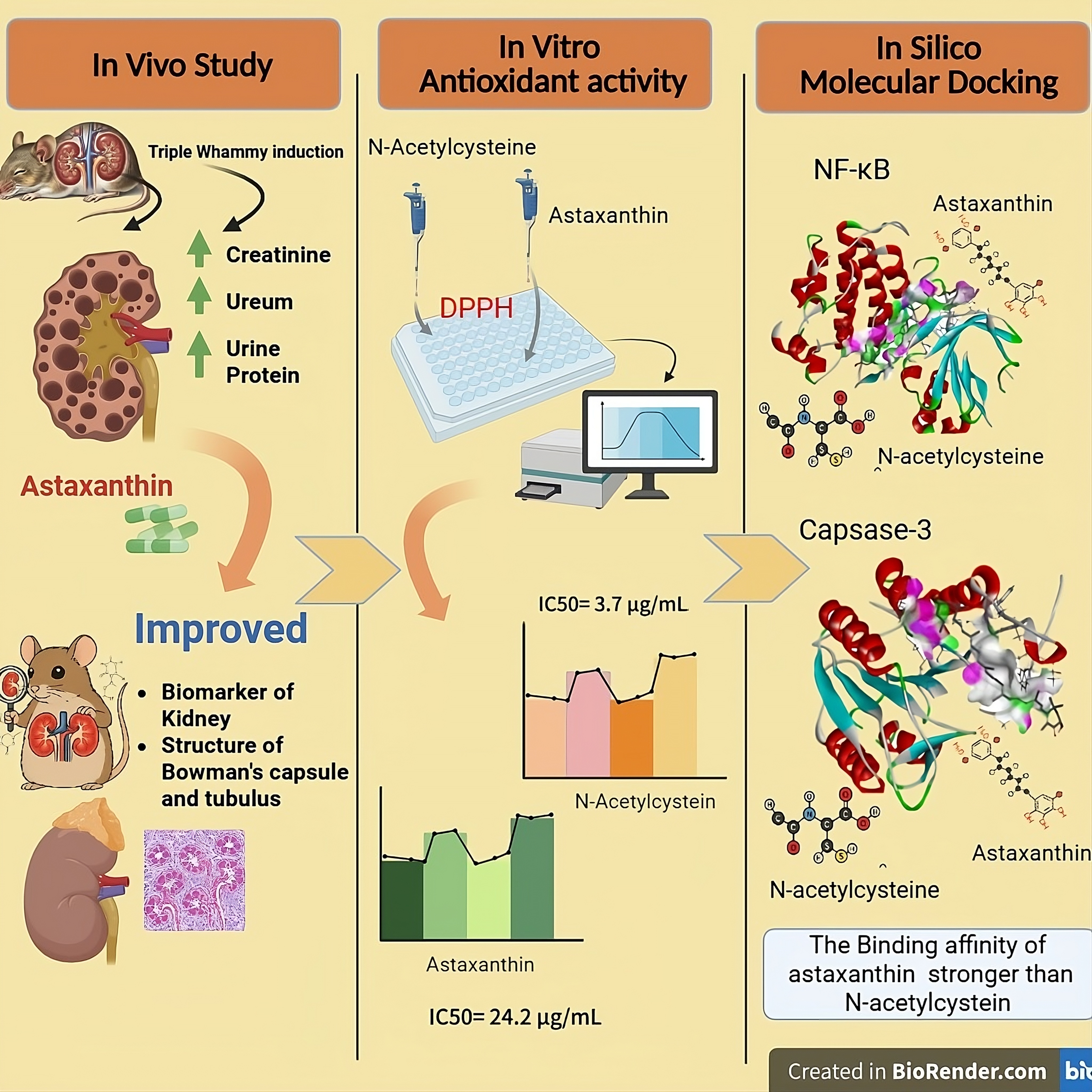
Downloads
References
RL Mehta, EA Burdmann, J Cerdá, J Feehally, F Finkelstein, G García-García, M Godin, V Jha, NH Lameire, NW Levin, A Lewington, R Lombardi, E Macedo, M Rocco, E Aronoff-Spencer, M Tonelli, J Zhang and G Remuzzi. Recognition and management of acute kidney injury in the International Society of Nephrology 0by25 Global Snapshot: A multinational cross-sectional study. The Lancet 2016; 387(10032), 2017-2025.
YY Djabir, A Arsyad, U Usmar, E Wahyudin, H Arwi and IS Rupang. The stages of development of liver and renal injuries in rats induced by fixed dose combination of antituberculosis regimen. FABAD Journal of Pharmaceutical Sciences 2020; 45(1), 29-35.
MØ Nørgård and P Svenningsen. Acute kidney injury by ischemia/reperfusion and extracellular vesicles. International Journal of Molecular Sciences 2023; 24(20), 15312.
CDM Barbado, LCS Fernández, LL Alegría, MCC Lecea and MG Valencia. Acute kidney injury associated with “triple whammy” combination: A protocol for a systematic review. F1000Research 2022; 11, 496.
KK Loboz and GM Shenfield. Drug combinations and impaired renal function - the ‘triple whammy’. British Journal of Clinical Pharmacology 2005; 59(2), 239-243.
LP García, LV Vicente, VB Gozalo, OH Thomas, MCG Macías, A Kurtz, AT Layton, AB Sanz, AI Morales, CM Salgado, M Pericacho, SMS Martínez and FJL Hernández. Pathophysiological mechanisms underlying a rat model of triple whammy acute kidney injury. Laboratory Investigation 2020; 100(11), 1455-1464.
S Pan and C Zhu. Biological and neurological activities of astaxanthin (review). Molecular Medicine Reports 2022; 26(4), 300.
A Donoso, JG Durán, AA Muñoz, PA González and CA Muñoz. Therapeutic uses of natural astaxanthin: An evidence-based review focused on human clinical trials. Pharmacological Research 2021; 166(8), 105479.
J Leete, C Wang, FJL Hernández and AT Layton. Determining risk factors for triple whammy acute kidney injury. Mathematical Biosciences 2022; 347, 108809.
AB Nair and S Jacob. A simple practice guide for dose conversion between animals and human. Journal of Basic and Clinical Pharmacy 2016; 7(2), 27-31.
D Ramírez and J Caballero. Is it reliable to take the molecular docking top scoring position as the best solution without considering available structural data? Molecules 2018; 23(5), 1038.
H Dahmke, J Schelshorn, R Fiumefreddo, P Schuetz, AR Salili, FC Diaz, CM Massetti and C Zaugg. Evaluation of triple whammy prescriptions after the implementation of a drug safety algorithm. Drugs - Real World Outcomes 2024; 11(1), 125-135.
M Ostermann, L Awdishu and M Legrand. Using diuretic therapy in the critically ill patient. Intensive Care Medicine 2024; 50(8), 1331-1334.
Y Kunitsu, D Hira, A Morikochi, T Ueda, T Isono, SY Morita and T Terada. Time until onset of acute kidney injury by combination therapy with “Triple whammy” drugs obtained from Japanese adverse drug event report database. PLoS One 2022; 17(2), e0263682.
J Jodynis-Liebert and M Kujawska. Biphasic dose-response induced by phytochemicals: Experimental evidence. Journal of Clinical Medicine 2020; 9(3), 718.
Y Zhou, JS Baker, X Chen, Y Wang, H Chen, GW Davison and X Yan. High-dose astaxanthin supplementation suppresses antioxidant enzyme activity during moderate-intensity swimming training in mice. Nutrients 2019; 11(6), 1244.
D Wu, H Xu, J Chen and L Zhang. Effects of astaxanthin supplementation on oxidative stress: A systematic review and meta-analysis of randomized controlled trials. International Journal for Vitamin and Nutrition Research 2020; 90(1-2), 179-194.
E Erbas, H Üstündağ, E Öztürk, SN Parlak and T Atcalı. Astaxanthin treatment reduces kidney damage and facilitates antioxidant recovery in lithium-intoxicated rats. Toxicon 2024; 241, 107664.
B Hashemi, S Fakhri, A Kiani, F Abbaszadeh, S Miraghaee, M Mohammadi and J Echeverría. Anti-neuropathic effects of astaxanthin in a rat model of chronic constriction injury: Passing through opioid/benzodiazepine receptors and relevance to its antioxidant and anti-inflammatory effects. Frontiers in Pharmacology 2024; 15, 1467788.
DL Kuehu, Y Fu, M Nasu, H Yang, VS Khadka and Y Deng. Effects of heat-induced oxidative stress and astaxanthin on the NF-kB, NFE2L2 and PPARα transcription factors and cytoprotective capacity in the thymus of broilers. Current Issues in Molecular Biology 2024; 46(8), 9215-9233.
İ Gulcin and SH Alwasel. DPPH radical scavenging assay. Processes 2023; 11(8), 2248.
CPM Pereira, ACR Souza, AR Vasconcelos, PS Prado and JJ Name. Antioxidant and anti inflammatory mechanisms of action of astaxanthin in cardiovascular diseases (review). International Journal of Molecular Medicine 2021; 47(1), 37-48.
L Ivanova and M Karelson. The impact of software used and the type of target protein on molecular docking accuracy. Molecules 2022; 27(24), 9041.
V Sivasakthi, P Anitha, KM Kumar, S Bag, P Senthilvel, P Lavanya, R Swetha, A Anbarasu and S Ramaiah. Hypothesis aromatic-aromatic interactions: Analysis of π-π interactions in interleukins and TNF proteins. Bioinformation 2013; 9(8), 432-439.
SX Guo, HL Zho, CL Huang, CG You, Q Fang, P Wu, XG Wang and CM Han. Astaxanthin attenuates early acute kidney injury following severe burns in rats by ameliorating oxidative stress and mitochondrial-related apoptosis. Marine Drugs 2015; 13(4), 2105-2123.
AZM Barizi, ANSS Azman, MFS Saad, MNH Abdullah, V Lim and YK Yong. Network pharmacology and molecular docking approaches of astaxanthin (ATX) against atherosclerosis. Pharmacognosy Research 2024; 16(3), 626-637.
S Davinelli, L Saso, F D'Angeli, V Calabrese, M Intrieri and G Scapagnini. Astaxanthin as a modulator of Nrf2, NF-κB, and their crosstalk: Molecular mechanisms and possible clinical applications. Molecules 2022; 27(2), 502.
W Jiang, H Zhao, L Zhang, B Wu and Z Zha. Maintenance of mitochondrial function by astaxanthin protects against bisphenol A-induced kidney toxicity in rats. Biomedicine & Pharmacotherapy 2020; 121, 109629.
Published
How to Cite
Issue
Section
License
Copyright (c) 2025 Walailak University

This work is licensed under a Creative Commons Attribution-NonCommercial-NoDerivatives 4.0 International License.





