
Effect of Graphene Oxide Concentration and Sintering Conditions on the Electrical Conductivity of MnO₂/N-Doped Graphene Composites for Potential Lithium-Ion Battery Anode Applications
DOI:
https://doi.org/10.48048/tis.2026.13157Keywords:
MnO2/N-doped graphene, Puspa wood biomass, Lithium-ion battery, Anode material, Hydrothermal, Electrical conductivityAbstract
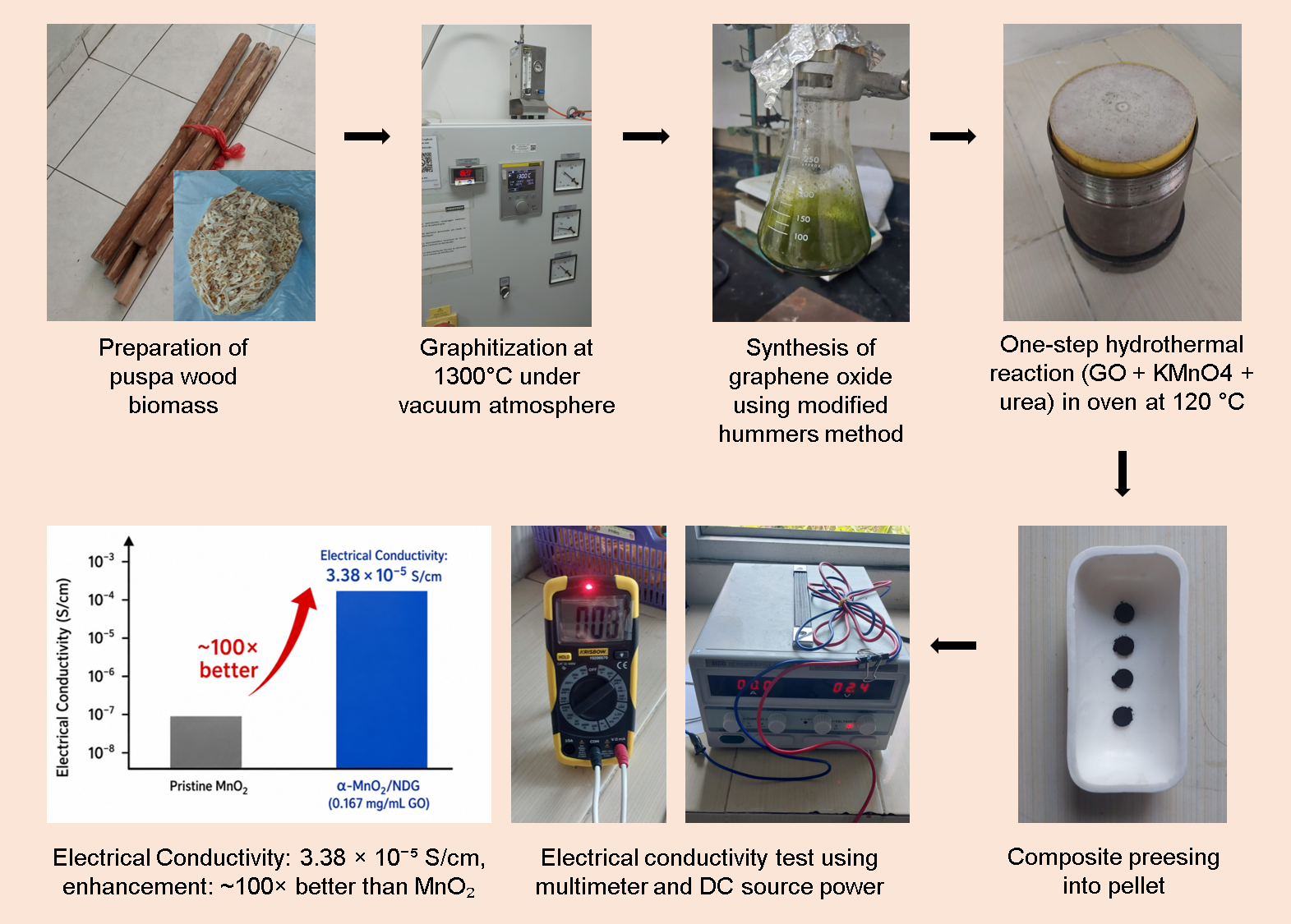
Advancing energy storage technology is crucial for a sustainable future. The development of sustainable anode materials is essential for advancing lithium-ion battery (LiB) technology. This study reports the synthesis, optimization, and characterization of a MnO₂/N-doped graphene (MnO2/NDG) composite derived from puspa wood biomass via a one-step hydrothermal method. Variations in graphene oxide (GO) concentration (0.167, 0.25, and 0.5 mg/mL) and sintering temperature (400 - 550 °C) were conducted to optimize the composite’s electrical conductivity. The materials were characterized using XRD, FTIR, UV–Vis, and TEM to identify crystal structure, functional groups, optical properties, and morphology. Results show that the optimum conditions were achieved at a GO concentration of 0.167 mg/mL and a sintering temperature of 550 °C, yielding a significantly enhanced electrical conductivity of 3.38×10⁻⁵ S/cm. This enhancement, stemming from the formation of a stable conductive network, addresses a key limitation for electrode applications. XRD and TEM analyses confirmed the formation of the α-MnO₂ (hollandite) phase with a nanorod morphology uniformly dispersed on graphene sheets. The sintering process strengthened Mn–O bonds and enhanced the reduction of GO to reduced graphene oxide (rGO), resulting in a stable conductive network. This study demonstrates the potential of puspa wood biomass as a sustainable carbon precursor for developing MnO₂/NDG composites with enhanced electrical properties for further investigation as anode materials.
HIGHLIGHTS
- MnO₂/N-doped graphene composite was successfully synthesized from Puspa wood biomass using a one-step hydrothermal method.
- The optimal electrical conductivity of 3.38 × 10⁻⁵ S/cm was achieved at 0.167 mg/mL GO and sintering temperature of 550°C.
- The rGO network forms a carpet-like percolating conductive pathway, significantly enhancing charge transport.
- Nitrogen doping (0.83 wt%) plays a supporting role in improving charge carrier density.
- The biomass-derived composite shows competitive electrical performance compared to modified carbon-based anodes.
GRAPHICAL ABSTRACT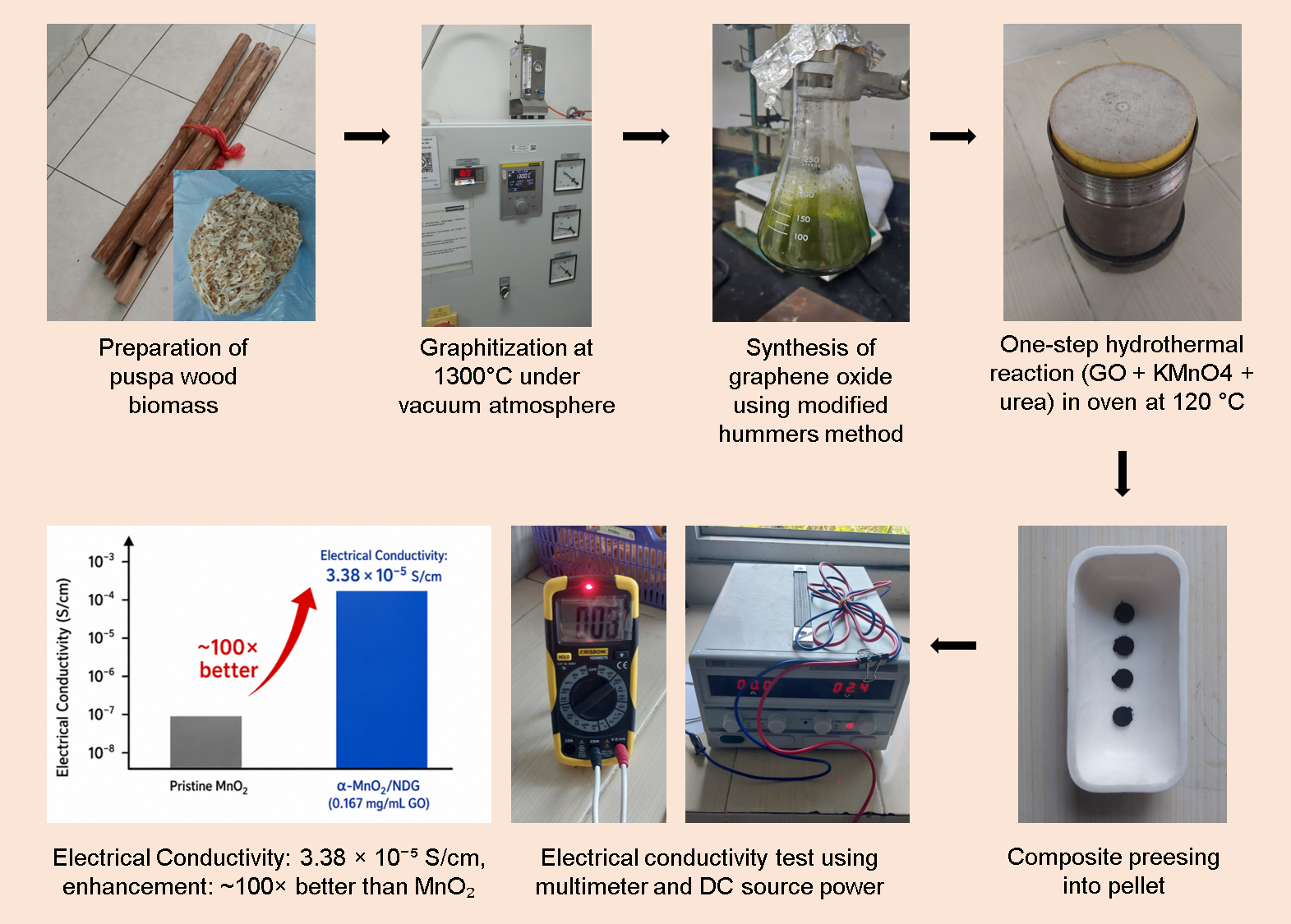
Downloads
References
P Wei, M Abid, H Adun, DK Awoh, D Cai, JH Zaini and O Bamisile. Progress in energy storage technologies and methods for renewable energy systems application. Applied Sciences 2023; 13(9), 5626.
Renewable energy statistics, Available at: https://www.irena.org/Publications/2023/Jul/Renewable-energy-statistics-2023
J Conzen, S Lakshmipathy, A Kapahi, S Kraft and M DiDomizio. Lithium ion battery energy storage systems (BESS) hazards. Journal of Loss Prevention in the Process Industries 2023; 81, 104932.
D Deng. Li-ion batteries: Basics, progress, and challenges. Energy Science & Engineering 2015; 3, 385-418.
MH Hossain, MA Chowdhury, N Hossain, MA Islam and MH Mobarak. Advances of lithium-ion batteries anode materials: A review. Chemical Engineering Journal Advances 2023; 16, 100569.
K Pongpanyanate, S Roddecha, C Piyanirund, T Phraewphiphat and P Hasin. Dispersed MnO2 nanoparticles/sugarcane bagasse-derived carbon composite as an anode material for lithium-ion batteries. RSC Advances 2024; 14(4), 2354-2368.
A Xia, C Zhao, Y Han, G Tan and H Ren. N-doped δ-MnO2 synthesized by the hydrothermal method and its electrochemical performance as anode materials. Ceramics International 2021; 47(10A), 13722-13728.
ZY Sui, C Wang, K Shu, QS Yang, Y Ge, GG Wallace and BH Han. Manganese dioxide-anchored three-dimensional nitrogen-doped graphene hybrid aerogels as excellent anode materials for lithium ion batteries. Journal of Materials Chemistry A 2015; 3(19), 10403-10412.
H Xu, L Ma and Z Jin. Nitrogen-doped graphene: Synthesis, characterizations and energy applications. Journal of Energy Chemistry 2018; 27(1), 146-160.
J Lang, X Zhang, B Liu, R Wang, J Chen and X Yan. The roles of graphene in advanced Li-ion hybrid supercapacitors. Journal of Energy Chemistry 27(1), 43-56.
MC Wu, Y Yao and X Zhang. Preparation and electrochemical performance study of MnO2/3D nitrogen-doped reduced graphene oxide. Materials Chemistry and Physics 2026; 348(P2), 131620.
ZS Wu, W Ren, L Xu, F Li and HM Cheng. Doped graphene sheets as anode materials with superhigh rate and large capacity for lithium ion batteries. ACS Nano 2011; 5(7), 5463-5471.
TK Ida, K Sonowal, AK Golder and B Mandal. Simple environmental-friendly method for graphite recovery from spent lithium-ion batteries and its utilization for the synthesis of graphene oxide. Separation and Purification Technology 2025; 374, 133758.
AS Kamal, R Othman and NH Jabarullah. Preparation and synthesis of synthetic graphite from biomass waste: A review. Systematic Reviews in Pharmacy 2020; 11(2), 881-894.
TN Syahri. Chemical analyses of 75 wood species from several location in Indonesia. Forest Products Research Journal 1988. https://api.semanticscholar.org/CorpusID:103301569
B Liu and ES Aydil. Growth of oriented single-crystalline rutile TiO 2 nanorods on transparent conducting substrates for dye-sensitized solar cells. Journal of the American Chemical Society 2009; 131(11), 3985-3990.
AA Peterson, F Vogel, RP Lachance, M Fröling, MJ Antal and JW Tester. Thermochemical biofuel production in hydrothermal media: A review of sub- and supercritical water technologies. Energy & Environmental Science 2008; 1(1), 32-65.
Z Du, W Guan, C He, Y Liu and W Ai. Advances in graphene-based hosts for lithium metal anodes. Energy Storage Materials 2024; 65, 103191.
MS Hossain, DH Huynh, L Jiang, S Rahman, PD Nguyen, F Al-Dirini, F Hossain, JH Bahk and E Skafidas. Investigating enhanced thermoelectric performance of graphene-based nano-structures. Nanoscale 10(10), 4786-4792.
AK Varma and P Mondal. Physicochemical characterization and pyrolysis kinetic study of sugarcane bagasse using thermogravimetric analysis. Journal of Energy Resources Technology, Transactions of the ASME 2016; 138(5), 052205.
M Taqi-Uddeen Safian, S Haron, M Nasir and M Ibrahim. A Review on Bio-based Graphene Derived from Biomass Wastes. BioResources 2020; 15(4), 9756-9785.
EH Sujiono, Zurnansyah, D Zabrian, MY Dahlan, BD Amin, Samnur and J Agus. Graphene oxide based coconut shell waste: Synthesis by modified Hummers method and characterization. Heliyon 2020; 6(8), e04568.
A Gutiérrez-Pardo, J Ramírez-Rico, R Cabezas-Rodríguez and J Martínez-Fernández. Effect of catalytic graphitization on the electrochemical behavior of wood derived carbons for use in supercapacitors. Journal of Power Sources 2015; 278, 18-26.
A Darmawan, DA Listanti, H Muhtar, C Azmiyawati and DN Bima. Innovative structured brick-and-mortar graphene oxide/polyvinyl pyrrolidone composite membrane for highly efficient desalination via pervaporation. Colloids and Surfaces A: Physicochemical and Engineering Aspects 2025; 707, 135853.
D Ariyanti, D Lesdantina, A Purbasari and Y Astuti. Synthesis of graphene-like material derived from biomass from agricultural waste and its application in Cu (II) removal. Korean Journal of Chemical Engineering 2023; 40(4), 964-974.
J Dong, G Lu, F Wu, C Xu, X Kang and Z Cheng. Facile synthesis of a nitrogen-doped graphene flower-like MnO 2 nanocomposite and its application in supercapacitors. Applied Surface Science 2018; 427(A), 986-993.
TK Das, S Banerjee, A Kumar, AK Debnath and V Sudarsan. Electrochemical performance of hydrothermally synthesized N-Doped reduced graphene oxide electrodes for supercapacitor application. Solid State Sciences 2019; 96, 105952.
SG Ibrahim. Physical properties of chemically spray deposited nanocrystalline manganese sulfide (MnS) thin films. Journal of Materials Science: Materials in Electronics 2020; 32(1), 543-550.
P Parmar, S Mukherjee, VK Singh and BC Meikap. Thermo-kinetic analysis of sugarcane bagasse as a sustainable energy resource evaluation. Thermal Science and Engineering Progress 2024; 54, 102836.
J George, A Palatel, M Chandrasekharan, P Arun and C Muraleedharan. Effect of Operating Parameters in Air-Steam Gasification. Journal of Advanced Engineering Research 2017; 4(2), 89-93.
I Vaskalis, V Skoulou, G Stavropoulos and A Zabaniotou. Towards circular economy solutions for the management of rice processing residues to bioenergy via gasification. Sustainability 2019; 11(22), 6433.
L Utarina, R Rusdianasari and L Kalsum. Characterization of Palm Shell-Derived Bio-Oil Through Pyrolysis. Journal of Applied Agricultural Science and Technology 2022; 6(2), 139-148.
WR Asri, H Hasanudin, A Mara and D Desnelli. Pyrolysis of puspa wood sawdust and sugarcane bagasse into biochar. Aceh International Journal of Science and Technology 2022; 11(1), 56-69.
AA Mohammed, ZT Khodair and AA Khadom. Preparation and investigation of the structural properties of α-Al2O3 nanoparticles using the sol-gel method. Chemical Data Collections 2020; 29, 100531.
KM Mohamed, JJ Vijaya, AJPP Winston, K Akash, P Sagayaraj, S Rajeshkumar and MK Al-Sadoon. Untapped potential: Sugarcane bagasse to biocompatible graphene oxide as biomedicine. Diamond and Related Materials 2024; 148, 111479.
AA Azahar, MD Nurhafizah, MR Omar, N Abdullah and A Ul-Hamid. Bio-graphene production from oil palm shell waste valorised through sequential thermal and catalytic means. Carbon Trends 2022; 9, 100225.
JK Sarkar and Q Wang. Different pyrolysis process conditions of South Asian waste coconut shell and characterization of gas, bio-char, and bio-oil. Energies 2020; 13(8), 1970.
NAM Barakat, S gamal, MMA Hameed, OA Fadali, OH Abdelraheem, RA Hefny and HM Moustafa. Graphitized corncob 3D Biomass‒driven anode for high performance batch and continuous modes Air‒Cathode microbial fuel cells working by domestic wastewater. International Journal of Hydrogen Energy 2023; 48(98), 38854-38869.
A Mahmun and AB Deoghare. A comparative study on coconut shell-derived graphene oxide and reduced graphene oxide. Current Applied Physics 2024; 62, 12-21.
S Nanda, P Mohanty, KK Pant, S Naik, JA Kozinski and AK Dalai. Characterization of North American lignocellulosic biomass and biochars in terms of their candidacy for alternate renewable fuels. Bioenergy Research 2013; 6(2), 663-677.
N Pan, D Guan, T He, R Wang, I Wyman, Y Jin and C Xia. Removal of Th4+ ions from aqueous solutions by graphene oxide. Journal of Radioanalytical and Nuclear Chemistry 2013; 298(3), 1999-2008.
MJ Rampe, IRS Santoso, HL Rampe, VA Tiwow and TEA Rorano. Study of pore length and chemical composition of charcoal that results from the pyrolysis of coconut shell in Bolaang Mongondow, Sulawesi, Indonesia. Karbala International Journal of Modern Science 2022; 8(1), 96-104.
ME Guye, MD Dabaro and H Kim. Biomass-derived graphitic-like hierarchical porous carbon for electrochemical supercapacitor application. Journal of Energy Storage 2025; 115, 116037.
SB Singh and M De. Thermally exfoliated graphene oxide for hydrogen storage. Materials Chemistry and Physics 2020; 239, 122102.
S Biniak, G Trykowski, M Walczyk and M Richert. Thermo-chemical modification of Low-dimensional carbons: An infrared study. Journal of Applied Spectroscopy 2016; 83(4), 580-585.
RM Silverstein, FX Webster and DJ Kiemle. Spectrometric identification of organic compounds (7th ed.). John Wiley & Sons, John Wiley & Sons, 2005.
M Bera, C Yadav, P Gupta and PK Maji. Facile One-Pot synthesis of graphene oxide by sonication assisted mechanochemical approach and its surface chemistry. Journal of Nanoscience and Nanotechnology 2017; 18(2), 902-912.
B Abderrahim, M Aqil, TF Ezahra, T Abdesselam, E Abderrahman, A Mohamed, T Fatima and O Krim. Kinetic thermal degradation of cellulose, polybutylene succinate and a green composite: Comparative study. World Journal of Environmental Engineering 2015; 3(4), 95-110.
BD Ossonon and D Bélanger. Synthesis and characterization of sulfophenyl-functionalized reduced graphene oxide sheets. RSC Advances 2017; 7(44), 27224-27234.
X Jiao, Y Qiu, L Zhang and X Zhang. Comparison of the characteristic properties of reduced graphene oxides synthesized from natural graphites with different graphitization degrees. RSC Advances 2017; 7(82), 52337-52344.
Q Zhuo, J Gao, M Peng, L Bai, J Deng, Y Xia, Y Ma, J Zhong and X Sun. Large-scale synthesis of graphene by the reduction of graphene oxide at room temperature using metal nanoparticles as catalyst. Carbon 2013; 52, 559-564.
R Siburian, H Sihotang, SL Raja, M Supeno and C Simanjuntak. New route to synthesize of graphene nano sheets. Oriental Journal of Chemistry 2018; 34(1), 182-187.
S Sudakhar, KK Jaiswal, AP Ramaswamy, SG Peera and AP Ramaswamy. Green synthesis of N-graphene by hydrothermal-microwave irradiation for alkaline fuel cell application. International Journal of Recent Scientific Research 2017; 8(8), 19049-19053.
N Kumar, JR Rodriguez, VG Pol and A Sen. Synergistically advancing Li storage property of hydrothermally grown 1D pristine MnO2 over a mesh-like interconnected framework of 2D graphene oxide. Journal of Solid State Electrochemistry 2019; 23(5), 1443-1454.
H Yu, B Zhang, C Bulin, R Li and R Xing. High-efficient synthesis of graphene oxide based on improved hummers method. Scientific Reports 2016; 6, 36143.
TF Emiru and DW Ayele. Controlled synthesis, characterization and reduction of graphene oxide: A convenient method for large scale production. Egyptian Journal of Basic and Applied Sciences 2017; 4(1), 74-79.
HL Guo, XF Wang, QY Qian, FB Wang and XH Xia. A green approach to the synthesis of graphene nanosheets. ACS Nano 2009; 3(9), 2653-2659.
E Jayabal, A Natarajan and V Rengarajan. One-pot hydrothermal synthesis of nitrogen-doped reduced graphene oxide for the highly sensitive and simultaneous determination of dihydroxy benzene isomers. Journal of Applied Electrochemistry 2021; 51(8), 1189-1205.
MP Kumar, T Kesavan, G Kalita, P Ragupathy, TN Narayanan and DK Pattanayak. On the large capacitance of nitrogen doped graphene derived by a facile route. RSC Advances 2014; 4(73), 38689-38697.
Y Jiang, X Cui, L Zu, Z Hu, J Gan, H Lian, Y Liu and G Xing. High rate performance nanocomposite electrode of mesoporous manganese dioxide/silver nanowires in KI electrolytes. Nanomaterials 2015; 5(4), 1638-1653.
A Syifaurrahma, A Arnelli and Y Astuti. Lioh/coconut shell activated carbon ratio effect on the conductivity of lithium ion battery anode active material. Molekul 2021; 16(3), 233-241.
Nisa and ANR Riska. Sintering Material Zn0,9Mg0,1TiO3 Variasi Penambahan V2O5 dengan Metode Reaksi Padat. Jurnal Sains Dan Seni ITS 2015; 4(2), 2337-3520.
RA Davoglio, G Cabello, JF Marco and SR Biaggio. Synthesis and characterization of α-MnO2 nanoneedles for electrochemical supercapacitors. Electrochimica Acta 2018; 261, 428-435.
S Mahalingam, M Durai, C Sengottaiyan and YH Ahn. Effective chemical vapor deposition and characterization of N-doped graphene for high electrochemical performance. Journal of Nanoscience and Nanotechnology 2021; 21(6), 3183-3191.
M Ishaq, M Jabeen and W Song. Self-assembly synthesis and electrochemical performance of partially reduced graphene oxide supported hierarchical MnO2 Nanonocomposite for Supercapacitor. Journal of the Chemical Society of Pakistan 2019; 41(4), 577-590.
R Singh, M Kumar, L Tashi, H Khajuria and HN Sheikh. Hydrothermal synthesis of manganese oxide and nitrogen doped graphene (NG-MnO2) nanohybrid for visible light degradation of methyl orange dye. Molecular Physics 2019; 117(18), 2477-2486.
BO Orimolade, AO Idris, U Feleni and B Mamba. Enhanced visible light driven photoelectrochemical degradation of tetracycline hydrochloride using a BiOI photoanode modified with MnO2 films. Environmental Science and Pollution Research 2023; 30(9), 23678-23690.
AK Mageed, RAB Dayang, A Salmiaton, S Izhar, A Razak, HM Yusoff, FM Yasin and S Kamarudin. Preparation and Characterization of Nitrogen Doped Reduced Graphene Oxide Sheet. International Journal of Applied Chemistry 2016; 12(1), 104-108.
A Alangari, FM Aldakheel, A Mateen, MS Alqhatani, AL Alaofi, M Shahid, R Ali, R Syed, SF Adil and MR Shaik. Assessment of physicochemical, anticancer, antimicrobial, and biofilm activities of N-Doped graphene. Crystals 2022; 12(8), 1035.
Downloads
Published
How to Cite
Issue
Section
License
Copyright (c) 2026 Walailak University

This work is licensed under a Creative Commons Attribution-NonCommercial-NoDerivatives 4.0 International License.





