
Unlocking Antioxidant, Antibacterial and Anti-Inflammatory Peptides of Spirulina Platensis Through Bromelain Hydrolysis
DOI:
https://doi.org/10.48048/tis.2026.13101Keywords:
Bioactive peptides, Cell viability, Enzymatic hydrolysis, Functional biomolecules, Microalgal proteins, Nitric oxide inhibition, RAW 264.7 macrophagesAbstract
Spirulina platensis (Arthrospira platensis) is a protein-rich microalga widely recognized for its nutritional value; however, the bioactivity of its native proteins is limited. This study aimed to investigate whether bromelain-assisted enzymatic hydrolysis could enhance the antioxidant, antibacterial, and anti-inflammatory activities of S. platensis proteins. Proteins were extracted by freeze–thawing and sonication, followed by bromelain-mediated hydrolysis at pH 7 and 65 °C for 4 h. The resulting hydrolysates were characterized in terms of yield, degree of hydrolysis, molecular weight distribution, amino acid composition, and functional groups using standard analytical techniques. Bioactivities were assessed through ferric reducing antioxidant power (FRAP), disk diffusion antibacterial assays against Staphylococcus aureus and Escherichia coli, protein denaturation inhibition, and lipopolysaccharide-induced nitric oxide production in RAW 264.7 macrophage cells. The hydrolysis process yielded low-molecular-weight peptides (≤15 kDa) with an increased degree of hydrolysis and protein content compared to the crude extract. The protein hydrolysates exhibited measurable ferric reducing activity in the FRAP assay; however, their antioxidant reducing power was lower than that of the crude protein extract and therefore considered moderate rather than enhanced. In contrast, the hydrolysates demonstrated enhanced antibacterial activity compared with the non-hydrolyzed protein. In anti-inflammatory assays, the hydrolysates significantly inhibited protein denaturation and suppressed nitric oxide production in a concentration-dependent manner while maintaining high cell viability. These findings indicate that bromelain-assisted hydrolysis effectively enhances the bio-functional properties of S. platensis proteins. Thus, S. platensis protein hydrolysates show potential as natural sources of multifunctional bioactive compounds for food and biomedical applications.
HIGHLIGHTS
- Bromelain-mediated hydrolysis effectively converted Spirulina platensis proteins into low–molecular weight peptides (≈6 - 7 kDa), protein yield (67.5%) and degree of hydrolysis (60.515 ± 1.058%).
- Structural (FTIR, SDS-PAGE) and compositional analyses confirmed extensive protein conformational changes and enrichment of bioactivity-related hydrophobic and polar amino acids after hydrolysis.
- Bromelain-derived protein hydrolysates exhibited enhanced antibacterial activity against coli and S. aureus, with lower MIC and MBC values compared to crude protein.
- The hydrolysates have anti-inflammatory activity, strongly inhibiting BSA denaturation and suppressing nitric oxide production in LPS-stimulated RAW 264.7 macrophages (IC₅₀ = 10 µg/mL) without cytotoxic effects.
- An integrated in vitro evaluation demonstrated the multifunctional antibacterial and anti-inflammatory potential of bromelain-hydrolyzed platensis proteins, supporting their application as sustainable bioactive agents.
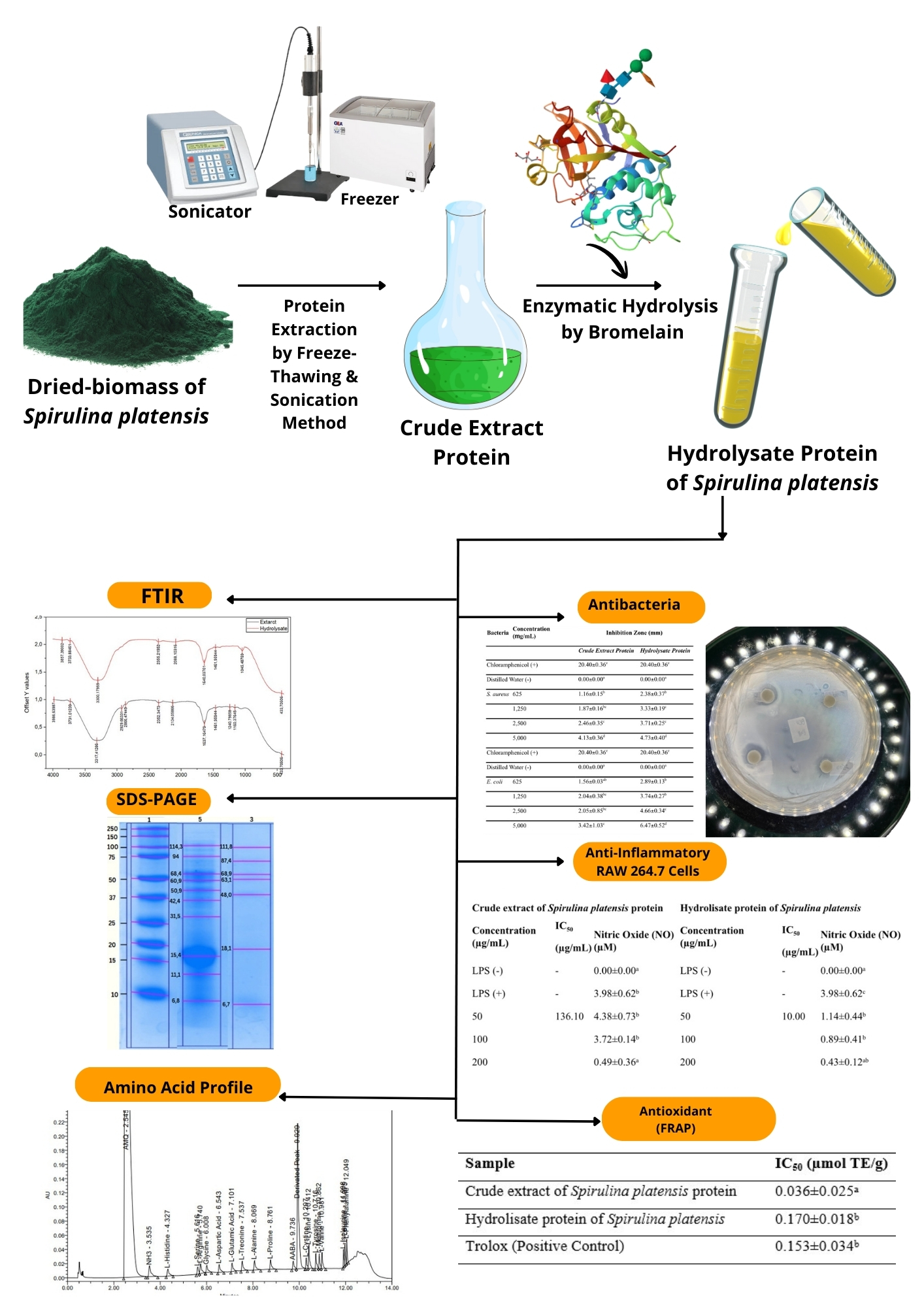
GRAPHICAL ABSTRACT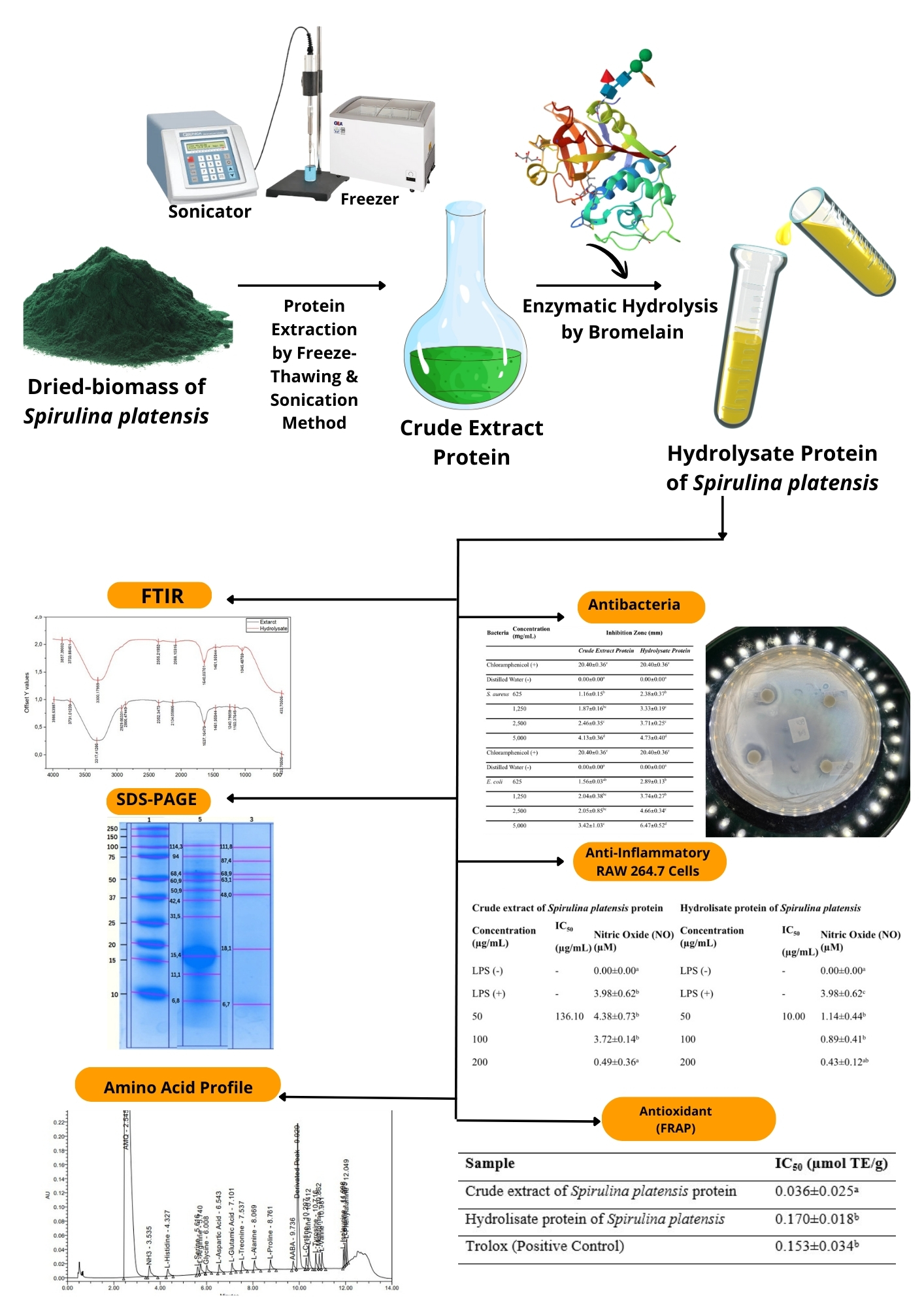
Downloads
References
R Urban-Chmiel, A Marek, D Stępień-Pyśniak, K Wieczorek, M Dec, A Nowaczek and J Osek. Antibiotic resistance in bacteria—a review. Antibiotics 2022; 11(8), 1079.
G Liu and M Qin. Analysis of the distribution and antibiotic resistance of pathogens causing infections in hospitals from 2017 to 2019. Evidence-Based Complementary and Alternative Medicine 2022; 2022, 3512582.
M Ameena, M Arumugham, K Ramalingam, S Rajeshkumar and R Shanmugam. Evaluation of the anti-inflammatory, antimicrobial, antioxidant, and cytotoxic effects of chitosan thiocolchicoside-lauric acid nanogel. Cureus 2023; 15(9), e46003.
DR Oktarina, Y Susilowati and E Halimah. The potential of Phyllanthus genus plants as immunomodulatory and anti-inflammatory. Indones. Journal of Pharmaceutical Biology 2021; 1(2), 47-77.
H Djamaludin, I Inayatussakinah, AA Kusdiyarlistio, Z Armanda, DR Dwijayanti, IK Maharsih, KD Palupi, PR Ferdian, RR Elfirta and H Notonegoro. Chemical profile and antioxidant activity of various cysteine-proteases’ impact on Spirulina protein hydrolysate. Indonesian Journal of Chemistry 2025; 25(3), 811.
Y Sun, Y Cui, R Wang, J Ma, H Sun, L Cheng and R Yang. The hydrolysis of pigment-protein phycoerythrin by bromelain enhances the color stability. Foods 2023; 12(13), 2574.
CBN Kumari, N Ambalavanan, SR Kumar, J Mahendra and U Sudhakar. Anti-oxidant, anti-inflammatory and antimicrobial activity of aqueous extract from acerola and amla. Bioinformation 2024; 20(7), 765-770.
Z Wang and X Zhang. Inhibitory effects of small molecular peptides from Spirulina (Arthrospira) platensis on cancer cell growth. Food & Function 2016; 7(2), 781-788.
AOAC International. Official methods of analysis, 22nd edition (2023). AOAC International, Rockville, Maryland, 2023.
A Domenighini and M Giordano. Fourier transform infrared spectroscopy of microalgae as a novel tool for biodiversity studies, species identification, and assessment of water quality. Journal of Phycology 2009; 45(2), 522-531.
A Ali, S Iqbal, A Khan and I Rabbani. Nutritional, bio-functional, and antioxidant properties of enzymatic hydrolysates derived from Spirulina platensis proteins. Foods 2025; 14(24), 4242.
Z Firdaus, SD Hardiningtyas and I Setyaningsih. Green extraction and purification of phycocyanin from Spirulina platensis: Evaluation of its bioactivity and photoprotection. Biochemical Engineering Journal 2025; 223, 109881.
Y Sun, R Chang, Q Li and B Li. Isolation and characterization of an antibacterial peptide from protein hydrolysates of Spirulina platensis. European Food Research and Technology 2016; 242(5), 685-692.
I Wiegand, K Hilpert and REW Hancock. Agar and broth dilution methods to determine the minimal inhibitory concentration (MIC) of antimicrobial substances. Nature Protocols 2008; 3(2), 163-175.
YA Bailey-Shaw, LA Williams, CE Green, S Rodney and AM Smith. In-vitro evaluation of anti-inflammatory potential of Jamaican plant extracts using BSA denaturation assay. International Journal of Pharmaceutical Sciences and Research 2017; 47(1), 145-153.
DR Dwijayanti, MH Widyananda, FE Hermanto, A Soewondo, M Afiyanti and N Widodo. Anti-inflammatory activity of Euphorbia hirta extract via transcriptomic and NO inhibition in RAW 264.7 cells. Food and Agricultural Immunology 2024; 35(1), 2351360.
NS Parimi, M Singh, JR Kastner, KC Das, LS Forsberg and P Azadi. Optimization of protein extraction from Spirulina platensis. Frontiers in Energy Research 2015; 3, 30.
A Naseri, GS Marinho, SL Holdt, JM Bartela and C Jacobsen. Enzyme-assisted extraction of protein from Palmaria palmata. Algal Research 2020; 47, 101849.
LND Duy, PT Duy, LTT Hoa, NTX Quynh and ND Ninh. Protein extraction from Spirulina platensis with cellulase assistance. Journal of Technology Education Science 2022; 17(1), 25-32.
Z Akbarbaglu, A Ayaseh, B Ghanbarzadeh and K Sarabandi. Techno-functional and biological properties of Spirulina platensis peptides. Algal Research 2022; 66, 102755.
S Sun, X Xu, X Sun, X Zhang, X Chen and N Xu. ACE inhibitory peptides from Ulva intestinalis. Marine Drugs 2019; 17(3), 179.
J Pekkoh, K Ruangrit, C Pumas, K Duangjan, S Chaipoot, R Phongphisutthinant, I Jeerapan, K Sawangrat, W Pathom-Aree and S Srinuanpan. Transforming microalgal Chlorella biomass into cosmetically and nutraceutically protein hydrolysates using high-efficiency enzymatic hydrolysis approach. Biomass Conversion and Biorefinery 2023; 13(7), 6299-6315.
CR Lisboa, AM Pereira, SP Ferreira and JAV Costa. Utilisation of Spirulina and Chlorella for enzymatic hydrolysates. Journal of Engineering Research and Applied Science 2014; 4(1), 29-38.
A Noman, Y Xu, WQ Al-Bukhaiti, SM Abed, AH Ali, AH Ramadhan and W Xia. Influence of enzymatic hydrolysis conditions on the degree of hydrolysis and functional properties of protein hydrolysate obtained from Chinese sturgeon (Acipenser sinensis) by using papain enzyme. Process Biochemistry 2018; 67, 19-28.
I Nugrahani, R Oktaviary, S Ibrahim, T Gusdinar and C Apsari. FTIR for peptide content estimation. Indonesian Journal of Pharmacy 2020; 31(2), 78-83.
Đ Tintor, K Ninković, J Milošević and NĐ Polović. Gaining insight into protein structure via ATR-FTIR spectroscopy. Vibrational Spectroscopy 2024; 134(13), 103726.
Y Ji, X Yang, Z Ji, L Zhu, N Ma, D Chen, X Jia, J Tang and Y Cao. DFT-calculated IR spectrum amide I, II, and III band contributions of N-methylacetamide fine components. ACS Omega 2020; 5(15), 8572-8578.
Z Akbarbaglu, A Ayaseh, B Ghanbarzadeh and K Sarabandi. Techno-functional, biological and structural properties of Spirulina platensis peptides from different proteases. Algal Research 2022; 66, 102755.
B Ling, T Cheng and S Wang. Recent developments in applications of radio frequency heating for improving safety and quality of food grains and their products: A review. Critical Reviews in Food Science and Nutrition 2020; 60(15), 2622-2642.
J Rivera-Jiménez, C Berraquero-García, R Pérez-Gálvez, PJ García-Moreno, FK Espejo-Carpio, A Guadix and EM Guadix. Peptides and protein hydrolysates exhibiting anti-inflammatory activity: Sources, structural features and modulation mechanisms. Food & Function 2022; 13(24), 12510-12540.
D Iram, MS Sansi, S Meena, AK Puniya and S Vij. In vitro antimicrobial and synergistic effect of fermented Indian zebu (Sahiwal) cow colostrum whey derived peptides with Lactobacillus rhamnosus against pathogenic bacteria. Journal of Food Science and Technology 2023; 60(10), 2568-2580.
ME Brassesco, A Paupério, CD Pereira, JP Ferreira and M Pintado. Peptide-rich yeast fractions from brewer’s spent yeast: A scalable fractionation approach and their functional application in bakery products. Foods 2025; 14(7), 1144.
D Agyei, CM Ongkudon, CY Wei, AS Chan and MK Danquah. Bioprocess challenges to the isolation and purification of bioactive peptides. Food and Bioproducts Processing 2016; 98, 244-256.
L Zheng, Y Zhao, H Dong, G Su and M Zhao. Structure–activity relationship of antioxidant dipeptides: Dominant role of Tyr, Trp, Cys and Met residues. Journal of Functional Foods 2016; 21, 485-496.
Y Mishra, HI Amin, V Mishra, M Vyas, PK Prabhakar, M Gupta, R Kanday, K Sudhakar, S Saini, A Hromić-Jahjefendić and AA Aljabali. Application of nanotechnology to herbal antioxidants as improved phytomedicine: An expanding horizon. Biomedicine & Pharmacotherapy 2022; 153, 113413.
MB Takyar, SH Khajavi and R Safari. Evaluation of antioxidant properties of Chlorella vulgaris and Spirulina platensis and their application in order to extend the shelf life of rainbow trout (Oncorhynchus mykiss) fillets during refrigerated storage. LWT 2019; 100, 244-249.
NY Htoo, O Kraseasintra, W Buncharoen, T Kaewkod, J Pekkoh, Y Tragoolpua, KS Khoo, S Chaipoot, S Srinuanpan and C Pumas. In vitro immunomodulation activity of protein hydrolysate from Spirulina (Arthrospira platensis): The ingredient of future foods. Frontiers in Marine Science 2024; 11, 1303025.
M Bidram and MR Ganjalikhany. Bioactive peptides from food science to pharmaceutical industries: Their mechanism of action, potential role in cancer treatment and available resources. Heliyon 2024; 10(23), e40563.
NK AlFadhly, N Alhelfi, AB Altemimi, DK Verma, F Cacciola and Narayanankutty. Trends and technological advancements in the possible food applications of Spirulina and their health benefits: A Review. Molecules 2022; 27, 5584.
M Vogelsang-O’Dwyer, AW Sahin, EK Arendt and Zannini. Enzymatic hydrolysis of pulse proteins as a tool to improve techno-functional properties. Foods 2022; 11(9), 1307.
MS Qoms, SK Wong, NM Fauzi, K Husain, S Makpol and JK Tan. Microalgae-derived peptides targeting lifestyle-related diseases: Discovery, mechanisms, structure–activity relationships, and structural modifications. Antioxidants 2025; 14(10), 1170.
AH Alkatheri, PSX Yap, A Abushelaibi, KS Lai, WH Cheng and SHE Lim. Host–bacterial interactions and antimicrobial peptides. Membranes 2022; 12(7), 715.
MN Calabrese, CA Tianco, AM Garate, MC Tan, J Ting, RA Galian, AP Bonto and AC Chang. Evaluation of Spirulina spp. crude extract revealed antimicrobial, antioxidant and UV photoprotective properties. Trends in Sciences 2024; 21(6), 7582.
JC Stephani, L Gerhards, B Khairalla, IA Solov’Yov and I Brand. How do antimicrobial peptides interact with the outer membrane of gram-negative bacteria? Role of lipopolysaccharides in peptide binding, anchoring, and penetration. ACS Infectious Diseases Journal 2024; 10(2), 763-778.
J Bu, N Luo, C Shen, C Xu, Q Zhu, C Chen, Y Xie, X Liu, Y Liu, C Luo and X Zhang. A fast and efficient virtual screening and identification strategy for helix peptide binders based on finDr webserver: A case study of bovine serum albumin (BSA). International Journal of Biological Macromolecules 2025; 306, 141118.
R Zhang, J Chen, X Mao, P Qi and X Zhang. Anti-inflammatory and anti-aging evaluation of pigment–protein complex extracted from Chlorella pyrenoidosa. Marine Drugs 2019; 17(10), 586.
NY Htoo, T Kaewkod, W Buncharoen, J Pekkoh, Y Tragoolpua, S Chaipoot, KS Khoo, B Cheirsilp, C Pumas and S Srinuanpan. Bioactive properties of protein hydrolysate from Arthrospira (Spirulina) platensis: A review. Applied Food Research 2025; 5(2), 101245.
LM Moreno-Vargas and D Prada-Gracia. Exploring the chemical features and biomedical relevance of cell-penetrating peptides. International Journal of Molecular Sciences 2024; 26(1), 59.
A Rahman, MA Matthews, CJ Nowell, DK Chalmers, PE Thompson, SE Nicholson, N Barlow and RS Norton. Enhanced nitric oxide production by macrophages treated with a cell-penetrating peptide conjugate. Bioorganic Chemistry 2022; 123, 105763.
M Zahid and PD Robbins. Cell-type specific penetrating peptides: Therapeutic promises and challenges. Molecules 2015; 20(7), 13055-13070.
Y Oh, WK Jung and JY Je. Protective effect of multifunctional peptides PIISVYWK and FSVVPSPK on oxidative stress-mediated HUVEC injury through antioxidant and anti-apoptotic action. Process Biochemistry 2023; 125, 121-129.
SJ Lee, J Im, SD Marasinghe, E Jo, MS Bandara, Y Lee, J Lee, GH Park and C Oh. Antioxidant and anti-inflammatory activities of cutlassfish head peptone in RAW 264.7 macrophages. Antioxidants 2025; 14(3), 286.
Published
How to Cite
Issue
Section
License
Copyright (c) 2026 Walailak University

This work is licensed under a Creative Commons Attribution-NonCommercial-NoDerivatives 4.0 International License.





