
Unveiling the Anti-Inflammatory Potential of Urena lobata: Insights into Nitric Oxide Suppression and Protein Targets
DOI:
https://doi.org/10.48048/tis.2026.12876Keywords:
Urena lobata, Inflammation, Nitric oxide, AKR1B1, NOX4, CDK5, Natural therapeutics, Urena lobata, Inflammation, Nitric oxide, AKR1B1, NOX4, CDK5, Natural therapeuticsAbstract
Urena lobata is recognized for its traditional medicinal use, particularly in addressing inflammation-related ailments. This study examined the anti-inflammatory properties of U. lobata extract and its fractions, focusing on their ability to suppress nitric oxide (NO) synthesis, a key mediator of inflammation. In vitro experiments using LPS-stimulated RAW 264.7 macrophages showed that the crude extract of U. lobata had an IC50 of 58.05 ± 5.87 µg/mL, while the ethyl acetate fraction showed greater suppression of NO formation with an IC50 of 31.40 ± 10.56 µg/mL. On the other hand, the n-butanol fraction and the water-soluble fraction did not have a significant effect on inhibition. Toxicity tests also showed that the n-hexane fraction was good at reducing NO formation (IC50 of 49.73 ± 9.49 µg/mL), but was toxic to cells at higher concentrations (> 200 µg/mL). The ethyl acetate fraction also inhibited the formation of important pro-inflammatory mediators, such as inducible nitric oxide synthase (iNOS), interleukin (IL)-12, and tumor necrosis factor-alpha (TNF-α). Protein target analysis revealed 40 proteins associated with the inflammatory cascade as potential targets for active chemicals in U. lobata. Molecular docking studies identified quercetin, apigenin, and luteolin as key bioactive compounds with strong binding affinity for inflammation-related proteins such as AKR1B1, NOX4, and CDK5, which subsequently influence NO suppression during inflammation, suggesting a multi-target mechanism of action. These results emphasize the therapeutic potential of U. lobata and its bioactive chemicals as candidates for natural anti-inflammatory drug formulations, while also underscoring the need to evaluate potential cytotoxicity in future studies.
HIGHLIGHTS
- Urena lobata extract and its ethyl acetate fraction significantly inhibited nitric oxide (NO) production in LPS-stimulated RAW 264.7 macrophages.
- Compared with other fractions, the ethyl acetate fraction exhibited superior anti-inflammatory activity (IC₅₀: 31.40 ± 10.56 µg/mL).
- The ethyl acetate fraction successfully downregulated key pro-inflammatory mediators, including TNF-α, IL-12, and iNOS.
- Using molecular docking, quercetin, apigenin, and luteolin were identified as key bioactive compounds targeting inflammation-related proteins (AKR1B1, NOX4, and CDK5).
- The multitarget mechanism underlying the anti-inflammatory effects of lobata was demonstrated by the prediction of 40 inflammation-related protein targets.
GRAPHICAL ABSTRACT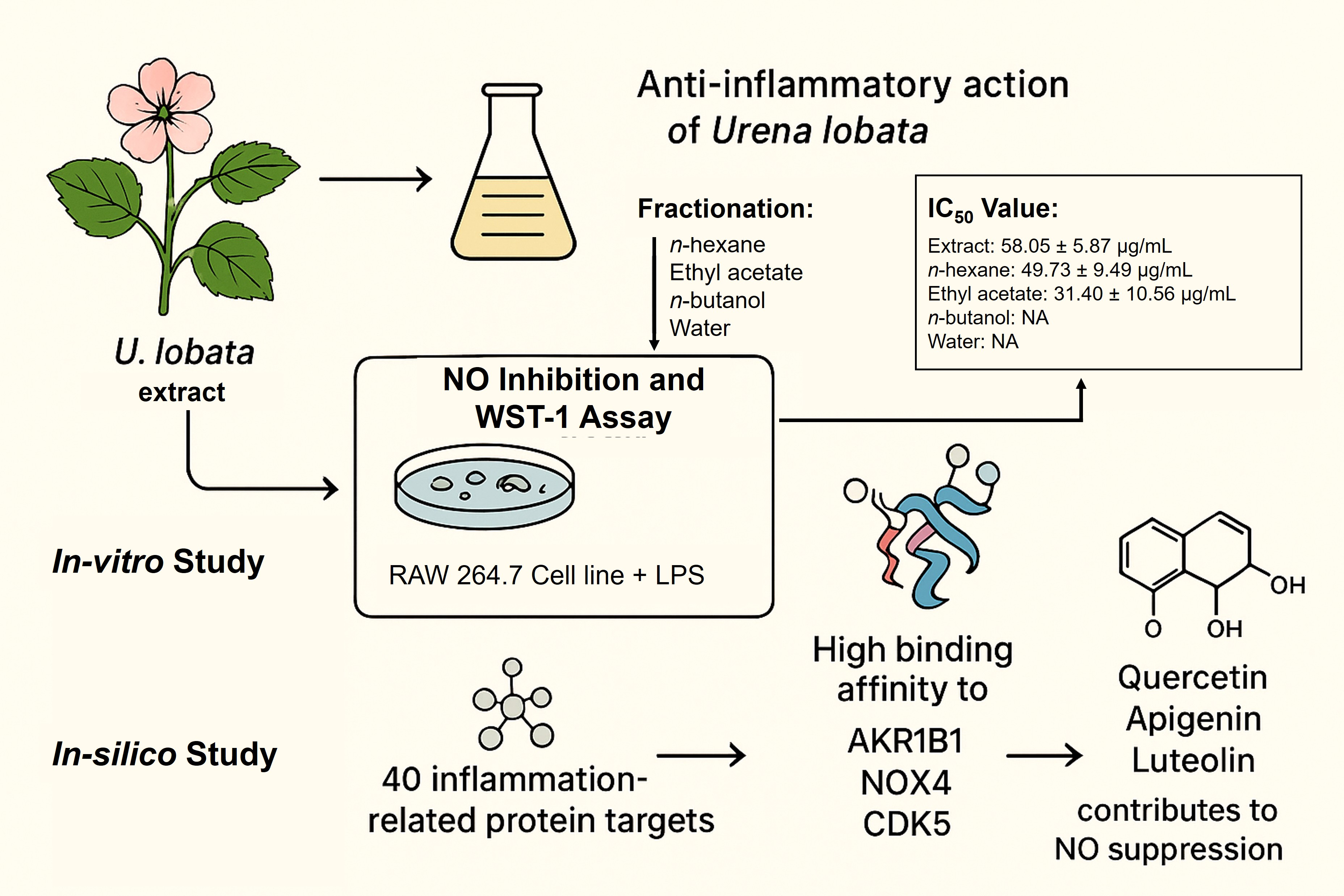
Downloads
References
YP Dhokane and U Akhtar. Pharmacological evaluation of lactuca canadensis. linn extract on anti-inflammatory activity in Experimental Animals. Research Journal of Pharmacology and Pharmacodynamics 2024; 16(1), 15-18.
P Bansal, D Verma, SS Tamber and R Sharma. An update on pathogenesis of inflammatory disorders with its management. RPS Pharmacy and Pharmacology Reports 2023; 2(2), 011.
DR Dwijayanti, T Shimada, T Ishii, T Okuyama, Y Ikeya, E Mukai and M Nishizawa. Bitter melon fruit extract has a hypoglycemic effect and reduces hepatic lipid accumulation in Ob/Ob mice. Phytotherapy Research 2020; 34(6), 1338-1346.
ED Ahire, KR Surana, KR Jadhav, SJ Kshirsagar and D Sonawane. Current therapeutic targets for neuropathic pain. Asian Journal of Pharmaceutical Research 2022; 12(1), 96-104.
A Nishida and A Andoh. The role of inflammation in cancer: Mechanisms of tumor initiation, progression, and metastasis. Cells 2025; 14(7), 488.
CLR Soares, P Wilairatana, LR Silva, PS Moreira, NMMV Barbosa, PR da Silva, HDM Coutinho, IRA de Menezes and CFB Felipe. Biochemical aspects of the inflammatory process: A narrative review. Biomedicine & Pharmacotherapy 2023; 168, 115764.
DB Johnson, R Sivasakthi, M Ashwini and R Venkatanarayanan. Anti-inflammatory activity screening of methanolic extract of Bryophyllum pinnatum root. Research Journal of Pharmacology and Pharmacodynamics 2022; 14(1), 1-3.
MG Shinde, KD Sayyad, GV Swami, PB Savant, PR Yalmar and ST Mane. A review on inflammation and its pharmacotherapy. Asian Journal of Pharmacy and Technology 2023; 13(3), 201-206.
I Ghlichloo and V Gerriets. Nonsteroidal Anti-Inflammatory Drugs (NSAIDs). StatPearls, USA, 2025.
J Srikanth and P Muralidharan. Analgesic and anti-inflammatory activity pericarps of Sapindus emarginatus vahl. Research Journal of Pharmacology and Pharmacodynamics 2009; 1(1), 21-24.
PR Kumar, SS Priyadarsini and M Thirumal. Nitric oxide radical scavenging activity of the ethanolic and chloroform extracts of Ocimum basilicum Linn. Leaves – A comparative study. Research Journal of Pharmacognosy and Phytochemistry 2017; 9(4), 215-218.
OO Oguntibeju. Medicinal plants with anti-inflammatory activities from selected countries and regions of Africa. Journal of Inflammation Research 2018; 11, 307-317.
A Adewale, A David, O Abiodun and A Craig. Studies on anti-microbial, antioxidant and phytochemical analysis of Urena lobata leaf extract. Journal of Physics and Natural Sciences 2007; 1(2), 1-9.
Y Purnomo and A Tilaqza. Inhibitory potential of pulutan (Urena lobata) leaf extract on inducible nitric oxide synthase as anti-inflammatory agent: in vitro and in silico approaches. Tropical Journal of Natural Product Research 2024; 8(8), 8195-8201.
Y Purnomo, A Tilaqza, DM Mirza and AZ Mustopa. In vitro and in silico assessment of the antidiabetic and antioxidant potential of Urena lobata leaf fraction. Tropical Journal of Natural Product Research 2025; 9(10), 5016-5024.
Y Purnomo and M Nishizawa. Dechlorophyllized Urena lobata leaf fraction inhibits nitric oxide production in IL-1β-induced rat hepatocytes. Tropical Journal of Natural Product Research 2025; 9(4), 1492-1495.
Y Purnomo, DW Soeatmadji, SB Sumitro and MA Widodo. Anti-hiperglycemic effect of Urena lobata leaf extract by inhibition of dipeptidyl peptidase-4 (DPP-4) on diabetic rat. International Journal of Pharmacognosy and Phytochemical Research 2015; 7(5), 1073-1079.
AB Kunnumakkara, AS Nair, KS Ahn, MK Pandey, Z Yi, M Liu and BB Aggarwal. Gossypin, a pentahydroxy glucosyl flavone, inhibits the transforming growth factor beta-activated kinase-1-mediated NF-KappaB activation pathway, leading to potentiation of apoptosis, suppression of invasion, and abrogation of osteoclastogenesis. Blood 2007; 109(12), 5112-5121.
DR Dwijayanti, MH Widyananda, FE Hermanto, A Soewondo, M Afiyanti and N Widodo. Revealing the anti-inflammatory activity of Euphorbia hirta extract: Transcriptomic and nitric oxide production analysis in LPS-induced RAW 264.7 cells. Food and Agricultural Immunology 2024; 35(1), 2351360.
DR Dwijayanti, A Mamamia, RYN Maulana, N Rosyadah and N Widodo. Beyond a spice: Harnessing the anti-inflammatory potential of Indonesian ginger ̶ insights into gingerenones and isogingerenone. Cogent Food & Agriculture 2025; 11(1), 2568198.
SK Srivastava, UCS Yadav, ABM Reddy, A Saxena, R Tammali, M Shoeb, NH Ansari, A Bhatnagar, MJ Petrash, S Srivastava and KV Ramana. Aldose reductase inhibition suppresses oxidative stress-induced inflammatory disorders. Chemico-Biological Interactions 2011; 191(1-3), 330-338.
A Lozhkin, AE Vendrov, H Pan, SA Wickline, NR Madamanchi and MS Runge. NADPH oxidase 4 regulates vascular inflammation in aging and atherosclerosis. Journal of Molecular and Cellular Cardiology 2017; 102, 10-21.
P Pfänder, AK Eiers, U Burret and S Vettorazzi. Deletion of Cdk5 in macrophages ameliorates anti-inflammatory response during endotoxemia through induction of C-Maf and Il-10. International Journal of Molecular Sciences 2021; 22(17), 9648.
T Venkatachalam, VK Kumar, PS Kumar, P Kalaiselvi, M Chitra and NS Kumar. In-vitro anti oxidant and antimicrobial activities of ethyl acetate extract of Evodia lunu-Ankenda (Gaertn) Merr. Bark. Research Journal of Pharmacognosy and Phytochemistry 2009; 1(3), 201-203.
DJ Sawarkar, C Vijaya, AO Turaskar, VS Shende, VK Chatap, VA Sawant and SN Borkar. Hepatoprotective activity of ethanolic and ethyl acetate extract of Ziziphus mauriatiana on liver damaged caused by Paracetamol in Rats. Research Journal of Pharmacognosy and Phytochemistry 2009; 1(3), 194-197.
BE Jose and P Panneerselvam. In vivo anti diabetic activity of ethyl acetate leaf extract of Azima tetracantha lam in streptozotocin-induced Diabetic Mice. Research Journal of Pharmacy and Technology 2019; 12(2), 660-664.
JD Milton and MA Jose. Anticancer activity of ethyl acetate root extract of Xanthium strumarium Linn. in N-nitroso N-methyl urea induced mammary carcinoma in female sprague-dawley Rats. Research Journal of Pharmacy and Technology 2016; 9(8), 1115-1118.
Y Zhao, M Zhang, H Li, Y Yang, L Xiaofy, Y Junjing and P Lei. Aldo-keto reductase 1B: Much learned, much more to do. hLife 2024; 2(4), 154-178.
Y Li, H Li, X Chen, X Li, J Su, S Yang, W Xiao and Z Deng. CDK5 regulates PPARγ/NF-κB signaling to exacerbate obesity-related osteoarthritis via modulating macrophage polarization and chondrocyte apoptosis. Cellular & Molecular Biology Letters 2025; 30, 135.
FJ Sánchez-Gómez, B Díez-Dacal, E García-Martín, JAG Agúndez, MA Pajares and D Pérez-Sala. Detoxifying enzymes at the cross-roads of inflammation, oxidative stress, and drug hypersensitivity: Role of glutathione transferase P1-1 and aldose reductase. Frontiers in Pharmacology 2016; 7, 00237.
JJ O'Shea and PJ Murray. Cytokine signaling modules in inflammatory responses. Immunity 2008; 28(4), 477-487.
U Weyemi and C Dupuy. The emerging role of ros-generating NADPH oxidase NOX4 In DNA-damage responses. Mutation Research/Reviews in Mutation Research 2012; 751(2), 77-81.
S Piera-Velazquez and SA Jimenez. Oxidative stress induced by Reactive Oxygen Species (ROS) and NADPH oxidase 4 (NOX4) in the pathogenesis of the fibrotic process in systemic sclerosis: A promising therapeutic target. Journal of Clinical Medicine 2021; 10(20), 4791.
PA Do and CH Lee. The role of CDK5 in Tumours and Tumour Microenvironments. Cancers 2021; 13(1), 101.
CB Rajashekar. Dual role of plant phenolic compounds as antioxidants and prooxidants. American Journal of Plant Sciences 2023; 14(1), 15-28.
Published
How to Cite
Issue
Section
License
Copyright (c) 2026 Walailak University

This work is licensed under a Creative Commons Attribution-NonCommercial-NoDerivatives 4.0 International License.





