
Assessment of the Cytotoxic, Antioxidant, and Antimelanogenic Properties of the Extracts of the Orchid Dendrobium
DOI:
https://doi.org/10.48048/tis.2026.13065Keywords:
Dendrobium hybrids, Antioxidant, Melanogenesis inhibition, Phenolic compounds, Reactive oxygen species reduction, Macrophages, MelanocytesAbstract
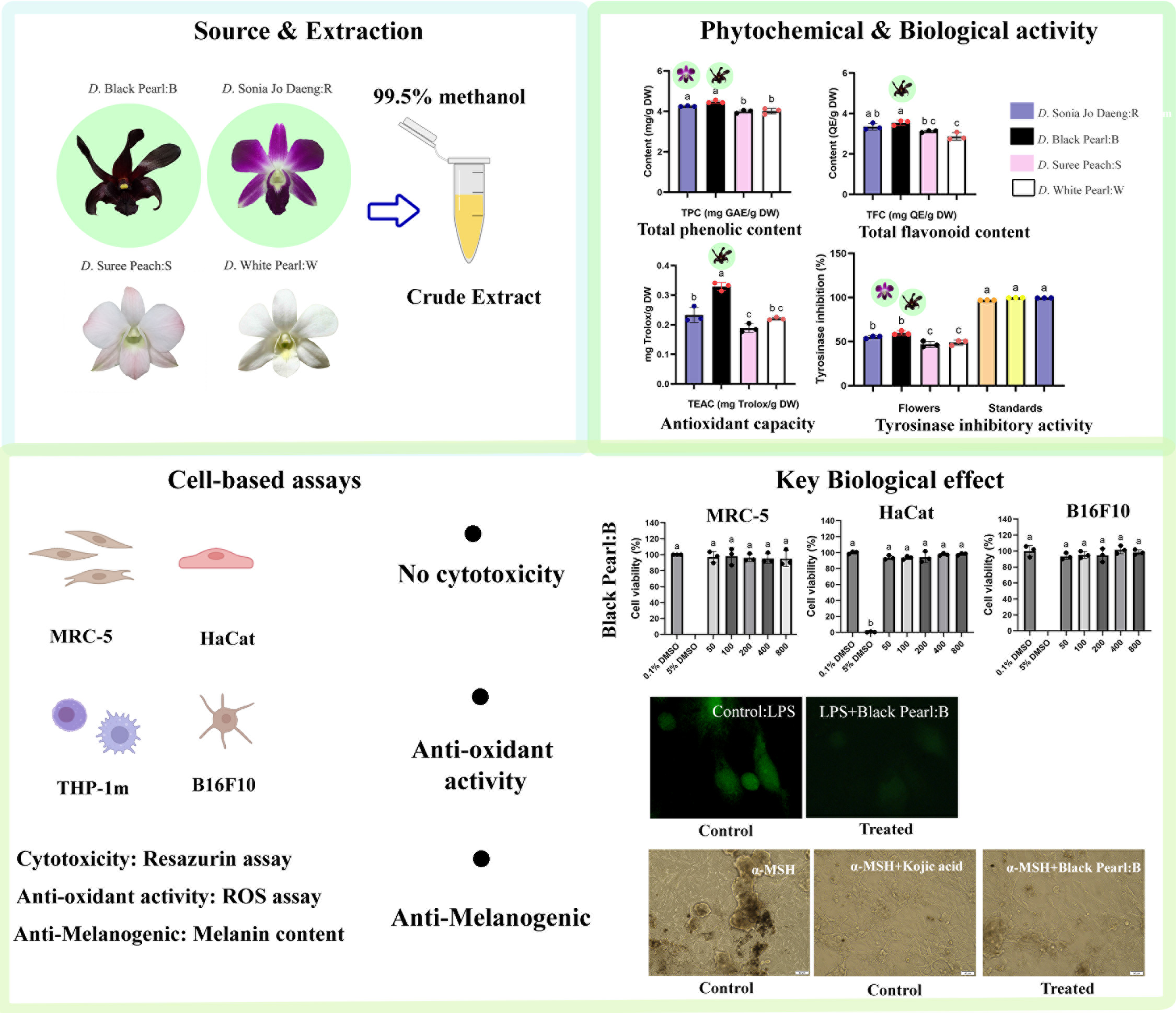
Dendrobium extracts are rich sources of bioactive phytochemicals with potential applications in cosmetics and healthcare. This study investigated the phytochemical composition and bioactivities of four hybrid cut-flower Dendrobium cultivars: Sonia ‘Jo Daeng’, Suree Peach, Black Pearl, and White Pearl. The crude flower extracts were evaluated for their antioxidant and antimelanogenic properties, and cytotoxic effects against human fibroblasts, keratinocytes, melanocytes, and macrophages. Among the tested cultivars, Black Pearl flower extracts exhibited the highest contents of phenolics, flavonoids, tannins, sugars, and vitamin C, which correlated with strong DPPH and Ferric Reducing Antioxidant Power (FRAP) antioxidant activities. The extracts were noncytotoxic at concentrations ≤ 800 µg/mL, maintaining > 90% cell viability. The extracts of D. Black Pearl and D. Sonia ‘Jo Daeng’ flowers significantly reduced ROS generation in THP-1-derived macrophages. However, Black Pearl extracts decreased melanin production in α-MSH-stimulated B16F10 melanocytes by ~41.0%, comparable to control. These findings suggest Black Pearl as a promising source of natural antioxidants and antimelanogenic compounds suitable for cosmetic and dermatological applications.
HIGHLIGHTS
- Methanolic extracts from flowers of four commercial hybrid Dendrobium cultivars were evaluated for phytochemical contents and skin-relevant bioactivities.
- Black Pearl exhibited the highest levels of phenolics, flavonoids, tannins, and anthocyanins, and demonstrated the strongest antioxidant capacity (DPPH and FRAP assays).
- All extracts were non-cytotoxic to fibroblasts, keratinocytes, melanocytes, and macrophage-like cells at concentrations ≤ 800 µg/mL (> 90% viability).
- Black Pearl reduced intracellular ROS in activated macrophages, supporting antioxidant effects under inflammatory oxidative conditions.
- Black Pearl suppressed α-MSH-induced melanogenesis in B16F10 cells comparable to kojic acid, emphasizing major experimental outcomes and their potential relevance for cosmetic and dermatological applications.
GRAPHICAL ABSTRACT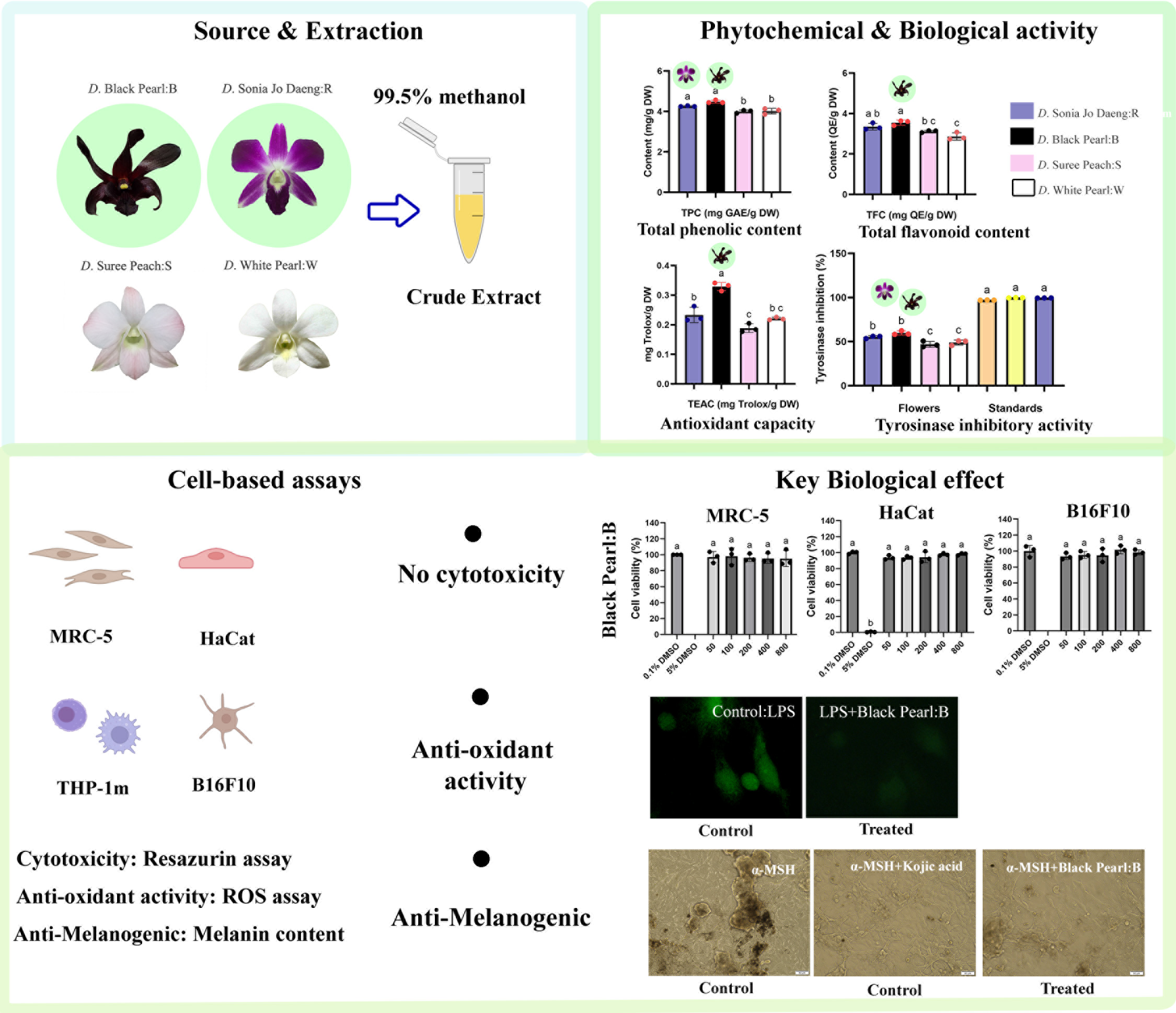
Downloads
References
P Li, T shen, L Li and Y Wang. Optimization of the selection of suitable harvesting periods for medicinal plants: Taking Dendrobium officinale as an example. Plant Methods 2024; 20(1), 43.
R Choonong, W Sermpradita, T Kitisripanyac, B Sritularakd and W Putalun. The contents of bibenzyl derivatives, flavonoids and a phenanthrene in selected Dendrobium spp. and the correlation with their antioxidant activity. ScienceAsia 2019; 45(3), 245-252.
M Chinsamy, J Finnie and JV Staden. Anti-inflammatory, antioxidant, anti-cholinesterase activity and mutagenicity of South African medicinal orchids. South African Journal of Botany 2014; 91, 88-98.
GY Liu, L Tan, L Cheng, LS Ding, Y Zhou, Y Deng, YQ He, DL Guo and SJ Xiao. Dendrobine-type alkaloids and bibenzyl derivatives from Dendrobium findlayanum. Fitoterapia 2020; 142, 104497.
S Zheng, Y Zhu, C Jiao, M Shi, L Wei, Y Zhou, Q Jin and Y Cai. Extraction and analysis of gigantol from Dendrobium officinale with response surface methodology. Molecules 2018; 23(4), 818.
J Olivero-Verbel, P Quintero-Rincón and K Caballero. Aromatic plants as cosmeceuticals: benefits and applications for skin health. Planta 2024; 260, 132.
K Obsuwan, JB Ryong and S Maksup. Analysis of bioactive compounds, polysaccharides and antioxidant activity in different parts of Dendrobium ‘Sonia Jo Daeng’. Science, Engineering and Health Studies 2019; 13(2), 73-82.
S Maksup and K Obsuwan. Flavonoid contents and antityrosinase activity in various parts of Dendrobium Sonia ‘Jo Daeng’ and Dendrobium ‘Khao Sanan’ at different growth stages. Acta Hortic 2020; 1298, 517-522.
M Hassan, S Shahzadi and A Kloczkowski. Tyrosinase inhibitors naturally present in plants and synthetic modifications of these natural products as anti-melanogenic agents: A review. Molecules 2023; 28(1), 378.
X Jia and L He. Unveiling the dual-edged roles of melanocytes: Key insights into skin photoaging and therapeutic avenues. Pharmacological Research 2025; 218, 107848.
M Mucha, E Skrzydlewska and A Gegotek. Natural protection against oxidative stress in human skin melanocytes. Communications Biology 2025; 8(1), 1283.
M Kanlayavattanakul, N Lourith and P Chaikul. Biological activity and phytochemical profiles of Dendrobium: A new source for specialty cosmetic materials. Industrial Crops and Products 2018; 120, 61-70.
S Li, J Wang, L Zhang, Y Zheng, G Ma, X Sun and J Yuan. Preparation of Dendrobium officinale flower anthocyanin and extended lifespan in Caenorhabditis elegans. Molecules 2022; 27(23), 8608.
M Han, Y Zhao, J Meng, J Yin and H Li. Analysis of physicochemical and antioxidant properties of Malus spp. petals reveals factors involved in flower color change and market value. Scientia Horticulturae 2023; 310, 111688.
S Warinhomhoun, C Muangnoi, V Buranasudja, W Mekboonsonglarp, P Rojsitthisak, K Likhitwitayawuid and B Sritularak. Antioxidant activities and protective effects of dendropachol, a new bisbibenzyl compound from Dendrobium pachyglossum, on hydrogen peroxide-induced oxidative stress in HaCaT keratinocytes. Antioxidants 2021; 10(2), 252.
K Thammasiri. Current status of orchid production in Thailand. Acta Hortic 2014; 1078, 25-33.
C Macwan, H Patel and K Kalia. A comparative evaluation of in vitro antioxidant properties of Bamboo Bambusa arundinacea leaves extracts. Journal of Cell and Tissue Research 2010; 10(3), 2413.
VL Singleton and JA Rossi. Colorimetry of total phenolics with phosphomolybdic-phosphotungstic acid reagents. American journal of Enology and Viticulture 1965; 16(3), 144-158.
UPN Kannaian, JB Edwin, V Rajagopal, SN Shankar and B Srinivasan. Phytochemical composition and antioxidant activity of coconut cotyledon. Heliyon 2020; 6(2), e03411.
J Lee, RW Durst and RE Wrolstad. Determination of total monomeric anthocyanin pigment content of fruit juices, beverages, natural colorants, and wines by the pH differential method: Collaborative study. J AOAC Int 2005; 88(5), 1269-1278
M DuBois, KA Gilles, JK Hamilton, PA Rebers and F Smith. Colorimetric method for determination of sugars and related substances. Analytical Chemistry 1956; 28(3), 350-356.
GL Miller. Use of dinitrosalicylic acid reagent for determination of reducing sugar. Analytical Chemistry 1959; 31(3), 426-428.
M Leitão, B Ferreira, B Guedes, D Moreira, PA García, L Barreiros and P Correia. Screening of antioxidant effect of spontaneous and bioinoculated with Gluconobacter oxydans fermented papaya: A comparative study. Fermentation 2023; 9(2), 124.
H Li, C Tang, Z Xu, X Liu and X Han. Effects of different light sources on the growth of non-heading Chinese cabbage (Brassica campestris L.). Journal of Agricultural Science 2012; 4(4), 262.
TS Chang. An updated review of tyrosinase inhibitors. Int J Mol Sci 2009; 10(6), 2440-2475.
M Tanaka, Y Kishimoto, E Saita, N Suzuki-Sugihara, T Kamiya, C Taguchi, K Iida and K Kondo. Terminalia bellirica extract inhibits low-density lipoprotein oxidation and macrophage inflammatory response in vitro. Antioxidants 2016; 5(2), 20.
HC Nguyen, KH Lin, MY Huang, CM Yang, TH Shih, TC Hsiung, YC Lin and FC Tsao. Antioxidant activities of the methanol extracts of various parts of Phalaenopsis orchids with white, yellow, and purple flowers. Notulae Botanicae Horti Agrobotanici Cluj-Napoca 2018; 46(2), 457-465.
C Chaiyasut, BS Sivamaruthi, N Pengkumsri, S Sirilun, S Peerajan, K Chaiyasut and P Kesika. Anthocyanin profile and its antioxidant activity of widely used fruits, vegetables, and flowers in Thailand. Asian Journal of Pharmaceutical and Clinical Research 2016; 9(6), 218-224.
AR Zuo, HH Dong, YY Yu, QL Shu, LX Zheng, XY Yu and SW Cao. The antityrosinase and antioxidant activities of flavonoids dominated by the number and location of phenolic hydroxyl groups. Chinese Medicine 2018; 13(1), 51.
N Sumaythachotphong, W Bundithya and N Potapohn. Flower color inheritance of Rhynchostylis gigantea (Lindl.) Ridl. Thai J. Agric. Sci. 2020; 53(4), 178-191.
KE Le, S Bharadwaj, AK Sahoo, U Yadava and
SG Kang. Determination of tyrosinase-cyanidin-3-O-glucoside and (-/+)-catechin binding modes reveal mechanistic differences in tyrosinase inhibition. Sci Rep 2021; 11, 24494.
C Monmai, JS Kim, JH Chin, S Lee and SH Baek. Inhibitory effects of polyphenol- and flavonoid-enriched rice seed extract on melanogenesis in melan-a Cells via MAPK signaling-mediated MITF downregulation. International Journal of Molecular 2023; 24(14), 11841
PK Das, DH Shin, SB Choi, SD Yoo, G Choi and YI Park. Cytokinins enhance sugar-induced anthocyanin biosynthesis in Arabidopsis. Molecules and Cells 2012; 34(1), 93-101.
C Solfanelli, A Poggi, E Loreti, A Alpi and P Perata. Sucrose-specific induction of the anthocyanin biosynthetic pathway in Arabidopsis. Plant Physiology 2006; 140(2), 637-646.
N Smirnoff. Ascorbic acid metabolism and functions: A comparison of plants and mammals. Free Radical Biology and Medicine 2018; 122, 116-129
MP Zia and I Alibaş. The effect of different drying techniques on color parameters, ascorbic acid content, anthocyanin and antioxidant capacities of cornelian cherry. Food Chem 2021; 364, 130358.
S Tan, Y Miao, C Zhou, Y Luo, Z Lin, R Xie and W Li. Effects of hot air drying on drying kinetics and anthocyanin degradation of blood-flesh peach. Foods 2022; 11(11), 1596.
F Wu, F Xu, W Liu, S Chen, H Luo, N Cheng, H Zhao and W Cao. A high-performance liquid chromatography with electrochemical detection method developed for the sensitive determination of ascorbic acid: Validation, application, and comparison with titration, spectrophotometric, and high-performance liquid chromatography with diode-array detection methods. Foods 2023; 12(16), 3100.
A Torres de Pinedo, P Peñalver and JC Morales. Synthesis and evaluation of new phenolic-based antioxidants: Structure-activity relationship. Food Chem 2007; 103(1), 55-61.
MS Brewer. Natural antioxidants: Sources, compounds, mechanisms of action, and potential applications. Comprehensive Reviews in Food Science and Food Safety 2011; 10(4), 221-247.
N Tena, J Martín and AG Asuero. State of the art of anthocyanins: Antioxidant activity, sources, bioavailability, and therapeutic effect in human health. Antioxidants 2020; 9(5), 451.
J Ávila-Román, R Talaverón, L Hernández-Cáceres, A de los Reyes, FJ Fernández-Arche, A González-Gallego, C García-Mauriño, ME Martín and M Motilva. Up-regulation of the Nrf2/HO-1 antioxidant pathway in macrophages by an extract from a new halophilic archaea isolated in Odiel saltworks. Antioxidants 2023; 12(5), 1080. doi:10.3390/antiox12051080.
S Carpentieri, M Pagano, M Russo, A Carullo, E Laezza, E Cervelli, P Formisano, M Treppiccione, G Panzella, G Giarra and M Scognamiglio. Antioxidant and anti-inflammatory effects of extracts from pulsed electric field-treated artichoke by-products in lipopolysaccharide-stimulated human THP-1 macrophages. Foods 2022; 11(15), 2250. doi:10.3390/foods11152250.
JP Ebanks, RR Wickett and RE Boissy. Mechanisms regulating skin pigmentation: The rise and fall of complexion coloration. International Journal of Molecular Sciences 2009; 10(9), 4066-4087.
R Sarkar, S Chugh and VK Garg. Newer and upcoming therapies for melasma. Indian Journal of Dermatology Venereology and Leprology 2012; 78, 417.
S Letchuman, HDT Madhuranga, BLNK Madhurangi, AD Premarathna and M Saravanan. Alkaloids unveiled: A comprehensive analysis of novel therapeutic properties, mechanisms, and plant-based innovations. Intelligent Pharmacy 2024; 3(4), 268-276.
Z Habli, G Toumieh, M Fatfat, ON Rahal and H Gali-Muhtasib. Emerging cytotoxic alkaloids in the battle against cancer: Overview of molecular mechanisms. Molecules 2017; 22(2), 250.
C Shen, H Guo, H Chen, Y Shi, Y Meng, J Lu, S Feng and H Wang. Identification and analysis of genes associated with the synthesis of bioactive constituents in Dendrobium officinale using RNA-Seq. Scientific Reports 2017; 7(1), 187.
Y Hushcha, I Blo, L Oton-Gonzalez, GD Mauro, F Martini, M Tognon and MD Mattei. MicroRNAs in the Regulation of Melanogenesis. International Journal of Molecular Sciences 2021; 22(11), 6104.
P Khongkarat, P Sadangrit, S Puthong, T Meemongkolkiat, P Phuwapraisirisan and C Chanchao. Anti-tyrosinase and anti-melanogenic effects of piperine isolated from Piper nigrum on B16F10 mouse melanoma cells. Heliyon 2024; 10(12), e33423.
Q Yu and L Fan. Antityrosinase and antioxidant activity of asparagus and its inhibition on B16F10 melanoma cells before and after hydrothermal treatment. Food Bioscience 2021; 41, 101026.
ZJ Cheng, GF Dai, JL Hsu, JJ Lin, WT Wu, CC Su and YJ Wu. Antimelanogenesis effect of methyl gallate through the regulation of PI3K/Akt and MEK/ERK in B16F10 melanoma cells. Evidence‐Based Complementary and Alternative Medicine 2022; 2022, 509.
Published
How to Cite
Issue
Section
License
Copyright (c) 2026 Walailak University

This work is licensed under a Creative Commons Attribution-NonCommercial-NoDerivatives 4.0 International License.





