
Effect of Environmental Stresses on Physiophytochemical Responses and Expressional Profiling Analysis of Flavone C-Glycoside-Associated Genes in Three Bamboo Species
DOI:
https://doi.org/10.48048/tis.2025.9102Keywords:
Abiotic stress, Bamboo resilience, C-glycosyltransferase, Orientin, Phenolic acid, Phytochemical profiling, VitexinAbstract
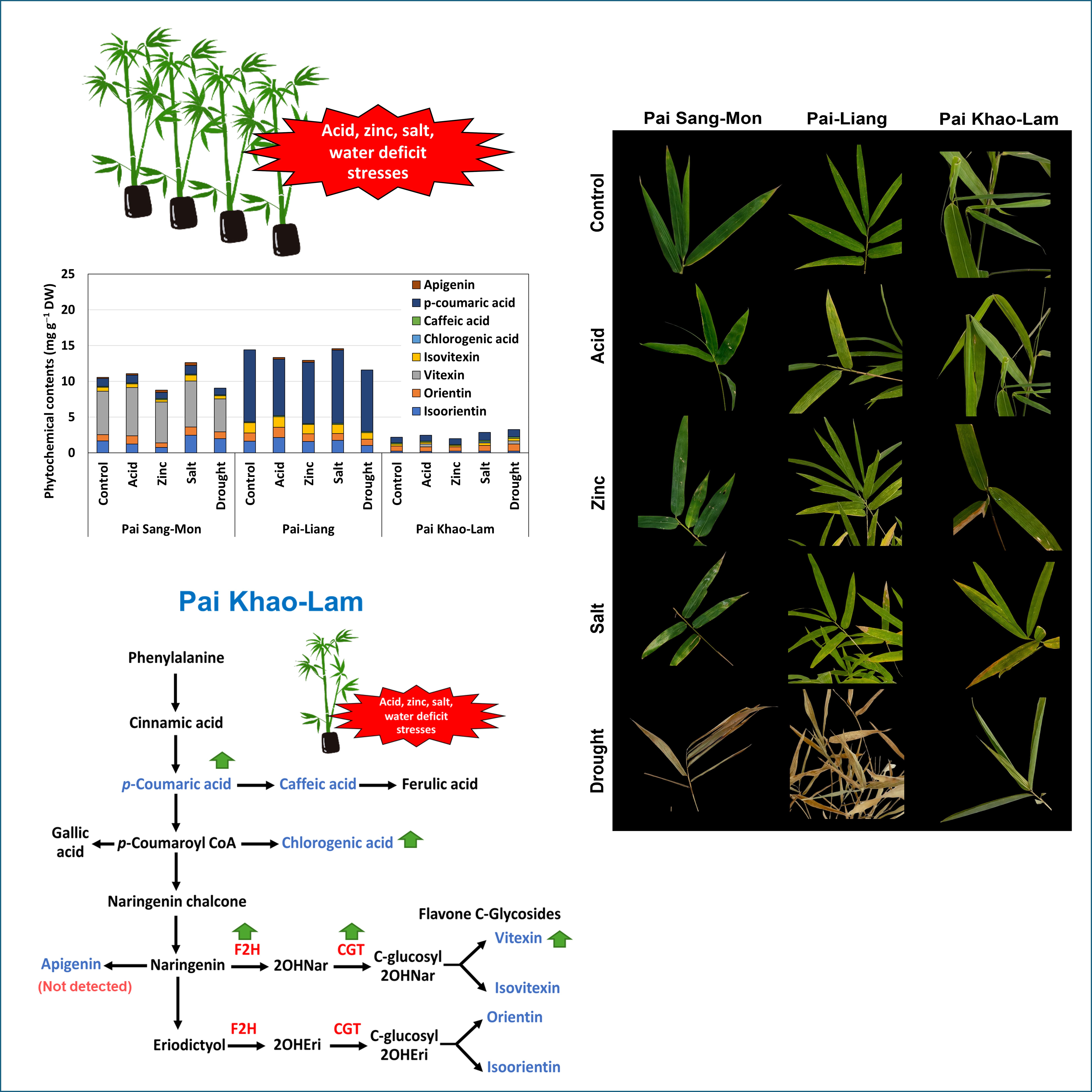
Bamboo, valued for its sustainability and versatility, holds potential in various domains, including food and medicine, due to its abundance of antioxidant compounds such as flavone C-glycosides (FCG) found in bamboo leaf extracts. However, the effects of environmental stress on bamboo growth, phytochemical synthesis, and the genetic regulation of FCG biosynthesis remain unclear. This study investigated the response mechanisms of 3 bamboo genotypes (Pai Sang-Mon, Pai-Liang, and Pai Khao-Lam) under different environmental stresses: Acidity (pH 4.0), heavy metal zinc (200 µM ZnSO4·7H2O), salinity (100 mM NaCl), and water deficit stress over 0, 1, 2, 4, and 8 days. The results indicated that water deficit stress had the most significant impact on growth and photosynthesis, with Pai Khao-Lam and Pai Sang-Mon exhibiting greater drought tolerance than Pai-Liang. Reversed-phase high-performance liquid chromatography (RP-HPLC) analysis revealed diverse responses in phytochemical content. Pai Sang-Mon showed increased caffeic acid and apigenin under salt stress, while Pai-Liang exhibited decreased phytochemical content under acid, zinc, and water deficit stresses. In contrast, Pai Khao-Lam showed elevated p-coumaric acid, chlorogenic acid and vitexin levels under multiple stresses, indicating robust antioxidant capabilities. Gene expression analysis using quantitative real-time PCR indicated differential gene responses among the bamboo genotypes. Pai Sang-Mon showed reduced vitexin levels correlating with decreased expression of the C-glycosyltransferase (CGT1) gene. Pai Khao-Lam exhibited increased expression of the flavanone 2-hydroxylase (F2H) and CGT1 genes under water deficit stress, suggesting a molecular response to maintain cellular homeostasis through phytochemical accumulation. In contrast, Pai-Liang showed increased expression of the sucrose nonfermenting 1-related protein kinase 1 (SnRK1) gene under short-term salt stress, indicating the sensitivity to osmotic stresses. These findings highlight the complex relationship between gene regulation, phytochemical accumulation, and stress tolerance in bamboo, offering valuable insights for breeding bamboo with enhanced stress tolerance and optimizing environmental conditions to maximize phytochemical production in bamboo leaf extracts.
HIGHLIGHTS
- Water deficit stress significantly impacts bamboo growth and photosynthesis.
- Greater drought tolerance in Pai Khao-Lam and Pai Sang-Mon than in Pai-Liang.
- Pai Khao-Lam shows increased chlorogenic and p-coumaric acid under multiple stresses.
- The regulation of CGT1, F2H, and SnRK1 genes differs in bamboo genotypes under stress.
GRAPHICAL ABSTRACT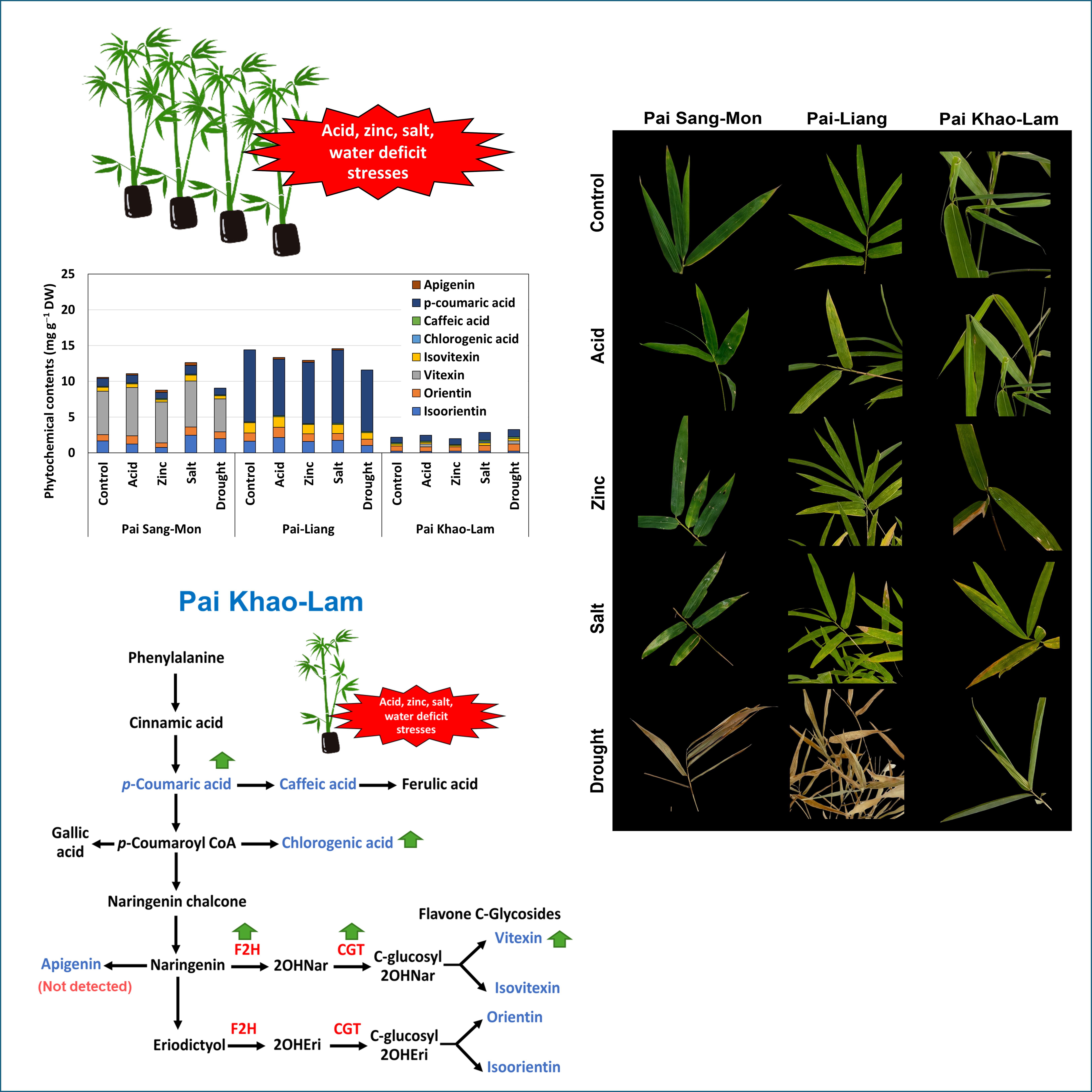
Downloads
References
J Gagliano, F Anselmo-Moreira, WR Sala-Carvalho and CM Furlan. What is known about the medicinal potential of bamboo? Advances in Traditional Medicine 2022; 22, 467-495.
S Sangkaew, A Tirawattananon and K Jindawong. BAMBOO of Thailand. 1st ed. Baan Lae Suan Publishing House, Bangkok, Thailand, 2011.
S Sudchaleaw, S Saensouk, P Saensouk and S Sungkaew. Species diversity and traditional utilization of bamboos (Poaceae) on the Phu Thai Ethnic Group in northeastern Thailand. Biodiversitas 2023; 24(4), 2261-2271.
C Nirmala, MS Bisht, HK Bajwa and O Santosh. Bamboo: A rich source of natural antioxidants and its applications in the food and pharmaceutical industry. Trends in Food Science & Technology 2018; 77, 91-99.
K Obsuwan, A Duangmanee and C Thepsithar. In vitro propagation of a useful tropical bamboo, Thyrsostachys siamensis Gamble, through shoot-derived callus. Horticulture, Environment, and Biotechnology 2019; 60, 261-267.
Y Cheng, S Wan, L Yao, D Lin, T Wu, Y Chen, A Zhang and C Lu. Bamboo leaf: A review of traditional medicinal property, phytochemistry, pharmacology, and purification technology. Journal of Ethnopharmacology 2023; 306, 116166.
IO Minatel, CV Borges, MI Ferreira, HAG Gomez, CYO Chen and GPP Lima. Phenolic compounds: Functional properties, impact of processing and bioavailability. In: Phenolic compounds - Biological activity. IntechOpen, London, 2017, p. 1-24.
Y Zhang, P Cai, G Cheng and Y Zhang. A brief review of phenolic compounds identified from plants: Their extraction, analysis, and biological activity. Natural Product Communications 2022; 17(1), 1-14.
AN Panche, AD Diwan and SR Chandra. Flavonoids: An overview. Journal of Nutritional Science 2016; 5, e47.
P Karawak, S Sengsai, C Thepsithar and S Maksup. Phytochemical content and antioxidant activity of leaf extracts from nine bamboo species and determination of flavone C-glycosides by TLC and HPLC. Acta Horticulturae 2020; 1298, 359-370.
S Kasemsukphaisan and S Maksup. Phytochemical profiling, antioxidant, and antityrosinase activities of bamboo leaves in Thailand. Applied Science and Engineering Progress 2023; 16(4), 6229.
J Wang, YD Yue, H Jiang and F Tang. Rapid screening for flavone c-glycosides in the leaves of different species of bamboo and simultaneous quantitation of four marker compounds by HPLC-UV/DAD. International Journal of Analytical Chemistry 2012; 2012, 205101.
Y Sun, Z Chen, J Yang, I Mutanda, S Li, Q Zhang, Y Zhang, Y Zhang and Y Wang. Pathway-specific enzymes from bamboo and crop leaves biosynthesize anti-nociceptive C-glycosylated flavones. Communications Biology 2020; 3, 110.
D Peng, M Shafi, Y Wang, S Li, W Yan, J Chen, Z Ye and D Liu. Effect of Zn stresses on physiology, growth, Zn accumulation, and chlorophyll of Phyllostachys pubescens. Environmental Science and Pollution Research International 2015; 22(19), 14983-14992.
A Pulavarty and BK Sarangi. Screening bamboo species for salt tolerance using growth parameters, physiological response and osmolytes accumulation as effective indicators. Chemistry and Ecology 2018; 34(4), 340-354.
BA Syed, M Patel, A Patel, B Gami and B Patel. Regulation of antioxidant enzymes and osmo-protectant molecules by salt and drought responsive genes in Bambusa balcooa. Journal of Plant Research 2021; 134(1), 165-175.
R Tong, B Zhou, Y Cao, X Ge and L Jiang. Metabolic profiles of moso bamboo in response to drought stress in a field investigation. Science of The Total Environment 2020; 720, 137722.
MAA Seeda, EAAA El-Nour, MMS Abdallah, HMS El-Bassiouny and AAA El-Monem. Impacts of salinity stress on plants and their tolerance strategies. Middle East Journal of Applied Sciences 2022; 12, 282-400.
A Emamverdian, Y Ding, F Mokhberdoran and Y Xie. Antioxidant response of bamboo plant (Indocalamus latifolius) as affected by heavy metal stress. Journal of Elementology 2018; 23, 341-352.
A Emamverdian, Y Ding, F Mokhberdoran and Y Xie. Growth responses and photosynthetic indices of bamboo plant (Indocalamus latifolius) under heavy metal stress. The Scientific World Journal 2018; 2018, 1219364.
D Liu, J Chen, Q Mahmood, S Li, J Wu, Z Ye, D Peng, W Yan and K Lu. Effect of Zn toxicity on root morphology, ultrastructure, and the ability to accumulate Zn in moso bamboo (Phyllostachys pubescens). Environmental Science and Pollution Research International 2014; 21(23), 13615-13624.
D Chen, Z Lan, X Bai, JB Grace and Y Bai. Evidence that acidification-induced declines in plant diversity and productivity are mediated by changes in below-ground communities and soil properties in a semi-arid steppe. Journal of Ecology 2013; 101(5), 1322-1334.
Q Ni, G Xu, Z Wang, Q Gao, S Wang and Y Zhang. Seasonal variations of the antioxidant composition in ground bamboo Sasa argenteastriatus leaves. International Journal of Molecular Sciences 2012; 13(2), 2249-2262.
Q Ni, Y Zhang, G Xu, Q Gao, L Gong and Y Zhang. Influence of harvest season and drying method on the antioxidant activity and active compounds of two bamboo grass leaves. Journal of Food Processing and Preservation 2014; 38(4), 1565-1576.
L Pan. Role of the Phyllostachys edulis SnRK1a gene in plant growth and stress tolerance. South African Journal of Botany 2020; 130, 414-421.
S Cha-um, K Supaibulwatana and C Kirdmanee. Water relation, photosynthetic ability and growth of Thai jasmine rice (Oryza sativa L. ssp. indica cv. KDML 105) to salt stress by application of exogenous glycinebetaine and choline. Journal of Agronomy and Crop Science 2006; 192(1), 25-36.
S Maksup, S Sengsai, K Laosuntisuk, J Asayotand and W Pongprayoon. Physiological responses and the expression of cellulose and lignin associated genes in Napier grass hybrids exposed to salt stress. Acta Physiologiae Plantarum 2020; 42, 109.
KJ Livak and TD Schmittgen. Analysis of relative gene expression data using real-time quantitative PCR and the 2−ΔΔCT Method. Methods 2001; 25(4), 402-408.
M Cheng, H Zou, X Huang, H Chen, N Zou and Q Yang. Effects of drought and salt stress on growth and physiology of Phyllostachys edulis seedlings. Acta Agriculturae Universitatis Jiangxiensis 2021; 43(4), 842-852.
L Mareri, L Parrotta and G Cai. Environmental stress and plants. International Journal of Molecular Sciences 2022; 23(10), 5416.
ZZ Wu, YQ Ying, YB Zhang, YF Bi, AK Wang and XH Du. Alleviation of drought stress in Phyllostachys edulis by N and P application. Scientific Reports 2018; 8, 228.
TY He, LL Fan, MWK Tarin, SY Shen, DJ Xie, LY Chen, JD Rong, LG Chen and YS Zheng. Physiological and proteomic responses of Dendrocalamus minor var. Amoenus (ghost bamboo) under drought stress. Applied Ecology and Environmental Research 2020; 18(4), 4817-4838.
Z Yang, Y Cao, J Zhao, B Zhou, X Ge, Q Li and M Li. Root response of moso bamboo (Phyllostachys edulis (Carrière) J. Houz.) seedlings to drought with different intensities and durations. Forests 2021; 12(1), 50.
I Ahmad, B Jabeen, MF Nawaz, M Asif, MHU Rashid, M Hussain, TH Farooq, S Ahmed and M Rafiq. Influence of salinity on the morphological behavior and ionic response of different commercially important bamboo species. Fresenius Environmental Bulletin 2022; 31(1), 668-676.
FN Cunha, MB Teixeira, FRC Filho, CCD Santos, DKM Alves and GN Cunha. Growth and development of ‘Taquara’ bamboo irrigated and fertilized with potassium and zinc. Irriga 2022; 27(1), 16-29.
R Recena, AM García-López and A Delgado. Zinc uptake by plants as affected by fertilization with Zn sulfate, phosphorus availability, and soil properties. Agronomy 2021; 11(2), 390.
D Neina. The role of soil pH in plant nutrition and soil remediation. Applied and Environmental Soil Science 2019; 2019, 5794869.
F Zhang, Q Jin, H Peng and T Zhu. Soil acidification in moso bamboo (Phyllostachys edulis) forests and changes of soil metal ions (Cu, Pb) concentration. Archives of Agronomy and Soil Science 2021; 67(13), 1799-1808.
M Naz, Z Dai, S Hussain, M Tariq, S Danish, IU Khan, S Qi and D Du. The soil pH and heavy metals revealed their impact on soil microbial community. Journal of Environmental Management 2022; 321, 115770.
U Salam, S Ullah, ZH Tang, AA Elateeq, Y Khan, J Khan, A Khan and S Ali. Plant metabolomics: An overview of the role of primary and secondary metabolites against different environmental stress factors. Life 2023; 13, 706.
L Yang, KS Wen, X Ruan, YX Zhao, F Wei and Q Wang. Response of plant secondary metabolites to environmental factors. Molecules 2018; 23(4), 762.
T Hui, Y Zhang, R Jia, Y Hu, W Wang, Y Wang, Y Wang, Y Zhu, L Yang and B Xiang. Metabolomic analysis reveals responses of Spirodela polyrhiza L. to salt stress. Journal of Plant Interactions 2023; 18(1), 2210163.
NH Ma, J Guo, SHX Chen, XR Yuan, T Zhang and Y Ding. Antioxidant and compositional HPLC analysis of three common bamboo leaves. Molecules 2020; 25(2), 409.
XL Qiu and QF Zhang. Identification and quantification of main flavonoids in the leaves of Bambusa multiplex cv. Fernleaf. Natural Product Research 2020; 34(14), 2076-2079.
SY Shao, Y Ting, J Wang, J Sun and XF Guo. Characterization and identification of the major flavonoids in Phyllostachys edulis leaf extract by UPLC-QTOF-MS/MS. Acta Chromatographica 2020; 32(4), 228-237.
CAA Farias, ARD Reis, DRD Morais, JA Camponogara, L Bettio, MA Pudenzi, CA Ballus and MT Barcia. Phenolic diversity and antioxidant potential of different varieties of bamboo leaves using LC-ESI-QTOF-MS/MS and LC-ESI-QqQ-MS/MS. Food Research International 2024; 179, 114025.
R Kopecká, M Kameniarová, M Černý, B Brzobohatý and J Novák. Abiotic stress in crop production. International Journal of Molecular Sciences 2023; 24(7), 6603.
CD Manh, SJ Kwon, J Jeon, YJ Park, JS Park and SU Park. Identification and characterization of phenylpropanoid biosynthetic genes and their accumulation in bitter melon (Momordica charantia). Molecules 2018; 23(2), 469.
K Yonekura-Sakakibara, Y Higashi and R Nakabayashi. The origin and evolution of plant flavonoid metabolism. Frontiers in Plant Science 2019; 10, 943.
M Hodaei, M Rahimmalek, A Arzani and M Talebi. The effect of water stress on phytochemical accumulation, bioactive compounds and expression of key genes involved in flavonoid biosynthesis in Chrysanthemum morifolium L. Industrial Crops and Products 2018; 120, 295-304.
A Shomali, S Das, N Arif, M Sarraf, N Zahra, V Yadav, S Aliniaeifard, DK Chauhan and M Hasanuzzaman. Diverse physiological roles of flavonoids in plant environmental stress responses and tolerance. Plants 2022; 11(22), 3158.
YH Cho, JW Hong, EC Kim and SD Yoo. Regulatory functions of SnRK1 in stress-responsive gene expression and in plant growth and development. Plant Physiology 2012; 158(4), 1955-1964.
M Rodriguez, R Parola, S Andreola, C Pereyra and G Martínez-Noël. TOR and SnRK1 signaling pathways in plant response to abiotic stresses: Do they always act according to the “yin-yang” model? Plant Science 2019; 288, 110220.
S Son, JH Im, JH Ko, Y Lee, SW Lee and KH Han. SNF1-related protein kinase 1 represses Arabidopsis growth through post-translational modification of E2Fa in response to energy stress. The New Phytologist 2023; 237(3), 823-839.
JH Lim, KJ Park, BK Kim, JW Jeong and HJ Kim. Effect of salinity stress on phenolic compounds and carotenoids in buckwheat (Fagopyrum esculentum M.) sprout. Food Chemistry 2012; 135, 1065-1070.
K Uchida, T Akashi and MY Hirai. Identification and characterization of glycosyltransferases catalyzing direct xanthone 4-C-glycosylation in Hypericum perforatum. FEBS Letters 2021; 595(20), 2608-2615.
ZL Wang, HM Gao, S Wang, M Zhang, K Chen, YQ Zhang, HD Wang, BY Han, LL Xu, TQ Song, CH Yun, X Qiao and M Ye. Dissection of the general two-step di-C-glycosylation pathway for the biosynthesis of (iso)schaftosides in higher plants. Proceedings of the National Academy of Sciences 2020; 117(48), 30816-30823.
Downloads
Additional Files
Published
How to Cite
Issue
Section
License
Copyright (c) 2024 Walailak University

This work is licensed under a Creative Commons Attribution-NonCommercial-NoDerivatives 4.0 International License.





