
Dual Quenching Fluorescent Detection of Cr(VI) Using N,S,P Co-Doped Carbon Dots Prepared via Rapid Microwave Synthesis
DOI:
https://doi.org/10.48048/tis.2026.13064Keywords:
Tri-atom-doped carbon dots, Fluorescence sensing, Chromium (VI) detection, Inner filter effect, Static quenching, Environmental monitoring, Microwave-assisted synthesisAbstract
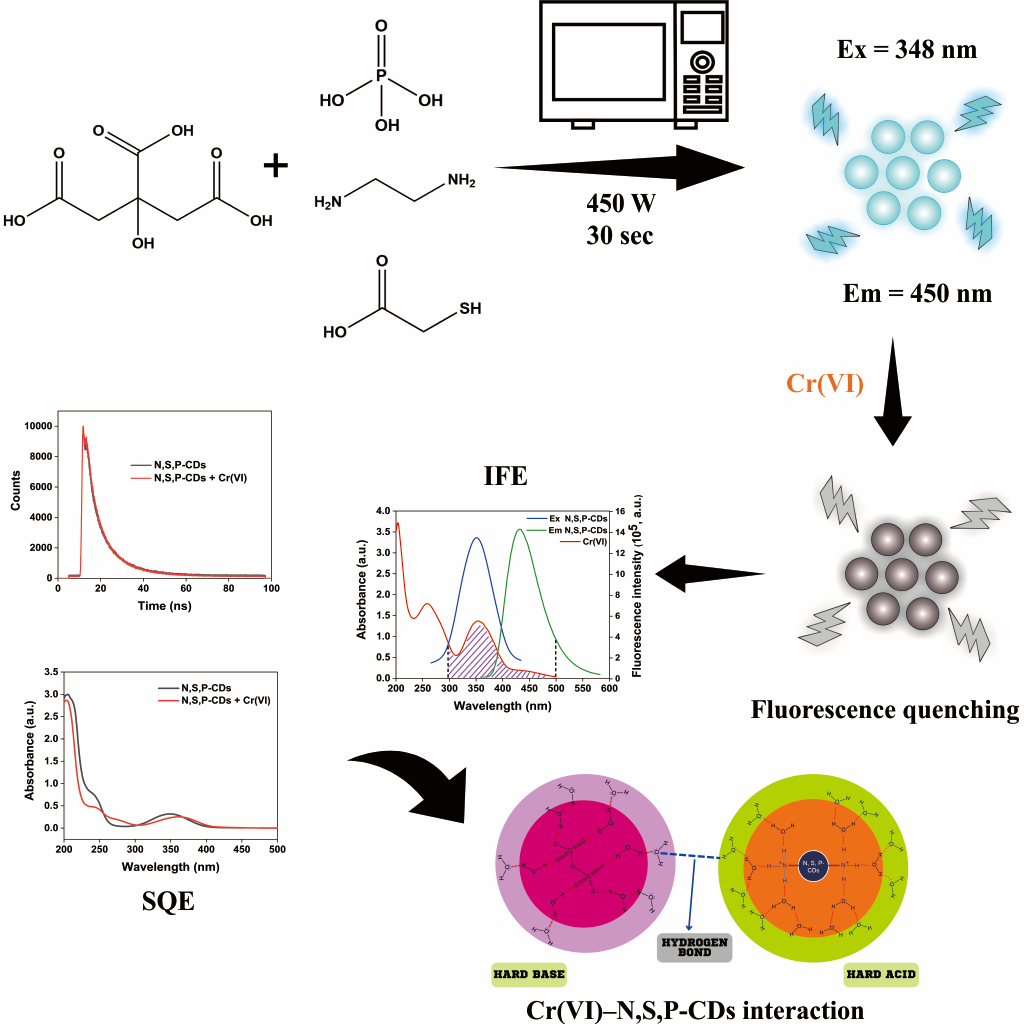
A rapid and sustainable microwave-assisted method was developed for synthesizing nitrogen-, sulfur-, and phosphorus-co-doped carbon dots (N,S,P-CDs) using citric acid as the carbon precursor, along with ethylenediamine, thioglycolic acid, and phosphoric acid as dopant sources, for the early detection of Cr(VI) in aqueous environments. The process achieved highly efficient dopant incorporation in just 30 s at 450 W, demonstrating its green, energy-saving characteristics. Beyond achieving an exceptional quantum yield of 89.64%, this study provides detailed insight into the N,S,P-CDs–Cr(VI) interaction and dual quenching mechanism, explaining the synergistic roles of IFE and SQE in N,S,P-CDs, with high selectivity confirmed in the presence of various cations and anions, an aspect rarely discussed in previous research. In-depth analysis of morphological and optical features, including UV-Vis, FT-IR, Raman, XRD, HR-TEM, zeta potential analyzer, and spectrofluorometer, confirmed effective doping and co-doping, the formation of a carbonaceous core structure, and the resulting strong fluorescence emission. The synthesized N,S,P-CDs exhibited high photostability and strong stability against pH and ionic-strength variations, with a linear detection range of 0 - 100 µM, a low limit of detection of 0.07354 µM, and a limit of quantification of 0.2451 µM. The sensor demonstrated competitive sensitivity, together with high analytical accuracy and precision. Application to real water samples verified accurate Cr(VI) detection below WHO limits, confirming the N,S,P-CDs as a sustainable and sensitive fluorescent platform for monitoring toxic metal pollutants in water.
HIGHLIGHTS
- N,S,P co-doped carbon dots were rapidly synthesized by a microwave-assisted method within 30 s at 450 W.
- Tri-atom doping promoted graphitic core formation and surface passivation, yielding a high quantum yield of 89.64%.
- Structural and optical characterizations confirmed successful heteroatom doping and graphitic core formation.
- The fluorescence response toward Cr(VI) arose from the combined contribution of the inner filter effect and static quenching.
- The N,S,P-CDs enabled highly selective and ultrasensitive Cr(VI) detection in real water samples with a detection limit of 0.07354 µM.
GRAPHICAL ABSTRACT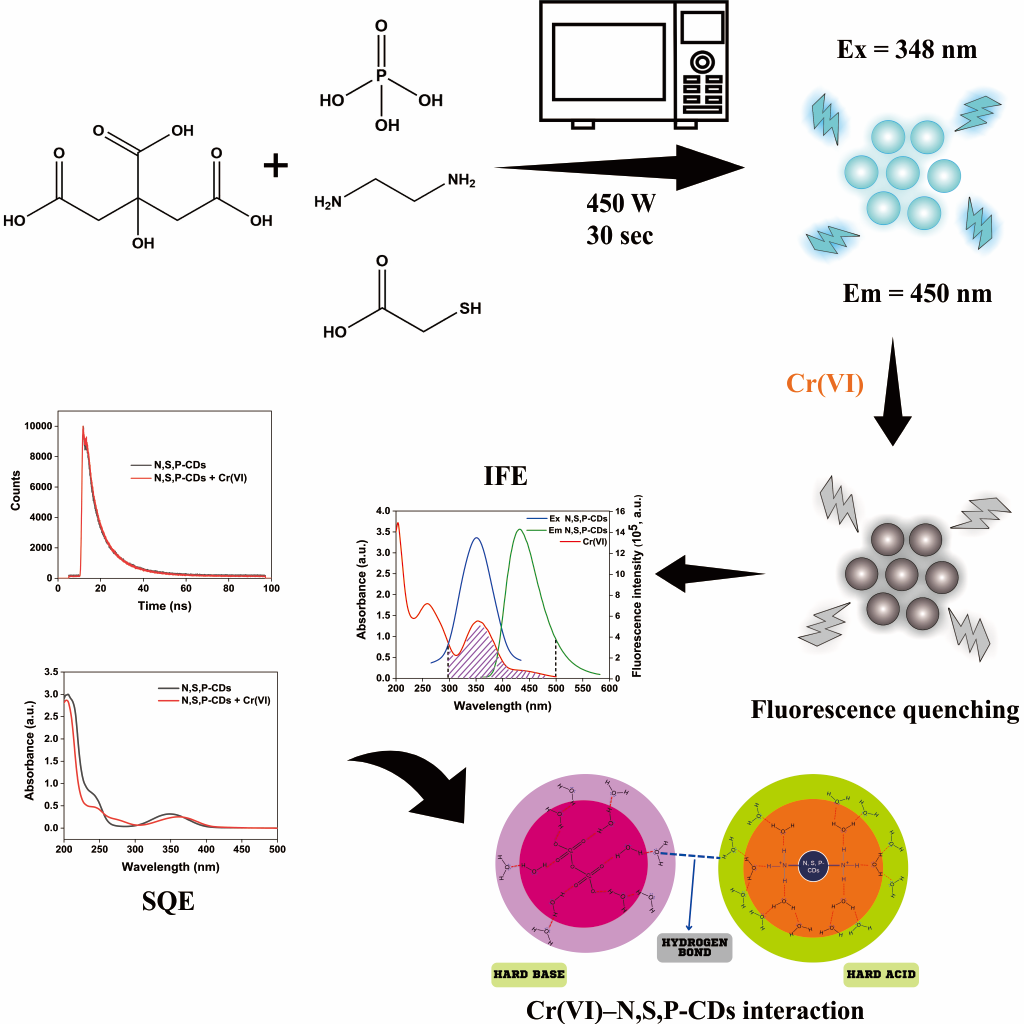
Downloads
References
CJ Walsh. Urban impacts on the ecology of receiving waters: A framework for assessment. Hydrobiologia 2000; 431, 107-114.
K Jomova, SY Alomar, E Nepovimova, K Kuca and M Valko. Heavy metals: Toxicity and human health effects. Archives of Toxicology 2025; 99(1), 153-209.
QY Chen, A Murphy, H Sun and M Costa. Molecular and epigenetic mechanisms of Cr(VI)-induced carcinogenesis. Toxicology and Applied Pharmacology 2019; 377, 114636.
A Monga, AB Fulke and D Dasgupta. Recent developments in essentiality of trivalent chromium and toxicity of hexavalent chromium: Implications on human health and remediation strategies. Journal of Hazardous Materials Advances 2022; 7, 100113.
S Mitra, AJ Chakraborty, AM Tareq, TB Emran, F Nainu, A Khusro, AM Idris, MU Khandaker, H Osman, FA Alhumaydhi and J Simal-Gandara. Impact of heavy metals on the environment and human health: Novel therapeutic insights to counter the toxicity. Journal of King Saud University - Science 2022; 34(3), 101865.
S Prasad, KK Yadav, S Kumar, N Gupta, MMS Cabral-Pinto, S Rezania, N Radwan and J Alam. Chromium contamination and effect on environmental health and its remediation: A sustainable approaches. Journal of Environmental Management 2021; 285, 112174.
J Chávez-Lara, M Galicia, K Carrasco-Urrutia and J Torres-Pérez. Sensitive detection of chromium (VI) using Au-NPs/MWCNT/chitosan composite via electrochemical approach. International Journal of Electrochemical Science 2023; 18(7), 100161.
ER Darwish, RF Alshehri, AS Amin and M Aish. Development of an innovative optical sensor to detect extremely low levels of chromium in real samples using colorimetric methods. Environmental Science: Advances 2023; 3(2), 274-289.
K Hagiwara, Y Koike, M Aizawa and T Nakamura. On-site determination of arsenic, selenium, and chromium(VI) in drinking water using a solid-phase extraction disk/handheld X-ray fluorescence spectrometer. Analytical Sciences 2018; 34(11), 1309-1315.
K Pytlakowska. Speciation of inorganic chromium in water samples by energy dispersive x-ray fluorescence spectrometry. Journal of Analytical Atomic Spectrometry 2016; 31(4), 968-974.
F Ming, J Hou, C Hou, M Yang, X Wang, J Li, D Huo and Q He. One-step synthesized fluorescent nitrogen doped carbon dots from thymidine for Cr(VI) detection in water. Spectrochimica Acta Part A: Molecular and Biomolecular Spectroscopy 2019; 222, 117165.
J Dei, S Mondal, A Biswas, DJ Sarkar, S Bhattacharyya, S Pal, S Mukherjee, S Sarkar, A Ghosh, V Bansal, R Bandhyopadhyay, BK Das and BK Behera. Cr-Detector: A simple chemosensing system for onsite Cr(VI) detection in water. PLoS One 2024; 19(1), e0295687.
AG Kolekar, SP Pawar, DB Gunjal, OS Nille, PV Anbhule, SV Koparde, NQ Nguyen, D Sohn, GB Kolekar, GS Gokavi and VR More. Facile synthesis of sulphur-doped carbon dots (S-CDs) using a hydrothermal method for the selective sensing of Cr6+ and Fe3+ ions: Application to environmental water sample analysis. RSC Advances 2024; 14(5), 3473-3479.
AB Patil, PL Chaudhary and PV Adhyapak. Carbon dots-cadmium sulfide quantum dots nanocomposite for ‘on-off’ fluorescence sensing of chromium(VI) ions. RSC Advances 2024; 14(18), 12923-12934.
J Xie, Z Wu, J Sun, C Lv and Q Sun. Green synthesis of carbon quantum dots derived from Lycium barbarum for effective fluorescence detection of Cr(VI) sensing. Journal of Fluorescence 2024; 34(2), 571-578.
NH Hussen, AH Hasan, YM FaqiKhedr, A Bogoyavlenskiy, AR Bhat and J Jamalis. Carbon dot based carbon nanoparticles as potent antimicrobial, antiviral, and anticancer agents. ACS Omega 2024; 9(9), 9849-9864.
VK Pandey, A Tripathi, A Taufeeq, AH Dar, AV Samrot, S Rustagi, S Malik, T Bhattacharya, AM Shaikh and B Kovács. Significance and applications of carbon dots in anti cancerous nanodrug conjugate development: A review. Applied Surface Science Advances 2024; 19, 100550.
S Sharma, R Kumar, K Kumar and N Thakur. Sustainable applications of biowaste-derived carbon dots in eco-friendly technological advancements: A review. Materials Science and Engineering: B 2024; 305, 117414.
P Singh, V Bhankar, S Kumar and K Kumar. Biomass-derived carbon dots as significant biological tools in the medicinal field: A review. Advances in Colloid and Interface Science 2024; 328, 103182.
L Zhai, XM Ren and Q Xu. Carbogenic π-conjugated domains as the origin of afterglow emissions in carbon dot-based organic composite films. Materials Chemistry Frontiers 2021; 5(11), 4272-4279.
B Wang, GIN Waterhouse, B Yang and S Lu. Advances in shell and core engineering of carbonized polymer dots for enhanced applications. Accounts of Chemical Research 2024; 57(19), 2928-2939.
L Wang, C Gu, L Wu, W Tan, Z Shang, Y Tian and J Ma. Recent advances in carbon dots for electrochemical sensing and biosensing: A systematic review. Microchemical Journal 2024; 207, 111687.
S Darinel, T Landa, N Kumar, R Bogireddy, I Kaur and V Batra. Heavy metal ion detection using green precursor derived carbon dots. iScience 2022; 25(2), 103816.
RB González-González, MB Morales-Murillo, MA Martínez-Prado, EM Melchor-Martínez, I Ahmed, M Bilal, R Parra-Saldívar and HMN Iqbal. Carbon dots-based nanomaterials for fluorescent sensing of toxic elements in environmental samples: Strategies for enhanced performance. Chemosphere 2022; 300, 134515.
W Zhong and J Yang. Fluorescent carbon quantum dots for heavy metal sensing. Science of the Total Environment 2024; 957, 177473.
A Priyadharshini and AA Napoleon. Metal and heteroatoms co-doped fluorescent carbon dots for highly selective and sensitive detection of Mg2+ ions in aqueous media: Applications in test strips, pharmaceutical, real samples and bioimaging. Spectrochimica Acta Part A: Molecular and Biomolecular Spectroscopy 2025; 332, 125851.
A Ahlawat, TK Dhiman, PR Solanki and PS Rana. Facile synthesis of carbon dots via pyrolysis and their application in photocatalytic degradation of rhodamine B (RhB). Environmental Science and Pollution Research 2024; 31(34), 46752-46759.
L Gan, Q Su, Z Chen and X Yang. Exploration of pH-responsive carbon dots for detecting nitrite and ascorbic acid. Applied Surface Science 2020; 530, 147269.
C Wu, S Zhang, M Liu and J He. One-step solvothermal synthesis of nitrogen-doped carbon dots with efficient red emission from conjugated perylene for multiple applications. Carbon 2024; 230, 119601.
Y Liu, H Yang, T Huang, L Niu and S Liu. Recent advances of biomass-derived carbon dots with room temperature phosphorescence characteristics. Nano Today 2024; 56, 102257.
N Wang, K Liu, Z Hou, Z Zhao, H Li and X Gao. The comparative techno-economic and life cycle assessment for multi-product biorefinery based on microwave and conventional hydrothermal biomass pretreatment. Journal of Cleaner Production 2024; 474, 143562.
ÇK Kurukavak, M Tok, M Yurdakul and M Kuş. Dual- and triple- hetero-atom-doped carbon dots as novel additives for the engineering of defects passivation to boost performance of perovskite solar cells. Journal of Materials Science: Materials in Electronics 2025; 36(8), 485.
A Saravanan, P Das, M Maruthapandi, S Aryal, S Michaeli, Y Mastai, JHT Luong and A Gedanken. Heteroatom co-doping (N, NS, NB) on carbon dots and their antibacterial and antioxidant properties. Surfaces and Interfaces 2024; 46, 103857.
J Qi, P Zhang, T Zhang, R Zhang, Q Zhang, J Wang, M Zong, Y Gong, X Liu, X Wu and B Li. Metal-doped carbon dots for biomedical applications: From design to implementation. Heliyon 2024; 10(11), e32133.
J Hu, M Su, H Yuan, C Jing, B Li and B Wang. Fluorescent responsive film based on nitrogen-doped carbon quantum dots embedded in mesoporous silica for visual detection of Cr(VI). Journal of Environmental Chemical Engineering 2025; 13(2), 115656.
CS Ni, WJ Zhang, WZ Bi, MX Wu, SX Feng, XL Chen and LB Qu. Facile synthesis of N-doped graphene quantum dots as a fluorescent sensor for Cr(VI) and folic acid detection. RSC Advances 2024; 14(36), 26667-26673.
Y Chen, Z Wang, M Liang, Y Liu, W Dong, Q Hu, C Dong and X Gong. High-efficient nickel-doped lignin carbon dots as a fluorescent and smartphone-assisted sensing platform for sequential detection of Cr(VI) and ascorbic acid. International Journal of Biological Macromolecules 2024; 274(P2), 133790.
Y Wang, X Hu, W Li, X Huang, Z Li, W Zhang, X Zhang, X Zou and J Shi. Preparation of boron nitrogen co-doped carbon quantum dots for rapid detection of Cr(VI). Spectrochimica Acta Part A: Molecular and Biomolecular Spectroscopy 2020; 243, 118807.
SA Mathew, P Praveena, S Dhanavel, R Manikandan, S Senthilkumar and A Stephen. Luminescent chitosan/carbon dots as an effective nano-drug carrier for neurodegenerative diseases. RSC Advances 2020; 10(41), 24386-24396.
RB González-González, LT González, M Madou, C Leyva-Porras, SO Martinez-Chapa and A Mendoza. Synthesis, purification, and characterization of carbon dots from non-activated and activated pyrolytic carbon black. Nanomaterials 2022; 12(3), 298.
Y Feng, R Li, P Zhou and C Duan. Non-toxic carbon dots fluorescence sensor based on chitosan for sensitive and selective detection of Cr(VI) in water. Microchemical Journal 2022; 180, 107627.
H Kaur, K Garg, A Gupta, S Chakroborty, TJ Jose, IA Darwish and SK Shukla. One-Pot synthesis of waste poly (Vinyl-Chloride) derived carbon dots for antimicrobial applications. Journal of Molecular Liquids 2025; 417, 126540.
J Goswami, SS Rohman, AK Guha, P Basyach, K Sonowal, SP Borah, L Saikia and P Hazarika. Phosphoric acid assisted synthesis of fluorescent carbon dots from waste biomass for detection of Cr(VI) in aqueous media. Materials Chemistry and Physics 2022; 286, 126133.
YF Li, X Zhang, Q Lu, JZ Cao, S Gao, QZ Liu, XX Cai and H Zhao. Cellulose-based yellow-green emitting carbon dots with large Stokes shift as effective ‘turn off-on’ fluorescence platforms for Cr(VI) and AA dual efficacy detection. Analytica Chimica Acta 2024; 1324, 343102.
AM Mahmoud, MH Mahnashi, AA Fatease, MAH Mostafa, MM El-Wekil and R Ali. Fluorometric and electrochemical dual-mode detection of toxic flavonoid rutin based on new nitrogen and sulfur co-doped carbon dots: Enhanced selectivity based on masking the interfering flavonoids with BSA complexation. Journal of Food Composition and Analysis 2022; 108, 104428.
M Medhi, M Yumnam, P Mudoi and P Mishra. Green fluorescent carbon dots synthesized from various household green wastes for detection of parathion methyl pesticide. Journal of Luminescence 2025; 277, 120926.
P Cui and Y Xue. The role of center-N-doping in non-radiative recombination loss of nitrogen-doped graphene quantum dots. Materials Science in Semiconductor Processing 2022; 139, 106323.
C Long, Z Jiang, J Shangguan, T Qing, P Zhang and B Feng. Applications of carbon dots in environmental pollution control: A review. Chemical Engineering Journal 2021; 406, 126848.
YL Tian, YY Ji, X Zou, QM Chen, SL Zhang and ZJ Gong. N, P co-doped carbon dots as multifunctional fluorescence nano-sensor for sensitive and selective detection of Cr(VI) and ascorbic acid. Journal of Analysis and Testing 2022; 6(3), 335-345.
J Yu, R Kalimuthu, X Liu, W Zhang, Y Tan, K Yan, S Ye and J Feng. Unveiling the quenching mechanism of metal ions using solvent-driven N, S-doped carbon quantum dots. Optical Materials 2025; 162, 116948.
L Wu, W Pan, H Ye, N Liang and L Zhao. Sensitive fluorescence detection for hydrogen peroxide and glucose using biomass carbon dots: Dual-quenching mechanism insight. Colloids and Surfaces A: Physicochemical and Engineering Aspects 2022; 638, 128330.
SH Elagamy, RH Obaydo, A Barseem and H Lotfy. Dual emissive carbon dots as ratiometric fluorescence sensors: A comprehensive review. Sensing and Bio-Sensing Research 2025; 50, 100930.
S Liu, Y Zhang, Y Zhang, J Zhang, R Tian and L Zhao. Visual fluorescence detection kit for Cr(VI) based on biological matrix-derived carbon dots and assisted for AA. Diamond and Related Materials 2024; 148, 111382.
KF Kayani, SJ Mohammed, D Ghafoor, MK Rahim and HR Ahmed. Carbon dot as fluorescence sensor for glutathione in human serum samples: A review. Material Advances 2024; 5(11), 4618-4633.
Z Zhang, Y Liu, Y Lin, J Zhang and C Zheng. Inner filter effect-based sensing platforms: Strategies to enhance anti-interference capability and sensitivity for on-site analysis. Trends in Analytical Chemistry 2026; 195, 118552.
H Chen, D Li, Y Zheng, K Wang, X Zhang, S Zhou, S Wei, F Yong, J Nie, H Wen, J Wu, W Xue and S Huang. Metal-free carbon-dots nanozyme with oxidase-like activity as photocatalysts for highly efficient detection/reduction of Cr(VI) and antibacterial application. Separation and Purification Technology 2025; 356, 129852.
T Long, H Luo, H Li, J Sun, Y Wang, J Zhou, Y Chen and D Xu. Fe-doping green fluorescent carbon dots via co-electrolysis of chrysoidine G and potassium ferrocyanide for sensitive Cr(VI) detection. Spectrochimica Acta Part A: Molecular and Biomolecular Spectroscopy 2024; 311, 124010.
Y Tian and Y Yue. Phosphor doped carbon dots with high photoluminescence and stability towards pH and Cr(VI) sensors. Microchemical Journal 2024; 207, 112046.
X Hao, X Zhang, J Wang, C Liu, C Li and P Yang. Carbon dots with high brightness and stability towards efficient Cr(VI) and l-arginine sensors. Microchemical Journal 2024; 207, 112092.
R Newar, N Sultana, S Das, B Gogoi, NF Islam, H Sarma and A Baruah. Development of FRET-based optical sensors using N-doped carbon dots for detection of chromium (VI) and manganese (VII) in water for a sustainable future. Journal of Environmental Chemical Engineering 2024; 12(1), 111721.
Published
How to Cite
Issue
Section
License
Copyright (c) 2026 Walailak University

This work is licensed under a Creative Commons Attribution-NonCommercial-NoDerivatives 4.0 International License.





