
Integration of Response Surface Methodology and FTIR-Multivariate Profiling for Optimizing Green Extraction of Antioxidants from Indonesian Mangrove Sonneratia alba
DOI:
https://doi.org/10.48048/tis.2026.13027Keywords:
Sonneratia alba, Mangroves, Green extraction, Ultrasound-assisted extraction (UAE), Microwave-assisted extraction (MAE), Antioxidant activity, Response surface methodology (RSM), Stem barkAbstract
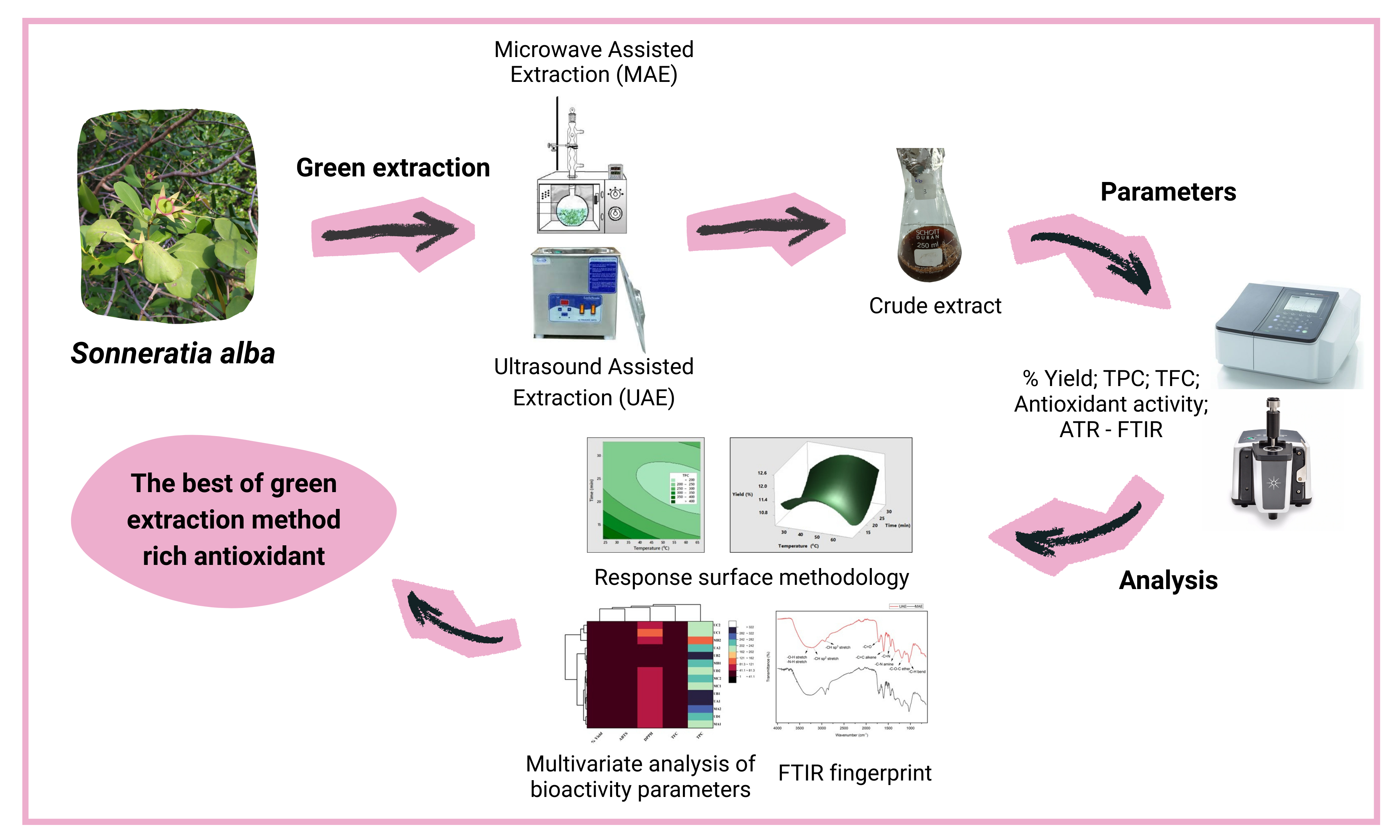
The various bioactive secondary metabolites found in mangrove ecosystems, which are ecologically important, have potential medical uses. Additionally, there is currently little information available regarding how to best and most environmentally friendly extract bioactive metabolites from mangrove species. As previous studies on some mangrove species have reported the presence of antioxidants, this study determines the effectiveness of 2 environmentally friendly extraction methods, microwave-assisted extraction (MAE) and ultrasound-assisted extraction (UAE), in releasing antioxidant compounds from Sonneratia alba stem bark that collected from Maumere beach in East Nusa Tenggara, Indonesia. Response surface methodology (RSM) was applied to optimize both green extraction techniques, with power and extraction time selected as the key parameters for MAE and temperature and extraction time for UAE. The obtained extracts were subsequently characterized using attenuated total reflectance-Fourier transform infrared (ATR-FTIR) spectroscopy. The extracts were evaluated for extraction yield, total phenolic content (TPC), total flavonoid content (TFC), and antioxidant activity (assessed using 2,2-diphenyl-1-picrylhydrazyl [DPPH] and 2,2′-azino-bis [ABTS] assays). The UAE method produced higher phenolic (321.55 mg GAE/g) and flavonoid (11.48 mg QE/g) contents, an extraction yield of 11.45%, and antioxidant activity (IC₅₀ = 22.41 µg/mL) at 40 °C for 30 min. In contrast, the MAE method yielded lower TPC (292.95 mg GAE/g) and TFC (10.37 mg QE/g) levels, but achieved a higher extraction yield (25.97%) and a shorter extraction time of 1 min at 700 W microwave power, as verified by FTIR spectroscopy, which identified aromatic, carbonyl, and hydroxyl functional groups characteristic of phenolic and alkaloids compounds. The results indicated that the UAE is more suitable for the recovery of bioactive compounds rich in antioxidants, while MAE offers higher extraction yields and shorter extraction times. These findings are beneficial for advancing the optimization of green extraction processes for the recovery of natural antioxidants from S. alba.
HIGHLIGHTS
- The work shows, for the first time, that ultrasound-assisted (UAE) and microwave-assisted (MAE) green extraction methods have been optimized to obtain phytochemicals from Sonneratia alba stem bark, a mangrove species found on the Maumere coast of Indonesia.
- The optimal extraction parameters were determined with the Response Surface Methodology (RSM). UAE at 40 °C for 30 min produced the highest total phenolic (321.55 mg GAE/g) and flavonoid (11.48 mg QE/g) contents, as well as strong antioxidant activity (IC₅₀ = 22.41 µg/mL).
- Microwave-assisted extraction generated a higher extraction yield (25.97%) in 1 min at 700 W, showing its efficiency and solvent economy.
- ATR-FTIR spectral fingerprinting revealed phenolic, flavonoid, and alkaloid functional groups in UAE and MAE extracts, indicating metabolite richness and compositional variations.
- Comparative multivariate and spectral analyses highlight UAE as a more sustainable and bioactivity-preserving approach, providing new insights into eco-friendly mangrove-derived antioxidant recovery for potential pharmaceutical and nutraceutical uses.
GRAPHICAL ABSTRACT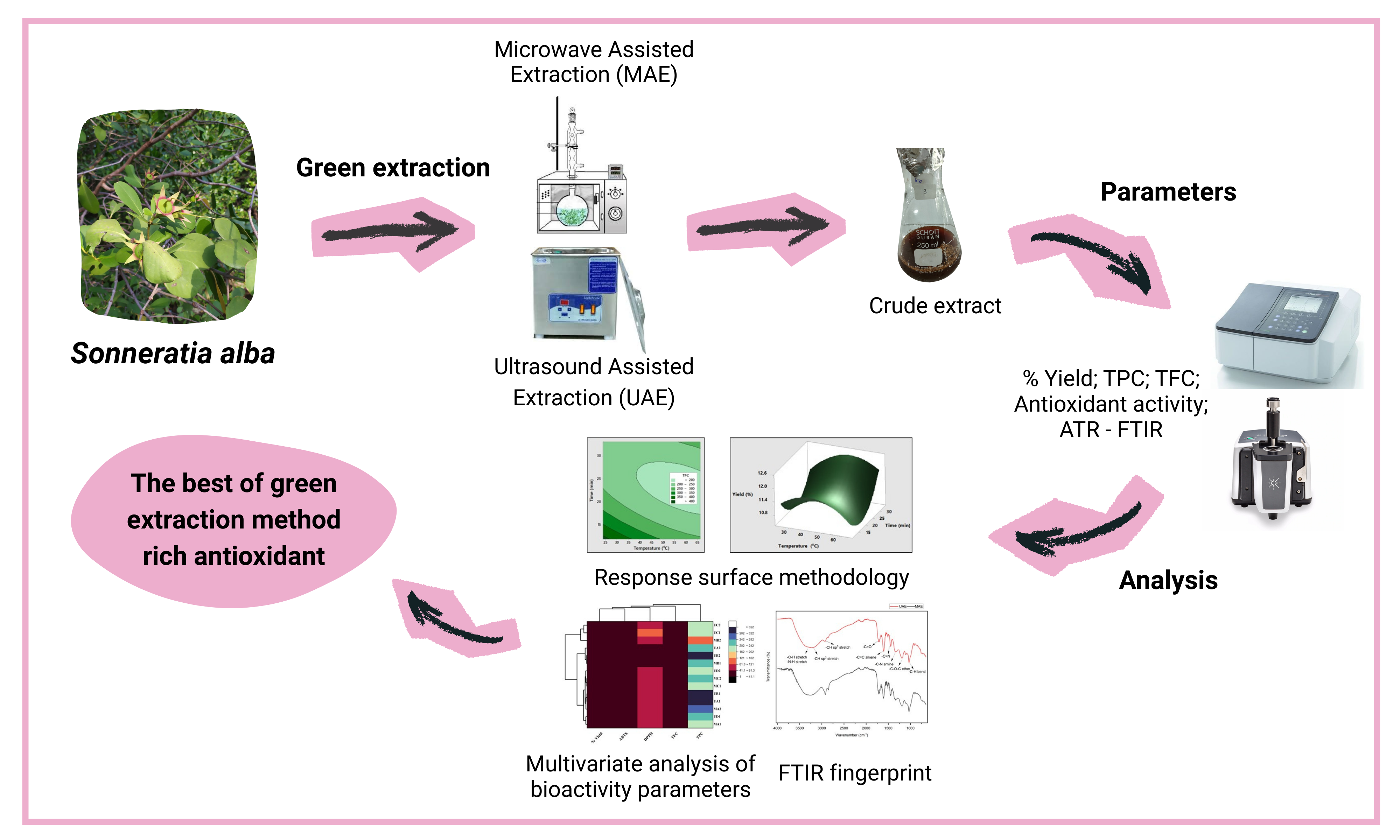
Downloads
References
AR Islam, MM Hasan, MT Islam and N Tanaka. Ethnobotanical study of plants used by the Munda ethnic group living around the Sundarbans, the world’s largest mangrove forest in southwestern Bangladesh. Journal of Ethnopharmacology 2022; 285, 114853.
JY Leung and NF Tam. Influence of plantation of an exotic mangrove species, Sonneratia caseolaris (L.) Engl., on macrobenthic infaunal community in Futian Mangrove National Nature Reserve, China. Journal of Experimental Marine Biology and Ecology 2013; 448, 1-9.
L Vittaya, U Charoendat, S Janyong, J Ui-Eng and N Leesakul. Comparative analyses of saponin, phenolic, and flavonoid contents in various parts of Rhizophora mucronata and Rhizophora apiculata and their growth inhibition of aquatic pathogenic bacteria. Journal of Applied Pharmaceutical Science 2022; 12(11), 111-121.
AD Rupidara, WL Tisera and ME Ledo. Studi etnobotani tumbuhan mangrove di Kupang (in Indonesian). Jurnal Ilmu dan Teknologi Kelautan Tropis 2020; 12(3), 875-884.
AS Nugraha, LN Firli, DM Rani, A Hidayatiningsih, ND Lestari, H Wongso, K Tarman, AC Rahaweman, J Manurung, NP Ariantari and A Papu. Indonesian marine and its medicinal contribution. Natural Products and Bioprospecting 2023; 13(1), 38.
RM Ghalib, R Hashim, O Sulaiman, MF Awalludin, SH Mehdi and F Kawamura. Fingerprint chemotaxonomic GC-TOFMS profile of wood and bark of mangrove tree Sonneratia caseolaris (L.) Engl. Journal of Saudi Chemical Society 2011; 15(3), 229-237.
S Mitra, N Naskar and P Chaudhuri. A review on potential bioactive phytochemicals for novel therapeutic applications with special emphasis on mangrove species. Phytomedicine Plus 2021; 1(4), 100107.
M Abbas, D Ahmed, MT Qamar, S Ihsan and ZI Noor. Optimization of ultrasound-assisted, microwave-assisted and Soxhlet extraction of bioactive compounds from Lagenaria siceraria: A comparative analysis. Bioresource Technology Reports 2021; 15, 100746.
M Vinatoru, TJ Mason and I Calinescu. Ultrasonically assisted extraction (UAE) and microwave assisted extraction (MAE) of functional compounds from plant materials. TrAC Trends in Analytical Chemistry 2017; 97, 159-178.
MP Sonar and VK Rathod. Microwave assisted extraction (MAE) used as a tool for rapid extraction of marmelosin from Aegle marmelos and evaluations of total phenolic and flavonoids content, antioxidant and anti-inflammatory activity. Chemical Data Collections 2020; 30, 100545.
D Wonggo, C Anwar, V Dotulong, A Reo, N Taher, RA Syahputra, F Nurkolis, TE Tallei, B Kim and A Tsopmo. Subcritical water extraction of mangrove fruit extract (Sonneratia alba) and its antioxidant activity, network pharmacology, and molecular connectivity studies. Journal of Agriculture and Food Research 2024; 18, 101334.
MH Ikhsan, AW Akili, A Hardianto, J Latip and T Herlina. Optimization of ultrasound-assisted extraction of anthocyanin from Erythrina crista-galli flowers. Trends in Sciences 2025; 22(7), 10076.
A Bampouli, K Kyriakopoulou, G Papaefstathiou, V Louli, N Aligiannis, K Magoulas and M Krokida. Evaluation of total antioxidant potential of Pistacia lentiscus var. chia leaves extracts using UHPLC-HRMS. Journal of Food Engineering 2015; 167, 25-31.
P Darvishzadeh and V Orsat. Microwave-assisted extraction of antioxidant compounds from Russian olive leaves and flowers: Optimization, HPLC characterization and comparison with other methods. Journal of Applied Research on Medicinal and Aromatic Plants 2022; 27, 100368.
J Rutuparna, A Ali and IA Ghazi. Comparative metabolomic analysis of unreleased and released pollen from Putranjiva roxburghii Wall. South African Journal of Botany 2022; 149, 758-767.
F Kuhn, ES de Azevedo, J Frazzon and CP Noreña. Evaluation of green extraction methods on bioactive compounds and antioxidant capacity from Bougainvillea glabra bracts. Sustainable Chemistry and Pharmacy 2021; 19, 100362.
DJ Bhuyan, Q Van Vuong, AC Chalmers, IA van Altena, MC Bowyer and CJ Scarlett. Microwave-assisted extraction of Eucalyptus robusta leaf for the optimal yield of total phenolic compounds. Industrial Crops and Products 2015; 69, 290-299.
R Wen, HN Lv, Y Jiang and PF Tu. Anti-inflammatory flavone and chalcone derivatives from the roots of Pongamia pinnata (L.) Pierre. Phytochemistry 2018; 149, 56-63.
M Sharma, S Hussain, T Shalima, R Aav and R Bhat. Valorization of seabuckthorn pomace to obtain bioactive carotenoids: An innovative approach of using green extraction techniques (ultrasonic and microwave-assisted extractions) synergized with green solvents (edible oils). Industrial Crops and Products 2022; 175, 114257.
L Shen, S Pang, M Zhong, Y Sun, A Qayum, Y Liu, A Rashid, B Xu, Q Liang, H Ma and X Ren. A comprehensive review of ultrasonic assisted extraction (UAE) for bioactive components: Principles, advantages, equipment, and combined technologies. Ultrasonics Sonochemistry 2023; 101, 106646.
A Barman, M Barman, R Das and S Ray. Traditional medicinal uses, phytochemistry, bioactivities and toxicity of the genus Maesa (Primulaceae): A comprehensive review. Journal of Herbal Medicine 2023; 41, 100720.
Y Wang, C Zhang, Y Zhao, F Wu, Y Yue, Y Zhang and D Li. Ultrasound-assisted optimization extraction and biological activities analysis of flavonoids from Sanghuangporus sanghuang. Ultrasonics Sonochemistry 2025; 117, 107326.
J Rumpf, R Burger and M Schulze. Statistical evaluation of DPPH, ABTS, FRAP, and Folin-Ciocalteu assays to assess the antioxidant capacity of lignins. International Journal of Biological Macromolecules 2023; 233, 123470.
S Amalraj, V Mariyammal, R Murugan, SS Gurav, J Krupa and M Ayyanar. Comparative evaluation on chemical composition, in vitro antioxidant, antidiabetic and antibacterial activities of various solvent extracts of Dregea volubilis leaves. South African Journal of Botany 2021; 138, 115-123.
L Vittaya, U Charoendat, J Ui-Eng and N Leesakul. Effect of extraction solvents on phenolic compounds and flavonoids from Pongame oiltree (Derris indica [Lamk.] Bennet) aerial parts and their growth inhibition of aquatic pathogenic bacteria. Agriculture and Natural Resources 2022; 56(3), 569-582.
LY Gu, Z Chen, J Zhao, XJ Ruan, SY Zhao and H Gao. Antioxidant, anticancer and apoptotic effects of the Bupleurum chinense root extract in HO-8910 ovarian cancer cells. Journal of BUON 2015; 20(5), 1341-1349.
TP Vo, MT Ho, PU Nguyen, ND Pham, KV Truong, TH Nguyen, DQ Nguyen and TT Vo. Extracting phenolics, flavonoids, and terpenoids from Codonopsis pilosula using green solvents. Sustainable Chemistry and Pharmacy 2024; 37, 101395.
MN Azam, P Biswas, A Khandker, MM Tareq, SJ Tauhida, TA Shishir, S Bibi, MA Alam, MN Zilani, NA Albekairi and A Alshammari. Profiling of antioxidant properties and identification of potential analgesic inhibitory activities of Allophylus villosus and Mycetia sinensis employing in vivo, in vitro, and computational techniques. Journal of Ethnopharmacology 2025; 336, 118695.
MC Diwathe, J Anandkumar and B Mazumdar. Optimization of ultrasound-assisted extraction of phenolics from Cordia dichotoma leaves using response surface methodology. Chemical Engineering Research and Design 2024; 208, 572-587.
L Vittaya, C Chalad, W Ratsameepakai and N Leesakul. Phytochemical characterization of bioactive compounds extracted with different solvents from Calophyllum inophyllum flowers and activity against pathogenic bacteria. South African Journal of Botany 2023; 154, 346-355.
S Mitra, N Naskar, S Lahiri and P Chaudhuri. A study on phytochemical profiling of Avicennia marina mangrove leaves collected from Indian Sundarbans. Sustainable Chemistry for the Environment 2023; 4, 100041.
D Silviani, WT Wahyuni, UD Syafitri, A Ilmiawati, DA Septaningsih, M Insanu, NS Aminah, A Rohman and M Rafi. LC-HRMS and FTIR-based metabolomics analysis and xanthine oxidase inhibitory evaluation of Sida rhombifolia with different drying methods. Biocatalysis and Agricultural Biotechnology 2023; 52, 102833.
S Thummajitsakul, P Piyaphan, S Khamthong, M Unkam and K Silprasit. Comparison of FTIR fingerprint, phenolic content, antioxidant and anti-glucosidase activities among Phaseolus vulgaris L., Arachis hypogaea L. and Plukenetia volubilis L. Electronic Journal of Biotechnology 2023; 61, 14-23.
Published
How to Cite
Issue
Section
License
Copyright (c) 2026 Walailak University

This work is licensed under a Creative Commons Attribution-NonCommercial-NoDerivatives 4.0 International License.





