
Effect of Gold-Modified Titanium Dioxide Thin Films on Electrical Resistance, Optical Transmittance, and Wetting Properties
DOI:
https://doi.org/10.48048/tis.2026.12946Keywords:
Titanium dioxide, Gold, Thin films, Sparking process, Sputtering deposition, Four-point probe, Sheet resistance, Hydrophilicity stabilityAbstract
Titanium dioxide (TiO2) thin films were synthesized via the sparking process at different durations and modified with gold (Au) by DC magnetron sputtering to study the effects of microstructure, plasmonic interactions, and interfacial charge transport. Pristine TiO2 films showed a transition from fine, uniform nanograins (1 h) to agglomerated structures (3 - 5 h), reducing transparency and increasing defect density, while thicker films exhibited improved electrical continuity. The 1 h TiO2 film offered the optimal balance of high transparency (~90%), uniform morphology, and long-term hydrophilicity. Au deposition significantly influenced film properties: Increasing sputtering current (10 - 50 mA) enhanced Au loading, transforming discontinuous nanoparticles into a percolated network at 30 mA, and causing agglomeration at 50 mA. This morphology controlled plasmonic absorption, sub-band-gap optical behavior, and conductivity. Au modification reduced sheet resistance from 37 MΩ/sq to 5.8 Ω/sq (30 mA) and enabled visible-light absorption via localized surface plasmon resonance and metal-induced gap states. Au-coated films maintained water contact angles <30° over 60 days, attributed to stabilized surface hydroxylation and suppression of hydrocarbon adsorption. Sputtering at 30 mA produced the optimal Au-TiO2 architecture, balancing transparency, conductivity, plasmonic activity, and durable wettability, offering a promising approach for low-cost transparent coatings, optoelectronic devices, and self-cleaning surfaces.
HIGHLIGHTS
- TiO₂ thin films were successfully fabricated using a sparking process and modified with Au by sputtering.
- Au deposition significantly reduced sheet resistance from MΩ to Ω range due to improved electrical percolation.
- Plasmonic interaction from Au nanoparticles enhanced visible-light absorption and optical behavior.
- The optimized Au-TiO₂ thin films maintained stable hydrophilicity (<30° contact angle) for 60 days.
- The developed Au-TiO₂ thin films show strong potential for transparent coatings, optoelectronics, and self-cleaning surfaces.
GRAPHICAL ABSTRACT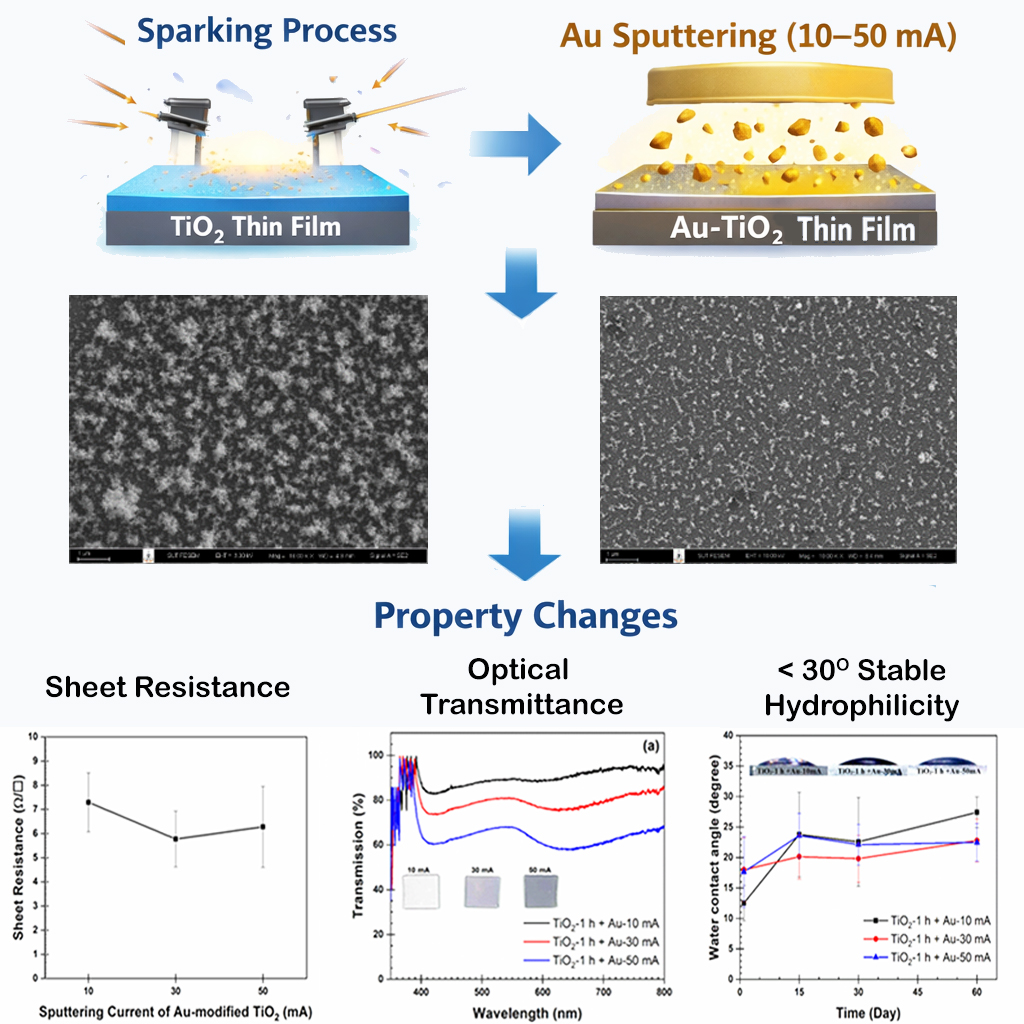
Downloads
References
J Xu, H Nagasawa, M Kanezashi and T Tsuru. UV-protective TiO2 thin films with high transparency in visible light region fabricated via atmospheric-pressure plasma-enhanced chemical vapor deposition. ACS Applied Materials & Interfaces 2018; 10(49), 42657-42665.
J Xu, H Nagasawa, M Kanezashi and T Tsuru. TiO2 coatings via atmospheric-pressure plasma-enhanced chemical vapor deposition for enhancing the UV-resistant properties of transparent plastics. ACS Omega 2021; 6(2), 1370-1377.
SN Sadikin, J Ridwan, MIA Umar, AAM Raub, J Yunas, AA Hamzah, D Dahlan, MYA Rahman and AA Umar. Photocatalytic activity and stability properties of porous TiO2 film as photocatalyst for methylene blue and methylene orange degradation. International Journal of Electrochemical Science 2023; 18(9), 100246.
A Lakshmi-Narayana, L Zhang, C Jiao, CM Julien and Y Qiu. TiO2 thin films on Au/Ti/SiO2/textured Si substrates as high capacity anode materials for Li-ion batteries. Ceramics International 2020; 46(8), 10299-10308.
Y Bougdid, G Kulkarni, F Chenard, CJ Sugrim, R Kumar and A Kar. Optical properties of transparent TiO2 films by sintering anatase nanoparticles with a CO2 laser. Optical Materials 2024; 156, 115969.
X Tian, X Cui, T Lai, J Ren, Z Yang, M Xiao, B Wang, X Xiao and Y Wang. Gas sensors based on TiO2 nanostructured materials for the detection of hazardous gases: A review. Nano Materials Science 2021; 3(4), 390-403.
D Nunes, E Fortunato and R Martins. Flexible nanostructured TiO2-based gas and UV sensors: A review. Discover Materials 2022; 2, 2.
A Nath, LR Singh and MB Sarkar. Enhanced surface wettability of Ag: TiO2 heterostructured assembly using double step glancing angle deposition technique. Ceramics International 2022; 48(8), 11392-11400.
P Cai, M Xu, M Wei, T Zhang and F Yao. Preparation and characterization of SiO2-TiO2 superhydrophilic coatings with photocatalytic activity induced by low temperature. Colloids and Surfaces A: Physicochemical and Engineering Aspects 2024; 686, 133264.
B Toboonsung. Electrical sheet resistance and wetting properties of TiO2 nanoparticle thin films prepared by sparking process. Advanced Materials Research 2017; 866, 313-317.
B Toboonsung. Surface morphologies and durability on water contact angle of titanium dioxide nanoparticle thin films. Key Engineering Materials 2019; 798, 158-162.
JA Rengifo-Herrera, P Osorio-Vargas and C Pulgarin. A critical review on N-modified TiO2 limits to treat chemical and biological contaminants in water. Evidence that enhanced visible light absorption does not lead to higher degradation rates under whole solar light. Journal of Hazardous Materials 2022; 425, 127979.
YE Tasisa, TK Sarma, R Krishnaraj and S Sarma. Band gap engineering of titanium dioxide (TiO2) nanoparticles prepared via green route and its visible-light-driven application for environmental remediation. Results in Chemistry 2024; 11, 101850.
J Li, Y Li, Q Lan, Z Yang and XJ Lv. Multiple phase N-doped TiO2 nanotubes/TiN/graphene nanocomposites for high-rate lithium ion batteries at low temperature. Journal of Power Sources 2019; 423, 166-173.
GMV Dias, JC Bernardes, BN Wesling, D Müller, LS Marques and CR Rambo. Preparation and electrochemical capacitance of high surface area TiO2-RuO2 aerogels. Open Ceramics 2021; 8, 100196.
MH Choi, CY Hong and YC Park. The hydrophilicity mechanism of anatase and rutile (110) TiO2 films based on donor-acceptor complexes. Thin Solid Films 2024; 797, 140349.
J Wu and L Zhong. Predictive modeling for VOC adsorption on TiO2 filters: Implications for enhanced photocatalytic oxidation in indoor air quality management. Chemical Engineering Journal 2024; 480, 148222.
J Woo, S Kim and S Lee. Durable and regenerable CuO/TiO2 coatings with long-lasting antifogging and self-cleaning abilities. Surface and Interfaces 2024; 53, 104984.
KS Yang, YR Lu, YY Hsu, CJ Lin, CM Tseng, SYH Liou, K Kumar, DH Wei, CL Dong and CL Chen. Plasmon-induced visible-light photocatalytic activity of Au nanoparticle-decorated hollow mesoporous TiO2: A view by x-ray spectroscopy. Journal of Physical Chemistry C 2018; 122(12), 6955-6962.
J Shondo, S Veziroglu, D Stefan, YK Mishra, T Strunskus, F Faupel and OC Aktas. Tuning wettability of TiO2 thin film by photocatalytic deposition of 3D flower- and hedgehog-like Au nano- and microstructures. Applied Surface Science 2021; 537, 147795.
K Wang, K Yoshiiri, L Rosa, Z Wei, S Juodkazis, B Ohtani and E Kowalska. TiO2/Au/TiO2 plasmonic photocatalyst with enhanced photocatalytic activity and stability under visible-light irradiation. Catalysis Today 2022; 397-399, 257-264.
P Birnal, MCM de Lucas, I Pochard, F Herbst, O Heintz, L Saviot, B Domenichini and L Imhoff. Visible-light photocatalytic degradation of dyes by TiO2-Au inverse opal films synthesized by atomic layer deposition. Applied Surface Science 2023; 609, 155213.
AM Machinin, A Awang, CF Pien, A Samavati and A Ul-Hamid. TiO2-decorated Au nanoparticle enhances wettability of glass for self-cleaning application. Optical Materials 2023; 143, 114246.
SH Han, WY Rho and BH Jun. Au-nanoparticle-embedded open-ended freestanding TiO2 nanotube arrays in dye-sensitized solar cells for better electron generation and electron transport. ACS Omega 2019; 4(23), 20346-20352.
JW Gregory, Y Gong, Y Han, S Huband, RI Walton, V Hessel and EV Rebrov. Au/TiO2 coatings for photocatalytic reduction of 4-nitrophenol to 4-aminophenol with green light. Catalysis Today 2023; 418, 114145.
W Thongsuwan, T Kumpika and P Singjai. Effect of high roughness on a long aging time of superhydrophilic TiO2 nanoparticle thin films. Current Applied Physics 2011; 11(5), 1237-1242.
N Sharma, H Ma, T Bottein, M Bugnet, F Vocanson, D Grosso, TE Itina, Y Ouerdane and N Destouches. Crystal growth in mesoporous TiO2 optical thin films. Journal of Physical Chemistry C 2019; 123(10), 6070-6079.
DNG Krishna, RP George and J Philip. Role of oxygen vacancy formation energy and insulating behavior in darkening of white amorphous TiO2. Journal of Physical Chemistry C 2021; 125(29), 16136-16146.
S Sahoo, AK Arora and V Sridharan. Raman line shapes of optical phonons of different symmetries in anatase TiO₂ nanocrystals. Journal of Physical Chemistry C 2009; 113(39), 16927-16933.
IA Alhomoudi and G Newaz. Residual stresses and Raman shift relation in anatase TiO2 thin film. Thin Solid Films 2009; 517(15), 4372-4378.
TS Senthil, N Muthukumarasamy, S Agilan, M Thambidurai and R Balasundaraprabhu. Preparation and characterization of nanocrystalline TiO2 thin films. Materials Science and Engineering B 2010; 174(1-3), 102-104.
B Endrődi, E Kecsenovity, K Rajeshwar and C Janáky. One-step electrodeposition of nanocrystalline TiO2 films with enhanced photoelectrochemical performance and charge storage. ACS Applied Energy Materials 2018; 1(2), 851-858.
MH Younus, GG Ali and HA Salih. The reinforced optical fiber sensing with bilayer AuNPs/SiC for pressure measurement: Characterization and optimization. Journal of Physics: Conference Series 2021; 1795, 012002.
AA Jabber and AR Abdulridha. Preparation and characterization of CuO/ZnO nanostructures thin films using thermal evaporation for advanced gas sensing applications. Trends in Sciences 2025; 22(3), 9002.
T Chanthong, W Intaratat and TN Wichean. Effect of thickness on electrical and optical properties of ZnO:Al films. Trends in Sciences 2023; 20(3), 6372.
Y Tian and T Tatsuma. Mechanisms and applications of plasmon-induced charge separation at TiO₂ films loaded with gold nanoparticles. Journal of the American Chemical Society 2005; 127(20), 7632-7637.
L Du, A Furube, K Yamamoto, K Hara, R Katoh and M Tachiya. Plasmon-induced charge separation and recombination dynamics in gold-TiO2 nanoparticle systems: Dependence on TiO2 particle size. Journal of Physical Chemistry C 2009; 113(16), 6454-6462.
A Furube, L Du, K Hara, R Katoh and M Tachiya. Ultrafast plasmon-induced electron transfer from gold nanodots into TiO2 nanoparticle. Journal of the American Chemical Society 2007; 129(48), 14852-14853.
N Ghorai, Z Yang, ST Gebre, S Wu, F Zhao, IN Ivanov and T Lian. Efficient size-dependent hot electron transfer from Au to TiO2 nanoparticles. Nano Letters 2025; 25(8), 3253-3258.
Y Liu, Q Chen, DA Cullen, Z Xie and T Lian. Efficient hot electron transfer from small Au nanoparticles. Nano Letters 2020; 20(6), 4322-4329.
DC Ratchford, AD Dunkelberger, I Vurgaftman, JC Owrutsky and PE Pehrsson. Quantification of efficient plasmonic hot-electron injection in gold nanoparticle-TiO2 films. Nano Letters 2017; 17(10), 6047-6055.
VM Kaganer, B Jenichen, R Shayduk, W Braun and H Riechert. Kinetic optimum of Volmer-weber growth. Physical Review Letters 2009; 102, 016103.
XM Tao, GX Ye, QL Ye, JS Jin, YF Lao and ZK Jiao. Anomalous electrical conductivity of a gold thin film percolation system. Physical Review B 2002; 66, 115406.
KH Müller, J Herrmann, B Raguse, G Baxter and T Reda. Percolation model for electron conduction in films of metal nanoparticles linked by organic molecules. Physical Review B 2002; 66, 075417.
MJ Lefferts, K Murugappan, C Wu, MR Castell. Electrical percolation through a discontinuous Au nanoparticle film. Applied Physics Letters 2018; 112(25), 251602.
Published
How to Cite
Issue
Section
License
Copyright (c) 2025 Walailak University

This work is licensed under a Creative Commons Attribution-NonCommercial-NoDerivatives 4.0 International License.





