
Design and Characterization of Microcapsule Loading Vernonia amygdalina Leaf Extract: A Phytochemical and Formulation-Based Approach to Antihypertensive Therapy Candidate
DOI:
https://doi.org/10.48048/tis.2026.12903Keywords:
African leaf, LC-ESI-MS characterization, Hypertension, Maltodextrin, Microencapsulation, Vernonia amygdalina, African leaf, LC-ESI-MS characterization, Hypertension, Maltodextrin, Microencapsulation, Vernonia amygdalinaAbstract
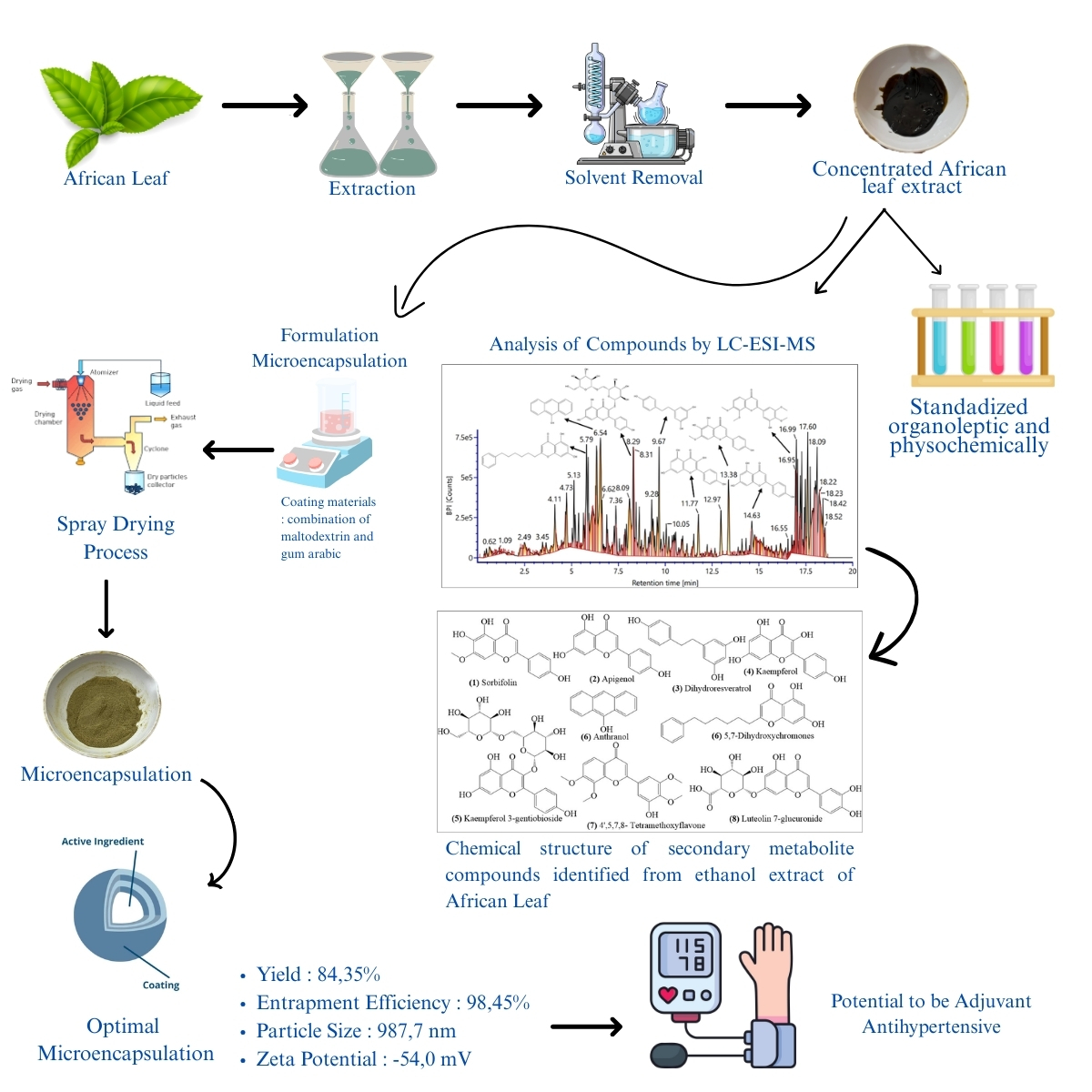
Vernonia amygdalina has historically been utilized in traditional medicine and is recognized for its bioactive constituents, including alkaloids, flavonoids, tannins, steroids, and saponins, which may have antihypertensive properties. This work sought to develop and assess a microencapsulated formulation of V. amygdalina leaf extract to enhance stability, bioavailability, and therapeutic efficacy. The extract was procured using ethanol maceration, standardized through organoleptic, physicochemical, and phytochemical evaluations, and subsequently characterized by LC-ESI-MS, which verified flavonoids (luteolin, apigenin, quercetin) and phenolic acids as the predominant components. Microencapsulation was executed using spray drying utilizing gum arabic and maltodextrin as encapsulating agents. Four formulations were evaluated, exhibiting entrapment efficiencies from 73.35% to 98.45%, water contents between 3.53% and 5.12%, and yields ranging from 72.40% to 84.35%. Formula 1 (gum arabic:maltodextrin ratio 7:1) exhibited the most advantageous properties, comprising the minimal water content (3.53%), maximal yield (84.35%), and nearly total entrapment efficiency (98.45%). The average particle size was 987.7 nm, with a zeta potential of –54.0 mV, signifying robust colloidal stability. SEM examination verified spherical shape with consistent distribution. The quantitative results indicate that microencapsulation enhanced extract stability and facilitated the regulated release of bioactive components, hence improving delivery performance. In conclusion, the refined formulation of V. amygdalina extract establishes a robust foundation for its advancement as a phytopharmaceutical or nutraceutical candidate for supplementary hypertension treatment, necessitating additional in vivo and clinical assessment.
HIGHLIGHTS
- Vernonia amygdalina leaf extract has been shown to contain flavonoids and phenolic acids, supporting its potential as an antihypertensive agent.
- The microencapsulation process using a combination of gum arabic and maltodextrin improves the stability of the extract while masking the bitter taste.
- A formula with a 7:1 ratio (gum arabic: maltodextrin) demonstrated the best results, with high yields and entrapment efficiency approaching > 90%.
- Physical and chemical characterization of the microencapsulation formula design demonstrated a stable system worthy of development.
- These findings form the basis for the development of phytopharmaceutical/nutraceutical products for health.
GRAPHICAL ABSTRACT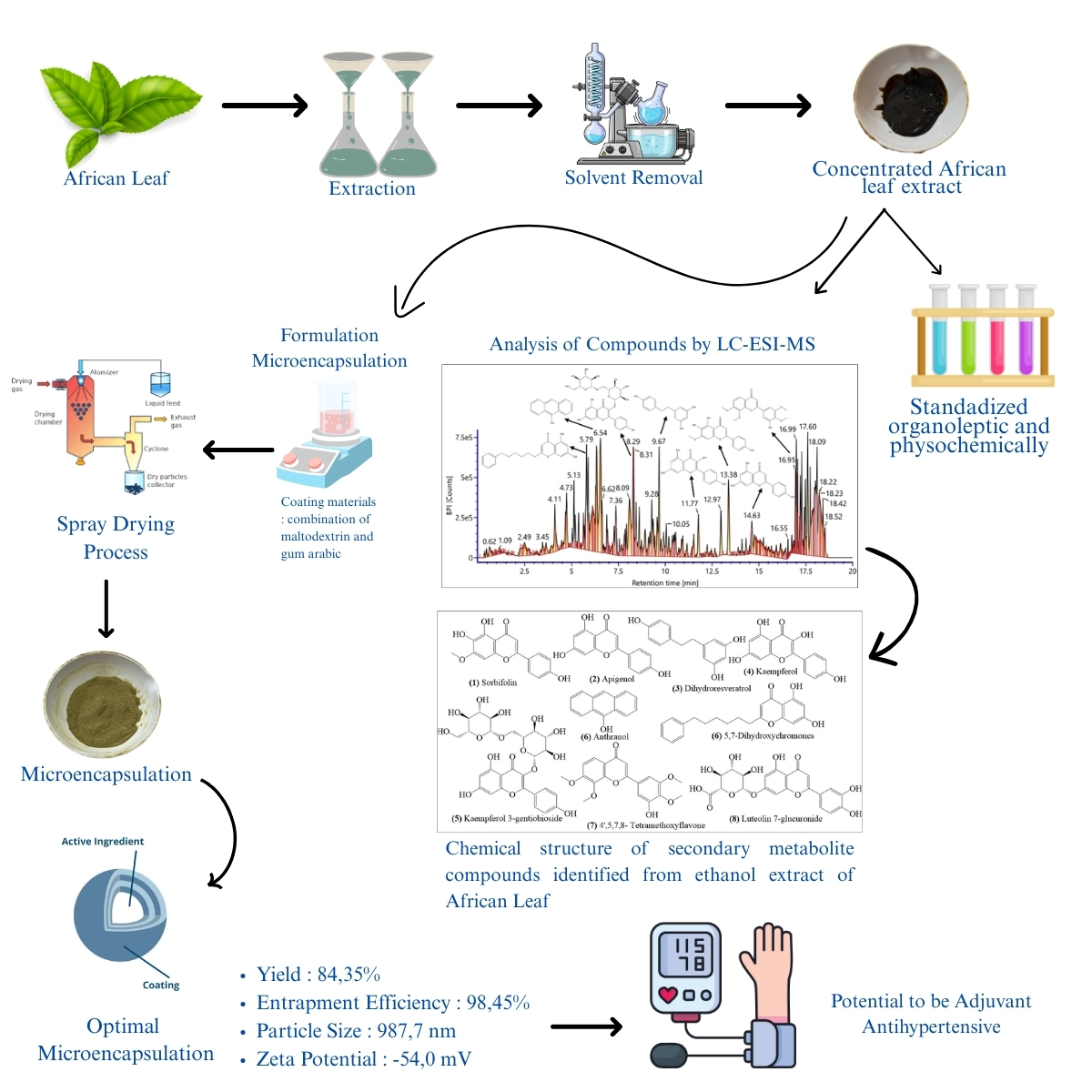
Downloads
References
S Goorani, S Zangene and JD Imig. Hypertension: A continuing public healthcare issue. International Journal of Molecule Sciences 2025; 26(1), 0123.
KT Mills, A Stefanescu and J He. The global epidemiology of hypertension. Nature Reviews Nephrology 2020; 16(4), 223-237.
AE Moran, R Gupta, A Pathni, K Osi, G Dessie, X Zhang, D Cazabon, B Banigbe, M Farrell and O Erojikwe. Implementation of global hearts hypertension control programs in 32 low- and middle-income countries: JACC international. Journal of the American College of Cardiology 2023; 82(17), 1868-1884.
K Kario, A Okura, S Hoshide and M Mogi. The WHO Global report 2023 on hypertension warning the emerging hypertension burden in globe and its treatment strategy. Hypertension Research 2024; 47(10), 1099-1102.
B Heidari, E Avenatti and K Nasir. Pharmacotherapy for essential hypertension: A brief review. Methodist DeBakey Cardiovascular Journal 2022; 18(1), 5-16.
E Grossman, P Verdecchia, A Shamiss, F Angeli and G Reboldi. Diuretic treatment of hypertension. Diabetes Care 2011; 34(S2), S246.
S Laurent. Antihypertensive drugs. Pharmacology Research 2017; 124, 116-125.
N Nasim, IS Sandeep and S Mohanty. Plant-derived natural products for drug discovery: Current approaches and prospects. Nucleus 2022; 65(5), 399-411.
SL Ooi and SC Pak. Natural products with pharmaceutical activities. Molecules 2025; 30(23), 4557.
CB Aware, DN Patil, SS Suryawanshi, PR Mali, MR Rane, RG Gurav and JP Jadhav. Natural bioactive products as promising therapeutics: A review of natural product-based drug development. South African Journal of Botany 2022; 151, 512-528.
AM Tura, M Anbessa, ED Tulu and BZ Tilinti. Exploring Vernonia amygdalina’s leaf extracts for phytochemical screening and its anti-bacterial activities. International Journal of Food Properties 2024; 27(6), 960-974.
GI Edo, PO Samuel, AN Jikah, FO Onoharigho, LI Idu, P Obasohan, AR Opiti, J Electric, VO Ikpekoro, CF Otunuya, E Ugbuwe, J Ongulu, M Ijide, ID Nwaose, SR Ajakaye and JE Owigho. Biological and bioactive components of bitter leaf (Vernonia amygdalina leaf): Insight on health and nutritional benefits. A review. Food Chemistry Advances 2023; 3, 100488.
LA Setiani, N Herlina, V Oktaviani and O Cahyani. The potential of African leaf extract (Gymnanthemum amygdalinum Del.) as antihypertensive in male white rats. Proceedings of the International Conference on Natural Sciences, Mathematics, Application, and Technology (ICON-SMART) 2022; 2, 10-17.
D Maaliki, AA Shaito, G Pintus, A El-Yazbi and AH Eid. Flavonoids in hypertension: A brief review of the underlying mechanisms. Current Opinion in Pharmacology 2019; 45, 57-65.
AP Haynes, S Desta, T Ahmad, K Neikirk, A Hinton, N Bloodworth and A Kirabo. The antioxidative effects of flavones in hypertensive disease. Biomedicines 2023; 11(11), 2877.
A Szpicer, W Bińkowska, A Stelmasiak, I Wojtasik-Kalinowska, A Czajkowska, S Mierzejewska, Z Domiszewski, T Rydzkowski, J Piepiórka-Stepuk and A Półtorak. Innovative microencapsulation techniques of bioactive compounds: Impact on physicochemical and sensory properties of food products and industrial applications. Applied Sciences 2025; 15(22), 11908.
D Das Emon, MS Islam, MAR Mazumder, MG Aziz and MS Rahman. Recent applications of microencapsulation techniques for delivery of functional ingredient in food products: A comprehensive review. Food Chemistry Advances 2025; 6, 100923.
JB Harborne. Phytochemical methods: A guide to modern techniques of plant analysis. 3rd ed. Chapman & Hall, London, 1998.
S Nur, A Aisyah, N Nursamsiar, F Sami, A Fadri, N Khairi and A Sapra. Standardization and GC-MS analysis of Kersen (Muntingia calabura L.) fruit ethanol extract as an herbal raw material. Bulletin of Pharmaceutical Sciences Assiut 2023; 46(2), 185037.
S Nur, FJ Sami, M Marwati, N Nursamsiar, A Fadri and K Khairuddin. Phenolic and flavonoid content of black mulberry (Morus nigra L.) stem and their evaluation antioxidant and cytotoxic profile. Borneo Journal of Pharmacy 2022; 5(4), 384-395.
SA Mahdavi, SM Jafari, E Assadpoor and D Dehnad. Microencapsulation optimization of natural anthocyanins with maltodextrin, gum Arabic and gelatin. International Journal of Biological Macromolecules 2016; 85, 379-385.
L Sadiah, R Indiarto and Y Cahyana. Karakteristik dan senyawa fenolik mikrokapsul ekstrak daun kelor (Moringa oleifera) dengan kombinasi maltodekstrin dan whey protein iso (in Indonesian). Jurnal Teknologi Industri Pertanian 2022; 32(3), 273-282.
J de Cássia Gomes da Rocha, TCB Rigolon, LLR Borges, ALAA Nascimento, NA Neves, ÍT Perrone, R Stephani and PC Stringheta. Anthocyanin stability in a mix of phenolic extracts microencapsulated by maltodextrine, whey protein and gum arabic. Journal of Food and Nutrition Research 2023; 11(1), 1-12.
S Nur, MFN Alwani, FJ Sami, A Sapra, AN Aisyah, M Indrisari, Nursamsiar, NA Yusuf and Aristianti. Transfersome-based delivery of Muntingia calabura fruit extract for anti-aging applications. Biocatalysis and Agricultural Biotechnology 2025; 66, 103604.
S Nur, FJ Sami, A Sapra, AN Aisyah, A Burhan, Megawati, Marwati, NA Yusuf, Mislia and Nursamsiar. Application Box-Behnken design for the optimum cream formula of Muntingia calabura fruit extract: In vitro and In vivo studies as an antiaging product. Research Journal of Pharmacy and Technology 2024; 17(12), 5325-5335.
K Qiao, M Zhao, Y Huang, L Liang and Y Zhang. Bitter perception and effects of foods rich in bitter compounds on human health: A comprehensive review. Foods 2024; 13(23), 3747.
X Chu, W Zhu, X Li, E Su and J Wang. Bitter flavors and bitter compounds in foods: identification, perception, and reduction techniques. Food Research International 2024; 183, 114234.
F Husain, Y Ysrafil, RPA Daud, AN Aisyah, A Fadri and S Nur. Authentication of medicinal chemicals in traditional herbal products (Jamu) by UV-Vis spectrophotometry. Hacettepe University Journal of the Faculty of Pharmacy 2023; 43(2), 1090673.
CDA Irudaya, U Venkatesan, R Srinivasan, S Moorthy and K Raja. Evaluation of stability and determination of shelf life of an herbal food supplement: Naturovita. Journal of Pharmacognosy and Phytochemistry 2023; 12(1), 219-225.
M Vera Zambrano, B Dutta, DG Mercer, HL MacLean and MF Touchie. Assessment of moisture content measurement methods of dried food products in small-scale operations in developing countries: A review. Trends in Food Science and Technology 2019; 88, 484-496.
A Monti, N Di Virgilio and G Venturi. Mineral composition and ash content of six major energy crops. Biomass and Bioenergy 2008; 32(3), 216-223.
P Dey, A Kundu, A Kumar, M Gupta, BM Lee, T Bhakta, S Dash and HS Kim. Analysis of alkaloids (indole alkaloids, isoquinoline alkaloids, tropane alkaloids). In: AS Silva, SF Nabavi, M Saeedi and SM Nabavi (Eds.). Recent advances in natural products analysis. Elsevier, Amsterdam, Netherland, 2020, p. 505-567.
YS Ch’ng, YC Loh, CS Tan, M Ahmad, MZ Asmawi, WMW Omar and MF Yam. Vasorelaxant properties of Vernonia amygdalina ethanol extract and its possible mechanism. Pharmacognosy Biology 2017; 55(12), 2083-2094.
EC Pham, VV Doan, TVL Thi, CV Ngo and LV Van. In vivo and in silico antihypertensive, anti-inflammatory, and analgesic activities of Vernonia amygdalina Del. leaf extracts. Heliyon 2024; 10(5), e38634.
Z Zhou, J Chen, Y Cui, R Zhao, H Wang, R Yu, T Jin, J Guo and Y Cong. Antihypertensive activity of different components of Veratrum alkaloids through metabonomic data analysis. Phytomedicine 2023; 120, 155033.
R Caminiti, C Carresi, R Mollace, R Macrì, F Scarano, F Oppedisano, J Maiuolo, M Serra, S Ruga, S Nucera, A Tavernese, M Gliozzi, V Musolino, E Palma, C Muscoli, S Rubattu, M Volterrani, M Federici, M Volpe and V Mollace. The potential effect of natural antioxidants on endothelial dysfunction associated with arterial hypertension. Frontiers in Cardiovascular Medicine 2024; 11, 1345218.
H Li and Q Zhang. Research progress of flavonoids regulating endothelial function. Pharmaceuticals 2023; 16(9), 1201.
MA Asif, SR Lisa and N Qais. Exploring the anti-hypertensive properties of medicinal plants and their bioactive metabolites: An extensive review. American Journal of Plant Sciences 2021; 12(11), 1705-1740.
TAFT Anuar and A Ismail. Southeast Asian medicinal plants with angiotensin converting enzyme (ACE) inhibition properties. Pharmacognosy Journal 2020; 12(6), 1429-1439.
H Luo, J Chen, C Su and L Zha. Advances in the Bioactivities of Phytochemical Saponins in the Prevention and Treatment of Atherosclerosis. Nutrients 2022; 14(23), 4998.
X Ma, J Lu, XR Gu, Y Jia, B Shen, Y Weiming, GH Du and CB Zheng. Cardioprotective effects and mechanisms of saponins on cardiovascular disease. Natural Product Communications 2022; 17(12), 1-8.
D Zielińska, M Starowicz, M Wronkowska and H Zieliński. Angiotensin-converting enzyme inhibitory activity of selected phenolic acids, flavonoids, their o-glucosides, and low-molecular-weight phenolic metabolites in relation to their oxidation potentials. Metabolites 2025; 15(7), 443.
L Guerrero, J Castillo, M Quiñones, S Garcia-Vallvé, L Arola, G Pujadas and B Muguerza. Inhibition of Angiotensin-Converting Enzyme Activity by Flavonoids: Structure-Activity Relationship Studies. PLoS One 2012; 7(12), e49493.
H Silva and NMF Lopes. Cardiovascular effects of caffeic acid and its derivatives: A comprehensive review. Frontiers in Physiology 2020; 11, 595516.
OR Alara, NH Abdurahman, CI Ukaegbu and NA Kabbashi. Extraction and characterization of bioactive compounds in Vernonia amygdalina leaf ethanolic extract comparing Soxhlet and microwave-assisted extraction techniques. Journal of Taibah University for Science 2019; 13(1), 414-422.
D Hudiyanti, MF Al Khafiz, K Anam, P Siahaan, L Suyati, S Sunarsih and SM Christa. Prospect of Gum Arabic–Cocoliposome Matrix to Encapsulate Curcumin for Oral Administration. Polymers 2024; 16(7), 944.
MV Loureiro, A Aguiar, RG dos Santos, JC Bordado, I Pinho and AC Marques. Design of Experiment for Optimizing Microencapsulation by the Solvent Evaporation Technique. Polymers 2024; 16(1), 111.
EF Apriani, S Septina and A Ahmadi. Effect of stirring speed and stirring time on characterization of clindamycin HCL ethosomal and ICH Q1A (R2) stability test. Farmacia 2023; 71(5), 956-965.
SM Jafari, E Assadpoor, Y He and B Bhandari. Encapsulation efficiency of food flavours and oils during spray drying. Drying Technology 2008; 26(7), 816-835.
D Story, A Aminoroaya, Z Skelton, M Kumari, Y Zhang and BR Smith. Nanoparticle-based therapies in hypertension. Hypertension 2023; 80(11), 2506-2514.
AMM Tamboli, J Munaf Tade and Zeta Potential. A comprehensive review. International Research Journal of Pharmacy and Medical Sciences 2025; 8, 115-124.
K Sakulnarmrat and I Konczak. Encapsulation of Melodorum fruticosum Lour. Anthocyanin-rich extract and its incorporation into model food. LWT 2022; 153, 112546.
A Al-Hamayda, B Abu-Jdayil, M Ayyash and J Tannous. Advances in microencapsulation techniques using Arabic gum: A comprehensive review. Industrial Crops and Products 2023; 205, 117556.
W Yang, Y Gong, Y Wang, C Wu, X Zhang, J Li and D Wu. Design of gum Arabic/gelatin composite microcapsules and their cosmetic applications in encapsulating tea tree essential oil. RSC Advances 2024; 14(9), 4880-4889.
N Nadali, A Pahlevanlo, M Sarabi-Jamab and A Balandari. Effect of maltodextrin with different dextrose equivalents on the physicochemical properties of spray-dried barberry juice (Berberis vulgaris L.). Journal of Food Science and Technology 2022; 59(7), 2855-2866.
Published
How to Cite
Issue
Section
License
Copyright (c) 2025 Walailak University

This work is licensed under a Creative Commons Attribution-NonCommercial-NoDerivatives 4.0 International License.





