
Multi-Target AntiAging Potential of Sterculia Populifolia DC Stem Bark: Inhibition of Tyrosinase, Elastase, and Hyaluronidase, LC–MS/MS Profiling and Molecular Docking
DOI:
https://doi.org/10.48048/tis.2026.12125Keywords:
Sterculia populifolia, Molecular docking, Tyrosinase inhibition, Elastase inhibition, Hyaluronidase inhibition, LCS/MS, AntiagingAbstract
This study evaluates the stem bark of Sterculia populifolia as a multi-target anti-aging cosmeceutical source, aiming to map its phytochemical profile and assess tyrosinase, elastase, and hyaluronidase inhibition integrated with molecular docking and LCMS/MS. Solvent-guided extraction (n-hexane, ethyl acetate, ethanol) was followed by phytochemical screening, LCMS/MS, in vitro enzyme assays against the three targets, and residue-level docking; integration of chemical features with bioactivity prioritized extracts and candidate molecules. Ethanol afforded the highest yield and enriched phenolic and heteroatom-rich constituents, aligning with the strongest tyrosinase inhibition; n-hexane concentrated lipophiles that produced the most pronounced anti-elastase effect, while hyaluronidase inhibition was moderate. Docking substantiated residue-level rationales: For tyrosinase, stearidonic acid, 4-[(E)-(3,5-diamino-1H-pyrazol-4-yl)diazenyl]phenol, N~4~-(4-methoxyphenyl)-5-nitro-N~2~-(tetrahydrofuran-2-ylmethyl)pyrimidine-2,4,6-triamine, and 6-Guanidinohexanoic acid Hemihydrate engaged copper-proximal, histidine-rich regions. For elastase, 5,5′-(1,3-phenylene)bis[2-(3-(1H-tetrazol-5-yl)propyl)-2H-tetrazole] and the same polyunsaturated fatty acid bridged S1/S2 subsites near His57/Ser195/Gly193. For hyaluronidase, ethyl 2-(3,5-dimethyl-1H-pyrazol-1-yl)-4-[(6-methyl-2-phenylpyrimidin-4-yl)hydrazinyl]pyrimidine-5-carboxylate and stearidonic acid occupied the substrate-binding loop, although solution-phase potency remained limited. These patterns mirror solvent selectivity and explain the anti-enzyme hierarchy; integrating chemistry with bioactivity strengthens the multi-target cosmeceutical prospect and underscores the need for enrichment and formulation to maximize hyaluronidase effects. Overall, ethanol extracts are prioritized for pigmentation control via tyrosinase, and n-hexane extracts for matrix protection via anti-elastase, while further bioassay-guided extraction, structure authentication, cellular and in vivo testing, and formulation optimization are warranted for translational development.
HIGHLIGHTS
- Sterculia populifolia stem bark was evaluated for its multi-target anti-aging potential through inhibition of tyrosinase, elastase, and hyaluronidase.
- Ethanolic extracts showed the highest tyrosinase inhibition, while n-hexane extracts exhibited the most pronounced anti-elastase activity
- Molecular docking analysis revealed key interactions between bioactive compounds and enzyme active sites, supporting observed bioactivities.
- In vitro assays confirmed that ethanol extracts had the strongest tyrosinase inhibition (IC50 = 513.80 µg/mL) and moderate anti-elastase effects.
- Sterculia populifolia bark is positioned as a multi-functional cosmeceutical candidate with potential for pigmentation control and skin protection, with further optimization needed.
GRAPHICAL ABSTRACT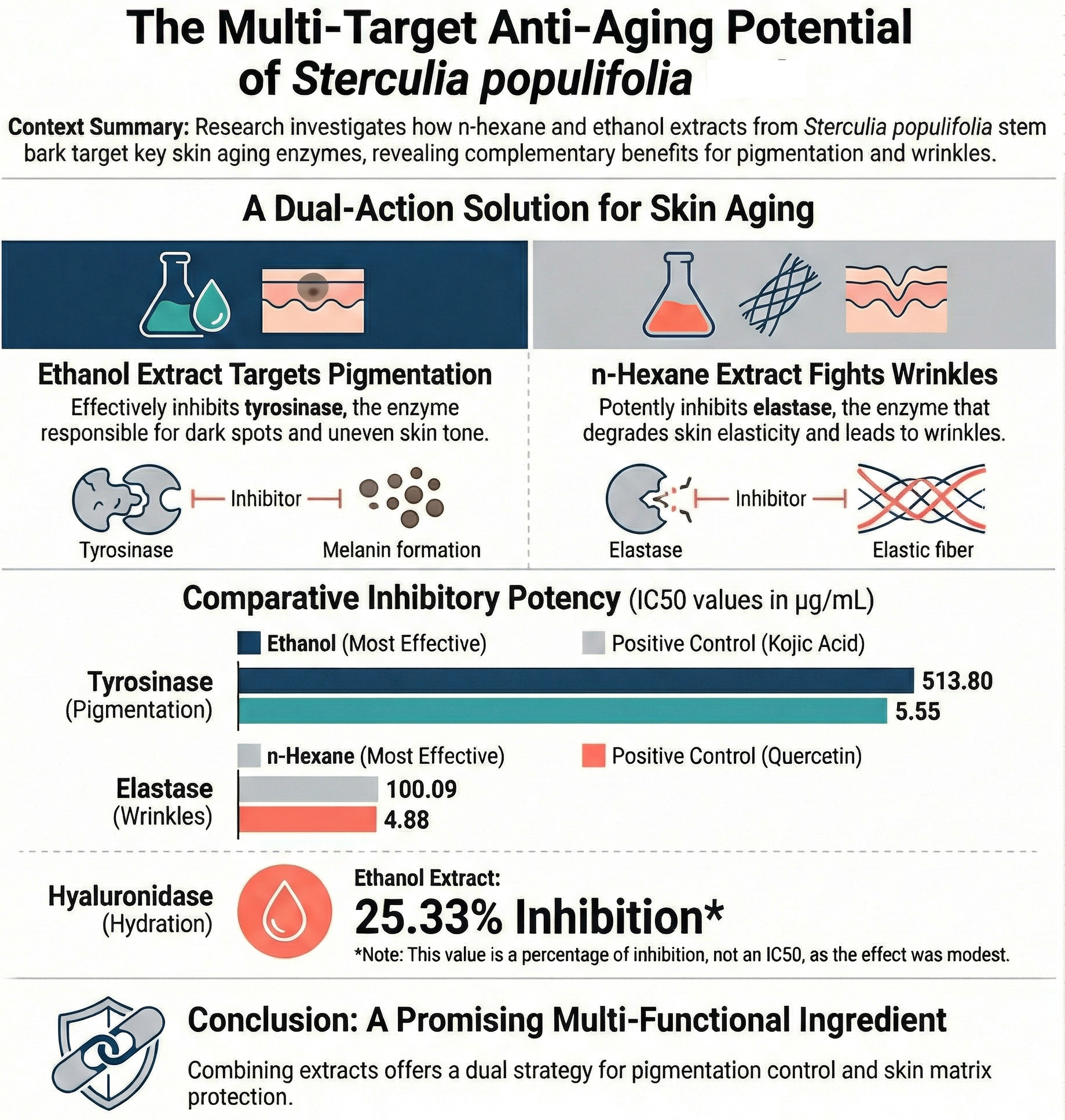
Downloads
References
N Khairi, S As’Ad, K Djawad and G Alam. The effectiveness of extract klika streculia populifolia cream on the collagen of albino mice against Ultraviolet B radiation. Indian Journal of Public Health Research and Development 2019; 10(1), 309.
N Khairi, S As’ad, K Djawad and G Alam. Effects of klika faloak (Sterculia populifolia). Egyptian Journal of Basic and Clinical Pharmacology 2019. https://doi.org/10.32527/2019/101408
N Khairi, S As’Ad, K Djawad and G Alam. The determination of antioxidants activity and sunblock Sterculia populifolia extract- based cream. Pharmaceutical and Biomedical Research 2018; 4(1), 20-26.
N Khairi, N Nursamsiar, NF Utami, M Marwati, S Nur, M Indrisari and S Kursia. Phytochemical profiling and enzyme inhibitory activity of Sterculia populifolia DC stem bark extract and fractions against elastase and tyrosinase. Narra J 2025; 5(3), e1778.
EF Costa, WV Magalhães and LCD Stasi. Recent advances in herbal-derived products with skin anti-aging properties and cosmetic applications. Molecules 2022; 27(21), 7518.
G Siquier-Dameto, S Boisnchatic, P Boadas-Vaello and E Verdú. Anti-aging and depigmentation effect of a hyaluronic acid mechanically stabilized complex on human skin explants. Polymers 2023; 15(11), 2438.
A Fernandes, PM Rodrigues, M Pintado and FK Tavaria. A systematic review of natural products for skin applications: Targeting inflammation, wound healing, and photo-aging. Phytomedicine 2023; 115, 154824.
S Kanwal, S Ahmad, MY Begum, A Siddiqua, H Rao, BA Ghalloo, MN Shahzad, I Ahmad and KR Khan. Chemical profiling, in-vitro biological evaluation and molecular docking studies of Ruellia tweediana: An unexplored plant. Saudi Pharmaceutical Journal 2024; 32(2), 101939.
N Jaradat, M Hawash, MT Qaoud, N Al-Maharik, M Qadi, F Hussein, L Issa, A Saleh, L Saleh and A Jadallah. Biological, phytochemical and molecular docking characteristics of Laurus nobilis L. fresh leaves essential oil from Palestine. BMC Complementary Medicine and Therapies 2024; 24(1), 223.
S Zolghadri, A Bahrami, MTH Khan, J Munoz-Munoz, F Garcia-Molina, F Garcia-Canovas and AA Saboury. A comprehensive review on tyrosinase inhibitors. Journal of Enzyme Inhibition and Medicinal Chemistry 2019; 34(1), 279-309.
HAS El-Nashar, MIG El-Din, L Hritcu and OA Eldahshan. Insights on the inhibitory power of flavonoids on tyrosinase activity: A survey from 2016 to 2021. Molecules 2021; 26(24), 7546.
M Chatatikun, A Tedasen, NC Pattaranggoon, W Palachum, S Chuaijit, A Mudpan, S Pruksaphanrat, S Sohbenalee, K Yamasaki and WK Klangbud. Antioxidant activity, anti-tyrosinase activity, molecular docking studies, and molecular dynamic simulation of active compounds found in nipa palm vinegar. PeerJ 2023; 11, e16494.
L Panzella and A Napolitano. Natural and bioinspired phenolic compounds as tyrosinase inhibitors for the treatment of skin hyperpigmentation: Recent advances. Cosmetics 2019; 6(4), 57.
K Pohntadavit, S Duangmano, M Osiriphan, N Leksawasdi, C Techapun, N Sumonsiri, SR Sommano, P Rachtanapun, R Nunta and J Khemacheewakul. Tyrosinase inhibitory activity of crude procyanidin extract from green soybean seed and the stability of bioactive compounds in an anti-aging skin care formulation. Cosmetics 2024; 11(5), 178.
CD Bui, TT Dinh, TT Le, TV Tran, CDM Huynh, TH Le, NT Nguyen, MTT Nguyen, HX Nguyen, TNV Do and H Tran-Van. Anti-tyrosinase activity of Curcuma aromatica ethyl acetate extract: From lead diarylheptanoids to melanogenesis targets. Beni-Suef University Journal of Basic and Applied Sciences 2025; 14(1), 86.
I Mahdi, P Imbimbo, AB Ortaakarsu, MA Ochieng, WB Bakrim, BE Drissi, MA Ibrahim, MAO Abdelfattah, MF Mahmoud, DM Monti and M Sobeh. Chemical profiling and dermatological and anti-aging properties of Syzygium jambos L. (Alston): Evidence from molecular docking, molecular dynamics, and in vitro experiments. Frontiers in Molecular Biosciences 2024; 10, 1331059.
J Lu, Z Zhao, L Pan, H Wu, S Wang, X Tong and S Wu. Hyaluronidase: Structure, mechanism of action, diseases and therapeutic targets. Molecular Biomedicine 2025; 6(1), 50.
H Yamaguchi, R Yamada, K Lama, UJ Youn, JH Lee and TJ Oh. Integrating LC-MS/MS and In Silico methods to uncover bioactive compounds with lipase inhibitory potential in the antarctic moss warnstorfia fontinaliopsis. Applied Biochemistry and Biotechnology 2025; 197(4), 2734-2756.
S Soltani, RBA Kolsi, N Baccouch, T Michel, N Allouche and HB Salah. LC–MS/MS Profiling, Biological activities and molecular docking studies of simmondsia chinensis leaves. Chinensis Leaves. Chemistry & Biodiversity 2025; 22(3), e202401833.
R Zhao, E Bruning, D Rossetti, B Starcher, M Seiberg and V Iotsova-Stone. Extracts from Glycine max (soybean) induce elastin synthesis and inhibit elastase activity. Experimental Dermatology 2009; 18(10), 883-886.
K Tsukahara, H Nakagawa, S Moriwaki, Y Takema, T Fujimura and G Imokawa. Inhibition of ultraviolet-B-induced wrinkle formation by an elastase-inhibiting herbal extract: Implication for the mechanism underlying elastase-associated wrinkles. International Journal of Dermatology 2006; 45(4), 460-468.
A García-Villegas, A Rojas-García, MC Villegas-Aguilar, P Fernández-Moreno, Á Fernández-Ochoa, ML Cádiz-Gurrea, D Arráez-Román and A Segura-Carretero. cosmeceutical potential of major tropical and subtropical fruit by-products for a sustainable revalorization. Antioxidants 2022; 11(2), 203.
N Zulkefli, CNMC Zahari, NH Sayuti, AA Kamarudin, N Saad, HS Hamezah, H Bunawan, SN Baharum, A Mediani, QU Ahmed, AFH Ismail and MN Sarian. Flavonoids as potential wound-healing molecules: Emphasis on Pathways Perspective. International Journal of Molecular Sciences 2023; 24(5), 4607.
KL Cheong, A Sabir, M Wang, S Zhong and K Tan. Advancements in the extraction, characterization, and bioactive potential of laminaran: A Review. Foods 2025; 14(10), 1683.
A Mir-Cerdà, O Nuñez, M Granados, S Sentellas and J Saurina. An overview of the extraction and characterization of bioactive phenolic compounds from agri-food waste within the framework of circular bioeconomy. TrAC Trends in Analytical Chemistry 2023; 161, 116994.
G Sliwoski, S Kothiwale, J Meiler and EW Lowe. Computational methods in drug discovery. Pharmacological Reviews 2014; 66(1), 334-395.
FS Senol Deniz, IE Orhan and H Duman. Profiling cosmeceutical effects of various herbal extracts through elastase, collagenase, tyrosinase inhibitory and antioxidant assays. Phytochemistry Letters 2021; 45, 171-183.
H Mechqoq, S Hourfane, ME Yaagoubi, AE Hamdaoui, JRGDS Almeida, JM Rocha and NE Aouad. Molecular docking, tyrosinase, collagenase, and elastase inhibition activities of argan by-products. Cosmeticsc 2022; 9(1), 24.
J Widelski, K Gaweł-Bęben, K Czech, E Paluch, O Bortkiewicz, S Kozachok, T Mroczek and P Okińczyc. Extracts from European propolises as potent tyrosinase inhibitors. Molecules 2022; 28(1), 55.
F Pintus, S Floris, A Fais, B Era, A Kumar, G Gatto, E Uriarte and MJ Matos. Hydroxy-3-phenylcoumarins as multitarget compounds for skin aging diseases: Synthesis, molecular docking and tyrosinase, elastase, collagenase and hyaluronidase inhibition, and sun protection factor. Molecules 2022; 27(20), 6914.
J Lee, S Moon, Y Hong, D Ahn and H Paik. Anti-elastase and anti-hyaluronidase activity of phosvitin isolated from hen egg yolk. British Poultry Science 2020; 61(1), 17-21.
C Jiratchayamaethasakul, Y Ding, O Hwang, ST Im, Y Jang, SW Myung, JM Lee, HS Kim, SC Ko and SH Lee. In vitro screening of elastase, collagenase, hyaluronidase, and tyrosinase inhibitory and antioxidant activities of 22 halophyte plant extracts for novel cosmeceuticals. Fisheries and Aquatic Sciences 2020; 23(1), 6.
Y Desmiaty, F Saputri, M Hanafi, R Prastiwi and B Elya. Anti-elastase, anti-tyrosinase and anti-oxidant of rubus fraxinifolius stem methanolic extract. Pharmacognosy Journal 2020; 12(2), 271-275.
LA Ticona, JS Sánchez-Corral, CDG Martín, SC Jiménez, AL González and CT Estrada. Rubus urticifolius Compounds with Antioxidant Activity, and inhibition potential against Tyrosinase, Melanin, Hyaluronidase, Elastase, and Collagenase. Pharmaceuticals 2024; 17(7), 937.
IGB Krisnayana, PD Febyani, IAYP Sari and NPL Laksmiani. Molecular docking of lutein as anti-photoaging agent in silico. Pharmacy Reports 2021; 1(1), 15.
NKDP Dewi, KD Suryadewi, DM Fitriari, KL Andini, NPL Laksmiani. Molecular docking of gallic acid as anti-photoaging in silico. Pharmacy Reports 2021; 1(2), 18.
A Akbar, NH Soekamto, Firdaus and Bahrun. Antioxidant of n-hexane, ethyl acetate and methanol extracts of Padina sp with DPPH method. IOP Conference Series: Earth and Environmental Science 2021; 800(1), 012019.
A Wakeel, SA Jan, I Ullah, ZK Shinwari and M Xu. Solvent polarity mediates phytochemical yield and antioxidant capacity of Isatis tinctoria. PeerJ 2019; 7, e7857.
MQ Lian, WH Chng, J Liang, HQ Yeo, CK Lee, M Belaid, M Tollemeto, MG Wacker, B Czarny and G Pastorin. Plant‐derived extracellular vesicles: Recent advancements and current challenges on their use for biomedical applications. Journal of Extracellular Vesicles 2022; 11(12), e12283.
AG Atanasov, B Waltenberger, EM Pferschy-Wenzig, T Linder, C Wawrosch, P Uhrin, V Temml, L Wang, S Schwaiger, EH Heiss, JM Rollinger, D Schuster, JM Breuss, V Bochkov, MD Mihovilovic, B Kopp, R Bauer, VM Dirsch and H Stuppner. Discovery and resupply of pharmacologically active plant-derived natural products: A review. Biotechnology Advances 2015; 33(8), 1582-1614.
M Syukur, MS Prahasiwi, N Nurkhasanah, S Yuliani, Y Purwaningsih and E Indriyanti. Profiling of active compounds of extract ethanol, n-Hexane, ethyl acetate and fraction ethanol of star anise (Illicium verum Hook. f.) and determination of total flavonoids, total phenolics and their potential as antioxidants. Science and Technology Indonesia 2023; 8(2), 219-226.
A Akbar, NH Soekamto, Firdaus and Bahrun. Total phenolics and flavonoids level of n-hexane, ethyl acetate and methanol extracts of Sargassum sp. along with their antioxidant activity by DPPH method. AIP Conference Proceedings 2022; 2638, 060009.
CD Bui, TT Dinh, TT Le, TV Tran, CDM Huynh, TH Le, NT Nguyen, MTT Nguyen, HX Nguyen, TNV Do and H Tran-Van. Anti-tyrosinase activity of Curcuma aromatica ethyl acetate extract: From lead diarylheptanoids to melanogenesis targets. Beni-Suef University Journal of Basic and Applied Sciences 2025; 14(1), 86.
L Panzella and A Napolitano. Natural and Bioinspired Phenolic Compounds as Tyrosinase Inhibitors for the Treatment of Skin Hyperpigmentation: Recent Advances. Cosmetics 2019; 6(4), 57.
T Pillaiyar, M Manickam and V Namasivayam. Skin whitening agents: Medicinal chemistry perspective of tyrosinase inhibitors. Journal of Enzyme Inhibition and Medicinal Chemistry 2017; 32(1), 403-425.
C Horng, H Wu, N Chiang, C Lee, YS Huang, HY Wang, JS Yang and FA Chen. Inhibitory effect of burdock leaves on elastase and tyrosinase activity. Experimental and Therapeutic Medicine 2017; 14(4), 3247-3252.
YS Lin, HJ Chen, JP Huang, PC Lee, CR Tsai, TF Hsu and WY Huang. Kinetics of tyrosinase inhibitory activity using vitis vinifera leaf extracts. BioMed Research International 2017; 2017, 5232680.
H Maamoun, G Rabie, I Shaker, B Alaidaroos and A El-Sayed. Biochemical properties of tyrosinase from aspergillus terreus and penicillium copticola; undecanoic acid from aspergillus flavus, an endophyte of moringa oleifera, is a novel potent tyrosinase inhibitor. Molecules 2021; 26(5), 1309.
F Yang, Y Hu, M Wu, M Guo and H Wang. Biologically active components and skincare benefits of rice fermentation products: A review. Cosmetics 2025; 12(1), 29.
CH Eun, MS Kang and IJ Kim. Elastase/Collagenase inhibition compositions of citrus unshiu and its association with phenolic content and anti-oxidant activity. Applied Sciences 2020; 10(14), 4838.
S Ahmad, M Saleem, N Riaz, Y Lee, R Diri, A Noor, D Almasri, A Bagalagel and MF Elsebai. The natural polypeptides as significant elastase inhibitors. Frontiers in Pharmacology 2020; 11, 688.
N Morisaki, S Moriwaki, Y Sugiyama-Nakagiri, K Haketa, Y Takema and G Imokawa. Neprilysin is identical to skin fibroblast elastase. Journal of Biological Chemistry 2010; 285(51), 39819-39827.
H Khojah, SR Ahmed, SY Alharbi, KK AlSabeelah, HY Alrayyes, KB Almusayyab, SR Alrawiliy, RM Alshammari, and S Qasim. Skin anti-aging potential of Launaea procumbens extract: Antioxidant and enzyme inhibition activities supported by ADMET and molecular docking studies. Saudi Pharmaceutical Journal 2024; 32(7), 102107.
I Mahdi, P Imbimbo, AB Ortaakarsu, MA Ochieng, WB Bakrim, BE Drissi, MA Ibrahim, MAO Abdelfattah, MF Mahmoud, DM Monti and M Sobeh. Chemical profiling and dermatological and anti-aging properties of Syzygium jambos L. (Alston): Evidence from molecular docking, molecular dynamics, and in vitro experiments. Frontiers in Molecular Biosciences 2024; 10, 1331059.
F Pintus, S Floris, A Fais, B Era, A Kumar, G Gatto and E Uriarte. Hydroxy-3-Phenylcoumarins as Multitarget Compounds for Skin Aging Diseases: Synthesis, Molecular Docking and Tyrosinase, Elastase, Collagenase and Hyaluronidase Inhibition, and Sun Protection Factor. Molecules 2022; 27(20), 6914.
FSS Deniz, RE Salmas, E Emerce, IIT Cankaya, HS Yusufoglu and IE Orhan. Evaluation of collagenase, elastase and tyrosinase inhibitory activities of Cotinus coggygria Scop. through in vitro and in silico approaches. South African Journal of Botany 2020; 132, 277-288.
JH Lee, SH Moon, Y Hong, DU Ahn and HD Paik. Anti-elastase and anti-hyaluronidase activity of phosvitin isolated from hen egg yolk. British Poultry Science 2020; 61(1), 17-21.
S Abdillah, G Wijiyanti, M Setiawan, S Noor and M Nurilmala. In vitro anti-tyrosinase and anti-elastase activity of collagen from sea cucumber (Holothuria leucospilota). African Journal of Biotechnology 2017; 16(15), 771-776.
A Vardhani, M Jufri, E Purwaningsih. Potency of γ-oryzanol-rich black rice bran (oryza sativa l. indica) extract for tyrosinase inhibition. International Journal of Pharmacy and Pharmaceutical Sciences 2020; 12(5), 85-89.
MC Kwon, WY Choi, YC Seo, JS Kim, CS Yoon, HW Lim, HS Kim, J Ahn and HY Lee. Enhancement of the Skin-protective activities of centella asiatica L. urban by a nano-encapsulation process. Journal of Biotechnology 2012; 157(1), 100-106.
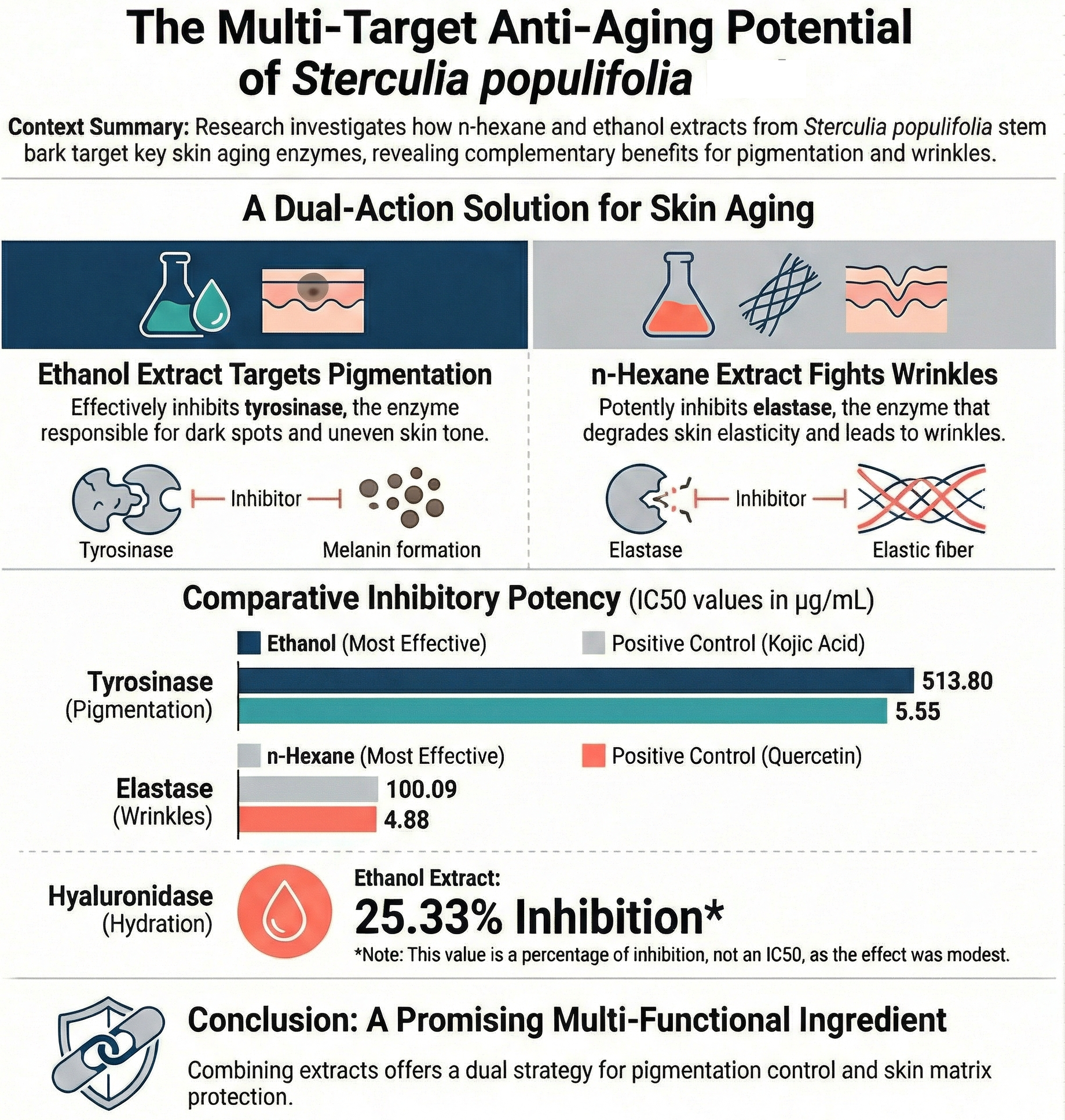
Published
How to Cite
Issue
Section
License
Copyright (c) 2025 Walailak University

This work is licensed under a Creative Commons Attribution-NonCommercial-NoDerivatives 4.0 International License.





