
Combined Effects of Sacha Inchi Protein Hydrolysate and Reduced-Dose Captopril on Duodenal and Cecal Morphology in L-NAME-Induced Hypertensive Rats
DOI:
https://doi.org/10.48048/tis.2026.12853Keywords:
Captopril, Hypertension model, Intestinal histology, Mucosal remodeling, Inflammation, Sacha inchi protein hydrolysate, L-NAME, Captopril, Hypertension model, Intestinal histology, Mucosal remodeling, Inflammation, Sacha inchi protein hydrolysate, L-NAMEAbstract
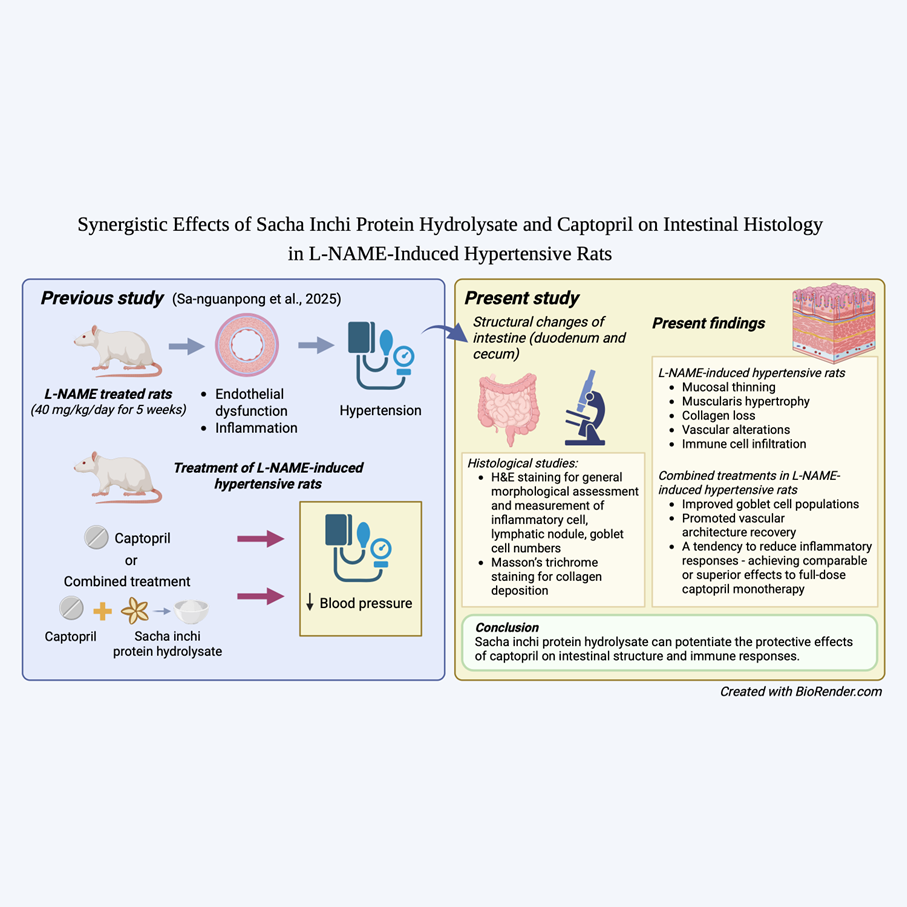
Hypertension disrupts intestinal homeostasis through structural remodeling and immune activation, contributing to gastrointestinal pathology. Angiotensin-converting enzyme inhibition confers measurable but incomplete tissue protection, suggesting that adjunctive approaches may further preserve intestinal integrity. This exploratory experimental study examined the intestinal effects of captopril alone or in combination with Sacha inchi protein hydrolysate, a plant-derived protein powder obtained from Plukenetia volubilis, in L-NAME-induced hypertensive rats (n = 4 - 5 per group). Animals were allocated to control, L-NAME, L-NAME plus captopril (5 mg/kg), or L-NAME plus low-dose captopril (2.5 mg/kg) combined with Sacha inchi protein hydrolysate (500 mg/kg). Histological analyses of the duodenum and cecum showed that L-NAME treatment induced pronounced mucosal thinning, muscular hypertrophy, reduced collagen deposition, vascular dilation, and increased inflammatory cell infiltration. Full-dose captopril partially attenuated these alterations but did not fully restore intestinal architecture. In contrast, the combination treatment significantly increased mucosal thickness in both intestinal regions (p < 0.001), enhanced collagen deposition (p < 0.05), and improved vascular architecture (p < 0.05), while inflammatory indices showed a consistent trend toward reduction. For several parameters, the combined regimen achieved outcomes comparable to or exceeding those observed with full-dose captopril. Collectively, these findings indicate that Sacha inchi protein hydrolysate may augment the intestinal protective effects of captopril under hypertensive conditions. Although preliminary and limited by sample size, the results provide supportive evidence for further investigation of plant-derived bioactive proteins as adjunctive strategies to mitigate hypertension-associated gastrointestinal remodeling.
HIGHLIGHTS
- Hypertension induces marked structural and immune disruption in the intestine.
- Captopril provides only partial protection against L-NAME–induced intestinal damage.
- Sacha inchi protein hydrolysate enhances the restorative effects of reduced-dose captopril.
- Combination therapy restores mucosal thickness, collagen, and vascular architecture.
- Findings support dose-sparing therapeutic strategies for hypertension-related gut pathology.
GRAPHICAL ABSTRACT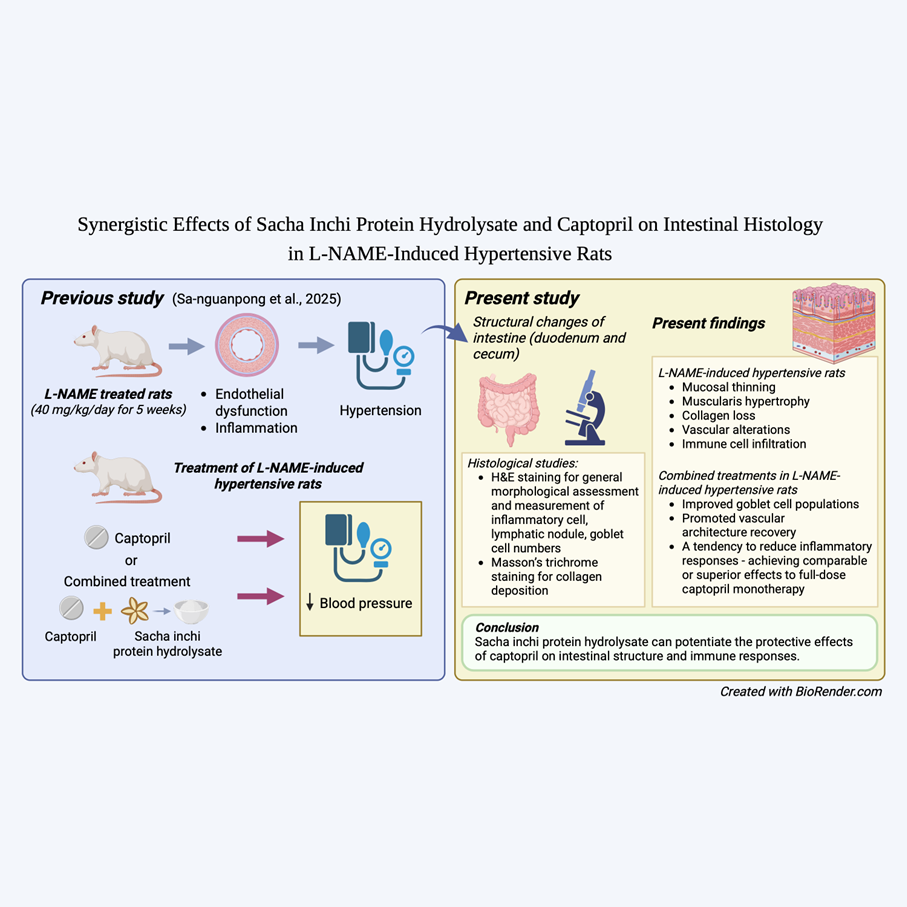
Downloads
References
References
B Zhou, P Perel, GA Mensah and M Ezzati. Global epidemiology, health burden and effective interventions for elevated blood pressure and hypertension. Nature Reviews Cardiology 2021; 18(11), 785-802.
A Luqman, A Hassan, M Ullah, S Naseem, M Ullah, L Zhang, AU Din, K Ullah, W Ahmad and G Wang. Role of the intestinal microbiome and its therapeutic intervention in cardiovascular disorder. Frontiers in Immunology 2024; 15, 1321395.
P Sa-nguanpong, P Wetprasit, A Inchan, C Chaichana, W Kaewkong, N Charoenphon, K Adthapanyawanich, K Tantanarat, W Tochampa, K Ruttarattanamongkol and T Bualeong. Sacha inchi meal protein hydrolysate mitigates lipid accumulation and oxidative stress in HepG2 and 3 T3-L1 cells and synergistically enhances captopril's antihypertensive effects in L-NAME-induced hypertensive rats. Journal of Functional Foods 2025; 127, 106772.
M Choi, JR Hwang, JH Sung, N Byun, YS Seok, GJ Cho, SJ Choi, JS Kim, SY Oh and CR Roh. Hydroxychloroquine reduces hypertension and soluble fms-like kinase-1 in a Nω‑nitro‑L‑arginine methyl ester-induced preeclampsia rat model. Journal of Hypertension 2022; 40, 2459-2468.
P Sa-nguanpong, P Wetprasit, U Chatturong, K Chootip, N Kantip, W Tochampa, K Ruttarattanamongkol and T Bualeong. Protective effects of Sacha inchi meal protein hydrolysate against oxidative stress and endothelial dysfunction via MDA suppression and SOD activation in L-NAME-induced hypertensive rats. European Journal of Medicinal Chemistry Reports 2025; 15, 100297.
EY Rha, JW Kim, JH Kim and G Yoo. Angiotensin-converting enzyme inhibitor, captopril, improves scar healing in hypertensive rats. International Journal of Medical Sciences 2021; 18(4), 975-983.
J Zicha, Z Dobešová and J Kuneš. Antihypertensive mechanisms of chronic captopril or N-acetylcysteine treatment in L-NAME hypertensive rats. Hypertension Research 2006; 29(12), 1021-1027.
MN Takuathung, W Sakuludomkan, R Khatsri, N Dukaew, N Kraivisitkul, B Ahmadmusa, C Mahakkanukrauh, K Wangthaweesap, J Onin, S Srichai, N Buawangpong and N Koonrungsesomboon. Adverse effects of angiotensin-converting enzyme inhibitors in humans: A systematic review and meta-analysis of 378 randomized controlled trials. International Journal of Environmental Research and Public Health 2022; 19, 8373.
A Lemus-Conejo, A Villanueva-Lazo, ME Martin, F Millan and MC Millan-Linares. Sacha inchi (Plukenetia volubilis L.) protein hydrolysate as a new ingredient of functional foods. Foods 2024; 13, 2045.
K Wang, M He, Z Tan, X Tang, B Du and P Li. Arabinogalactan polysaccharides derived from sacha inchi shells alleviate angiotensin II-induced endothelial cell dysfunction. Carbohydrate Polymers 2025; 368, 124149.
N Kobayashi, D Takahashi, S Takano, S Kimura and K Hase. The roles of peyer's patches and microfold cells in the gut immune system: Relevance to autoimmune diseases. Frontiers in Immunology 2019; 10, 2345.
MJ Cano-Cebrian, D Dahlgren, F Kullenberg, K Peters, T Olander, M Sjoblom and H Lennernas. Chemotherapeutics combined with luminal irritants: Effects on small-intestinal mannitol permeability and villus length in rats. International Journal of Molecular Sciences 2022; 23, 1021.
SA Lawal, A Voisin, H Olof, M Bording-Jorgensen and H Armstrong. Diversity of the microbiota communities found in the various regions of the intestinal tract in healthy individuals and inflammatory bowel diseases. Frontiers in Immunology 2023; 14, 1242242.
MM Santisteban, Y Qi, J Zubcevic, S Kim, T Yang, V Shenoy, CT Cole-Jeffrey, GO Lobaton, DC Stewart, A Rubiano, CS Simmons, F Garcia-Pereira, RD Johnson, CJ Pepine and MK Raizada. Hypertension-linked pathophysiological alterations in the gut. Circulation Research 2017; 120(2), 312-323.
HJ Suh, HS Yang, KS Ra, DO Noh, KH Kwon, JH Hwang and KW Yu. Peyer's patch-mediated intestinal immune system modulating activity of pectic-type polysaccharide from peel of Citrus unshiu. Food Chemistry 2013; 138(2-3), 1079-1086.
B Li, X He, SS Lei, FC Zhou, NY Zhang, YH Chen, YZ Wang, J Su, JJ Yu, LZ Li, X Zheng, R Luo, D Kolodynska, S Xiong, GY Lv and SH Chen. Hypertensive rats treated chronically with Nω‑nitro‑L‑arginine methyl ester (L-NAME) induced disorder of hepatic fatty acid metabolism and intestinal pathophysiology. Frontiers in Pharmacology 2019; 10, 1677.
HB Li, T Yang, EM Richards, CJ Pepine and MK Raizada. Maternal treatment with captopril persistently alters gut-brain communication and attenuates hypertension of male offspring. Hypertension 2020; 75(5), 1315-1324.
T Bualeong, JM Wyss and S Roysommuti. Advances in Experimental Medicine and Biology 2019; 1155, 45-59.
S Suwanangul, RE Aluko, P Sangsawad, D Kreungngernd and K Ruttarattanamongkol. Antioxidant and enzyme inhibitory properties of sacha inchi (Plukenetia volubilis) protein hydrolysate and its peptide fractions. Journal of Food Biochemistry 2022; 46, e14464.
E Torres-Sánchez, I Lorca-Alonso, S Gonzalez-de la Fuente, B Hernandez-Ledesma and LF Gutierrez. Antioxidant peptides from Sacha Inchi meal: An in vitro, ex vivo, and in silico approach. Foods 2024; 13(23), 3924.
P Bryniarski, K Nazimek and J Marcinkiewicz. Immunomodulatory activity of the most commonly used antihypertensive drugs-angiotensin converting enzyme Inhibitors and angiotensin II receptor blockers. International Journal of Molecular Sciences 2022; 23(3), 1772.
JH Kim, H Kim, YH Kim, WS Chung, JK Suh and SJ Kim. Antioxidant effect of captopril and enalapril on reactive oxygen species-induced endothelial dysfunction in the rabbit abdominal aorta. The Korean Journal of Thoracic and Cardiovascular Surgery 2013; 46, 14-21.
M Majzunova, M Kvandova, A Berenyiova, P Balis, I Dovinova and S Cacanyiova. Chronic NOS inhibition affects oxidative state and antioxidant response differently in the kidneys of young normotensive and hypertensive rats. Oxidative Medicine and Cellular Longevity 2019; 2019(1), 5349398.
Z Gu, L Fang and P Ma. The angiotensin-converting enzyme inhibitor, captopril, suppressed hepatic stellate cell activation via NF-kappaB or wnt3α/β-catenin pathway. Bioengineered 2021; 12(1), 8370-8377.
JY Yoo, M Groer, SVO Dutra, A Sarkar and DI McSkimming. Gut microbiota and immune system interactions. Microorganisms 2020; 8(10), 1587.
M Balcerowska and P Kwasnik. The multifaceted impact of stress on immune function. Molecular Biology Reports 2025; 52(1), 1008.
S Brown, GDG Nores, A Sarker, C Ly, C Li, HJ Park, GE Hespe, J Gardenier, K Kuonqui, A Campbell, J Shin, RP Kataru, O Aras and BJ Mehrara. Topical captopril: A promising treatment for secondary lymphedema. Translational Research 2023; 257, 43-53.
S Yang and M Yu. Role of goblet cells in intestinal barrier and mucosal immunity. Journal of Inflammation Research 2021; 14, 3171-3183.
W Deng, M Zhu, I Lloyd, M Nedunuri, C Zhou, W Liu, Y Li, Q Li, X Wang, Q Zhang, TA Jhuma, J Li and T Yang. Beyond the microbiome: The gut's role in hypertension. Function 2025; 6(5), zqaf037.
I Brockhausen, D Falconer and S Sara. Relationships between bacteria and the mucus layer. Carbohydrate Research 2024; 546, 109309.
J Teerapornpuntakit, S Chatree, K Limpatchayopas, J Chamta, A Monteil and C Promsuban. Comparative histology of the swine colon raised under intensive management farming and backyard farming systems in Thailand. Trends in Sciences 2026; 23, 11188.
Z Wang, Y Wang, X Wang, G Zhao, H Zeng, H Xiao, L Han, J Ding, Y Chang and R Zuo. Vitamin E enhances immune function and the intestinal histological structure by regulating the nodal-mediated signaling pathway: A case study on the sea cucumber apostichopus japonicus. Biology 2025; 14(8), 1008.
M Vancamelbeke and S Vermeire. The intestinal barrier: A fundamental role in health and disease. Expert Review of Gastroenterology & Hepatology 2017; 11, 821-834.
CY Peng, AN Chen, ZZ Hu, MM Hu, HT Wang, HB Liu, J Cheng, ZY Xiong, Y Shi, Y Pan, XM Sha and ZC Tu. Comparative analysis of antioxidant activity and accelerated collagen expression of human skin fibroblasts with gelatin hydrolysates from different sources. Food Chemistry: X 2025; 29, 102850.
Published
How to Cite
Issue
Section
License
Copyright (c) 2026 Walailak University

This work is licensed under a Creative Commons Attribution-NonCommercial-NoDerivatives 4.0 International License.





