
Comparative Histology of the Swine Colon Raised under Intensive Management Farming and Backyard Farming Systems in Thailand
DOI:
https://doi.org/10.48048/tis.2026.11188Keywords:
Backyard farming system, Colon, Colon histology, Colon morphology, Intensive management farming system, Intestinal health, SwineAbstract
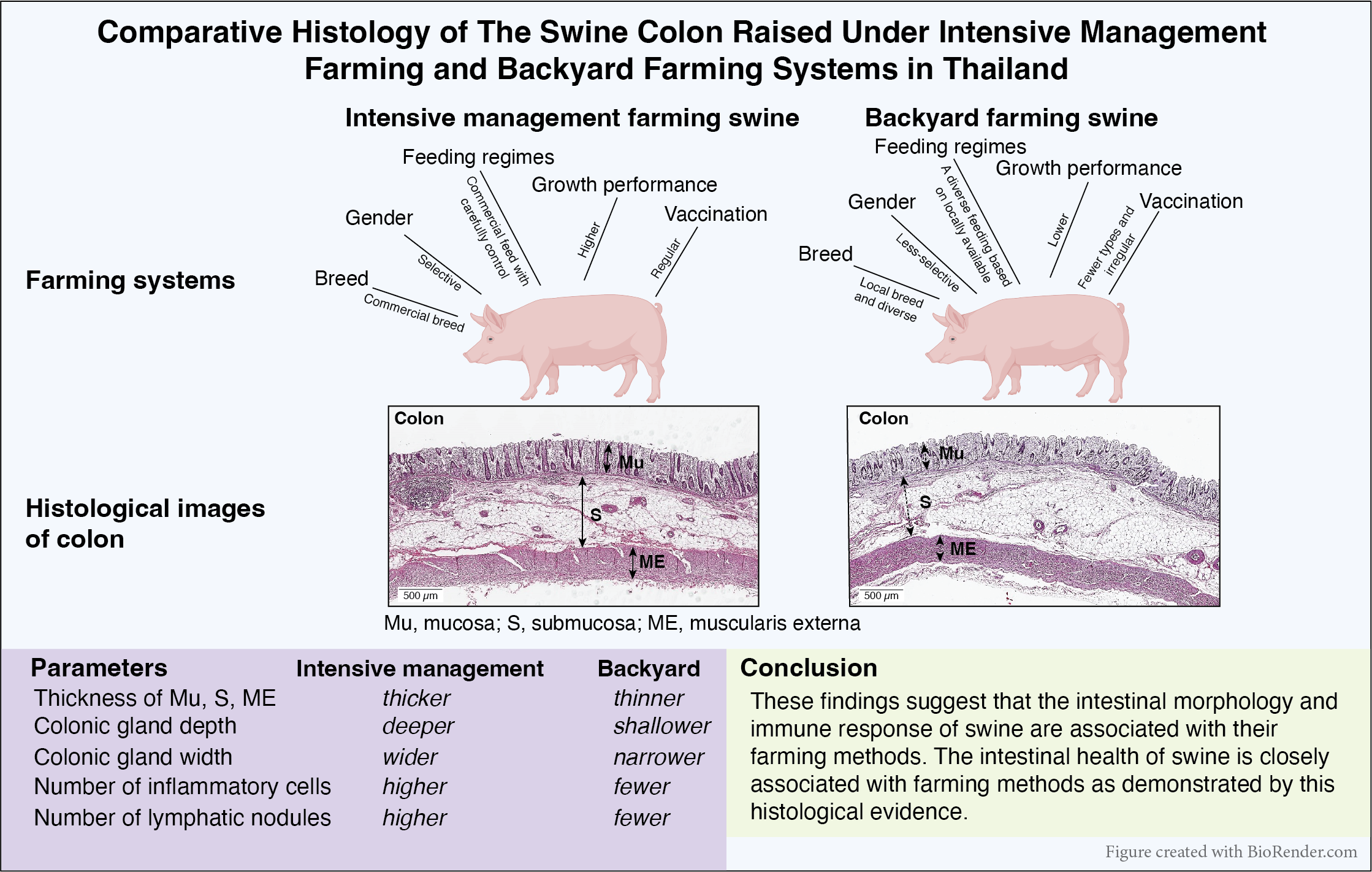
Swine farming methods can influence gut health by altering intestinal morphology and immune function. This study aimed to compare the histological characteristics of the colon in swine raised under 2 different management systems - intensive management farming and backyard farming - to evaluate how these environments impact intestinal structure and health. Colon tissues (n = 10 per group) were collected and examined using Hematoxylin and Eosin staining. Histological analysis focused on the thickness of the mucosa, submucosa, and muscularis externa layers, the morphology of intestinal glands, and the presence of inflammatory cells and lymphatic nodules in the mucosa. The results showed that swine raised under intensive management farming had significantly thicker mucosal, submucosal, and muscularis externa layers than those raised under backyard conditions (p < 0.001). Backyard-farmed swine exhibited significantly shallower and narrower intestinal glands, as well as reduced numbers of inflammatory cells and lymphatic nodules (p < 0.001), suggesting a lower degree of immune activation. In conclusion, our findings suggest that intensive management enhances nutrient absorption and mucosal defense via a thicker colonic mucosa, whereas backyard farming may impair digestive efficiency and immune responsiveness. By linking husbandry conditions to intestinal histology, this study provides clinically relevant insights into how farming systems influence swine gut health which may ultimately impact overall productivity and product quality. These results underscore the importance of appropriate farm management in supporting gastrointestinal and immune function in livestock.
HIGHLIGHTS
- Histological analysis revealed significant differences in colon structure between swine raised under intensive management farming and backyard farming in Thailand.
- Swine raised under intensive management farming showed significantly thicker mucosa, submucosa, and muscularis externa layers.
- Backyard-farmed swine exhibited shallower and narrower intestinal glands with reduced inflammatory cells and lymphatic nodules.
- Farming method influences gut morphology and immune response in swine, suggesting a link between husbandry conditions and intestinal health.
- Thinner mucosal layers and reduced immune activity in backyard swine may impact nutrient absorption and disease resistance.
- Our study provides the first comparative histological evidence linking farming systems to intestinal morphology and immune profiles in swine.
GRAPHICAL ABSTRACT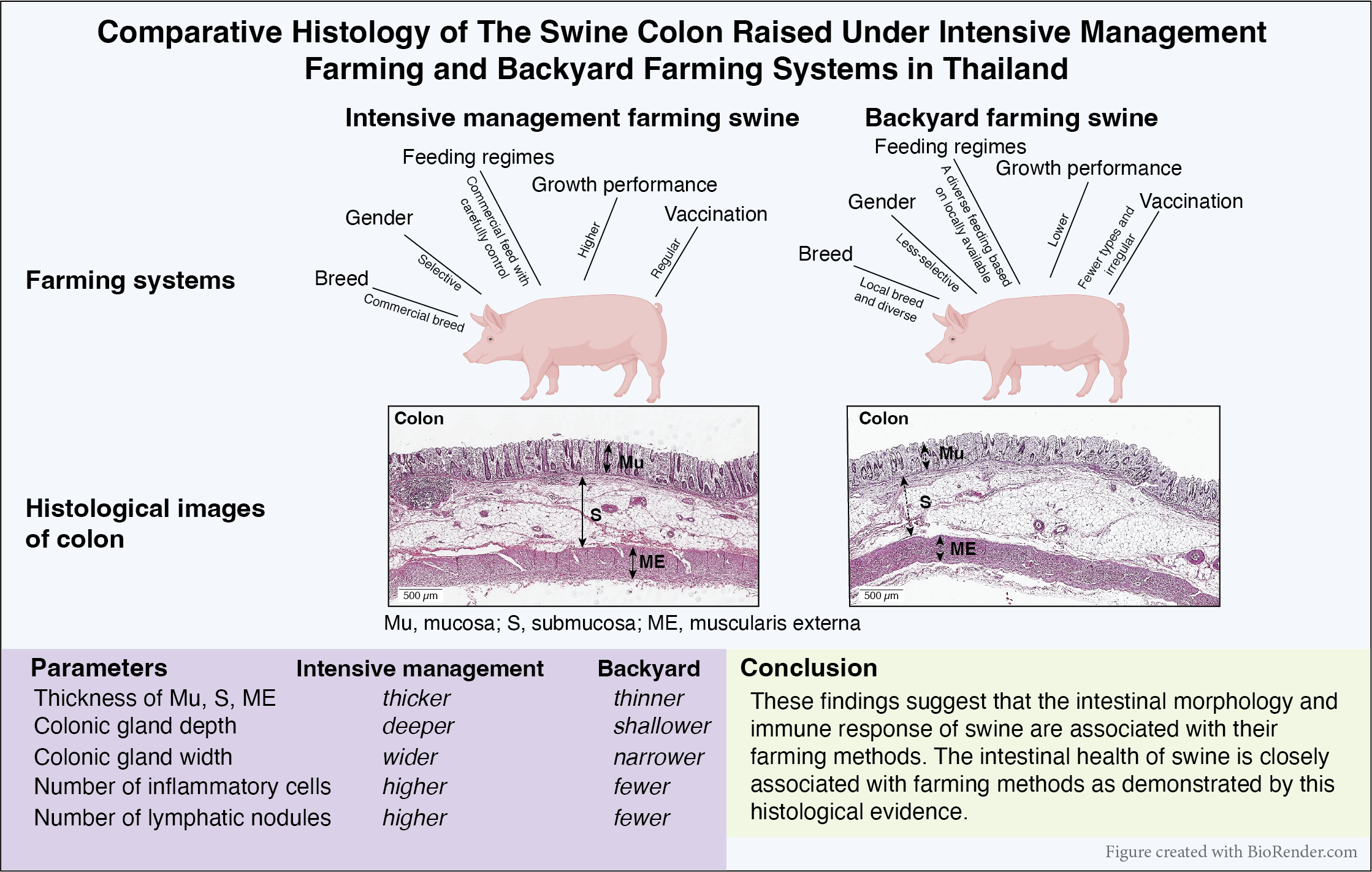
Downloads
References
MA von Keyserlingk, J Hendricks, B Ventura and DM Weary. Swine industry perspectives on the future of pig farming. Animal Welfare 2024; 33, e7.
S Chatree, N Kongkhwet, S Inkho, S Jaisamuta, A Monteil and C Promsuban. Revealing of stomach histology of beta-agonist free, hygienic, and natural swine. Cogent Food & Agriculture 2023; 9(1), 2208248.
A Ludwiczak, E Skrzypczak, J Składanowska-Baryza, M Stanisz, P Ślósarz and P Racewicz. How housing conditions determine the welfare of pigs. Animals 2021; 11(12), 3484.
PJ Lammers, MS Honeyman, RM Park and MD Pairis-Garcia. Swine housing systems, behavior, and welfare. In: LI Chiba (Ed.). Sustainable swine nutrition. 2nd ed. John Wiley & Sons, New Jersey, United States, 2022, p. 603-622.
sKR Sylven, T Wallgren, P Almerheim, LE Selling, M Jacobson and P Wallgren. A comparison of 2 systems for group housing of gestating sows - effects on productivity, removal, and treatments. Porcine Health Management 2025; 11(1), 1.
A Horrillo, P Gaspar, A Muñoz, M Escribano and E González. Fattening Iberian pigs indoors vs. outdoors: Production performance and market value. Animals 2023; 13(3), 506.
C Leeb, G Rudolph, D Bochicchio, S Edwards, B Fruh, M Holinger, D Holmes, G Illmann, D Knop, A Prunier, T Rousing, C Winckler and S Dippel. Effects of 3 husbandry systems on health, welfare and productivity of organic pigs. Animal 2019; 13(9), 2025-2033.
D Temple and X Manteca. Animal welfare in extensive production systems Is still an area of concern. Frontiers in Sustainable Food Systems 2020; 4, 545902.
E Roura, M Müller, RG Campbell, M Ryoo and M Navarro. Digestive physiology and nutrition of swine. In: LI Chiba (Ed.). Sustainable swine nutrition. 2nd ed. John Wiley & Sons, New Jersey, United States, 2022, p. 1-36.
S Chatree, N Kongkhwet, S Inkho, S Jaisamuta, A Monteil and C Promsuban. Revealing of stomach histology of beta-agonist free, hygienic, and natural swine. Cogent Food & Agriculture 2023; 9(1), 2208248.
NR Santucci and A Velez. Physiology of lower gastrointestinal tract. Alimentary Pharmacology & Therapeutics 2024; 60(S1), S1-S19.
CA Evans and BM Corfe. Colorectal keratins: Integrating nutrition, metabolism and colorectal health. Seminars in Cell & Developmental Biology 2022; 128, 103-111.
P Matyba, K Ferenc, Z Gajewski, M Sady, T Skrzypek, J Karamon and A Jabłoński. Digestive diseases of pigs. In: R Zabielski and T Skrzypek (Eds.). Atlas of the pig gut: Research and techniques from birth to adulthood. Academic Press, London, 2021, p. 139-160.
F Cardoso-Toset, J Gomez-Laguna, L Gomez-Gascon, IM Rodriguez-Gomez, A Galan-Relano, L Carrasco, C Tarradas, AI Vela and I Luque. Histopathological and microbiological study of porcine lymphadenitis: Contributions to diagnosis and control of the disease. Porcine Health Management 2020; 6(1), 36.
M Lunetta, M Grivois, C Hansen, P Seery, C Felty, E Rizzo and C Jackson. Comparative study of 2 reprocessing methods for formalin fixed paraffin embedded tissue. Journal of Histotechnology 2022; 45(3), 120-128.
N Prochazkova, MF Laursen, G La Barbera, E Tsekitsidi, MS Jorgensen, MA Rasmussen, J Raes, TR Licht, LO Dragsted and HM Roager. Gut physiology and environment explain variations in human gut microbiome composition and metabolism. Nature Microbiology 2024; 9(12), 3210-3225.
DK Meyerholz, ER Burrough, N Kirchhof, DJ Anderson and KL Helke. Swine models in translational research and medicine. Veterinary Pathology 2024; 61(4), 512-523.
T Mayassi, C Li, A Segerstolpe, EM Brown, R Weisberg, T Nakata, H Yano, P Herbst, D Artis, DB Graham and RJ Xavier. Spatially restricted immune and microbiota-driven adaptation of the gut. Nature 2024; 636(8042), 447-456.
RV Knox. Swine fertility in a changing climate. Animal Reproduction Science 2024; 269, 107537.
HRM Fischer, J Krucken, S Fiedler, V Duckwitz, H Nienhoff, S Steuber, R Daher and G von Samson-Himmelstjerna. Gastrointestinal nematodes in German outdoor-reared pigs based on faecal egg count and next-generation sequencing nemabiome data. Porcine Health Management 2024; 10(1), 33.
A AlZaabi, HA Younus, HA Al-Reasi and R Al-Hajri. Could environmental exposure and climate change Be a key factor in the rising incidence of early onset colorectal cancer? Heliyon 2024; 10(16), e35935.
AJ Oliver, N Huang, R Bartolome-Casado, R Li, S Koplev, HR Nilsen, M Moy, B Cakir, K Polanski, V Gudino, E Melon-Ardanaz, D Sumanaweera, D Dimitrov, LM Milchsack, MEB FitzPatrick, NM Provine, JM Boccacino, E Dann, AV Predeus, …, SA Teichmann. Single-cell integration reveals metaplasia in inflammatory gut diseases. Nature 2024; 635(8039), 699-707.
P Cholewińska, W Górniak and K Wojnarowski. Impact of selected environmental factors on microbiome of the digestive tract of ruminants. BMC Veterinary Research 2021; 17(1), 25.
M Onji, V Sigl, T Lendl, M Novatchkova, A Ullate-Agote, A Andersson-Rolf, I Kozieradzki, R Koglgruber, TP Pai, D Lichtscheidl, K Nayak, M Zilbauer, NA Carranza Garcia, LK Sievers, M Falk-Paulsen, SJF Cronin, A Hagelkruys, S Sawa, LC Osborne, …, JM Penninger. RANK drives structured intestinal epithelial expansion during pregnancy. Nature 2025; 637(8044), 156-166.
HP Diehl, A Wildey, VD Prasasty and TJ Siahaan. Organization of the intestinal mucosa and barriers to oral drug delivery. In: JP Martins and HA Santos (Eds.). Nanotechnology for oral drug delivery. Academic Press, London, 2020, p. 7-25.
C Arjin, S Hongsibsong, K Pringproa, W Ruksiriwanich, C Lumsangkul, J Arunorat, P Chuammitri, M Seel-Audom, SR Sommano and K Sringarm. Immune response enhancement by dietary supplementation with Caesalpinia sappan extract in weaned pigs challenged with porcine reproductive and respiratory syndrome virus. BMC Veterinary Research 2024; 20(1), 111.
S Nazki, A Khatun, CG Jeong, SUS Mattoo, S Gu, SI Lee, SC Kim, JH Park, MS Yang, B Kim, CK Park, SM Lee and WI Kim. Evaluation of local and systemic immune responses in pigs experimentally challenged with porcine reproductive and respiratory syndrome virus. Veterinary Research 2020; 51(1), 66.
R Hokari and A Tomioka. The role of lymphatics in intestinal inflammation. Inflammation and Regeneration 2021; 41(1), 25.
S Park, S Sun, L Kovanda, AO Sokale, A Barri, K Kim, X Li and Y Liu. Effects of monoglyceride blend on systemic and intestinal immune responses, and gut health of weaned pigs experimentally infected with a pathogenic Escherichia coli. Journal of Animal Science and Biotechnology 2024; 15(1), 141.
V Stefanetti, AC Mancinelli, L Pascucci, L Menchetti, C Castellini, C Mugnai, E Fiorilla, B Miniscalco, D Chiattelli, MP Franciosini and PC Proietti. Effect of rearing systems on immune status, stress parameters, intestinal morphology, and mortality in conventional and local chicken breeds. Poultry Science 2023; 102(12), 103110.
JM Gama and RC Oliveira. Mesenchymal tumors of the gastrointestinal tract - beyond GIST - A review. Gastrointestinal Disorders 2024; 6(1), 257-291.
AHJFM Campos, LC Auresco, LV Marins, PHdA Divino, J Sabbaga and PM Hoff. Predictive biomarkers in colorectal adenocarcinoma - a Brazilian perspective on current and future practices. Surgical and Experimental Pathology 2024; 7(1), 20.
D Tang, Z Li, T Mahmood, D Liu, Y Hu and Y Guo. The association between microbial community and ileal gene expression on intestinal wall thickness alterations in chickens. Poultry Science 2020; 99(4), 1847-1861.
M Wulczynski, SPJ Brooks, J Green, F Matias, M Kalmokoff, JM Green-Johnson and ST Clarke. Environmental enrichment with nylon gnaw sticks introduces variation in Sprague Dawley rat immune and lower gastrointestinal parameters with differences between sexes. Animal Microbiome 2025; 7(1), 12.
NJ Karandikar, CL Vanderlugt, T Eagar, L Tan, JA Bluestone and SD Miller. Tissue-specific up-regulation of B7-1 expression and function during the course of murine relapsing experimental autoimmune encephalomyelitis. The Journal of Immunology 1998; 161(1), 192-199.
C Wen, I van Dixhoorn, D Schokker, H Woelders, N Stockhofe-Zurwieden, JMJ Rebel and H Smidt. Environmentally enriched housing conditions affect pig welfare, immune system and gut microbiota in early life. Animal Microbiome 2021; 3(1), 52.
C Szabo, J Kachungwa Lugata and A Ortega. Gut health and influencing factors in pigs. Animals 2023; 13(8), 1350.
Published
How to Cite
Issue
Section
License
Copyright (c) 2025 Walailak University

This work is licensed under a Creative Commons Attribution-NonCommercial-NoDerivatives 4.0 International License.





