
Antioxidant Properties of Oryza sativa var. Luem Pua Rice Wine in Alcoholic and Dealcoholized Forms: In HepG2 Cell Studies with Identification of Health-Beneficial Probiotics
DOI:
https://doi.org/10.48048/tis.2026.12834Keywords:
Luem Pua rice, Wine, Dealcoholized wine, Antioxidant activity, Probiotic microorganisms, Functional beverage, Nutraceutical, Luem Pua rice, Wine, Dealcoholized wine, Antioxidant activity, Probiotic microorganisms, Functional beverage, NutraceuticalAbstract
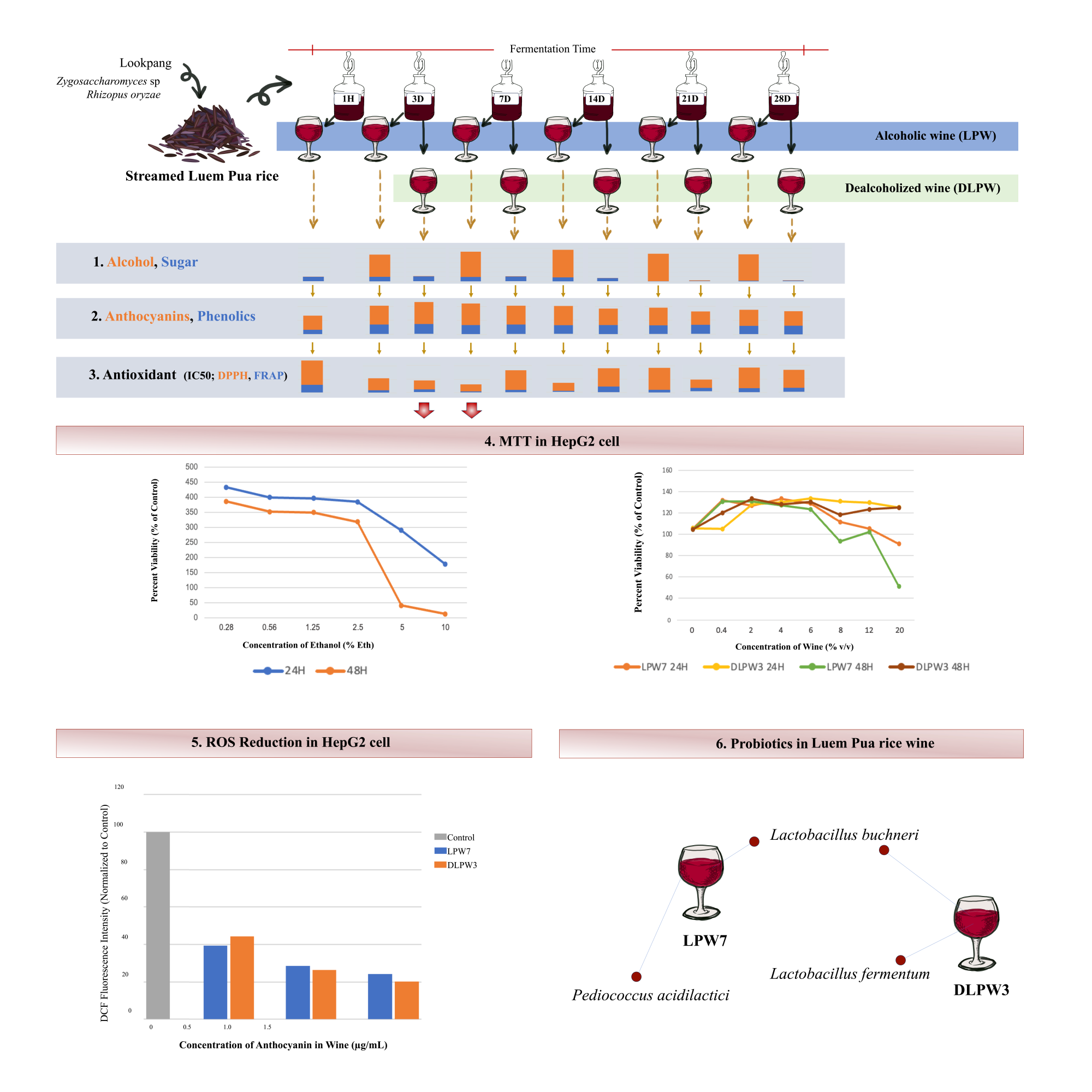
Luem Pua black glutinous rice (Oryza sativa L. var. Luem Pua), rich in anthocyanins and phenolics with antioxidant properties. Fermented plant-based beverages contain these compounds and may support probiotic growth. This study investigates Luem Pua rice wine in alcoholic (LPW) and dealcoholized (DLPW) forms over 0-28 days of fermentation, analyzing antioxidants, phenolic/anthocyanin content, cytotoxicity, ROS reduction, and probiotic growth. Phenolic content peaked at 3 days, slightly decreasing later, with DLPW showing higher levels than LPW. DLPW3 and LPW7 had the highest anthocyanins, strong DPPH scavenging, and FRAP values. Cytotoxicity tests showed DLPW3 (20 %v/v) was non-toxic to HepG2 cells, while LPW7 (2.13% ethanol) reduced viability at 48 h. Both, with 0.5 - 1.5 µg/mL anthocyanins, reduced ROS, with higher concentrations more effective. Lactobacillus buchneri, Pediococcus acidilactici, and Lactobacillus fermentum were identified, with higher counts in LPW7. Despite alcohol removal, DLPW3 retained strong bioactivity, highlighting its potential as a nutraceutical, alcohol-free alternative.
HIGHLIGHTS
- Developed and characterized a fermented rice wine from Oryza sativa Luem Pua, a pigmented glutinous rice rich in antioxidants.
- Compared alcoholic (LPW) and dealcoholized (DLPW) forms to evaluate effects on microbial safety, probiotic viability, and antioxidant stability.
- Identified beneficial lactic acid bacteria (Lactobacillus buchneri, Pediococcus acidilactici, Lactobacillus fermentum) without detecting harmful microorganisms.
- Demonstrated that dealcoholization preserved phenolics, anthocyanins, and antioxidant activity while maintaining cell safety in HepG2 assays.
- Findings support the development of safe, alcohol-free, functional fermented beverages with probiotic potential.
GRAPHICAL ABSTRACT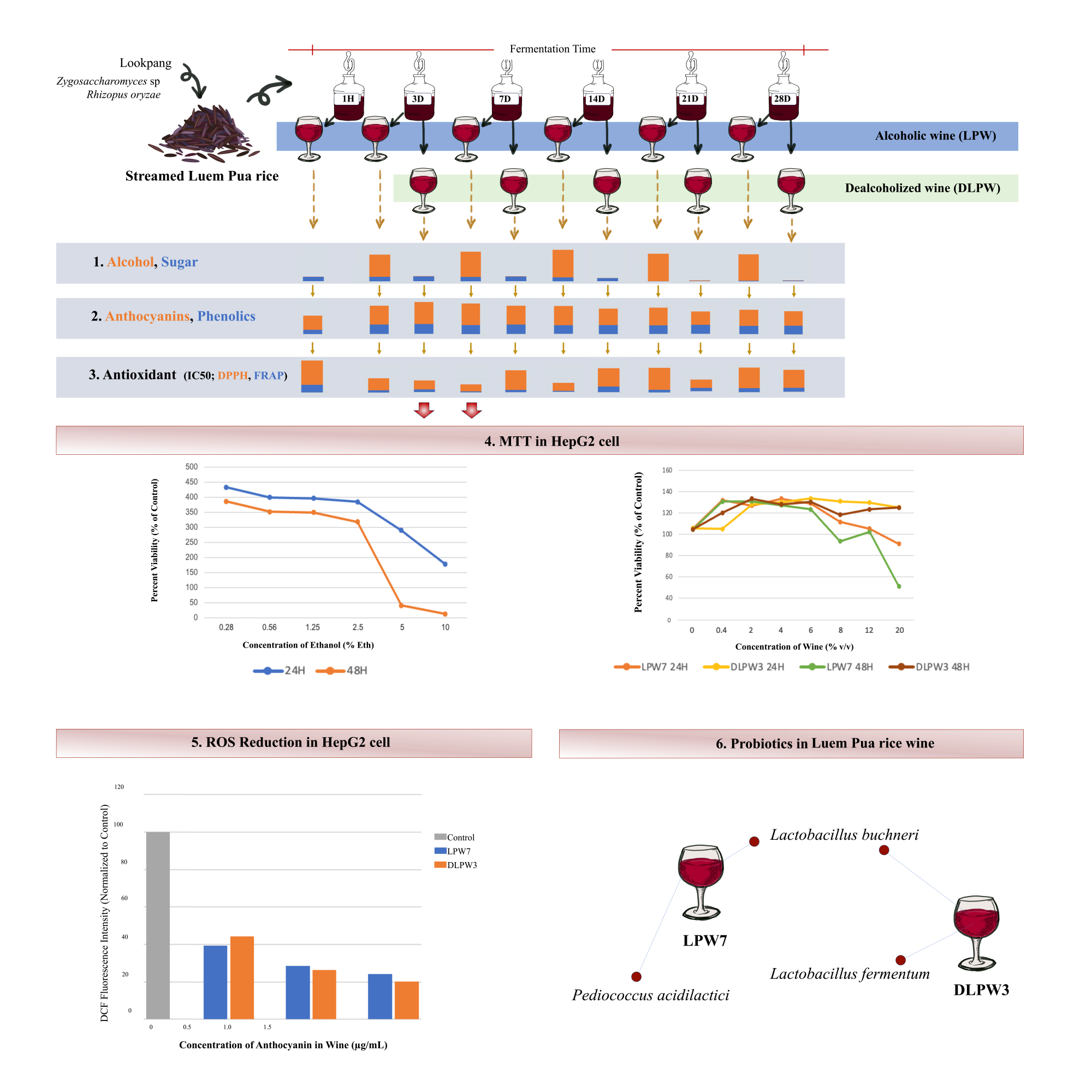
Downloads
References
P Suwannalert and S Rattanachitthawat. High levels of phytophenolics and antioxidant activities in Oryza Sativa - unpolished Thai rice strain of Leum Phua. Tropical Journal of Pharmaceutical Research 2011. https://doi.org/10.4314/tjpr.v10i4.8
S Srisuwan, T Arkaravichien, S Mahatheeranont, P Puangsombat, P Seekhaw, ANL Noenplab and J Sattayasai. Effects of aqueous extract of unpolished dark purple glutinous rice, var Luem Pua, on ROS in SK-N-SH cells and scopolamine-induced memory deficit in mice. Tropical Journal of Pharmaceutical Research 2015. Tropical Journal of Pharmaceutical Research 2015; 14(9), 1635-1641.
K Thipart, K Phunikhom, ANL Noenplab and J Sattayasai. Dark Purple Luem Pua rice extract reduces disease severity in rat models of inflammatory bowel disease. Tropical Journal of Pharmaceutical Research 2020; 19(3), 629-636.
T Chumphon, P Sriprasertsak and S Promsai. Development of rice as potential carriers for probiotic Lactobacillus amylovorus. International Journal of Food Science and Technology 2016; 51(5), 1260-1267.
VB Shet, SD Sagar, MN Bollamma, TJ Mary, RC Vaman, A Aparna and S Yumnam. Production of fermented fruit juice and value addition by blending medicinal plants. Journal of Bacteriology & Mycology: Open Access 2017; 5(6), 395-397.
JB German and RL Walzem. The health benefits of wine. Annual Review of Nutrition 2000; 20, 561-593.
S Arranz, G Chiva-Blanch, P Valderas-Martínez, A Medina-Remón, RM Lamuela-Raventós and R Estruch. Wine, beer, alcohol and polyphenols on cardiovascular disease and cancer. Nutrient 2012; 4(7), 759-781.
A García-Ruiz, DGD Llano, A Esteban-Fernández, T Requena, B Bartolomé and MV Moreno-Arribas. Assessment of probiotic properties in lactic acid bacteria isolated from wine. Food Microbiololy 2014. https://doi.org/10.1016/j.fm.2014.06.015
K Kondo. Beer and health: Preventive effects of beer components on lifestyle-related diseases. BioFactors 2004; 22(1-4), 303-310.
U.S. Food and Drug Administration. CPG Sec 510.400 - Dealcoholized wine and malt beverages-Labeling, Available at: https://www.fda.gov/regulatory-information/search-fda-guidance-documents/cpg-sec-510400-dealcoholized-wine-and-malt-beverages-labeling, accessed March 2025.
VL Singleton and JA Rossi. Colorimetry of total phenolics with photomolybdic-phosphotungstic acid reagents. American Journal of Enology and Viticulture 1965; 16, 144-158.
J Lee, RW Durst and RE Wrolstad. Determination of total monomeric anthocyanin pigment content of fruit juices, beverages, natural colorants, and wines by the pH differential method: Collaborative study. Journal of AOAC International 2005; 88(5), 1269-1278.
K Theeraraksakul, K Jaengwang, K Choowongkomon and L Tabtimmai. Exploring the biological functions and anti-melanogenesis of Phallus indusiatus for mushroom-based cosmetic applications. Cosmetics 2023; 10(5), 121.
C Sonklin, AM Alashi, N Laohakunjit and RE Aluko. Functional characterization of mung bean meal protein-derived antioxidant peptides. Molecules 2021; 26(6), 1515.
R Gil-Muñoz, E Gómez-Plaza, A Martínez and JM López-Roca. Evolution of the CIELAB and other spectrophotometric parameters during wine fermentation. Influence of some pre and postfermentative factors. Food Research International 1997; 30(9), 699-705.
V Ivanova, B Vojnoski and M Stefova. Effect of winemaking treatment and wine aging on phenolic content in Vranec wines. Journal of Food Science and Technology 2012; 49, 161-172.
F He, NN Liang, L Mu, QH Pan, J Wang, MJ Reeves and CQ Duan. Anthocyanins and their variation in red wines II. Anthocyanin derived pigments and their color evolution. Molecules 2012; 17(2), 1483-1519.
MS Ursu, I Aprodu, SA Milea, E Enachi, G Râpeanu, GE Bahrim and N Stǎnciuc. Thermal degradation kinetics of anthocyanins extracted from purple maize flour extract and the effect of heating on selected biological functionality. Foods 2020; 9(11), 1593.
P Silva. Low-alcohol and nonalcoholic wines: From production to cardiovascular health, along with their economic effects. Beverages 2024; 10(3), 49.
AMS Azima, A Noriham and N Manshoor. Anthocyanin content in relation to the antioxidant activity and colour properties of Garcinia mangostana peel, Syzigium cumini and Clitoria ternatea extracts. International Food Research Journal 2014; 21(6), 2369-2375.
C Brownmiller, LR Howard and RL Prior. Processing and storage effects on monomeric anthocyanins, percent polymeric color, and antioxidant capacity of processed blueberry products. Journal of Food Science 2008; 73(5), H72-H79.
DB Goldstein. Effect of alcohol on cellular membranes. Annals of Emergency Medicine 1986; 15(9), 1013-1018.
M Patra, E Salonen, E Terama, I Vattulainen, R Faller, BW Lee, J Holopainen and M Karttunen. Under the influence of alcohol: The effect of ethanol and methanol on lipid bilayers. Biophysical Journal 2006; 90(4), 1121-1135.
HS Kim, SJ Kim, J Bae, Y Wang, SY Park, YS Min, HDJ and UD Sohn. The p90rsk-mediated signaling of ethanol-induced cell proliferation in HepG2 cell line. Korean Journal of Physiology & Pharmacology 2016; 20(6), 595-603.
A Zoubeidi, A Zardan, RM Wiedmann, J Locke, E Beraldi, L Fazli and ME Gleave. Hsp27 promotes insulin-like growth factor-I survival signaling in prostate cancer via p90Rsk-dependent phosphorylation and inactivation of BAD. Cancer Research 2010; 70(6), 2307-2317.
LA Kubasiak, OM Hernandez, NH Bishopric and KA Webster. Hypoxia and acidosis activate cardiac myocyte death through the Bcl-2 family protein BNIP3. The Proceedings of the National Academy of Sciences 2002; 99(20), 12825-12830.
N Kar, D Gupta and J Bellare. Ethanol affects fibroblast behavior differentially at low and high doses: A comprehensive, dose-response evaluation. Toxicology Reports 2021; 8, 1054-1066.
M Hennig, MT Yip-Schneider, P Klein, S Wentz, JM Matos, C Doyle, J Choi, H Wu, A O’Mara, A Menze, S Noble, IH McKillop and CM Schmidt. Ethanol-TGFalpha-MEK signaling promotes growth of human hepatocellular carcinoma. Journal of Surgical Research 2009; 154(2), 187-195.
MA Shah and HA Rogoff. Implications of reactive oxygen species on cancer formation and its treatment. Seminars in Oncology 2021; 48(3), 238-245.
S Kumari, AK Badana, MG Murali, G Shailender and R Malla. Reactive oxygen species: A key constituent in cancer survival. Biomarker Insights 2018; 13, 1177271918755391.
M Schieber and NS Chandel. ROS function in redox signaling and oxidative stress. Current Biology 2014; 24(10), R453-R462.
C Fuchs, T Bakuradze, R Steinke, R Grewal, GP Eckert and E Richling. Polyphenolic composition of extracts from winery by-products and effects on cellular cytotoxicity and mitochondrial functions in HepG2 cells. Journal of Functional Foods 2020; 70, 103988.
S Hogan, C Canning, S Sun, X Sun and K Zhou. Effects of grape pomace antioxidant extract on oxidative stress and inflammation in diet induced obese mice. Journal of Agricultural and Food Chemistry 2010; 58(21), 11250-11256.
MJ Jara-Palacios, D Hernanz, T Cifuentes-Gomez, ML Escudero-Gilete, FJ Heredia and JPE Spencer. Assessment of white grape pomace from winemaking as source of bioactive compounds, and its antiproliferative activity. Food Chemistry 2015; 183, 78-82.
B Rodríguez-Morgado, M Candiracci, C Santa-María, E Revilla, B Gordillo, J Parrado and A Castaño. Obtaining from grape pomace an enzymatic extract with anti-inflammatory properties. Plant Foods for Human Nutrition 2015; 70, 42-49.
A Gupta, ME Ellis and KA Oduse. The roles of phytochemicals in red wine as a protective agent against alcohol damage. International Food Research Journal 2013; 20(3), 1191-1197.
A Vilela, F Cosme and A Inês. Wine and non-dairy fermented beverages: A novel source of pro- and prebiotics. Fermentation 2020; 6(4), 113.
CIL Roy, PM Wells, J Si, J Raes, JT Bell and TD Spector. Red wine consumption associated with increased gut microbiota α-diversity in 3 independent cohorts. Gastroenterology 2020; 158(1), 270-272.
XQ Zeng, DD Pan and YX Guo. The probiotic properties of Lactobacillus buchneri P2. Journal of Applied Microbiology 2010; 108(6), 2059-2066.
MJ Cheon, SM Lim, NK Lee and HD Paik. Probiotic properties and neuroprotective effects of Lactobacillus buchneri KU200793 isolated from Korean fermented foods. International Journal of Molecular Sciences 2020; 21(4), 1227.
SB Peter, Z Qiao, HN Godspower, SB Ajeje, M Xu, X Zhang, T Yang and Z Rao. Biotechnological innovations and therapeutic application of Pediococcus and Lactic Acid Bacteria: The next-generation microorganism. Frontiers in Bioengineering and Biotechnology 2022; 9, 802031.
P Feng, J Yang, S Zhao, Z Ling, R Han, Y Wu, ES Salama, A Kakade, A Khan, W Jin, W Zhang, BH Jeon, J Fan, M Liu, T Mamtimin, P Liu and X Li. Human supplementation with Pediococcus acidilactici GR-1 decreases heavy metals levels through modifying the gut microbiota and metabolome. npj Biofilms and Microbiomes 2022; 8, 63.
R Díaz, D Carrasco, J Quiñones, A Martínez, G Sepúlveda, I Pérez-Núñez, R Huaiquipán, D Cancino-Baier, JF Beltrán, JG Farías, EA Paz and N Sepúlveda. The probiotic Pediococcus acidilactici in the feed of Salmonids: A strategy to improve reproductive parameters. Animals 2025; 15(11), 1659.
K Naghmouchi, Y Belguesmia, F Bendali, G Spano, BS Seal and D Drider. Lactobacillus fermentum: A bacterial species with potential for food preservation and biomedical applications. Critical Reviews in Food Science and Nutrition 2020; 60(20), 3387-3399.
Published
How to Cite
Issue
Section
License
Copyright (c) 2025 Walailak University

This work is licensed under a Creative Commons Attribution-NonCommercial-NoDerivatives 4.0 International License.





