
Analgesic Profiling of Capsicum Extracts Using the Hot Plate Test in Mice: An Integrative Analysis of Bioactive Compounds Based on FT-IR, GC-MS, and Molecular Docking Studies
DOI:
https://doi.org/10.48048/tis.2026.12828Keywords:
Capsicum extracts, Analgesic, FTIR, GC-MS, Molecular dockingAbstract
This study aims to investigate the analgesic potential of extracts from 3 Capsicum species, namely Capsicum chinense (CC), Capsicum frutescens (CF), and Capsicum annuum (CA), using a hot plate test in mice. In addition, the study identified the key bioactive compounds in the extracts through a combined analysis of Fourier Transform Infrared Spectroscopy (FTIR), Gas Chromatography-Mass Spectrometry (GC-MS), and molecular docking studies. During the experimental procedures, extracts from the stem, fruit, and seed of 3 Capsicum species were prepared using methanol, hexane, and distilled water as solvents. The chemical composition of these extracts was profiled and classified through Fourier-transform infrared (FTIR) spectroscopy combined with cluster analysis. Subsequently, the analgesic activity of the samples was assessed in vivo using the hot plate test in mice. Gas chromatography-mass spectrometry (GC-MS) was used to identify the bioactive compounds present in both the most potent and least potent extracts. Molecular docking studies were then conducted to predict the interactions between these compounds and specific analgesic protein targets, namely 5IKQ, 4TLM, and 4EJ4. The results showed that the aquadest fruit extract of CC had the highest analgesic activity, while extracts from CF and CA had minimal effects. GC-MS analysis showed that the extract with minimal effects contained terpenoids, sterols, vitamins, hydrocarbons, and fatty acids. However, CC was rich in alkaloids capsaicin (4.38%) and dihydrocapsaicin, O-acetyl- (2.26%), terpenoids (nerolidyl acetate) (11.32%), phenolics (2-methoxy-phenol) (1.37%), and fatty acid derivatives. Molecular docking studies confirmed that capsaicin and dihydrocapsaicin, O-acetyl- exhibited strong binding affinities with analgesic protein targets 5IKQ (‒8.0 kcal/mol), 4TLM (‒5.3 and ‒4.9 kcal/mol), and 4EJ4 (‒7.3 and ‒6.5 kcal/mol) outperforming the reference drug sodium diclofenac (‒8.3, ‒5.9, and ‒6.6 kcal/mol). This study described the significant analgesic potential of CC extracts, particularly the aquadest fruit extract, as a promising candidate for developing new pain management therapies.
HIGHLIGHTS
- Capsicum chinense aquadest fruit extract exhibited the strongest analgesic activity in the hot plate test, consistent with the FT-IR cluster grouping based on functional group similarities.
- GC–MS profiling confirmed that capsaicinoids (capsaicin and O-acetyl dihydrocapsaicin), along with fatty acids and terpenoids, dominated the most active extracts and contributed to their analgesic and anti-inflammatory potential.
- Molecular docking further demonstrated strong interactions between capsaicin-related compounds and COX-2, TRPV1, and NMDA receptors, supporting the potential of Capsicum extracts as promising natural analgesic candidates.
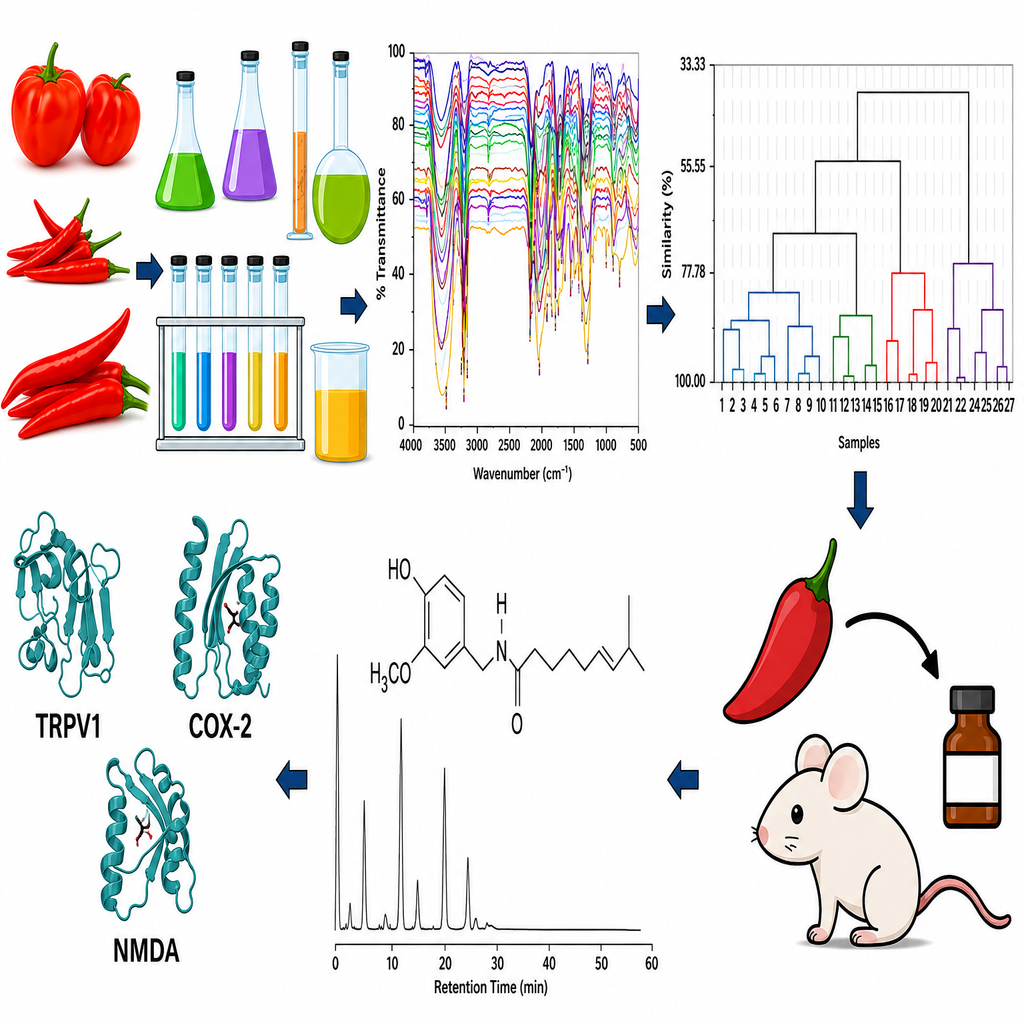
GRAPHICAL ABSTRACT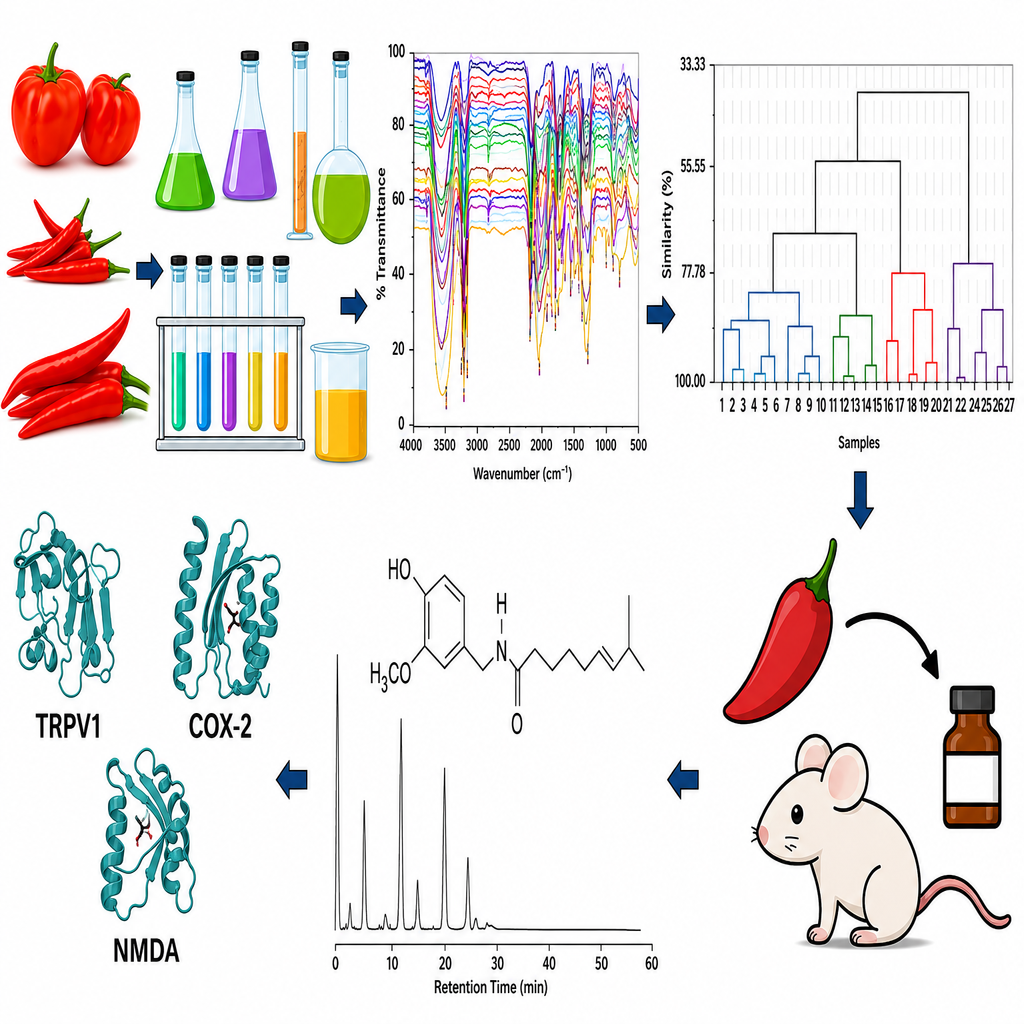
Downloads
References
A Peghetti, R Seri, E Cavalli and V Martin. Pain Management. Cham: Springer, 2024, p. 537-570.
FF Pandelani, SLN Nyalunga, MM Mogotsi and VB Mkhatshwa. Chronic pain: Its impact on the quality of life and gender. Frontiers in Pain Research 2023; 4, 1253460.
T Tabernacki, D Gilbert, S Rhodes, K Scarberry, R Pope, M McNamara, S Gupta, S Banik and K Mishra. The burden of chronic pain in transgender and gender diverse populations: Evidence from a large US clinical database. European Journal of Pain 2025; 29(2), e4725.
P Tiberio, M Balordi, M Castaldo, A Viganò, F Jacobs, C Benvenuti, R Torrisi, A Zambelli, A Santoro and RD Sanctis. Empowerment, pain control, and quality of life improvement in early triple-negative breast cancer patients through pain neuroscience education: A prospective cohort pilot study protocol (EMPOWER Trial). Journal of Personalized Medicine 2024; 14(7), 711.
D Blaibel, CJ Fernandez and JM Pappachan. Acute worsening of microvascular complications of diabetes mellitus during rapid glycemic control: The pathobiology and therapeutic implications. World Journal of Diabetes 2024; 15(3), 311-317.
S Tushingham, J Cottle, M Adesokan, OO Ogwumike, A Ojagbemi, B Stubbs, F Fatoye and OO Babatunde. The prevalence and pattern of comorbid long-term conditions with low back pain and osteoarthritis in low- and middle-income countries: A systematic review and meta-analysis. International Journal of Health Promotion and Education 2024.
C Zanza, T Romenskaya, F Racca, E Rocca, F Piccolella, A Piccioni, A Saviano, G Formenti-Ujlaki, G Savioli, F Franceschi and Y Longhitano. Severe trauma-induced coagulopathy: Molecular mechanisms underlying critical illness. International Journal of Molecular Sciences 2023; 24(8), 7118.
A Tsoupras, DA Gkika, I Siadimas, I Christodoulopoulos, P Efthymiopoulos and GZ Kyzas. The multifaceted effects of non-steroidal and non-opioid anti-inflammatory and analgesic drugs on platelets. Pharmaceuticals 2024; 17(5), 627.
I Badshah, M Anwar, B Murtaza and MI Khan. Molecular mechanisms of morphine tolerance and dependence: Novel insights and future perspectives. Molecular and Cellular Biochemistry 2024; 479, 1457-1485.
A Zimmerman and A Laitman. Safe management of adverse effects associated with prescription opioids in the palliative care population: A narrative review. Journal of Clinical Medicine 2024; 13(10), 2746.
A Manhapra, RR MacLean, R Rosenheck and WC Becker. Are opioids effective analgesics and is physiological opioid dependence benign? Revising current assumptions to effectively manage long-term opioid therapy and its deprescribing. British Journal of Clinical Pharmacology 2024; 90(12), 2962-2976.
N Alhammadi, AH Asiri, FM Alshahrani, AY Alqahtani, MMA Qout, RA Alnami, AS Alasiri and AS Al-Zomia. Gastrointestinal complications associated with non-steroidal anti-inflammatory drug use among adults: A retrospective, single-center study. Cureus 2022; 14(6), 26154.
S Liang, X Wang and X Zhu. Insights from pharmacovigilance and pharmacodynamics on cardiovascular safety signals of NSAIDs. Frontiers in Pharmacology 2024; 15, 1455212.
JM LaForge, K Urso, JM Day, CW Bourgeois, MM Ross, S Ahmadzadeh, S Shekoohi, EM Cornett, AM Kaye and AD Kaye. Non-steroidal anti-inflammatory drugs: Clinical implications, renal impairment risks, and AKI. Advances in Therapy 2023; 40, 2082-2096.
TT Bakare, HO Uzoeto, LN Gonlepa, S Cosmas, JN Ajima, AV Arazu, SP Ezechukwu, CM Didiugwu, GO Ibiang, AG Osotuyi and OA Durojaye. Evolution and challenges of opioids in pain management: Understanding mechanisms and exploring strategies for safer analgesics. Medicinal Chemistry Research 2024; 33, 563-579.
H Duranova, V Valkova and L Gabriny. Chili peppers (Capsicum spp.): An update on current knowledge. Phytochemistry Reviews 2022; 21, 1379-1413.
K Patel and KD Patel. Biological importance, pharmacological activities, and nutraceutical potential of capsanthin: A review of Capsicum plant capsaicinoids. Current Drug Research Reviews 2024; 16(1), 18-31.
GNC Ferreira, GV Ferraz, LR da Silva, AC Oliveira, LR de Almeida, MF Costa, RNO Silva, VB da Silva, ÂC de Almeida Lopes and RLF Gomes. Assessment of phenotypic divergence and hybrid development in ornamental peppers (Capsicum spp.). Genetic Resources and Crop Evolution 2025; 72, 5499-5513.
Z Kebu, A Gure and GJ Molole. Total phenolic and flavonoid content, lipophilic components, and antioxidant activities of Capsicum annuum varieties grown in Omo Nada, Jimma, Ethiopia. Natural Product Communications 2024; 19(12), 1-11.
AT Jolayemi and JAO Ojewole. Comparative anti-inflammatory properties of capsaicin and ethyl-acetate extract of Capsicum frutescens Linn. [Solanaceae] in rats. African Health Sciences 2013; 13(2), 357-361.
V Rastogi, M Porwal, MS Sikarwar, B Singh, P Choudhary and BC Mohanta. A review on phytochemical and pharmacological potential of Bhut Jolokia (a cultivar of Capsicum chinense Jacq.). Journal of Applied Pharmaceutical Science 2024; 14(5), 79-90.
H Duranova, V Valkova and L Gabriny. Chili peppers (Capsicum spp.): The spice not only for cuisine purposes: An update on current knowledge. Phytochemistry Reviews 2022; 21, 1379-1413.
T Lefebvre, E Destandau and E Lesellier. Selective extraction of bioactive compounds from plants using recent extraction techniques: A review. Journal of Chromatography A 2021; 1635, 461770.
B Yasir, AD Astuti, M Raihan, R Natzir, Subehan, A Rohman and G Alam. Optimization of Pagoda (Clerodendrum paniculatum L.) extraction based by analytical factorial design approach, its phytochemical compound, and cytotoxicity activity. Egyptian Journal of Chemistry 2022; 65(9), 421-430.
B Yasir, S Mus, S Rahimah, RM Tandiongan, KP Klara, N Afrida, NRK Nisaa, R Risna, AW Jur, G Alam and A Rohman. Antimicrobial profiling of Piper betle L. and Piper nigrum L. against methicillin-resistant Staphylococcus aureus (MRSA): Integrative analysis of bioactive compounds based on FT-IR, GC-MS, and molecular docking studies. Separations 2024; 11(11), 322.
A Maharjan, BMK Vasamsetti and JH Park. A comprehensive review of capsaicin: Biosynthesis, industrial productions, processing to applications, and clinical uses. Heliyon 2024; 10(21), e39721.
F Wang, Y Xue, L Fu, Y Wang, M He, L Zhao and X Liao. Extraction, purification, bioactivity and pharmacological effects of capsaicin: A review. Critical Reviews in Food Science and Nutrition 2022; 62(19), 5322-5348.
MDO Al-Bedairy, ZSH Al-Saadi, ZRK Al-Majidi, MSK Al-Humairi, FAAR Al-Groushi, MBBM Al-Waeli, MAJ Al-Abode and AHN Al-Aazawei. Anticoagulant, antioxidant, and antimicrobial activity: Biological activity and investigation of bioactive natural compounds using FTIR and GC-MS techniques. Journal of Current Medical Research and Opinion 2024; 7(4), 2236-2249.
CA Amaya-Rodriguez, K Carvajal-Zamorano, D Bustos, M Alegría-Arcos and K Castillo. A journey from molecule to physiology and in silico tools for drug discovery targeting the transient receptor potential vanilloid type 1 (TRPV1) channel. Frontiers in Pharmacology 2024; 14, 1251061.
M Rudrapal, WA Eltayeb, G Rakshit, AA El-Arabey, J Khan, SM Aldosari, B Alshehri and M Abdalla. Dual synergistic inhibition of COX and LOX by potential chemicals from Indian daily spices investigated through detailed computational studies. Scientific Reports 2023; 13, 8656.
B Yasir and G Alam. Chemometrics-assisted fingerprinting profiling of extract variation from Pagoda (Clerodendrum paniculatum L.) using TLC-densitometric method. Egyptian Journal of Chemistry 2023; 66(13), 1589-1596.
MF Khan, G Khodve, S Yadav, K Mallick and S Banerjee. Probiotic treatment improves post-traumatic stress disorder outcomes in mice. Behavioural Brain Research 2025; 476, 115246.
P Villiger, C Calvet, EM Pastor-Arroyo, CA Wagner and P Seebeck. Thermoneutral environment improves mouse welfare and reduces stress in metabolic cages. Lab Animal 2025; 54(11), 303-312.
J Deshpande, S Jeyakodi and V Juturu. Tolerability of capsaicinoids from Capsicum extract in a beadlet form: A pilot study. Journal of Toxicology 2016; 2016(1), 6584649.
M Gautam, A Yamada, AI Yamada, Q Wu, K Kridsada, J Ling, H Yu, P Dong, M Ma, J Gu and W Luo. Distinct local and global functions of mouse Aβ low-threshold mechanoreceptors in mechanical nociception. Nature Communications 2024; 15, 2911.
FA Khan, G Ali, K Rahman, Y Khan, M Ayaz, OF Mosa, A Nawaz, SS ul Hassan and S Bungau. Efficacy of 2-hydroxyflavanone in rodent models of pain and inflammation: Involvement of opioidergic and GABAergic anti-nociceptive mechanisms. Molecules 2022; 27(17), 5431.
M Gupta, UK Mazumder, RS Kumar, P Gomathi, Y Rajeshwar, BB Kakoti and VT Selven. Anti-inflammatory, analgesic and antipyretic effects of methanol extract from Bauhinia racemosa stem bark in animal models. Journal of Ethnopharmacology 2005; 98(3), 267-273.
MA Hijazi, A El-Mallah, M Aboul-Ela and A Ellakany. Evaluation of analgesic activity of Papaver libanoticum extract in mice: Involvement of opioid receptors. Evidence-Based Complementary and Alternative Medicine 2017; 2017(1), 8935085.
Z Fakhar, A Hosseinpouran, OQ Munro, S Sarmadi and S Gharaghani. Revealing key structural features for developing new agonists targeting δ opioid receptor: Combined machine learning and molecular modeling perspective. Medicine in Drug Discovery 2024; 21, 100176.
NH Zilani, A Islam, P Biswas, Anisuzzman, H Hossain, JA Shilpi, N Hasan and G Hossain. Metabolite profiling, anti-inflammatory and analgesic potentials of edible herb Colocasia gigantea and molecular docking study against COX-II enzyme. Journal of Ethnopharmacology 2021; 281, 114577.
W Liu, X Jiang, Y Zu, Y Yang, Y Liu, X Sun, Z Xu, H Ding and Q Zhao. A comprehensive description of GluN2B-selective N-methyl-D-aspartate (NMDA) receptor antagonists. European Journal of Medicinal Chemistry 2020; 200, 112447.
JA Olguín-Rojas, LA Vázquez-León, M Palma, MT Fernández-Ponce, L Casas, G Fernández Barbero and G del Carmen Rodríguez-Jimenes. Re-valorization of red Habanero chili pepper (Capsicum chinense Jacq.) waste by recovery of bioactive compounds: Effects of different extraction processes. Agronomy 2024; 14(4), 660.
MF Fabela-Morón, JC Cuevas-Bernardino, T Ayora-Talavera and N Pacheco. Trends in capsaicinoids extraction from habanero chili pepper (Capsicum chinense Jacq.): Recent advanced techniques. Food Reviews International 2020; 36(2), 105-134.
K Islam, A Rawoof, A Kumar, J Momo, I Ahmed, M Dubey and N Ramchiary. Genetic regulation, environmental cues, and extraction methods for higher yield of secondary metabolites in Capsicum. Journal of Agricultural and Food Chemistry 2023; 71(24), 9213-9242.
LT Wang, Q Chen, RY Hong and MR Kumar. Preparation of oleic acid modified multi-walled carbon nanotubes for polystyrene matrix and enhanced properties by solution blending. Journal of Materials Science: Materials in Electronics 2015; 26, 8667-8675.
VK Ahluwalia. Infrared spectroscopy. Cham: Springer Nature, Switzerland, 2023, p. 179-231.
X Zheng, Y Hao, M Zhao, Z Ye, X Zhang, K Zhang, Y Lin and S Liang. Efficient enzymatic synthesis of D-α-tocopherol acetate by Carica papaya lipase-catalyzed acetylation of D-α-tocopherol in a solvent-free system. LWT 2024; 202, 116289.
JP Colli-Pacheco, CR Rios-Soberanis, VM Moo-Huchin and E Perez-Pacheco. Study of the incorporation of oleoresin Capsicum as an interfacial agent in starch–poly(lactic acid) bilayer films. Polymer Bulletin 2023; 80, 9077-9095.
A Ahmad and H Ayub. Fourier transform infrared spectroscopy (FTIR) technique for food analysis and authentication. Singapore: Springer Nature, Singapore, 2022, p. 103-142.
M Baranska and H Schulz. Determination of alkaloids through infrared and Raman spectroscopy. The Alkaloids: Chemistry and Biology 2009; 67, 217-255.
A Bouguettaya, Q Yu, X Liu, X Zhou and A Song. Efficient agglomerative hierarchical clustering. Expert Systems with Applications 2015; 42(5), 2785-2797.
S Cheon, JS Kim, MR Woo, SH Ji, S Park, F ud Din, JO Kim, YS Youn, KT Oh, SJ Lim, SG Jin, JE Chung and HG Choi. Establishment of nanoparticle screening technique: A pivotal role of sodium carboxymethylcellulose in enhancing oral bioavailability of poorly water-soluble aceclofenac. International Journal of Biological Macromolecules 2024; 277(2), 134246.
NK Azam, P Biswas, A Khandker, MI Tareq, SJ Tauhida, TA Shishir, S Bibi, A Alam, NH Zilani, NA Albekairi, A Alshammari, S Rahman and N Hasan. Profiling of antioxidant properties and identification of potential analgesic inhibitory activities of Allophylus villosus and Mycetia sinensis employing in vivo, in vitro, and computational techniques. Journal of Ethnopharmacology 2025; 336, 118695.
PN Sampaio and CC Calado. Enhancing bioactive compound classification through the synergy of Fourier-transform infrared spectroscopy and advanced machine learning methods. Antibiotics 2024; 13(5), 428.
YM Bian, XB He, YK Jing, LR Wang, JM Wang and XQ Xie. Computational systems pharmacology analysis of cannabidiol: A combination of chemogenomics-knowledgebase network analysis and integrated in silico modeling and simulation. Acta Pharmacologica Sinica 2019; 40, 374-386.
WK Chan, LTH Tan, KG Chan, LH Lee and BH Goh. Nerolidol: A sesquiterpene alcohol with multi-faceted pharmacological and biological activities. Molecules 2016; 21(5), 529.
J Alves, H Gaspar, J Silva, C Alves, A Martins, F Teodoro, P Susano, S Pinteus and R Pedrosa. Unravelling the anti-inflammatory and antioxidant potential of the marine sponge Cliona celata from the Portuguese coastline. Marine Drugs 2021; 19(11), 632.
SA Segovia, MH Vickers, XD Zhang, C Gray and CM Reynolds. Maternal supplementation with conjugated linoleic acid in the setting of diet-induced obesity normalises the inflammatory phenotype in mothers and reverses metabolic dysfunction and impaired insulin sensitivity in offspring. The Journal of Nutritional Biochemistry 2015; 26(12), 1448-1457.
J Yang, K Zhang, S Bai, Q Zeng, J Wang, H Peng, Y Xuan, Z Su and X Ding. Effects of maternal and progeny dietary vitamin E on growth performance and antioxidant status of progeny chicks before and after egg storage. Animals 2021; 11(4), 998.
W Zhang, Y Zhang, J Fan, Z Feng and X Song. Pharmacological activity of capsaicin: Mechanisms and controversies. Molecular Medicine Reports 2024; 29(3), 38.
G El-Saber Batiha, A Alqahtani, OA Ojo, HM Shaheen, L Wasef, M Elzeiny, M Ismail, M Shalaby, T Murata, A Zaragoza-Bastida, N Rivero-Perez, AM Beshbishy, KI Kasozi, P Jeandet and HF Hetta. Biological properties, bioactive constituents, and pharmacokinetics of some Capsicum spp. and capsaicinoids. International Journal of Molecular Sciences 2020; 21(15), 5179.
A Almotayri, M Jois, J Radcliffe, M Munasinghe and J Thomas. The effects of red chilli, black pepper, turmeric, and ginger on body weight: A systematic review. Human Nutrition & Metabolism 2020; 19, 200111.
BJ Orlando and MG Malkowski. Substrate-selective inhibition of cyclooxygenase-2 by fenamic acid derivatives is dependent on peroxide tone. Journal of Biological Chemistry 2016; 291(29), 15069-15081.
CH Lee, W Lü, JC Michel, A Goehring, J Du, X Song and E Gouaux. NMDA receptor structures reveal subunit arrangement and pore architecture. Nature 2014; 511, 191-197.
T Laorob, J Ngoenkam, A Nuiyen, P Thitiwuthikiat, D Pejchang, W Thongsuk, U Wichai, S Pongcharoen and P Paensuwan. Comparative effectiveness of nitro dihydrocapsaicin, new synthetic derivative capsaicinoid, and capsaicin in alleviating oxidative stress and inflammation on lipopolysaccharide-stimulated corneal epithelial cells. Experimental Eye Research 2024; 244, 109950.
S Granier, A Manglik, AC Kruse, TS Kobilka, FS Thian, WI Weis and BK Kobilka. Structure of the δ-opioid receptor bound to naltrindole. Nature 2012; 485, 400-404.
JD Smith, VT Stillerová, M Dračinský, M Popr, HLA Gaustad, Q Lorenzi, H Smrčková, JK Reinhardt, MA Liénard, L Bednárová, P Šácha and T Pluskal. Discovery and isolation of novel capsaicinoids and their TRPV1-related activity. European Journal of Pharmacology 2025; 999, 177700.
Downloads
Published
How to Cite
Issue
Section
License
Copyright (c) 2026 Walailak University

This work is licensed under a Creative Commons Attribution-NonCommercial-NoDerivatives 4.0 International License.