
Structural-Functional Analysis and Response Surface Methodology (RSM) Modelling of Chitosan-Botanical Extract Edible Coatings and Films
DOI:
https://doi.org/10.48048/tis.2026.12794Keywords:
Custom design, FTIR, RSM, Custom design, Chitosan extract, Edible coating, Edible film, FTIR, RSMAbstract
Demand for bioactive edible coatings and films from renewable biopolymers is increasing due to the need for sustainable alternatives to synthetic plastics. However, achieving formulations that simultaneously optimize mechanical strength, flexibility, and stability of bioactive compounds remains a challenge. This study introduces a novel approach by integrating 3 spice extracts-garlic, red ginger, and red galangal as synergistic reinforcers within a chitosan matrix for edible coating and film systems, modelled through a custom Response Surface Methodology (RSM) design. This study aims to investigate interactive effects between chitosan concentration, extract proportion, and glycerol plasticization on structural performance and bioactive functionality. Fresh extracts of garlic, red ginger, and red galangal were prepared without solvents and combined with chitosan solutions at varying concentrations. Formulations for films included glycerol as a plasticizer, whereas coating formulations excluded glycerol. Results demonstrated that variations in chitosan and extract concentrations significantly influenced pH, antimicrobial activity, tensile strength, and elongation. FTIR analysis confirmed enhanced hydrogen bonding and matrix reinforcement through phenolic-based interactions, explaining improved flexibility and mechanical stability. Conversely, antioxidant activity and inhibition against S. aureus showed non-significant differences across formulations, indicating different sensitivity mechanisms. The RSM model produced highly valid predictive equations for linear, quadratic, and 2FI interaction responses, with strong goodness of fit parameters. The optimal formulation, consisting of 1.33% chitosan and 33.3% extract, generated a balanced performance indicated by pH 4.31, IC₅₀ 4.43 ppm, inhibition zones against E. coli 2.32 mm, S. aureus 4.70 mm, Salmonella 5.23 mm, thickness 0.18 mm, tensile strength 5.01 MPa, elongation 6.00%, and WVTR 252.74 g·day⁻¹·m⁻². These findings provide strong evidence that combining multiple spice extracts within a chitosan matrix improves antimicrobial strength and mechanical flexibility without compromising stability. This study establishes an innovative formulation strategy with significant potential for scalable production of sustainable edible coatings and films as eco-friendly packaging materials.
HIGHLIGHTS
- Chitosan-extract-based coatings and edible films are well formulated and proven to affect pH and inhibit the growth of E. coli and Salmonella.
- The formulation of chitosan, extract, and glycerol affects the thickness, tensile strength, elongation, and WVTR of edible films.
- Chitosan extract expands the inhibition zone, lowers IC50, increases thickness, lowers WVTR, but reduces tensile strength; glycerol increases elongation and flexibility.
- FTIR analysis confirms hydrogen bonding and the contribution of stable active compounds in the coating matrix.
- Custom RSM modelling produces accurate linear, quadratic, and 2FI models that predict responses, confirming the potential of edible coatings and chitosan-extract films as environmentally friendly food packaging.
GRAPHICAL ABSTRACT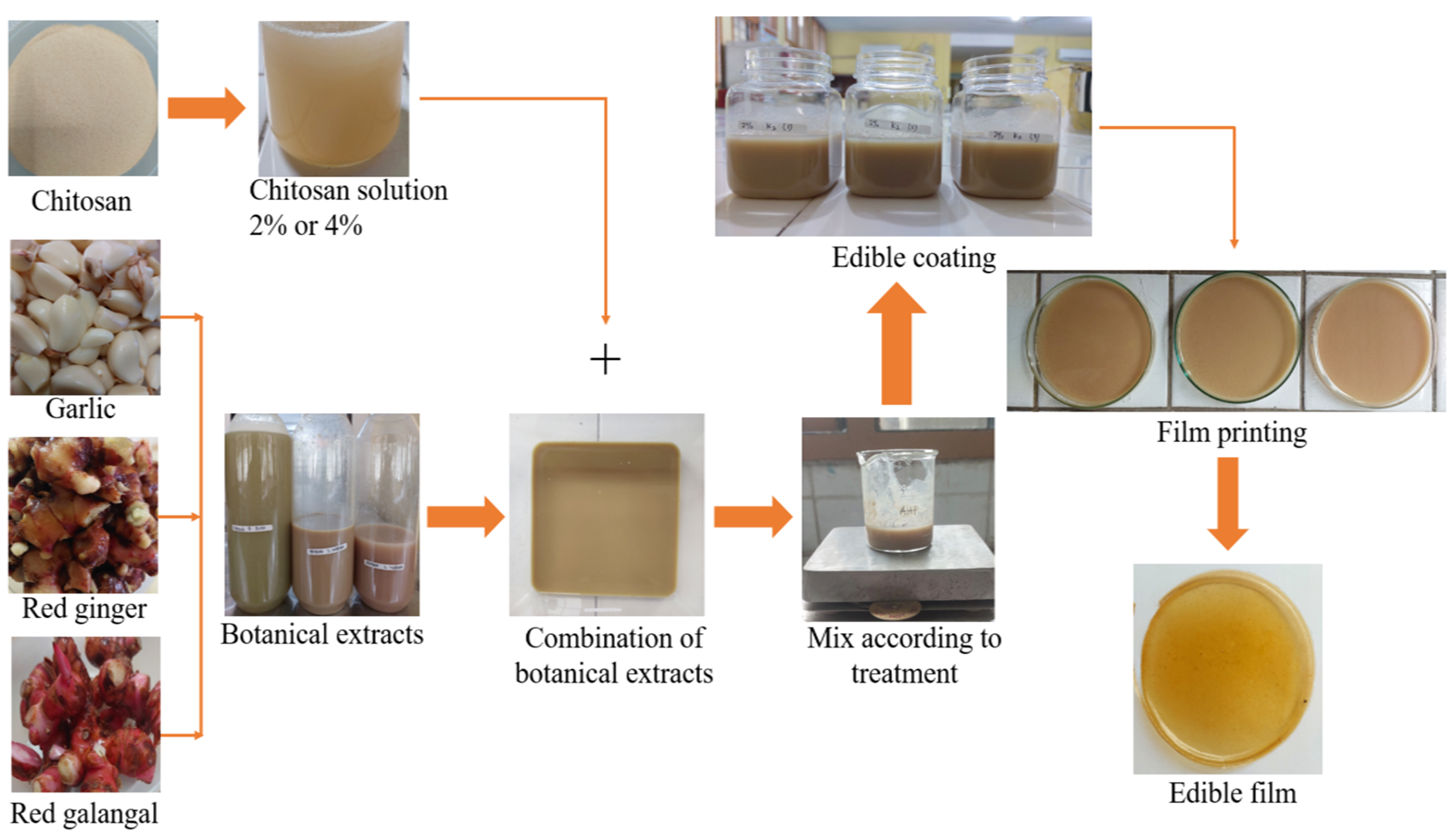
Downloads
References
A Matloob, H Ayub, M Mohsin, S Ambreen, FA Khan, S Oranab, MA Rahim, W Khalid, GA Nayik, S Ramniwas and S Ercisli. A review on edible coatings and films: advances, composition, production methods, and safety concerns. American Chemical Society Omega 2023; 8(32), 28932-28944.
D Castro, A Podshivalov, A Ponomareva and A Zhilenkov. Study of the reinforcing effect and antibacterial activity of edible films based on a mixture of chitosan/cassava starch filled with bentonite particles with intercalated ginger essential oil. Polymers 2024; 16(17), 2531.
P Cazón, E Morales-Sanchez, G Velazquez and M Vázquez. Measurement of the water vapor permeability of chitosan films: A laboratory experiment on food packaging materials. Journal of Chemical Education 2022; 99, 2403-2408.
A Jiang, R Patel, B Padhan, S Palimkar, P Galgali, A Adhikari, I Varga and M Patel. Chitosan based biodegradable composite for antibacterial food packaging application. Polymers 2023; 15(10), 2235.
LA Picos-Corrales, AM Morales-Burgos, JP Ruelas-Leyva, G Crini, E García-Armenta, SA Jimenez-Lam, LE Ayón-Reyna, F Rocha-Alonzo, L Calderón-Zamora, U Osuna-Martínez, A Calderón-Castro, G De-Paz-Arroyo and LN Inzunza-Camacho. Chitosan as an outstanding polysaccharide improving health-commodities of humans and environmental protection. Polymers 2023; 15(3), 526.
S Ma, Y Zheng, R Zhou and M Ma. Characterization of chitosan films incorporated with different substances of konjac glucomannan, cassava starch, maltodextrin and gelatin, and application in mongolian cheese packaging. Coatings 2021; 11(1), 84.
BH Ulusoy, FK Yildirim and C Hecer. Edible films and coatings: A good idea from past to future technology. Journal of Food Technology Research 2018; 5(1), 28-33.
M Barik, G BhagyaRaj, KK Dash and R Shams. A thorough evaluation of chitosan-based packaging film and coating for food product shelf-life extension. Journal of Agriculture and Food Research 2024; 16, 101164.
C Antonino, G Difonzo, M Faccia and F Caponio. Effect of edible coatings and films enriched with plant extracts and essential oils on the preservation of animal-derived foods. Journal of Food Science 2024; 89(2), 748-772.
W Chang, F Liu, HR Sharif, Z Huang, HD Goff and F Zhong. Preparation of chitosan films by neutralization for improving their preservation effects on chilled meat. Food Hydrocolloids 2019; 90, 50-61.
NE Suyatma, S Gunawan, RY Putri, A Tara, F Abbès, DY Hastati and B Abbès. Active biohybrid nanocomposite films made from chitosan, ZnO nanoparticles, and stearic acid: Optimization study to develop antibacterial films for food packaging application. Materials 2023; 16(3), 926.
K Venkatachalam, N Rakkapao and S Lekjing. Physicochemical and antimicrobial characterization of chitosan and native glutinous rice starch-based composite edible films: Influence of different essential oils incorporation. Membranes 2023; 13(2), 161.
F Handayasari, NE Suyatma and S Nurjanah. Physiochemical and antibacterial analysis of gelatin-chitosan edible film with the addition of nitrite and garlic essential oil by response surface methodology. Journal of Food Processing and Preservation 2019; 43(12), e14265.
A Al-Harrasi, S Bhtaia, MS Al-Azri, HA Makeen, M Albratty, HA Alhazmi, S Mohan, A Sharma and T Behl. Development and characterization of chitosan and porphyran based composite edible films containing ginger essential oil. Polymers 2022; 14(9), 1782.
W Zhou, Y He, F Liu, L Liao, X Huang, R Li, Y Zou, L Zhou, L Zou, Y Liu, R Ruan and J Li. Carboxymethyl chitosan-pullulan edible films enriched with galangal essential oil: Characterization and application in mango preservation. Carbohydrate Polymers 2021; 256, 117579.
A Irawan, DR Barleany, J Jayanudin, M Yulivianti, D Desiana and F Haqi. Antimicrobial activity of chitosan based edible film enriched with red ginger essential oil as an active packaging for food. Research Journal of Pharmaceutical, Biological and Chemical Sciences 2017; 8(3), 1523-1530.
S Mishra, S Mullasseri, R Mishra, A Saha, MS Induja and D Madduru. Chitosan biopolymer film with garlic peel extract. Current Science 2022; 122, 12-15.
SA Al-Hilifi, RM Al-Ali and AT Petkoska. Ginger essential oil as an active addition to composite chitosan films: development and characterization. Gels 2022; 8(6), 327.
Y Cao, W Gu, J Zhang, Y Chu, X Ye, Y Hu and J Chen. Effects of chitosan, aqueous extract of ginger, onion and garlic on quality and shelf life of stewed-pork during refrigerated storage. Food Chemistry 2013; 141, 1655-1660.
Y Levania, Michael and EA Prasetyanto. Chitosan and red ginger extract patches for diabetic foot ulcers: An alternative for urban healthcare challenges. Jurnal Perkotaan 2025; 17(1), 38-45.
R Elsabagh, SS Ibrahim, EM Abd-Elaaty, A Abdeen, AM Rayan, SF Ibrahim, M Abdo, F Imbrea, L Şmuleac, AM El-Sayed, RY Abd Elghaffar and MK Morsy. Chitosan edible coating: a potential control of toxic biogenic amines and enhancing the quality and shelf life of chilled tuna filets. Frontiers in Sustainable Food Systems 2023; 7, 1-12.
NA Pratiwi, I Rostini, A Yustiati and RA Pratama. Effect of red ginger essential oil (Zingiber officinale Var. Rubrum) addition on chitosan based edible coating towards organoleptic characteristics pempek. Asian Journal of Fisheries and Aquatic Research 2021; 15(5), 1-9.
SH Nofiyanti, LDR Fajarini, IGAM Putra and YLV Arista. Process intensification of polyphenol and flavonoid extraction from ant nest (Myrmecodia pendans) via ohmic heating: Investigating joule heating and electric field-time interactions using a response surface methodology. Trends in Sciences 2025; 22(11), 10471.
JO Akullo, B Kiage, D Nakimbugwe and J Kinyuru. Effect of aqueous and organic solvent extraction on in-vitro antimicrobial activity of 2 varieties of fresh ginger (Zingiber officinale) and garlic (Allium sativum). Heliyon 2022; 8(9), e10457.
MW Apriliyani, Purwadi, A Manab, BM Ahmad and LM Uula. Physico-chemical and antimicrobial properties of caseinchitosan edible films as food quality and food safety Physico-chemical and antimicrobial properties of casein- chitosan edible films as food quality and food safety. IOP Conference Series: Earth and Environmental Science 2020; 443, 012018.
JMF Pavoni, CL Luchese and IC Tessaro. Impact of acid type for chitosan dissolution on the characteristics and biodegradability of cornstarch/chitosan based films. International Journal of Biological Macromolecules 2019; 138, 693-70.
A Pavinatto, AV de A Mattos, ACG Malpass, MH Okura, DT Balogh and RC Sanfelice. Coating with chitosan-based edible films for mechanical/biological protection of strawberries. International Journal of Biological Macromolecules 2019; 151, 1004-1011.
A Pažarauskait˙e, EN Fernández, I Sone, M Sivertsvik and N Sharmin. Combined effect of citric acid and polyphenol-rich grape seed extract towards bioactive smart food packaging systems. Polymers 2023; 15(14), 3118.
H Dysjaland, I Sone, EN Fernández, M Sivertsvik and N Sharmin. Mechanical, barrier, antioxidant and antimicrobial properties of alginate films: Effect of seaweed powder and plasma-activated water. Molecules 2022; 27(23), 8356.
T Ganić, S Vuletić, B Nikolić, M Stevanović, M Kuzmanović, D Kekić, S Đurović, S Cvetković and D Mitić-Ćulafić. Cinnamon essential oil and its emulsion as efficient antibiofilm agents to combat Acinetobacter baumannii. Frontiers in Microbiology 2022; 13, 989667.
D Wang, J Sun, J Li, Z Sun, F Liu, L Du and D Wang. Preparation and characterization of gelatin/zein nanofiber films loaded with perillaldehyde, thymol, or ɛ-polylysine and evaluation of their effects on the preservation of chilled chicken breast. Food Chemistry 2022; 373, 131439.
D Silvia, Zulkarnain, RI Fadhilah, H Kamilah and NNAK Shah. Effect of ginger (Zingiber officinale) extracts on mechanical and antimicrobial properties of ganyong starch edible films as primary packaging of crabstick. Trends in Sciences 2024; 21(7), 7711.
X Guo, C Ren, Y Zhang, H Cui and C Shi. Stability of zein-based films and their mechanism of change during storage at different temperatures and relative humidity. Journal of Food Processing and Preservation 2020; 44(9), e14671.
H Du, C Liu, O Unsalan, C Altunayar-Unsalan, S Xiong, A Manyande and H Chen. Development and characterization of fish myofibrillar protein/chitosan/rosemary extract composite edible films and the improvement of lipid oxidation stability during the grass carp fillets storage. International Journal of Biological Macromolecules 2021; 184, 463-475.
E Díaz‐montes and R Castro‐muñoz. Trends in chitosan as a primary biopolymer for functional films and coatings manufacture for food and natural products. Polymers 2021; 13(5), 767.
S Khan, AAA Abdo, Y Shu, Z Zhang and T Liang. The extraction and impact of essential oils on bioactive films and food preservation, with emphasis on antioxidant and antibacterial activities-A review. Foods 2023; 12(22), 4169.
M Flórez, E Guerra-Rodríguez, P Cazón and M Vázquez. Chitosan for food packaging: Recent advances in active and intelligent films. Food Hydrocolloids 2022; 124, 107328.
S Ghani, H Barzegar, M Noshad and M Hojjati. The preparation, characterization and in vitro application evaluation of soluble soybean polysaccharide films incorporated with cinnamon essential oil nanoemulsions. International Journal of Biological Macromolecules 2018; 112, 197-202.
A Tügen, B Ocak and Ö Özdestan-Ocak. Development of gelatin/chitosan film incorporated with lemon essential oil with antioxidant properties. Journal of Food Measurement and Characterization 2020; 14, 3010-3019.
RM Al-Ali, SA Al-Hilifi and MMA Rashed. Fabrication, characterization, and anti‐free radical performance of edible packaging‐chitosan film synthesized from shrimp shell incorporated with ginger essential oil. Journal of Food Measurement and Characterization 2021; 15, 2951-2962.
L Asghar, A Sahar, MI Khan and M Shahid. Fabrication and characterization of chitosan and gelatin-based antimicrobial films incorporated with different essential oils. Foods 2024; 13(12), 1796.
SB Bhatwalkar, R Mondal, SBN Krishna, JK Adam, P Govender and R Anupam. Antibacterial properties of organosulfur compounds of garlic (Allium sativum). Frontiers in Microbiology 2021; 12, 613077.
IM Aziz, AA Alfuraydi, OM Almarfadi, MAM Aboul-Soud, AK Alshememry, AN Alsaleh and FN Almajhdi. Phytochemical analysis, antioxidant, anticancer, and antibacterial potential of Alpinia galanga (L.) rhizome. Heliyon 2024; 10(17), e37196.
A Amalraj, JT Haponiuk, S Thomas and S Gopi. Preparation, characterization and antimicrobial activity of polyvinyl alcohol/gum arabic/chitosan composite films incorporated with black pepper essential oil and ginger essential oil. International Journal of Biological Macromolecules 2020; 151, 366-375.
T Hong, JY Yin, SP Nie and MY Xie. Applications of infrared spectroscopy in polysaccharide structural analysis: Progress, challenge and perspective. Food Chemistry 2021; 12, 100168.
VS dos Santos, MV Lorevice, GS Baccarin, FM da Costa, R da Silva Fernandes, FA Aouada and MR de Moura. Combining chitosan nanoparticles and garlic essential Oil as additive fillers to produce pectin-based nanocomposite edible films. Polymers 2023; 15(10), 2244.
MG Maienschein-Cline and CH Londergan. The CN stretching band of aliphatic thiocyanate is sensitive to solvent dynamics and specific solvation. The Journal Physical Chemistry A Letters 2007; 111(40), 10020-10025.
A Sarhan. Characterization of chitosan and polyethylene glycol blend film. Egyptian Journal of Chemistry 2019; 62(12), 405-412.
B Karkar, S Şahin, D Bekiz, B Akça and C Özakın. Evaluation of antioxidant films of chitosan with Aquilaria agallocha extract as packaging material. Journal of Food Science 2023; 88, 2571-2582.
YY Ren, JL Fang, RZ Gong, ZL Xiang and PP Sun. Preparation of alkali-soluble polysaccharide from Clausena lansium (Lour.) skeels and its effects on properties of chitosan-based edible film. Frontiers in Sustainable Food Systems 2023; 7, 1185951.
A Haddar, E Sellami, O Bouazizi, A Sila and A Bougatef. Biodegradable levan/chitosan composite films: Development and application in beef filet packaging. Foods 2025; 14(12), 2133.
J Wang, M Ismail, NR Khan, DEN Khan, T Iftikhar, MG Shahid, SU Shah and ZU Rehman. Chitosan based ethanolic Allium sativum extract hydrogel film: A novel skin tissue regeneration platform for 2nd degree burn wound healing. Biomedical Materials 2024; 19(4), 045036.
M Elma, EA Pradana, N Sihombing, RN Thala’ah, A Rahma and ELA Rampun. Edible film fabrication derived from nagara starch and ded ginger essential oil as a package of instant noodles seasoning. IOP Conference Series: Earth and Environmental Science 2022; 999, 012024.
A Zehra, SM Wani, N Jan, TA Bhat, SA Rather, AR Malik and SZ Hussain. Development of chitosan-based biodegradable films enriched with thyme essential oil and additives for potential applications in packaging of fresh collard greens. Scientific Reports 2022; 12(1), 16923.
Z Shen and DP Kamdem. Development and characterization of biodegradable chitosan films containing 2 essential oils. International Journal of Biological Macromolecules 2015; 74, 289-296.
P Cazón and M Vázquez. Mechanical and barrier properties of chitosan combined with other components as food packaging film. Environmental Chemistry Letters 2019; 18(2), 257-267.
Published
How to Cite
Issue
Section
License
Copyright (c) 2025 Walailak University

This work is licensed under a Creative Commons Attribution-NonCommercial-NoDerivatives 4.0 International License.





