
Caffeic Acid Derivatives as Promising Efflux Pump Inhibitors Against Multidrug-Resistant Pseudomonas aeruginosa: Insights from Molecular Docking Studies
DOI:
https://doi.org/10.48048/tis.2026.12778Keywords:
Multidrug resistance, Pseudomonas aeruginosa, Mex B protein, Efflux pump inhibitor, Caffeic acid derivatives, Molecular docking, AutoDockAbstract
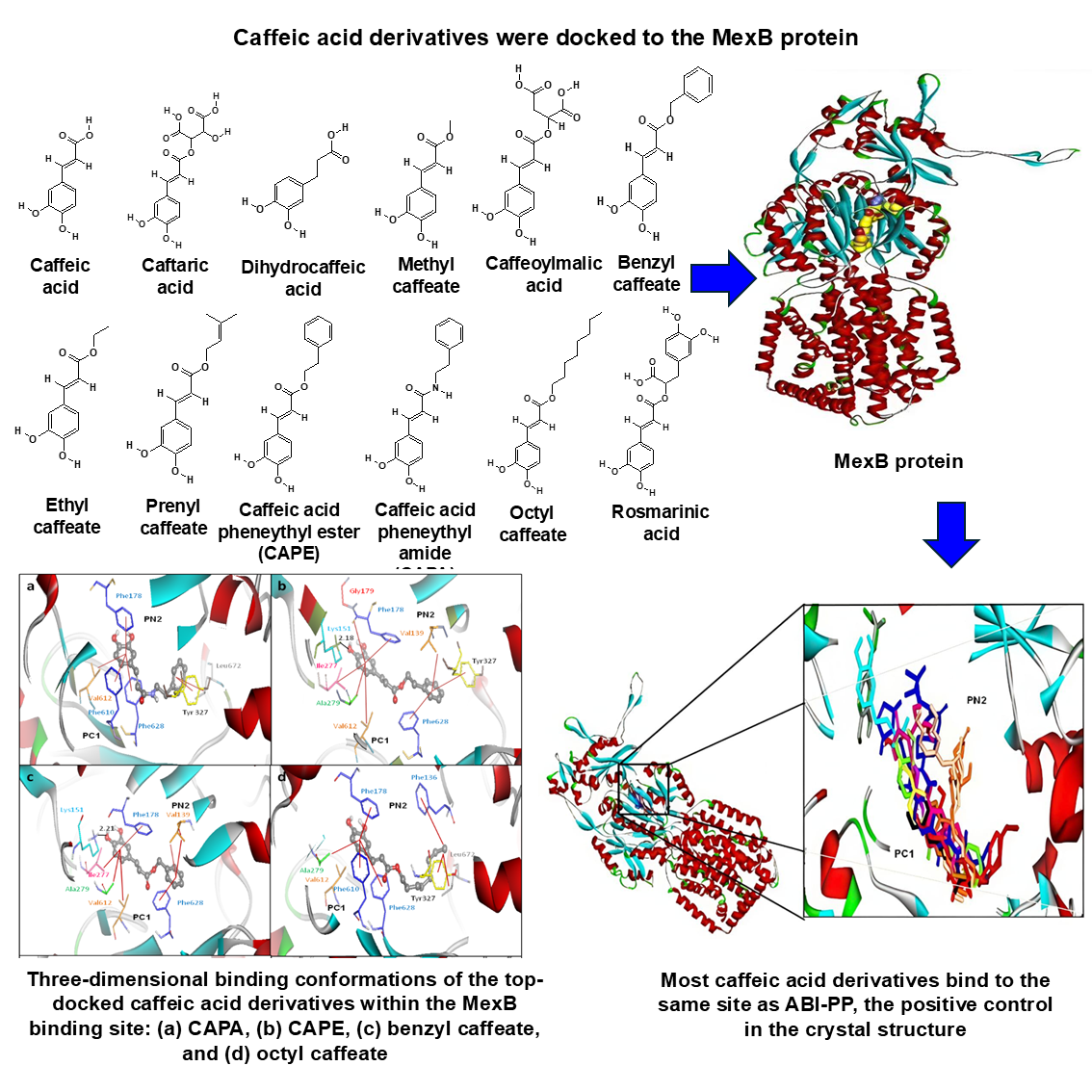
Pseudomonas aeruginosa is a highly resilient bacterial pathogen intrinsically resistant to multiple antibiotics due to its low outer membrane permeability and the overexpression of multidrug efflux pumps, particularly MexAB-OprM. Targeting efflux activity through efflux pumps inhibitors (EPIs) represents a promising strategy to restore antibiotic efficacy. This in silico study explores caffeic acid and its structurally diverse derivatives (benzyl caffeate, caffeoylmalic acid, caftaric acid, caffeic acid phenethyl amide (CAPA), caffeic acid phenethyl ester (CAPE), dihydrocaffeic acid, ethyl caffeate, methyl caffeate, octyl caffeate, prenyl caffeate, and rosmarinic acid) as potential EPIs targeting P. aeruginosa, specifically the MexB protein of the MexAB-OprM system. Molecular docking simulations were performed using AutoDock 4.2 to determine binding affinities and interaction profiles of the selected compounds within the MexB distal binding pocket. Docking analysis revealed that all derivatives preferentially localized to the distal binding pocket of the MexB transporter, interacting extensively with hydrophobic and aromatic residues enriched in the PN2 and PC1 subdomains of the T monomer. These regions are enriched with phenylalanine residues (Phe136, Phe178, Phe610, Phe615 and Phe628), which facilitate with π–π stacking and hydrophobic interactions and hydrogen bond interaction. Among the tested compounds, CAPE and CAPA showed the most favorable docking energies and interaction patterns, with binding conformations closely mimicking the binding behavior of those established EPI, ABI-PP. Although their binding energies were moderately higher than ABI-PP, CAPA and CAPE demonstrated strong structural alignment and interaction with key residues, suggesting their potential as novel efflux pump inhibitors to combat multidrug resistance in P. aeruginosa. Overall, these findings suggest that CAPA and CAPE possess promising structural features for efflux pump inhibition and may serve as lead compounds for the development of novel adjuvant therapies against multidrug‑resistant P. aeruginosa. Further experimental validation is warranted to confirm their inhibitory potential and assess their clinical relevance.
HIGHLIGHTS
- The study targets the MexB efflux pump of Pseudomonas aeruginosa, a key contributor to multidrug resistance.
- Twelve caffeic acid derivatives were docked in silico, showing preferential binding near the PN2 and PC1 subdomains of MexB.
- Stable interactions involved key phenylalanine residues (Phe136, Phe178, Phe610, Phe615 and Phe628) with CAPE and CAPA identified as the most promising inhibitors.
GRAPHICAL ABSTRACT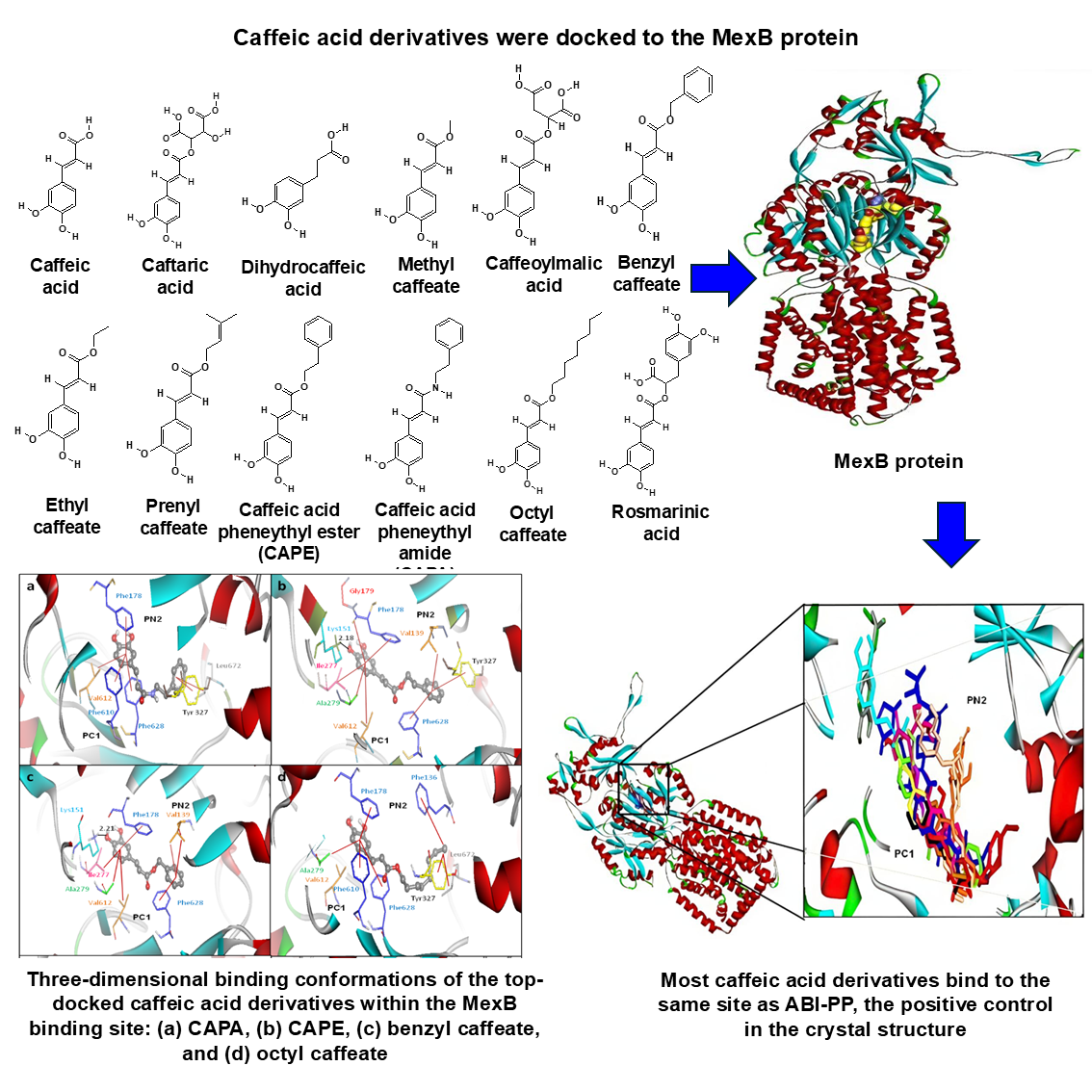
Downloads
References
I Jurado-Martin, M Sainz-Mejias and S McClean. Pseudomonas aeruginosa: An audacious pathogen with an adaptable arsenal of virulence factors. International Journal of Molecular Sciences 2021; 22(6), 3128.
M Haque, M Sartelli, J McKimm and M Abu Bakar. Health care-associated infections - an overview. Infection and Drug Resistance 2018; 11, 2321-2333.
KL McCarthy and DL Paterson. Increased risk of death with recurrent Pseudomonas aeruginosa bacteremia. Diagnostic Microbiology and Infectious Disease 2017; 88(2), 152-157.
MD Parkins, R Somayaji and VJ Waters. Epidemiology, biology, and impact of clonal Pseudomonas aeruginosa infections in cystic fibrosis. Clinical Microbiology Reviews 2018; 31(4), e00019-18.
XZ Li, P Plesiat and H Nikaido. The challenge of efflux-mediated antibiotic resistance in Gram-negative bacteria. Clinical Microbiology Reviews 2015; 28(2), 337-418.
J Dreier and P Ruggerone. Interaction of antibacterial compounds with RND efflux pumps in Pseudomonas aeruginosa. Frontiers in Microbiology 2015; 6, 660.
S Guenard, C Muller, L Monlezun, P Benas, I Broutin, K Jeannot and P Plesiat. Multiple mutations lead to MexXY-OprM-dependent aminoglycoside resistance in clinical strains of Pseudomonas aeruginosa. Antimicro-bial Agents and Chemotherapy 2014; 58, 221-228.
MB Habib, NA Shah, A Amir, HA Alghamdi, MH Tariq, K Nisa and M Ammoun. Decoding MexB efflux pump genes: structural, molecular, and phylogenetic analysis of multidrug-resistant and extensively drug-resistant Pseudomonas aeruginosa. Frontiers in Cellular and Infection Microbiology 2025; 14, 1519737.
E Kello, R Greenberg, W Li, S Polansky, R Maldonado, Y Peter and P Basu. The effect of antibiotic treatment and gene expression of Mex B efflux transporters on the resistance in Pseudomonas aeruginosa biofilms. Applied Microbiology 2023; 3(3), 709-721.
M Duffey, RP Jumde, RMA da Costa, HK Ropponen, B Blasco and LJV Piddock. Extending the potency and lifespan of antibiotic: Inhibitors of Gram-negative bacterial efflux pumps. ACS Infectious Diseases 2024; 10(5) 1458-1482.
RP Lamers, JF Cavallari and LL Burrows. The efflux inhibitor phenylalanine-arginine beta-naphthylamide (PAβN) permeabilizes the outer membrane of Gram-negative bacteria. PLoS One 2013; 8(3), e60666.
S Schuster, JA Bohnert, M Vavra, JW Rossen and WV Kern. Proof of an outer membrane target of the efflux inhibitor Phe-Arg-β-Naphthylamide from random mutagenesis. Molecules 2019; 24(3), 470.
AD Kinana, AV Vargiu, T May and H Nikaido. Aminoacyl β-Naphthylamides as substrates and modulators of AcrB multidrug efflux pump. Proceedings of the National Academy of Sciences of the United States of America 2016; 113(5), 1405-1410.
N Bamola, P Verma and C Negi. A review on some traditional medicinal plants. International Journal of Life Sciences Scientific Research 2018; 4(1) 1550-1556.
M Dev and M Mukadam. Functional group profiling of medicinal plants using FTIR spectroscopy. World Journal of Biology Pharmacy and Health Sciences 2025, 21(01), 243-249.
MN Clifford. Chlorogenic acids and other cinnamates - nature, occurrence, dietary burden, absorption and metabolism. Journal of the Science of Food and Agriculture 2000; 80, 1033-1043.
C Chaowuttikul, C Palanuvej and N Ruangrungsi. Quantification of chlorogenic acid, rosmarinic acid, and caffeic acid contents in selected Thai medicinal plants using RP-HPLC-DAD. Brazilian Journal of Pharmaceutical Sciences 2020; 56, e17547.
F Khan, NI Bamunuarachchi, N Tabassum and YM Kim. Caffeic acid and its derivatives: Antimicrobial drugs toward. Microbial Pathogens Journal of Agricultural and Food Chemistry 2021; 69(10), 2979-3004.
NN Muhammad Abdul Kadar, F Ahmad, SL Teoh and MF Yahaya. Caffeic acid on metabolic syndrome: A review. Molecules 2021; 26(18), 5490.
N Pavlikova. Caffeic acid and diseases-mechanisms of action. International Journal of Molecular Sciences 2022; 24(1), 588.
H Wang, GJ Provan and K Helliwell. Determination of rosmarinic acid and caffeic acid in aromatic herbs by HPLC. Food Chemistry 2004; 87(2), 307-311.
RW Jiang, KM Lau, PM Hon, TC Mak, KS Woo and KP Fung. Chemistry and biological activities of caffeic acid derivatives from Salvia miltiorrhiza. Current Medicinal Chemistry 2005; 12(2), 237-246.
M Yoshimoto, R Kurata-Azuma, M Fujii, H De-Xing, K Ikeda, T Yoshidome and M Osako. Enzymatic production of caffeic acid by Koji from plant resources containing caffeoylquinic acid derivatives. Bioscience, Biotechnology, and Biochemistry 2005; 69(9), 1777-1781.
J Yu, J Xie, M Sun, S Xiong, C Xu, Z Zhang, M Li, C Li and L Lin. Plant-derived caffeic acid and its derivatives: An overview of their NMR data and biosynthetic pathways. Molecules 2024; 29(7), 1625.
A Trivedi, S Bhati and A Joshi. Establishment of callus cultures and quantification of caffeic acid using HPTLC from Desmodium gangeticum (L.). Natural Product Research 2025; 39(17), 4871-4878.
P Dhiman, N Malik and A Khatkar. Hybrid caffeic acid derivatives as monoamine oxidases inhibitors: Synthesis, radical scavenging activity, molecular docking studies and in silico ADMET analysis. Chemistry Central Journal 2018; 12, 112.
K Sidoryk, A Jaromin, N Filipczak N, P Cmoch and M Cybulski. Synthesis and antioxidant activity of caffeic acid derivatives. Molecules 2018; 23(9), 2199.
MD Armas-Ricard, E Ruiz-Reyes and O Ramírez-Rodríguez. Caffeates and caffeamides: Synthetic methodologies and their Antioxidant properties. Hindawi International Journal of Medicinal Chemistry 2019; 2019, 2592609.
X Peng, G Wu, A Zhao, K Huang, L Chai, B Natarajan, S Yang, H Chen and C Lin. Synthesis of novel caffeic acid derivatives and their protective effect against hydrogen peroxide induced oxidative stress via Nrf2 pathway. Life Sciences 2020; 247, 117439.
Y Mou, S Wen, HK Sha, Y Zhao, LJ Gui, Y Wang and ZY Jiang. Discovery and development of caffeic acid analogs as versatile therapeutic agents. Pharmaceuticals 2024; 17(10), 1403.
X Zhao, ZW Liu, H Liu, J Guo and SH Long. Hybrid molecules based on caffeic acid as potential therapeutics: A focused review. European Journal of Medicinal Chemistry 2022; 243, 114745.
K Sakae, D Nonaka, M Y Hirata, R Fujiwara, A Kondo, S Noda and T Tanaka. Caffeic acid production from glucose using metabolically engineered Escherichia coli. Enzyme and Microbial Technology 2023; 164, 110193.
H Shen, A Yamashita, M Nakakoshi, H Yokoe, M Sudo, H Kasai, T Tanaka, Y Fujimoto, M Ikeda, N Kato, N Sakamoto, H Shindo, S Maekawa and K Moriishi. Inhibitory effects of caffeic acid phenethyl ester derivatives on replication of hepatitis C virus. PLOS One 2013; 8(12), e82299.
H Utsunomiya, M Ichinose, K Ikeda, M Uozaki, J Morishita, T Kuwahara, AH Koyama and H Yamasaki. Inhibition by caffeic acid of the influenza A virus multiplication in vitro. International Journal of Molecular Medicine 2014; 34, 1020-1024.
JCO Sardi, FP Gullo, IA Freires, NS Pitangui, MP Segalla, AM Fusco-Almeida, PL Rosalen, LO Regasini and MJS Mendes-Giannini. Synthesis, antifungal activity of caffeic acid derivative esters, and their synergism with fluconazole and nystatin against Candida spp. Diagnostic Microbiology and Infectious Disease 2016; 86(4), 387-391.
M Kepa, M Miklasinska-Majdanik, RD Wojtyczka, D Idzik, K Korzeniowski, J Smolen-Dzirba and TJ Wasik. Antimicrobial potential of caffeic acid against Staphylococcus aureus clinical strains. Biomedical Research International 2018; 15, 7413504.
FCP Rossatto, N Tharmalingam, IE Escobar, PA d’Azevedo, KR Zimmer and E Mylonakis. Antifungal Activity of the phenolic compounds Ellagic Acid (EA) and Caffeic Acid Phenethyl Ester (CAPE) against Drug-Resistant Candida auris. Journal of Fungi 2021; 7(9), 763.
W Sun and MH Shahrajabian. Therapeutic potential of phenolic compounds in medicinal plants - Natural health products for human health. Molecules 2023; 28(4), 1845.
M Bhattacharya and S Mandal. Antibacterial activity of caffeic acid from plant sources: A review based on in silico, in vitro and in vivo approaches. The Microbe 2025; 8, 100541.
M Salehi, I Haghani, M Saeedi, K Morteza-Semnani, R Negarandeh, A Hosseinnataj, A Jafari, A Lotfizadeh, A Rafiei and T Molania. Antifungal efficacy of caffeic acid and nano-caffeic acid particles against candidiasis: An in vitro study. Journal of Oral Microbiology 2025; 17(1), 2564690.
MV Saivish, CC Pacca, VG da Costa, GL Menezes, RA da Silva, L Nebo, GSD da Silva, BRGA Milhim, IS Teixeira, T Henrique, NFB Mistrão, VM Hernandes, N Zini, AC de Carvalho, MA Fontoura, P Rahal, L Sacchetto, RE Marques and ML Nogueira. Caffeic acid has antiviral activity against Ilhéus virus in vitro. Viruses 2023; 15(2), 494.
GM Morris, R Huey, W Lindstrom, MF Sanner, RK Belew, DS Goodsell and J Olson. AutoDock4 and AutoDockTools4: Automated docking with selective receptor flexibility. Journal of Computational Chemistry 2009; 30(16), 2785-2791.
R Nakashima, K Sakurai, S Yamasaki, K Hayashi, C Nagata, K Hoshino, Y Onodera, K Nishino and A Yamaguchi. Structural basis for the inhibition of bacterial multidrug exporters. Nature 2013; 500, 102-106.
C Lipinski, F Lombardo, BW Dominy and PJ Feeney. Experimental and computational approaches to estimate solubility and permeability in drug discovery and development settings. Advanced Drug Delivery Reviews 1997; 23, 3-25.
S Forli, R Huey, ME Pique, MF Sanner, DS Goodsell and AJ Olson. Computational protein-ligand docking and virtual drug screening with the Autodock suite. Nature Protocols 2016; 11, 905-919.
FJ Solis and RJB Wets. Minimization by random search techniques. Mathematics of Operations Research 1981; 6(1), 19-30.
GM Morris, DS Goodsell, RS Halliday, R Huey, WE Hart, RK Belew and AJ Olson. Automated docking using a Lamarckian genetic algorithm and an empirical binding free energy function. Journal of Computational Chemistry 1998; 19(14), 1639-1662.
RA Laskowski and MB Swindells. Ligplot+: Multiple ligand-protein interaction diagrams for drug discovery. Journal of Chemical Information and Modeling 2011; 51(10), 2778-2786.
J Fu, K Cheng, ZM Zhang, RQ Fang and HL Zhu. Synthesis, structure and structure-activity relationship analysis of caffeic acid amides as potential antimicrobials. European Journal of Medicinal Chemistry 2010; 45(6), 2638-2643.
RP Verma and C Hansch. An approach towards the quantitative structure-activity relationships of caffeic acid and its derivatives. ChemBioChem 2004; 5(9), 1188-1195.
M Touaibia, J Jean-Francoise and J Doiron. Caffeic acid, a versatile pharmacophore: An overview. Mini-Reviews in Medicinal Chemistry 2011; 11(8), 695-713.
J Yang, GA Marriner, X Wang, PD Bowman, SM Kerwin and S Stavchansky. Synthesis of a series of caffeic acid phenethyl amide (CAPA) fluorinated derivatives: Comparison of cytoprotective effects to caffeic acid phenethyl ester (CAPE). Bioorganic and Medicinal Chemistry 2010; 18(14), 5032-5038.
EW Yu, G McDermott, HI Zgurskaya, H Nikaido and DE Koshland. Structural basis of multiple drug-binding capacity of the AcrB multidrug efflux pump. Science 2003; 300(5621), 976-980.
D Seeliger and BL de Groot. Conformational transitions upon ligand binding: Holo-structure prediction from apo conformations. Biophysical Journal 2010; 98(3), 428a.
F Collu, AV Vargui, J Dreier, M Casella and P Ruggerone. Recognition of imipenem and meropenem by RND-transporter MexB studied by computer simulations. Journal of the American Chemical Society 2012; 134(46), 19146-19158.
Downloads
Published
How to Cite
Issue
Section
License
Copyright (c) 2026 Walailak University

This work is licensed under a Creative Commons Attribution-NonCommercial-NoDerivatives 4.0 International License.