From Channels to Circulation: Mechanistic Insights into the Calcium-Regulatory Actions of A-52
DOI:
https://doi.org/10.48048/tis.2027.12769Keywords:
A-52, Calcium signaling, Antihypertensive activity, L-type Ca²⁺ channel, SERCA, RyR2, NCX, Renin–angiotensin pathway, In silico docking, In vivo studyAbstract
Hypertension is closely associated with disturbances in calcium ion (Ca²⁺) homeostasis in vascular and cardiac tissues. In this study, the antihypertensive activity of compound A-52 was explored using combined in silico and in vivo approaches. Molecular docking analysis was conducted to assess the interaction of A-52 with selected Ca²⁺-related targets, including L-type and R-type calcium channels, SERCA (Ca²⁺-ATPase), RyR2 (ryanodine receptor), the Na⁺/Ca²⁺ exchanger (NCX), and renin. The docking results revealed moderate binding affinities (–5.2 to –6.1 kcal/mol), which are commonly observed in preliminary docking studies, with interactions mediated by hydrogen bonding, π–π stacking, and hydrophobic contacts with key amino acid residues. These in silico findings, together with vascular reactivity data, suggest a possible involvement of calcium-dependent mechanisms, although no direct electrophysiological or Ca²⁺ flux measurements were performed. The in vivo antihypertensive effect of A-52 was evaluated in an adrenaline-induced acute hypertension model in Wistar rats. Intravenous administration of A-52 at a dose of 25 mg/kg resulted in a significant reduction of systolic and diastolic blood pressure within two hours, without evidence of severe hypotension. In contrast, a higher dose (50 mg/kg) induced a transient and unstable blood pressure response, indicating dose sensitivity under the applied conditions. Comparative evaluation with structurally related compounds (A-51 and A-54) showed that A-52 produced a more consistent antihypertensive response in this acute model. Overall, the results provide preliminary evidence that A-52 may influence pathways associated with Ca²⁺ handling and blood pressure regulation. Further studies involving chronic models, larger sample sizes, pharmacokinetic profiling, toxicity assessment, and direct functional assays are required to clarify its mechanism of action and therapeutic relevance.
HIGHLIGHTS
- Compound A-52 was evaluated for antihypertensive activity using in silico and in vivo approaches.
- Molecular docking predicted interactions of A-52 with multiple Ca²⁺-regulating proteins.
- A-52 exhibited docking affinities ranging from −5.2 to −6.1 kcal/mol across the investigated targets.
- A-52 at 25 mg/kg reduced systolic and diastolic blood pressure in hypertensive rats.
- The findings suggest potential calcium-dependent mechanisms underlying A-52 activity, warranting further validation.
GRAPHICAL ABSTRACT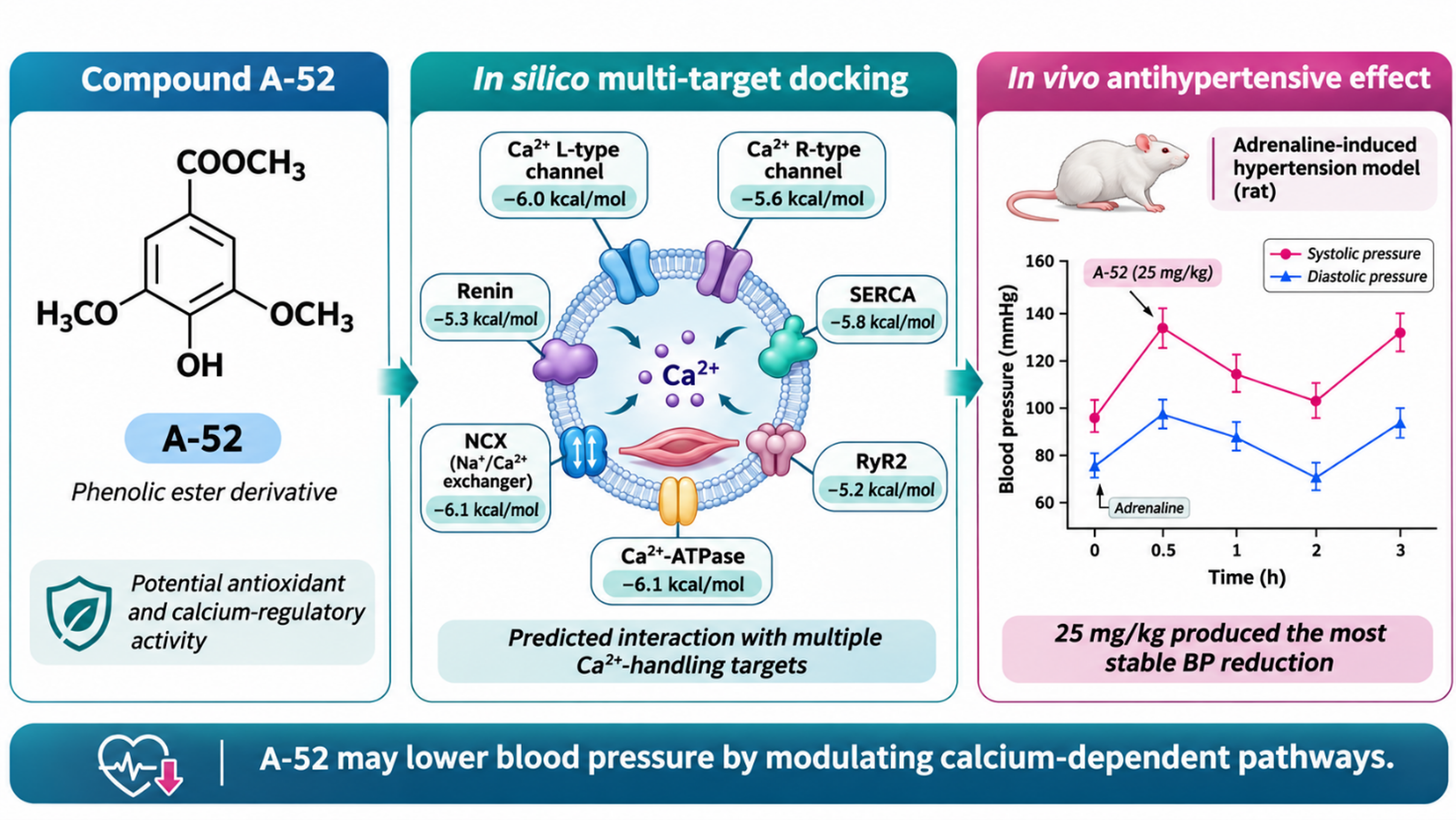
Downloads
References
S Sodiqova, S Kadirova, A Zaynabiddinov, I Abdullaev, L Makhmudov, U Gayibov, M Yuldasheva, M Xolmirzayeva, R Rakhimov, A Mutalibov and H Karimjonov. Channelopathy activity Of A-41(Propyl Ester of Gallic Acid): Experimental and computational study of antihypertensive activity. Trends in Sciences 2025; 22(9), 10496.
Aripov TF, Gayibov UG. Antiradical and antioxidant activity of the preparation “Rutan” from Rhus coriaria L. J Theor Clin Med. 2023;4, 164–170.
R Sayidaliyeva, S Kadirova, A Zaynabiddinov, I Abdullaev, L Makhmudov, U Gayibov, M Yuldasheva, M Kholmirzayeva, R Rakhimov, A Mutalibov and H Karimjonov. A-51 as a natural calcium channel blocker: An integrative study targeting hypertension. Trends in Sciences 2025; 22(11), 10760.
M Zaripova, I Abdullaev, A Bogbekov, U Gayibov, S Omonturdiev, R Makhmudov, N Ergashev, G Jabbarova, S Gayibova and T Aripov. In Vitro and in Silico studies of Gnaphalium U. Extract: Inhibition of α-amylase and α-glucosidase as a potential strategy for metabolic syndrome regulation. Trends in Sciences 2025; 22(8), 10098.
OS Zoirovich, AIZ Ugli, ID Raxmatillayevich, ML Umarjonovich, ZM Ravshanovna, GS Narimanovna, GU Gapparjanovich and AT Fatikhovich. The effect of Ájuga Turkestánica on the rat aortic smooth muscle ion channels. Biomedical & Pharmacology Journal 2024; 17(2), 1213-1222.
AV Mahmudov, OS Abduraimov, SB Erdonov, UG Gayibov and LY Izotova. Bioecological features of nigella sativa L. in different conditions of Uzbekistan. Plant Science Today 2022; 9(2): 421-426.
Gayibov UG, Zoirovich OA, Fotima AS, et al. Plant-derived and synthetic antihypoxic agents in cardiovascular diseases: mechanisms, key pathways and therapeutic potential. Plant Sci Today. (Early Access).
D Inomjonov, I Abdullaev, S Omonturdiev, A Abdullaev, L Maxmudov, M Zaripova, M Abdullayeva, D Abduazimova, S Menglieva, S Gayibova, Ma Sadbarxon, U Gayibov and T Aripov. In Vitro and In Vivo studies of crategus and inula helenium extracts: Their effects on rat blood pressure. Trends in Sciences 2025, 22(3), 9158
I Abdullaev, U Gayibov, S Omonturdiev, S Fotima, S Gayibova and T Aripov. Molecular pathways in cardiovascular disease under hypoxia: Mechanisms, biomarkers, and therapeutic targets[J]. The Journal of Biomedical Research 2025; 39(3): 254-269.
A Abdullaev, I Abdullaev, A Bogbekov, U Gayibov, S Omonturdiev, S Gayibova, M Turahodjayev, K Ruziboev and T Aripov. Antioxidant potential of rhodiola heterodonta extract: Activation of Nrf2 pathway via integrative In Vivo and In Silico studies. Trends in Sciences, 2025; 22(5), 9521.
MR Zaripova, SN Gayibova, RR Makhmudov, AA Mamadrahimov, Nl Vypova, UG Gayibov, SM Miralimova and TF Aripov. Characterization of Rhodiola heterodonta (Crassulaceae): Phytocomposition, antioxidant and antihyperglycemic activities. Preventive Nutrition and Food Science 2024; 29(2), 135-145.
AV Mahmudov, OS Abduraimov, SB Erdonov, AL Allamurotov, OT Mamatqosimov, UG Gayibov and L Izotova. Seed productivity of Linum usitatissimum L. in different ecological conditions of Uzbekistan. Plant Science Today 2022; 9(4), 1090-1101.
U Gayibov, SN Gayibova, MK Pozilov, FS Tuxtaeva, UR Yusupova, GMK DJabbarova, ZA Mamatova, NA Ergashev and TF Aripov. Influence of quercetin and dihydroquercetin on some functional parameters of rat liver mitochondria. Journal of Microbiology, Biotechnology and Food Sciences 2021; 11(1), e2924.
UG Gayibov. Influence of new polyphenol compound from Euphorbia plant on mitochondrial function. Journal of Microbiology, Biotechnology and Food Sciences 2019; 8(4), 1021-1025.
Pozilov MK, Gayibov UG, Asrarov MI, et al. Physiological alterations of mitochondria under diabetes condition and its correction by polyphenol gossitan. J Microbiol Biotechnol Food Sci, 2022, 12(2): e2224.
Vakhobjonovna AG, Jurayevich KE, Ogli AIZ, Azamovich EN, Rasuljonovich MR, Islomovich AM. Tannins as modulators in the prevention of mitochondrial dysfunction. Trends Sci. 2025;22(8),10436.
Abdurazakova I, Zaynabiddinov A, Abdullaev I, Makhmudov L, et al. Pharmacological evaluation of F-45 on the cardiovascular system using in vitro, in vivo models and molecular dockings. Trends Sci. 2025;22(12), 10924.
Mamajanov M, Abdullaev I, Sotimov G, Mavlanova S, et al. Mitochondrial and pharmacokinetic insights into 3,5,7,2′,6′-pentahydroxyflavanone: respiratory modulation, calcium handling, and membrane stability. Trends Sci. 2025;22(12), 10984.
Z Shakiryanova, R Khegay, U Gayibov, A Saparbekova, Z Konarbayeva, A Latif and O Smirnova. Isolation and study of a bioactive extract enriched with anthocyanin from red grape pomace (Cabernet sauvignon). Agronomy Research 2023; 21(3), 1293-1303.
Gayibov UG, Gayibova SN, Karimjonov HM, Abdullaev AA, et al. Antioxidant and cardioprotective properties of polyphenolic plant extract of Rhus glabra L. Plant Sci Today. 2024;11(3), 2348–1900.
O Gaibullayeva, A Islomov, D Abdugafurova, B Elmurodov, B Mirsalixov, L Mahmudov, I Adullaev, K Baratov, S Omonturdiev and S Sa’dullayeva. Inula helenium L. root extract in sunflower oil: Determination of its content of water-soluble vitamins and immunity-promoting effect. Biomedical Pharmacology Journal 2024; 17(4), 2729-2737.
Y Umidakhon, B Erkin, G Ulugbek, et al. Correction of the mitochondrial NADH oxidase activity, peroxidation and phospholipid metabolism by haplogenin-7-glucoside in hypoxia and ischemia[J]. Trends Sci 2022, 19(21), 6260.
AA Abdullaev, DR Inamjanov, DS Abduazimova, SZ Omonturdiyev, UG Gayibov, SN Gayibova and TF Aripov. Sílybum Mariánum’s impact on physiological alterations and oxidative stress in diabetic rats. Biomedical and Pharmacology Journal 2024; 17(2), 1291-1300.
Li, M., Zhang, M., Fatixovich, A.T. et al. Green-synthesized Zn²⁺-polyphenol networks (CGA/RA) for enhanced multifunctional food preservation. Food Measure (2025).
UG Gayibov, SN Gayibova , HM Karimjonov, AA Abdullaev, DS Abduazimova, RN Rakhimov, HS Ruziboev, MA Xolmirzayeva, AE Zaynabiddinov and TF Aripov. Antiradical and antioxidant activity of the preparation “Rutan” from Rhus coriaria L. Journal of Theoretical and Clinical Medicine 2023; 4, 164-170.
AQQ Azimova, AX Islomov, SA Maulyanov, D Gulyamovna Abdugafurova, LU Mahmudov, IZiyoyiddin Abdullaev, AS Ishmuratova, SQ Siddikova and IR Askarov. Determination of vitamins and pharmacological properties of Vitis vinifera L. plant fruit part (mixed varieties) syrup-honey. Biomedical and Pharmacology Journal 2024; 17(4), 2779-2786.
Downloads
Published
How to Cite
Issue
Section
License
Copyright (c) 2025 Walailak University

This work is licensed under a Creative Commons Attribution-NonCommercial-NoDerivatives 4.0 International License.