
Synergistic Enhancement of Nisin Production through Metabolic and Regulatory Engineering of Lactococcus lactis ATCC 11454: Thermal and pH Stability and Application in Food Model System
DOI:
https://doi.org/10.48048/tis.2026.12748Keywords:
Antimicrobial activity, Engineered lactic acid bacteria, Nisin, Preservation, StabilityAbstract
Nisin is one of the most studied bacteriocins due to its broad antimicrobial spectrum and Generally Recognized as Safe status. In this study, nisRK was overexpressed in lactic acid-deficient Lactococcus lactis ATCC 11454, generating a recombinant Lactococcus lactis ATCC 11454 Δldh carrying pMG36e-P8-nisRK (ldhΔnisRKOE), to enhance nisin biosynthesis. Growth kinetics (OD600 monitoring) and antimicrobial activity agar (well diffusion assay) were compared among wildtype, ldh∆, nisRKOE, and double mutant strains. The ldhΔnisRKOE strain exhibited significantly higher antimicrobial activity than all other strains, with inhibition zones increased by up to 107% against Gram-positive and 78% against Gram-negative bacteria, compared with the wildtype. Thermal and pH stability tests showed that antimicrobial activity was well preserved at low temperatures (0 -4 °C) and across a wide pH range (2 - 10), with optimal performance near pH 6. Activity declined by 26% - 34% following heat treatment at 100 - 121 °C. Application in raw chicken demonstrated that CFS from the engineered strain slowed microbial growth and extended shelf life. After seven days at 4 °C, treated samples maintained lower bacterial counts (8.41 ± 0.02 log CFU/g) compared with controls (9.10 ± 0.07 log CFU/g). At 30 °C, untreated samples spoiled within 72 h, while treated meats remained stable until day 7. These findings highlight that combining metabolic redirection with regulatory overexpression can substantially improves nisin yield and antimicrobial activity. L. lactis ATCC 11454-ldhΔnisRKOE strain holds strong potential as a microbial cell factory for bacteriocin-based applications in food preservation and biotechnology.
HIGHLIGHTS
- First report of nisRK overexpression in lactic acid deficient lactis background
- Overexpression of nisRK enhances nisin biosynthesis and antimicrobial activity
- L. lactis ATCC 11454-ldhΔ-nisRKOE strain exhibited highest antimicrobial activity.
- Antimicrobial activity remained stable across a wide pH range and moderate heat conditions.
- The application to raw chicken slowed spoilage and prolonged shelf life.
GRAPHICAL ABSTRACT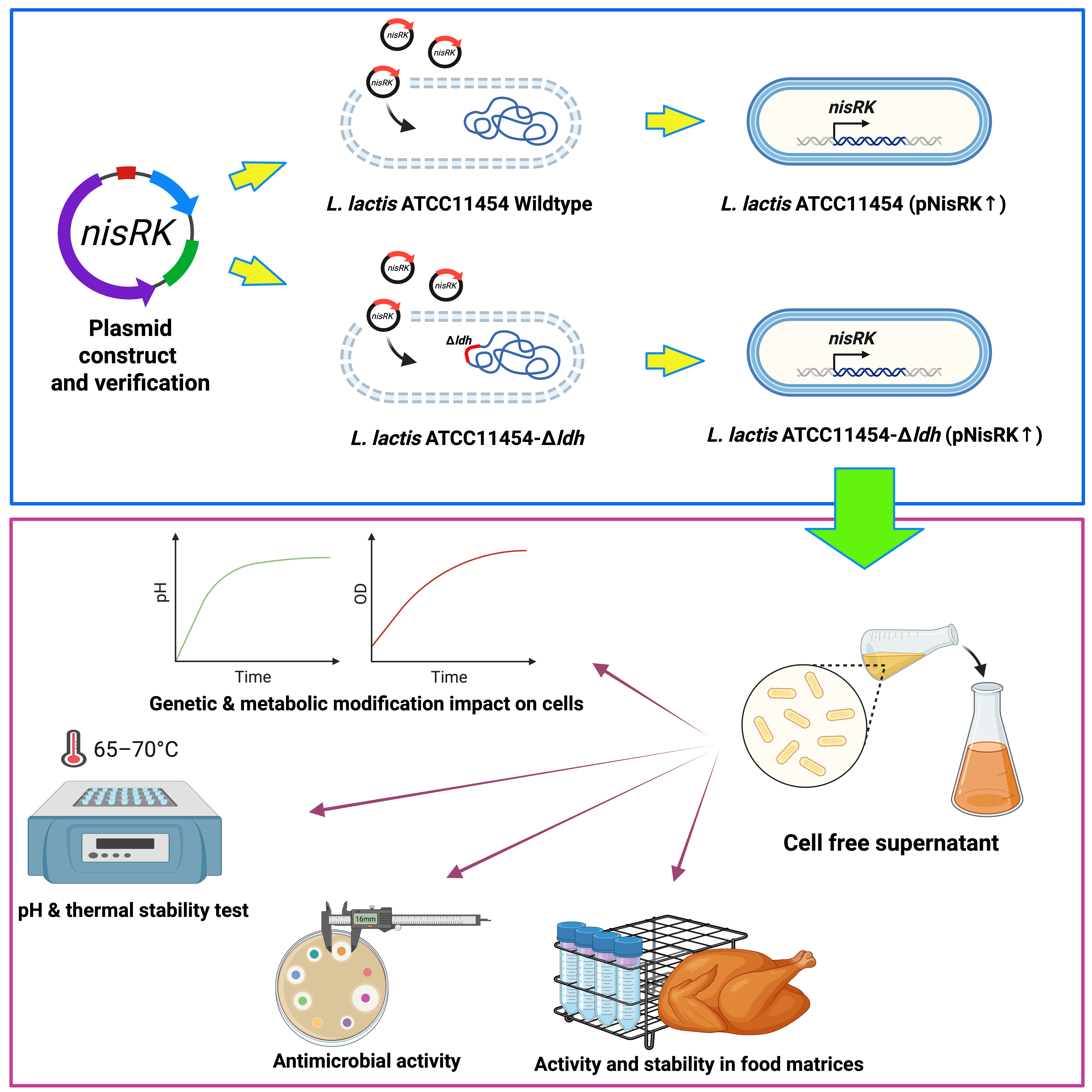
Downloads
References
AEC Olivos, A Linares‐Castañeda, LJ Corzo‐Ríos, M Márquez‐Lemus and C Jiménez‐Martínez. Nisin as a food preservative: Physicochemical, sensory properties and antimicrobial activity in Mexican tomato sauce. International Journal of Food Science & Technology 2024; 59(5), 3020-3030.
L Yuan, S Wu, K Tian, S Wang, H Wu and J Qiao. Nisin-relevant antimicrobial peptides: Synthesis strategies and applications. Food & Function 2024; 15(19), 9662-9677.
GH Choi, JII Fugaban, CM Dioso, JEV Bucheli, WH Holzapfel and SD Todorov. Antimicrobial peptides (Bacteriocins) produced by Lactococcus lactis and Pediococcus pentosaceus strains with activity against clinical and food-borne pathogens. Probiotics and Antimicrobial Proteins 2025; 17(3), 1171-1192.
MP Mokoena, CA Omatola and AO Olaniran. Applications of lactic acid bacteria and their bacteriocins against food spoilage microorganisms and foodborne pathogens. Molecules 2021; 26(22), 7055.
AM Charest, E Reed, S Bozorgzadeh, L Hernandez, NV Getsey, L Smith, A Galperina, HE Beauregard, HA Charest, M Mitchell and MA Riley. Nisin inhibition of gram-negative bacteria. Microorganisms 2024; 12(6), 1230.
C García-Ausencio, F Guzmán-Chávez, R Rodríguez-Sanoja and S Sánchez. Promiscuity of lanthipeptide enzymes: New challenges and applications. World Journal of Microbiology and Biotechnology 2025; 41(8), 1-20.
OP Kuipers, MM Beerthuyzen, PGGA de Ruyter, EJ Luesink and WM de Vos. Autoregulation of nisin biosynthesis in Lactococcus lactis by signal transduction. Journal of Biological Chemistry 1995; 270(45), 27299-27304.
CI Cheigh, H Park, HJ Choi and YR Pyun. Enhanced nisin production by increasing genes involved in nisin Z biosynthesis in Lactococcus lactis subsp. lactis A164. Biotechnology Letters 2005; 27(3), 155-160.
CI Cheigh, HJ Choi, H Park, SB Kim, MC Kook, TS Kim, JK Hwang and YR Pyun. Influence of growth conditions on the production of a nisin-like bacteriocin by Lactococcus lactis subsp. lactis A164 isolated from kimchi. Journal of Biotechnology 2002; 95(3), 225-235.
ZJ Ni, XY Zhang, F Liu, M Wang, RH Hao, PX Ling and XQ Zhu. Effect of co-overexpression of nisin key genes on nisin production improvement in Lactococcus lactis LS01. Probiotics and Antimicrobial Proteins 2017; 9(2), 204-212.
C Liu, L Zhang, H Liu and K Cheng. Delivery strategies of the CRISPR-Cas9 gene-editing system for therapeutic applications. Journal of Controlled Release 2017; 266, 17-26.
NHM Rasid, NA Halid, AS Ai-Lian, S Sabri, MHA Rahim, N Saari and H Hasan. Rerouting the metabolic pathway in Lactococcus lactis ATCC 11454 to improve nisin productivity by disrupting lactate dehydrogenase (ldh). Food Biotechnology 2024; 38(2), 180-194.
R Portieles, H Xu, F Chen, J Gao, L Du, X Gao, CB Nordelo, Q Yue, L Zhao, NP Gonzales, RS Bermudez and O Borrás-Hidalgo. Bioengineering of a Lactococcus lactis subsp. lactis strain enhances nisin production and bioactivity. PLoS One 2023; 18(4), 0281175.
YF Zhang, SY Liu, YH Du, WJ Feng, JH Liu and JJ Qiao. Genome shuffling of Lactococcus lactis subsp. lactis YF11 for improving nisin Z production and comparative analysis. Journal of Dairy Science 2014; 97(5), 2528-2541.
Y Haryani, NA Halid, SG Guat, MAR Nor-Khaizura, MA Hatta, S Sabri, S Radu and H Hasan. Efficient metabolic pathway modification in various strains of lactic acid bacteria using CRISPR/Cas9 system for elevated synthesis of antimicrobial compounds. Journal of Biotechnology 2024; 395, 53-63.
Y Haryani, NA Halid, GS Guat, NK MAR, A Hatta, S Sabri, S Radu and H Hasan. Characterisation, molecular identification, and antimicrobial activity of lactic acid bacteria isolated from selected fermented foods and beverages in Malaysia. FEMS Microbiology Letters 2023; 370, 023.
NL Sidek, M Halim, JS Tan, S Abbasiliasi, S Mustafa and AB Ariff. Stability of bacteriocin-like inhibitory substance (BLIS) produced by Pediococcus acidilactici KP10 at different extreme conditions. BioMed Research International 2018; 2018, 5973484.
DM Jo, SK Park, F Khan, MG Kang, JH Lee and YM Kim. An approach to extend the shelf life of ribbonfish fillet using lactic acid bacteria cell-free culture supernatant. Food Control 2021; 123, 107731.
MP Zacharof and RW Lovitt. Bacteriocins produced by lactic acid bacteria: A review. APCBEE Procedia 2012; 2, 50-56.
JP van Pijkeren and RA Britton. High-efficiency recombineering in lactic acid bacteria. Nucleic Acids Research 2012; 40(10), 76.
D Field, PD Cotter, RP Ross and C Hill. Bioengineering of the model lantibiotic nisin. Bioengineered 2015; 6(4), 187-192.
JN Hansen and PWE Sandine. Nisin as a model food preservative. Critical Reviews in Food Science and Nutrition 1996; 34(1), 69-93.
C Wang, Y Cui and X Qu. Mechanisms and improvement of acid resistance in lactic acid bacteria. Archives of Microbiology 2018; 200(2), 195-201.
A Frelet-Barrand. Lactococcus lactis, an attractive cell factory for the expression of functional membrane proteins. Biomolecules 2022; 12(2), 180.
XX Zhou, WF Li, GX Ma and YJ Pan. The nisin-controlled gene expression system: Construction, application and improvements. Biotechnology Advances 2006; 24(3), 285-295.
J Wu, M Zang, S Wang, B Zhao, J Bai, C Xu, Y Shi and X Qiao. Nisin: From a structural and meat preservation perspective. Food Microbiology 2023; 111, 104207.
S Yang, X Li, W Cang, D Mu, S Ji, R Wu and J Wu. Combined ε-polylysine and thermosonication treatment to inactivate Bacillus cereus and application in pasteurized milk. Food Bioscience 2023; 55, 102896.
GM de Almeida, CMN Mendonça, A Converti and RP de Souza Oliveira. Kinetic and thermodynamic parameters of nisin thermoinactivation. Journal of Food Engineering 2020; 280, 109986.
S Khelissa, NE Chihib and A Gharsallaoui. Conditions of nisin production by Lactococcus lactis subsp. lactis and its main uses as a food preservative. Archives of Microbiology 2021; 203(2), 465-480.
W Liu and JN Hansen. Some chemical and physical properties of nisin, a small-protein antibiotic produced by Lactococcus lactis. Applied and Environmental Microbiology 1990; 56(8), 2551-2558.
T Musafija-Jeknic. 1996, Structural analysis of thermally inactivated nisin. PhD Thesis. Oregon State University, Corvallis, USA.
P Holcapkova, ZK Raskova, M Hrabalikova, A Salakova, J Drbohlav and V Sedlarik. Isolation and thermal stabilization of bacteriocin nisin derived from whey for antimicrobial modifications of polymers. International Journal of Polymer Science 2017; 2017(1), 3072582.
S Senan, HA El-Aal, R Dave and A Hassan. Production and stability of nisin in whey protein concentrate. LWT - Food Science and Technology 2016; 71, 125-129.
DS Jung, FW Bodyfelt and MA Daeschel. Influence of fat and emulsifiers on nisin efficacy against Listeria monocytogenes in fluid milk. Journal of Dairy Science 1992; 75(2), 387-393.
D Lahiri, M Nag, B Dutta, T Sarkar, S Pati, D Basu, ZA Kari, LS Wei, S Smaoui, KW Goh and RR Ray. Bacteriocin: A natural approach for food safety and food security. Frontiers in Bioengineering and Biotechnology 2022; 10, 1005918.
X Liu, H Yao, X Zhao and C Ge. Biofilm formation and control of foodborne pathogenic bacteria. Molecules 2023; 28(6), 2432.
BD Needham and MS Trent. Fortifying the barrier: The impact of lipid A remodeling on bacterial pathogenesis. Nature Reviews Microbiology 2013; 11(7), 467-481.
JL Webber, R Namivandi-Zangeneh, S Drozdek, KA Wilk, C Boyer, EHH Wong, BH Bradshaw-Hajek, M Krasowska and DA Beattie. Incorporation and antimicrobial activity of nisin Z within carrageenan/chitosan multilayers. Scientific Reports 2021; 11(1), 1690.
I Wiedemann, E Breukink, C van Kraaij, OP Kuipers, G Bierbaum, B de Kruijff and HG Sahl. Specific binding of nisin to the peptidoglycan precursor lipid II combines pore formation and inhibition of cell wall biosynthesis for potent antibiotic activity. Journal of Biological Chemistry 2001; 276(3), 1772-1779.
H Zhou, J Fang, Y Tian and XY Lu. Mechanisms of nisin resistance in Gram-positive bacteria. Annals of Microbiology 2013; 64(2), 413-420.
M Yıldırım-Yalçın, H Sadıkoğlu and M Şeker. Characterization of edible film based on grape juice and cross-linked maize starch and its effects on the storage quality of chicken breast fillets. LWT 2021; 142, 111012.
W Wójcik, M Łukasiewicz and K Puppel. Biogenic amines: Formation, action and toxicity - a review. Journal of the Science of Food and Agriculture 2021; 101(7), 2634-2640.
Y Lei, Y Zhang, Y Cheng, J Huang and M Huang. Monitoring and identification of spoilage-related microorganisms in braised chicken with modified atmosphere packaging during refrigerated storage. Food Science and Human Wellness 2023; 12(1), 28-34.
DK Wardhana, AEP Haskito, MTE Purnama, DA Safitri and S Annisa. Detection of microbial contamination in chicken meat from local markets in Surabaya, East Java, Indonesia. Veterinary World 2021; 14(12), 3138-3143.
EE Popa, AC Miteluț, M Râpă, PA Popescu, MC Drăghici, M Geicu-Cristea and ME Popa. Antimicrobial active packaging containing nisin for preservation of animal-origin products: An overview. Foods 2022; 11(23), 3820.
L Settier-Ramírez, G López-Carballo, R Gavara and P Hernández-Muñoz. Broadening the antimicrobial spectrum of nisin-producing Lactococcus lactis subsp. Lactis to Gram-negative bacteria by means of active packaging. International Journal of Food Microbiology 2021; 339, 109007.
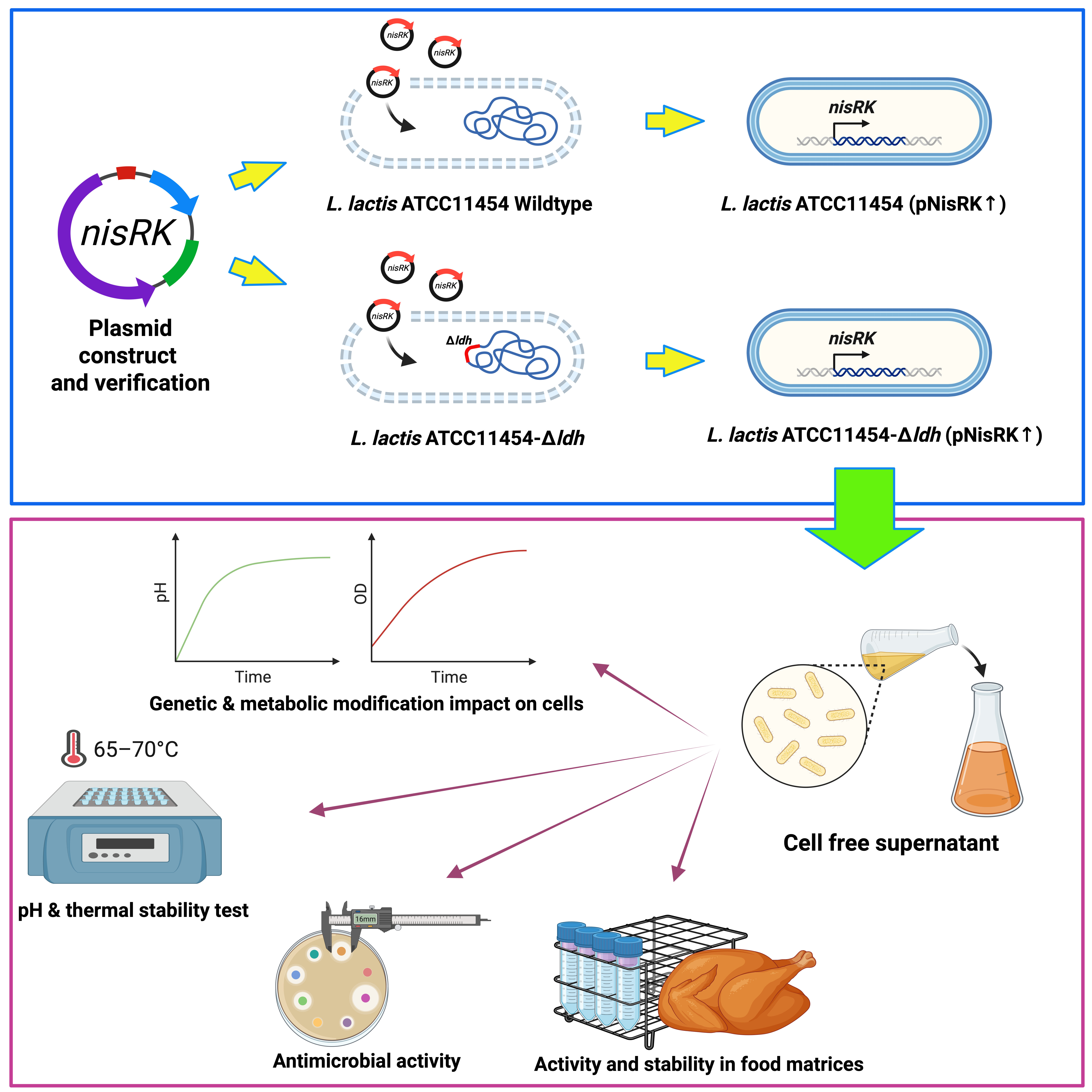
Published
How to Cite
Issue
Section
License
Copyright (c) 2025 Walailak University

This work is licensed under a Creative Commons Attribution-NonCommercial-NoDerivatives 4.0 International License.





