
Phytochemical Constituents and In Vitro Antioxidant and Anticancer Activities of Hornstedtia conoidea Ridl. (Zingiberaceae) from the Simeulue Islands
DOI:
https://doi.org/10.48048/tis.2026.12697Keywords:
Aceh, Antiproliferation, Breast cancer, Cervical cancer, Flavonoid content, Phenolic contentAbstract
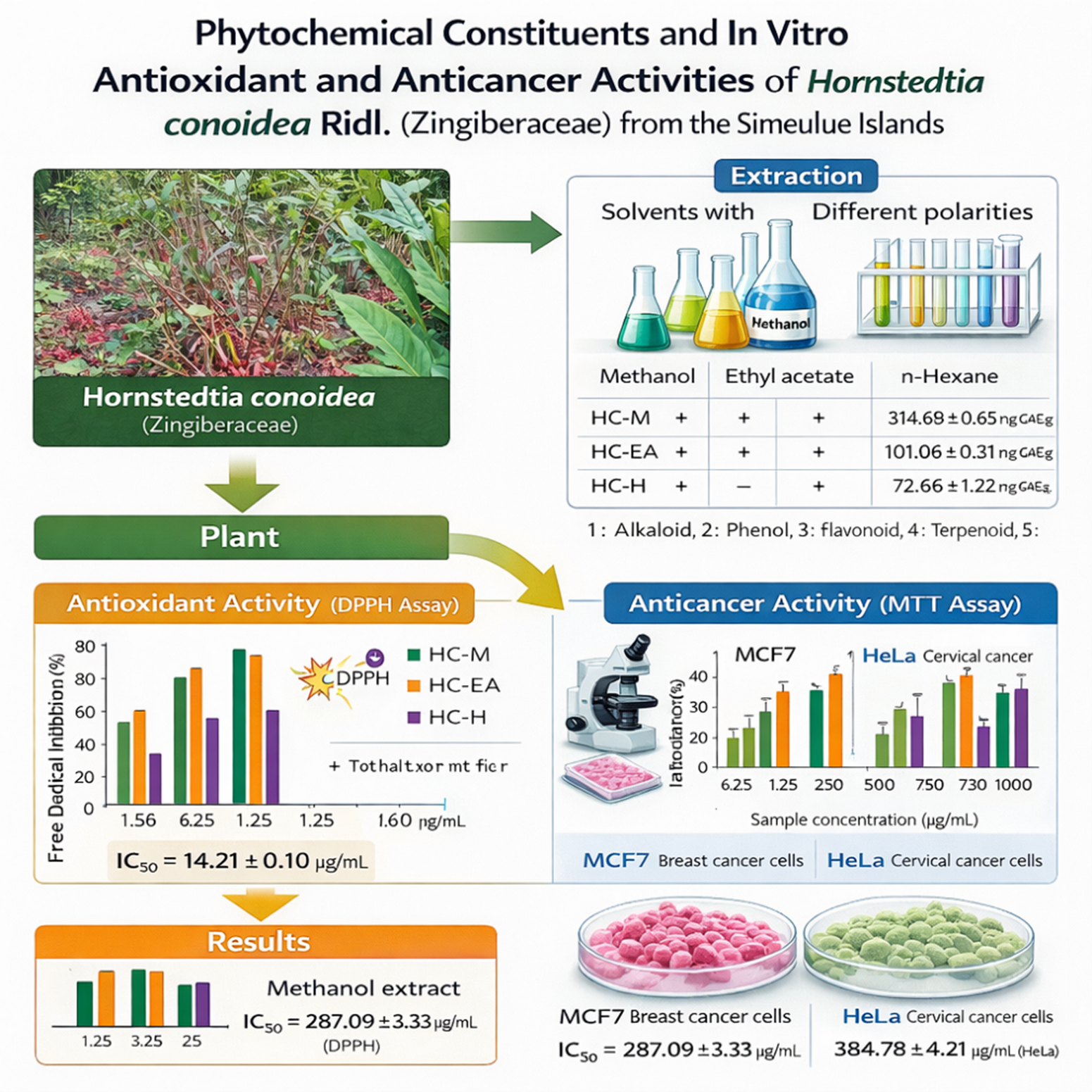
Hornstedtia conoidea (Zingiberaceae) is a traditional medicinal plant in the Simeulue Islands. Previous studies on the Hornstedtia genus have reported various pharmacological activities, including antioxidant, toxicity, antimicrobial, and glucosidase inhibitory effects; however, its anticancer activity, particularly against breast and cervical cancer, has not yet been scientifically validated. This study aimed to examine the antioxidant and anticancer activities of H. conoidea leaf extracts. The extraction process used solvents with different polarities (methanol, ethyl acetate, and n-hexane). Phytochemical screening and measurements of total phenolic and flavonoid contents were conducted for each extract. Antioxidant activity was evaluated using the 2,2-diphenyl-1-picrylhydrazyl (DPPH) assay, and antiproliferative activity against breast (MCF7) and cervical (HeLa) cancer cells was assessed using the 3-(4,5-dimethylthiazol-2-yl)-2,5-diphenyltetrazolium bromide (MTT) assay. The results showed that the methanol leaf extract of H. conoidea contained alkaloids, phenols, flavonoids, steroids, and terpenoids, with the highest total phenolic (314.69 ± 0.65 mg/g) and flavonoid (43.62 ± 1.20 mg/g) contents among the tested extracts. This extract also exhibited the strongest antioxidant activity, with an IC₅₀ of 14.21± 0.100 µg/mL against DPPH. In addition, the methanol extract demonstrated higher antiproliferative activity against cancer cells compared to the other extracts, with IC₅₀ values of 287.09 ± 3.33 µg/mL for MCF7 cells and 384.78 ± 4.21µg/mL for HeLa cells; however, this activity is classified as weak. The methanolic and ethyl acetate leaf extracts of H. conoidea exhibited strong antioxidant activity, indicating their potential for further development as natural antioxidant agents. In contrast, the in vitro antiproliferative effects against breast and cervical cancer cells remain limited and require further investigation.
HIGHLIGHTS
- Hornstedtia conoidea leaf extract from Mount Sibao, Simeulue Island, Aceh, Indonesia contained alkaloids, phenols, flavonoids, terpenoids, and steroids.
- Methanol was the optimal solvent for extracting phenol and flavonoid compounds from Hornstedtia conoidea leaf in this study.
- Hornstedtia conoidea leaf methanolic extract exhibited very strong antioxidant activity, indicating its potential for further development as a novel therapeutic agent.
- Hornstedtia conoidea leaf extract exhibited weak inhibitory effects on the proliferation of breast and cervical cancer cells in vitro.
GRAPHICAL ABSTRACT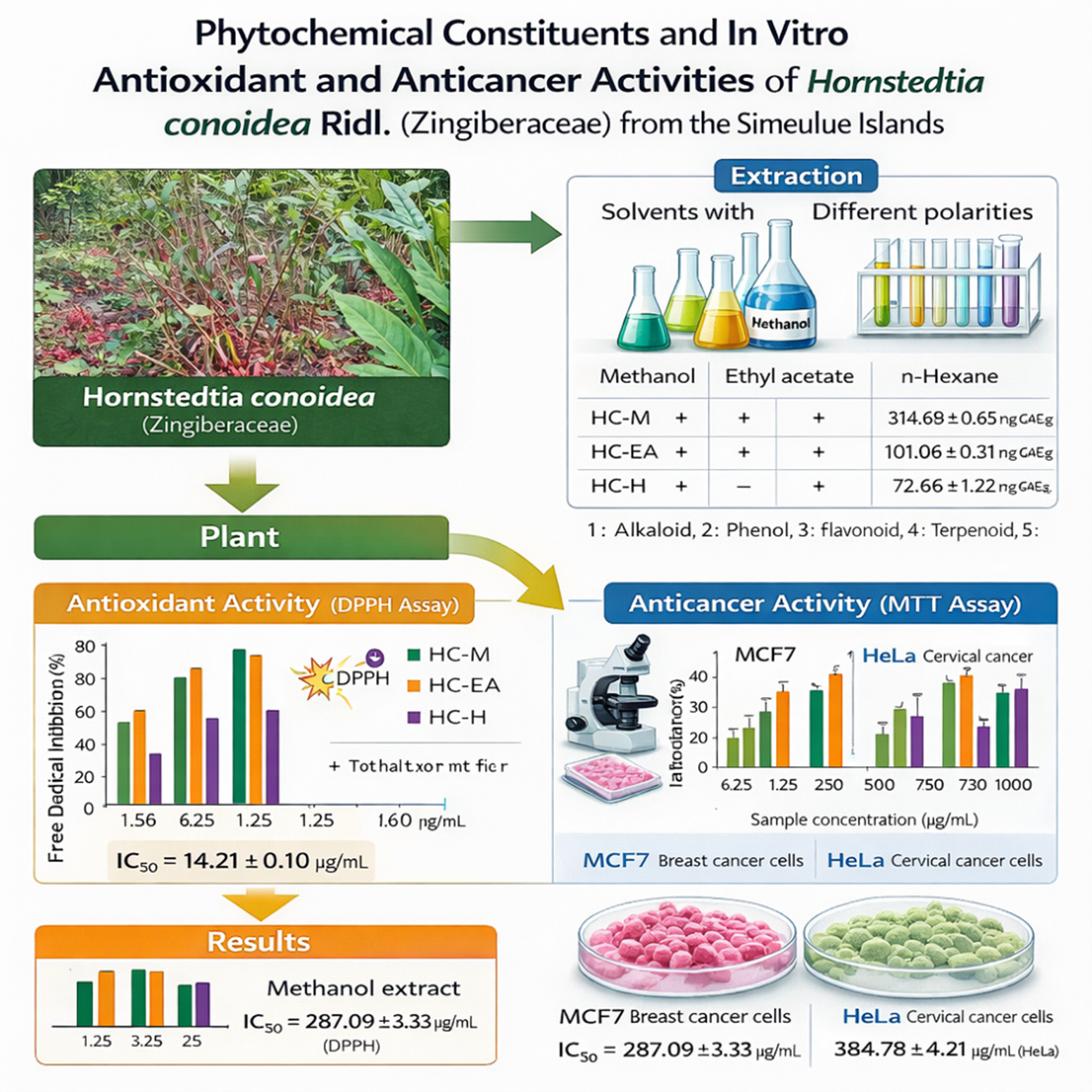
Downloads
References
G Pizzino, N Irrera, M Cucinotta, G Pallio, F Mannino, V Arcoraci, F Squadrito, D Altavilla and A Bitto. Oxidative stress: Harms and benefits for human health. Oxidative Medicine and Cellular Longevity 2017; 2017(1), 8416763.
H Sung, J Ferlay, RL Siegel, M Laversanne, I Soerjomataram, A Jemal and F Bray. Global cancer statistics 2020: GLOBOCAN estimates of incidence and mortality worldwide for 36 cancers in 185 countries. CA: A Cancer Journal for Clinicians 2021; 71(3), 209-249.
The Global Cancer Observatory, Available at: https://gco.iarc.who.int/media/globocan/factsheets/populations/935-asia-fact-sheet.pdf, accessed December 2025.
S Gondhowiardjo, N Christina, NPD Ganapati, S Hawariy, F Radityamurti, VF Jayalie, S Octavianus, AP Putra, SM Sekarutami, GB Prajogi, A Giselvania, M Adham, ARAH Hamid, E Widyastuti, Y Prabowo, T Aninditha, G Purwoto, RA Aman, TP Siregar, AD Siswoyo, ..., Priyambodho. Five-year cancer epidemiology at the national referral hospital: Hospital-based cancer registry data in Indonesia. JCO Global Oncology 2021; 7, 190-203.
F Xing, Q Hu, Y Qin, J Xu, B Zhang, X Yu and W Wang. The relationship of redox with hallmarks of cancer: The importance of homeostasis and context. Frontiers in Oncology 2022; 12, 862743
S Skalli, R Hassikou and M Arahou. An ethnobotanical survey of medicinal plants used for diabetes treatment in Rabat, Morocco. Heliyon 2019; 5(3), 01421.
RN Alolga, F Wang, X Zhang, J Li, LSP Tran and Y Yin. Bioactive compounds from the Zingiberaceae family with known antioxidant activities for possible therapeutic uses. Antioxidants 2022; 11(7), 1281.
YQ Zhou, H Liu, MX He, R Wang, QQ Zeng, Y Wang, WC Ye and QW Zhang. A review of the botany, phytochemical, and pharmacological properties of Galangal. Academic Press, London, 2018, p. 351-396.
Saudah, Zumaidar, Darusman, Fitmawati, DI Roslim and Ernilasari. Ethnobotanical knowledge of Etlingera elatior for medicinal and food uses among ethnic groups in Aceh Province, Indonesia. Biodiversitas 2022; 23(8), 4361-4370.
SE Hashim and HM Sirat. Chemical composition, antioxidant, antimicrobial, and α-glucosidase activities of essential oils of Hornstedtia scyphifera (Zingiberaceae). Natural Product Communications 2018; 13(2), 229-232.
NP Menzed and FM Acma. In vitro studies on pollen viability, pollen germination and pollen tube growth of Hornstedtia conoidea Ridl. - A Philippine endemic ginger species. Journal of Tropical Life Science 2018; 8(3), 303-310.
GB Barbosa and MCY Nueva. Antioxidant activity and phenolic content of Hornstedtia conoidea (Zingiberaceae). Asian Journal of Biological and Life Sciences 2019; 8(1), 1-7.
GB Barbosa, CV Alinapon, MM Enot, GJD Baltazar, EO Buncales, AG Gultiano, and AMG Ang. Cytotoxicity, antioxidant activity, and total phenolic content of the ethanolic leaf extract of Hornstedtia conoidea Ridl. Asian Journal of Biological and Life Sciences 2022; 11(1), 166-172.
B Ginting, Mustanir, Nurdin, Maulidna, Murniana, and Safrina. Evaluation of antioxidant and anticancer activity of Myristica fragrans Houtt. Bark. Pharmacognosy Journal 2021; 13(3), 780-786.
Masyudi, M Hanafiah, Rinidar, S Usman and Marlina. Phytochemical screening and GC-MS analysis of bioactive compounds of Blumea balsamifera leaf extracts from South Aceh, Indonesia. Biodiversitas 2022; 23(3), 1344-1352.
AP Keim, A Agusta, MF Royyani, O Efendy and BA Qarim. Botani pulau simeulue (spermatophyta). Unimal Press, Lhokseumawe, Indonesia, 2019.
GA Otunola and AJ Afolayan. A review of the antidiabetic activities of ginger. IntechOpen 2020. https://doi.org/10.5772/intechopen.88899
JR Shaikh and MK Patil. Qualitative tests for preliminary phytochemical screening: An overview. International Journal of Chemical Studies 2020; 8(2), 603-608.
S Dubale, D Kebebe, A Zeynudin, N Abdissa and S Suleman. Phytochemical screening and antimicrobial activity evaluation of selected medicinal plants in Ethiopia. Journal of Experimental Pharmacology 2023; 15, 51-62.
YH Lee, C Choo, MI Watawana, N Jayawerdana and VY Waisundara. An appraisal of eighteen commonly consumed edible plants as functional food based on their antioxidant and starch hydrolase inhibitory activities. Journal of the Science of Food and Agriculture 2015; 95(14), 2956-2964.
S Aryal, MK Baniya, K Danekhu, P Kunwar, R Gurung and N Koirala. Total phenolic content, flavonoid content, and antioxidant potential of wild vegetables from western Nepal. Plants 2019; 8(4), 96.
M Alfarabi, M Safithri, JM Cing, ES Arodes, D Andrianto, R Kurniasih and HEC Hutapea. Antioxidant and antiproliferative activity of black rice extract against colon cancer cells in-vitro and in-silico. Trends in Sciences 2025; 22(10), 10397.
IE Mannoubi. Impact of different solvents on extraction yield, phenolic composition, in vitro antioxidant and antibacterial activities of deseeded Opuntia stricta fruit. Journal of Umm Al-Qura University for Applied Sciences 2023; 9, 176-184.
A Akbar, NH Soekamto, Firdaus and Bahrun. Antioxidant of n-hexane, ethyl acetate and methanol extracts of Padina sp with DPPH method. IOP Conference Series: Earth and Environmental Science 2021; 800, 012019.
MS Sankhla, K Parihar, R Kumar, DS Bhagat, SS Sonone, GK Singh, V Nagar, G Awasthi and CS Yadav. Ecofriendly approach for steroids, terpenes, and alkaloids-based biosurfactant. Biointerface Research in Applied Chemistry 2023; 13(2), 114.
WB Adeosun and DT Loots. Medicinal plants against viral infections: A review of metabolomics evidence for the antiviral properties and potentials in plant sources. Viruses 2024; 16(2), 218.
J Kappen, A David, K Pieplow, A Wujtschik, I Ware, D Dhar, C Wagner, MD Davari, K Franke and LA Wessjohann. Exploring Hornstedtia scyphifera: An extensive multimethod phytochemical investigation reveals the chemical composition and bioactive potential. Discover Plants 2025; 2, 6.
ZX Ng, SN Samsuri and PH Yong. The antioxidant index and chemometric analysis of tannin, flavonoid, and total phenolic extracted from medicinal plant foods with the solvents of different polarities. Journal of Food Processing and Preservation 2020; 44(9), 14680.
AA Belew and SH Gebre. Comparative assessment of phenolic and flavonoid contents and antioxidant activities in methanol extracts of spices from Jigjiga market, Ethiopia. Pharmacological Research - Natural Products 2025; 6, 100168.
N Asmilia, W Sari, R Nursanty, Saudah and Zumaidar. Phytochemical diversity and anticancer potential of Etlingera elatior fruits across ecological regions in Aceh, Indonesia. Biodiversitas 2025; 26(11), 5423-5429.
SA de Souza Farias, KS da Costa and JBL Martins. Analysis of conformational, structural, magnetic, and electronic properties related to antioxidant activity: Revisiting flavan, anthocyanidin, flavanone, flavonol, isoflavone, flavone, and flavan-3-ol. ACS Omega 2021; 6(13), 8908-8918.
VR Puspa, Zumaidar, Nurdin and Fitmawati. Phytochemicals and bioactivities of Erigeron sumatrensis Retz. from Gayo Highlands: Antioxidant, antidiabetic, anticancer. Journal of Human, Earth, and Future 2025; 6(1), 41-66.
KLB Santos, VAN Bragança, LV Pacheco, SSB Ota, CPO Aguiar and RS Borges. Essential features for antioxidant capacity of ascorbic acid (vitamin C). Journal of Molecular Modeling 2022; 28, 1-9.
F Martino-Morales, AJ Alonso-Castro, JR Zapata-Morales, C Carranza-Álvarez and OH Aragon-Martinez. Use of standardized units for a correct interpretation of IC50 values obtained from the inhibition of the DPPH radical by natural antioxidants. Chemical Papers 2020; 74, 3325-3334.
R Sangeeta. An overview of doxorubicin formulations in cancer therapy. Journal of Cancer Research and Therapeutics 2014; 10(4), 853-858.
T Soumya, PR Jayasree and PRM Kumar. Zingiberaceae plants: A cornucopia of promising chemotherapeuticals for cancer cure. Springer, Cham, Switzerland, 2023, p. 427-462.
TA Zughaibi, M Suhail, M Tarique and S Tabrez. Targeting PI3K/Akt/mTOR pathway by different flavonoids: A cancer chemopreventive approach. International Journal of Molecular Sciences 2021; 22(22), 12455.
Published
How to Cite
Issue
Section
License
Copyright (c) 2026 Walailak University

This work is licensed under a Creative Commons Attribution-NonCommercial-NoDerivatives 4.0 International License.





