
Cyclooxygenase Modulatory Activity of γ-Oryzanol from Pathumthani 1 Rice Bran: Integration of HPLC Composition, Cell Assays, and Molecular Docking
DOI:
https://doi.org/10.48048/tis.2026.12666Keywords:
Pathumthani 1 (PTT1) rice bran, γ-Oryzanol, COX-2 selectivity, Pathumthani 1 (PTT1) rice bran, γ-Oryzanol, Steryl ferulates, Campesteryl ferulate, Anti-inflammatory, COX-2 selectivity, Molecular dockingAbstract
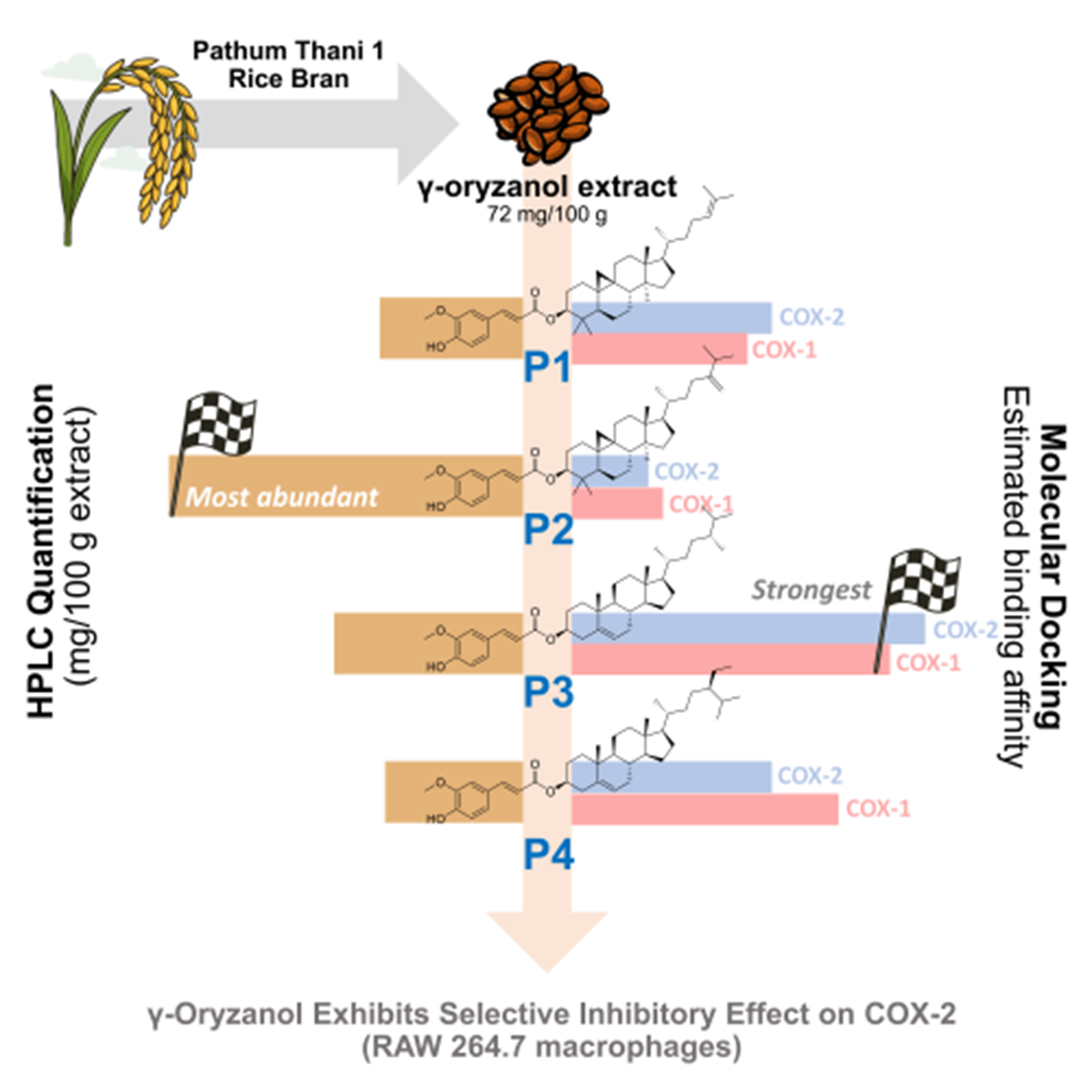
Gamma (g)-Oryzanol, a mixture of ferulic acid esters of plant sterols and triterpene alcohols, exhibits notable antioxidant and anti-inflammatory properties. This study investigated the composition and cyclooxygenase (COX) modulatory activity of γ-oryzanol extract obtained from Oryza sativa L. var. indica cv. Pathumthani 1 (PTT1) rice bran. Quantitative HPLC analysis indicated a total γ-oryzanol content of 71.93 ± 8.74 mg/100 g extract, with cycloartenyl ferulate, 24-methylenecycloartanyl ferulate, campesteryl ferulate, and sitosteryl ferulates as the primary constituents. COX activity assays in LPS-stimulated RAW 264.7 macrophages demonstrated that the extract selectively inhibited COX-2 activity in a dose-dependent manner, whereas COX-1 inhibition was not statistically significant, indicating enzyme selectivity. Complementary molecular docking analysis further supported these findings, showing that all steryl ferulates exhibited stable binding conformations within the COX-2 catalytic cleft with low RMSD values. Among them, campesteryl ferulate displayed the most favorable binding energy toward both COX isoforms. Collectively, these results emphasize the possible use of γ-oryzanol from PTT1 rice bran as a natural COX-2 selective modulator with therapeutic relevance in inflammatory regulation.
HIGHLIGHTS
- Pathumthani 1 (PTT1) rice bran showed high concentration of total γ-oryzanol.
- γ-Oryzanol from PTT1 rice bran selectively inhibited COX-2 activity.
- Molecular docking demonstrated campesteryl ferulate having stable COX-2 binding with strong affinity.
GRAPHICAL ABSTRACT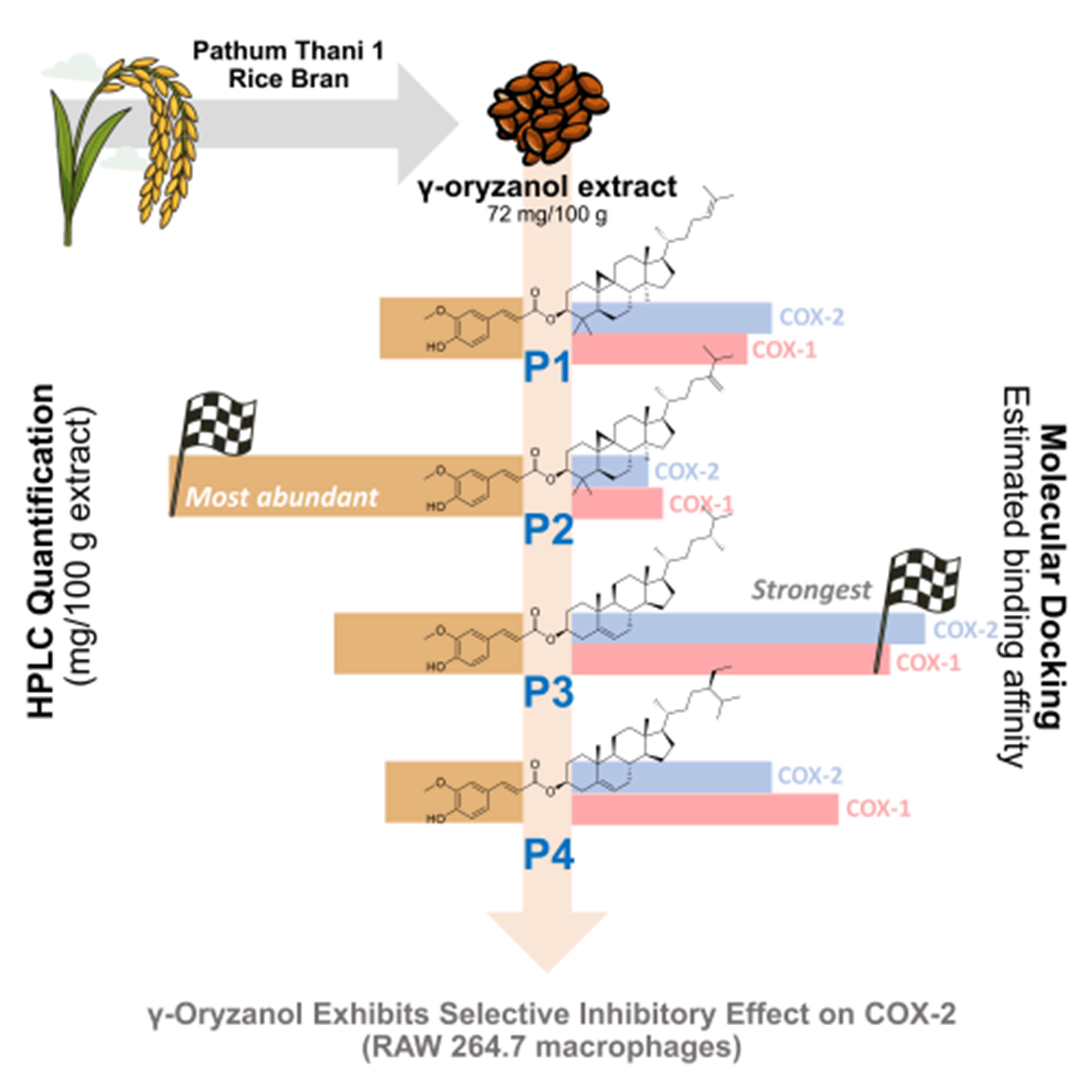
Downloads
References
MG Sahini and E Mutegoa. Extraction, phytochemistry, nutritional, and therapeutical potentials of rice bran oil: A review. Phytomedicine Plus 2023; 3(2), 100453.
H Juricic, M Cuccioloni, L Bonfili, M Angeletti, D Uberti, AM Eleuteri and V Cecarini. Biochemical, biological, and clinical properties of γ-Oryzanol. Antioxidants 2025; 14(9), 1099.
T Hudson and J Katzinger. 196 - Menopause. In: J E Pizzorno and MT Murray (Eds.). Textbook of natural medicine. St. Louis MO, Churchill Livingstone, 2020.
X Tian, X Wang, M Fang, L Yu, F Ma, X Wang, L Zhang and P Li. Nutrients in rice bran oil and their nutritional functions: A review. Critical Reviews in Food Science and Nutrition 2025; 65(14) 2840-2857.
P Christine Natalia, S Anna, W Ernanin Dyah and F Fatchiyah. Virtual prediction of brown rice gamma oryzanol as anti-inflammation via COX-1 and COX-2 inhibitions. Berkala Penelitian Hayati 2023; 29(2), 57-66.
SY Shin, HW Kim, HH Jang, YJ Hwang, JS Choe, JB Kim, et al. γ-Oryzanol suppresses COX-2 expression by inhibiting reactive oxygen species-mediated Erk1/2 and Egr-1 signaling in LPS-stimulated RAW264.7 macrophages. Biochemical and Biophysical Research Communications 2017; 491(2), 486-492.
K Jin, C Qian, J Lin and B Liu. Cyclooxygenase-2–Prostaglandin E2 pathway: A key player in tumor-associated immune cells. Frontiers in Oncology 2023; 13, 1099811.
B Hinz and A Pahl. Cyclooxygenase-1. In: SJ Enna and DB Bylund (Eds.). xPharm: The comprehensive pharmacology reference. New York, Elsevier, 2007, p. 1-5.
M Tomić, A Micov, U Pecikoza, and R Stepanović-Petrović. Chapter 1 - Clinical uses of nonsteroidal anti-inflammatory drugs (NSAIDs) and potential benefits of NSAIDs modified-release preparations. In: B Čalija (Ed.). Microsized and nanosized carriers for nonsteroidal anti-inflammatory drugs. Academic Press, Boston, 2017.
Y Faki and A Er. Different chemical structures and physiological/pathological roles of cyclooxygen¬ases. Rambam Maimonides Medical Journal 2021; 12(1), e0003.
I Morita. Distinct functions of COX-1 and COX-2. Prostaglandins & Other Lipid Mediators 2002; 68-69, 165-175.
Y Liu, L Shi, W Qiu and Y Shi. Ferulic acid exhibits anti-inflammatory effects by inducing autophagy and blocking NLRP3 inflammasome activation. Molecular & Cellular Toxicology 2022; 18(4), 509-519.
S Chimthai, S Cheabu, W Aesomnuk, S Ruengphayak, S Arikit, A Vanavichit and C Malumpong. Breeding for heat tolerant aromatic rice varieties and identification of novel QTL regions associated with heat tolerance during reproductive phase by QTL-Seq. Rice Science 2025; 32(1), 67-80.
C Chinvongamorn and S Sansenya. The γ-oryzanol content of Thai rice cultivars and the effects of gamma irradiation on the γ-oryzanol content of germinated Thai market rice. Oriental Journal of Chemistry 2020; 36, 812-818.
C Siripattanakulkajorn, P Sombutsuwan, A Nakornsadet, S Chumsantea, S Lilitchan, K Krisnangkura and K Aryusuk. Policosanol and other bioactive compounds in different Thai rice varieties. Journal of Food Composition and Analysis 2024; 126, 105891.
M Yamsaray, T Sreewongchai, C Phumichai and P Chalermchaiwat. Yield and nutritional properties of improved red pericarp Thai rice varieties. ScienceAsia 2023; 49, 155-160.
J Welch, J Wallace, AB Lansley and C Roper. Evaluation of the toxicity of sodium dodecyl sulphate (SDS) in the MucilAir™ human airway model in vitro. Regulatory Toxicology and Pharmacology 2021; 125, 105022.
BS Selinsky, K Gupta, CT Sharkey and PJ Loll. Structural analysis of NSAID binding by prostaglandin H2 synthase: Time-dependent and time-independent inhibitors elicit identical enzyme conformations. Biochemistry 2001; 40(17), 5172-5180.
JL Wang, D Limburg, MJ Graneto, J Springer, JR Hamper, S Liao, JL Pawlitz, RG Kurumbail, T Maziasz, JJ Talley, JR Kiefer and J Carter. The novel benzopyran class of selective cyclooxygenase-2 inhibitors. Part 2: The second clinical candidate having a shorter and favorable human half-life. Bioorganic & Medicinal Chemistry Letters 2010; 20(23), 7159-7163.
GM Morris, R Huey, W Lindstrom, MF Sanner, RK Belew, DS Goodsell and AJ Olson. AutoDock4 and AutoDockTools4: Automated docking with selective receptor flexibility. Journal of Computational Chemistry 2009; 30(16), 2785-2791.
SD Oniga, L Pacureanu, CI Stoica, MD Palage, A Crăciun, LR Rusu, EL Crisan and C Araniciu. COX inhibition profile and molecular docking studies of some 2-(trimethoxyphenyl)-thiazoles. Molecules 2017; 22(9), 1507.
LG Ferreira, RN Dos Santos, G Oliva and AD Andricopulo. Molecular docking and structure-based drug design strategies. Molecules 2015; 20(7), 13384-13421.
MK Gilson and HX Zhou. Calculation of protein–ligand binding affinities. Annual Review of Biophysics and Biomolecular Structure 2007; 36, 21-42.
DDL Minh. Implicit ligand theory: Rigorous binding free energies and thermodynamic expectations from molecular docking. Journal of Chemical Physics 2012; 137(10), 104106.
TC Chou. Drug combination studies and their synergy quantification using the Chou-Talalay method. Cancer Research 2010; 70(2), 440-446.
KA Ko and DK Lee. Nonsteroidal anti-inflammatory drug-induced peptic ulcer disease. The Korean Journal of Helicobacter and Upper Gastrointestinal Research 2025; 25(1), 34-41.
J Park, HJ Chang, KJ Hwang, SH Yum, CE Park, JH Kim and M Kim. Association of COX-2 selectivity in pain medication use with endometriosis incidence: Retrospective cohort study. Yonsei Medical Journal 2025; 66(6), 374-382.
B Roschek Jr, RC Fink, D Li, M McMichael, CM Tower, RD Smith and RS Alberte. Pro-inflammatory enzymes, cyclooxygenase 1, cyclooxygenase 2, and 5-lipooxygenase, inhibited by stabilized rice bran extracts. Journal of Medicinal Food 2009; 12(3), 615-623.
MS Islam, T Murata, M Fujisawa, R Nagasaka, H Ushio, AM Bari, M Hori and H Ozaki. Anti-inflammatory effects of phytosteryl ferulates in colitis induced by dextran sulphate sodium in mice. British Journal of Pharmacology 2008; 154(4), 812-824.
X Xia, H Lin, F Luo, X Wu, L Zhu, S Chen and H Luo, F Ye, X Peng, Y Zhang, G Yang and Q Lin. Oryzanol ameliorates DSS-stimulated gut barrier damage via targeting the gut microbiota accompanied by the TLR4/NF-κB/NLRP3 cascade response in vivo. Journal of Agricultural and Food Chemistry 2022; 70(50), 15747-15762.
A Zarghi and S Arfaei. Selective COX-2 inhibitors: A review of their structure–activity relationships. Iranian Journal of Pharmaceutical Research 2011; 10(4), 655-683.
CA Rouzer and LJ Marnett. Structural and chemical biology of the interaction of cyclooxygenase with substrates and non-steroidal anti-inflammatory drugs. Chemical Reviews 2020; 120(15), 7592-7641.
S Xu, DJ Hermanson, S Banerjee, K Ghebreselasie, GM Clayton, RM Garavito and LJ Marnett. Oxicams bind in a novel mode to the cyclooxygenase active site via a two-water-mediated H-bonding network. The Journal of Biological Chemistry 2014; 289(10), 6799-6808.
Published
How to Cite
Issue
Section
License
Copyright (c) 2025 Walailak University

This work is licensed under a Creative Commons Attribution-NonCommercial-NoDerivatives 4.0 International License.





