
Molecular Docking and Pharmacokinetic Analysis of Antioxidant Content in Popular Indonesian Herbal Plants for Adjuvant Therapy in Cancer
DOI:
https://doi.org/10.48048/tis.2026.12633Keywords:
Molecular docking, Natural antioxidants, Apoptosis, Adjuvant cancer therapyAbstract
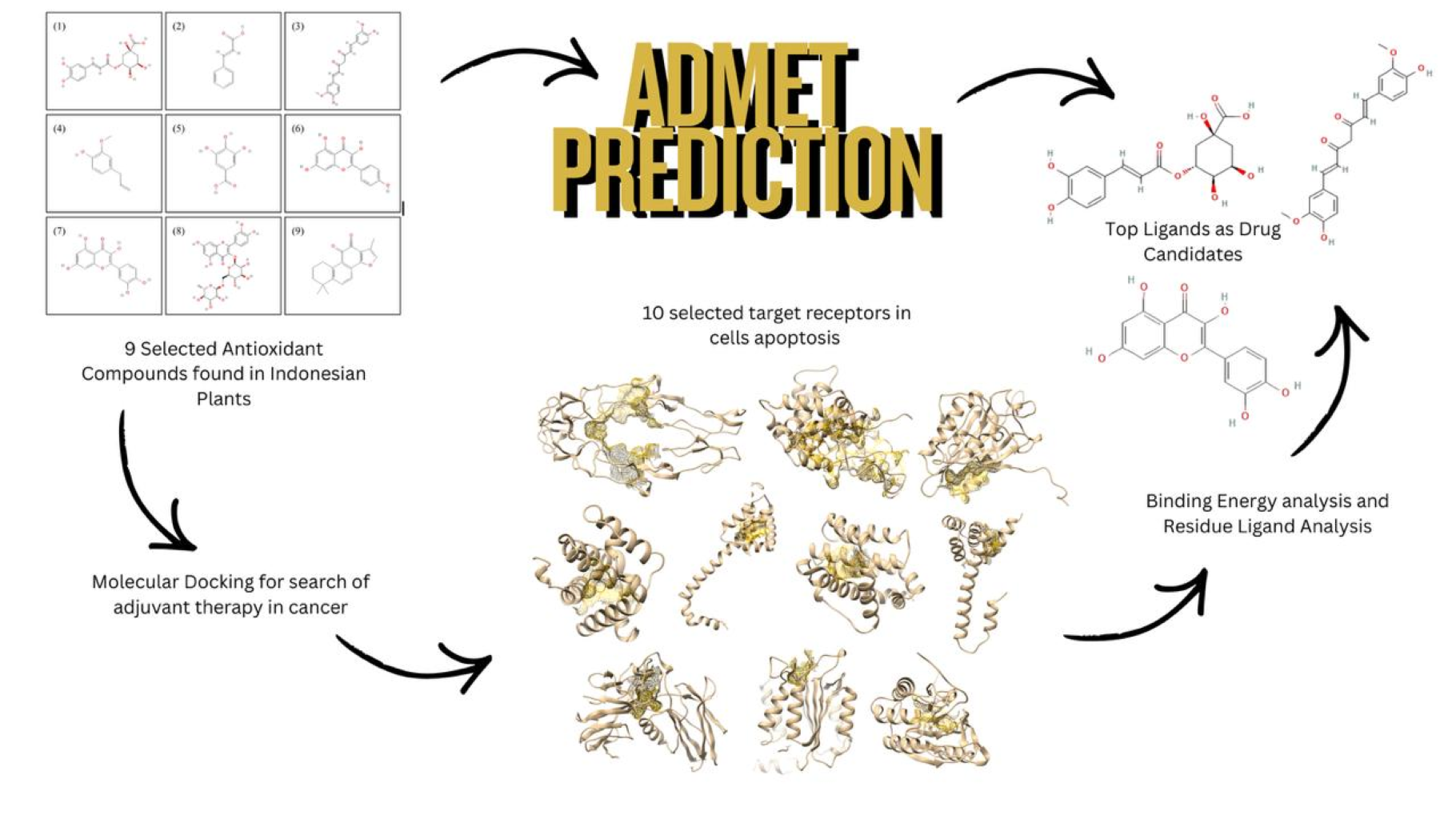
Cancer remains a significant global health burden due to high rates of morbidity, mortality, and disease recurrence. Apoptosis has emerged as an essential therapeutic target in cancer, and natural antioxidants from Indonesian medicinal plants show promise as modulators of apoptotic pathways because of their relative safety and bioactivity. This study aimed to identify phytochemical candidates with potential for adjuvant cancer therapy by evaluating their interaction with key apoptosis-regulating proteins. Nine antioxidant compounds (chlorogenic acid, cinnamic acid, curcumin, eugenol, gallic acid, kaempferol, quercetin, rutin, and tanshinone) were subjected to molecular docking against ten proteins representing intrinsic and extrinsic apoptotic pathways using AutoDock Vina, with dasatinib as a reference inhibitor. Drug-likeness was assessed according to Lipinski’s rules, while pharmacokinetics and toxicity predictions were performed using ADMETLab 3.0 and ProTox-II. The analysis showed that several compounds, particularly chlorogenic acid, curcumin, and quercetin, exhibited strong binding affinities to apoptosis-regulating proteins and interacted with critical amino acid residues associated with pro-apoptotic signaling. While rutin and tanshinone also demonstrated favorable docking scores, their pharmacokinetic limitations and predicted toxicity reduced their therapeutic potential. The combined evaluation of molecular binding, drug-likeness, and safety profiles supports chlorogenic acid, quercetin, and curcumin as the most viable candidates for further investigation. These findings indicate that specific plant-derived antioxidants may contribute to apoptosis-induced cancer inhibition and offer a rational basis for selecting lead compounds for future in vitro and in vivo validation. Overall, this study provides a systematic in silico framework to prioritize natural compounds as potential adjuvant therapeutic agents targeting apoptosis in cancer.
HIGHLIGHTS
- Nine antioxidants derived from Indonesian herbal plants were systematically evaluated using molecular docking against key apoptosis-regulating proteins.
- Chlorogenic acid, curcumin, and quercetin demonstrated the strongest binding affinities and favorable interaction profiles, indicating high potential as adjuvant anticancer candidates.
- Integration of molecular docking with ADMET and toxicity predictions enabled a comprehensive prioritization of compounds beyond binding affinity alone.
- The findings provide a rational in silico framework for accelerating the development of plant-derived antioxidants as modulators of apoptotic pathways in cancer therapy.
GRAPHICAL ABSTRACT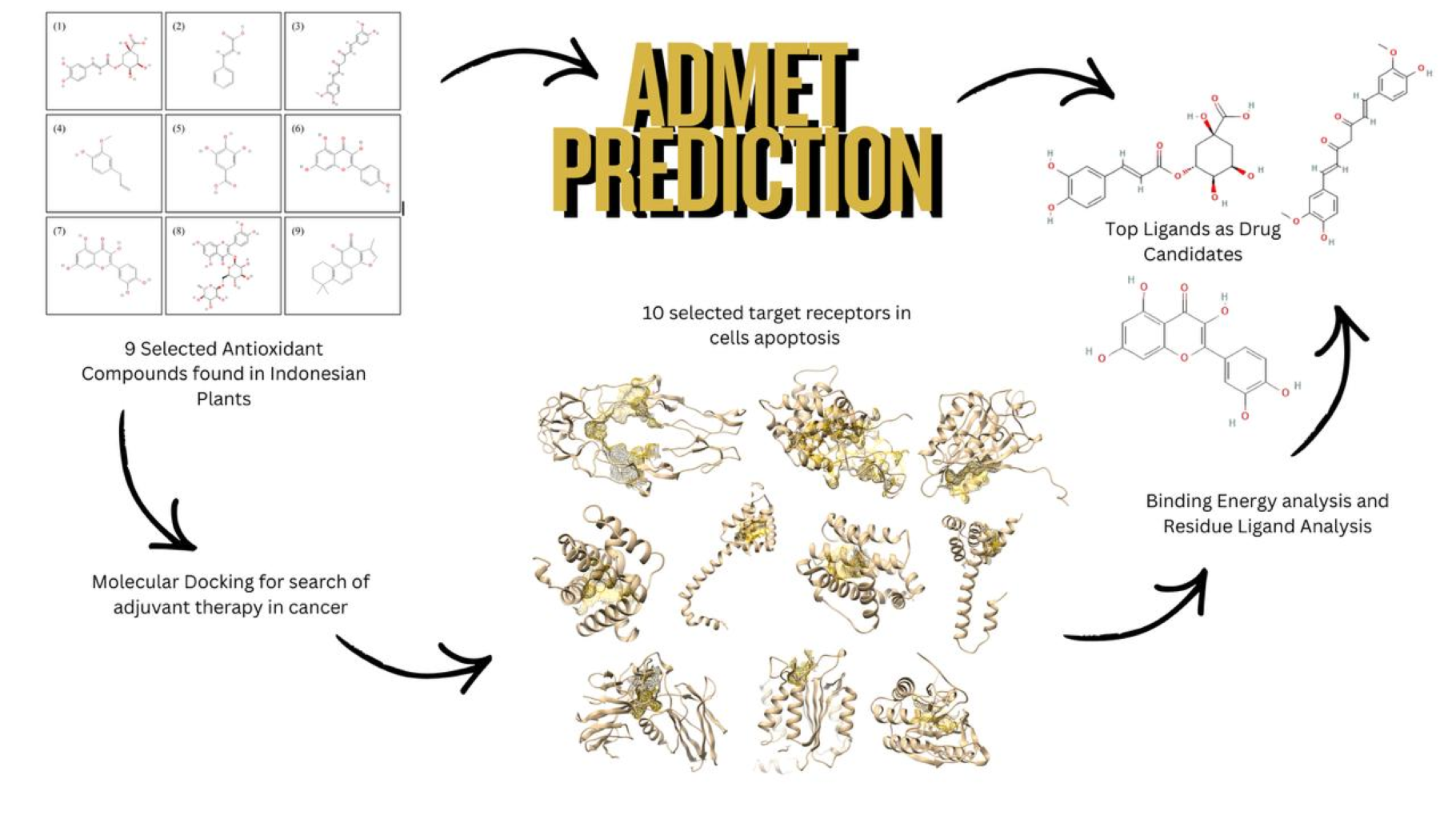
Downloads
References
H Sung, J Ferlay, RL Siegel, M Laversanne, I Soerjomataram, A Jemal and F Bray. Global cancer statistics 2020: GLOBOCAN estimates of incidence and mortality worldwide for 36 Cancers in 185 Countries. CA: A Cancer Journal for Clinicians 2021; 71(3), 209-249.
J Ferlay, M Colombet, I Soerjomataram, DM Parkin, M Piñeros, A Znaor and F Bray. Cancer statistics for the year 2020: An overview. International Journal of Cancer 2021; 149(4), 778-789.
RL Siegel, KD Miller and A Jemal. Cancer statistics, 2016. CA: A Cancer Journal for Clinicians 2016; 66(1), 7-30.
Z Si, J Ying and Y Zhou. A study on the global burden of non-melanoma skin cancer from 1990 to 2019. Archives of Medical Science 2024; 20(6), 1902-1908.
AN Hata, JA Engelman and AC Faber. The BCL2 family: Key mediators of the apoptotic response to targeted anticancer therapeutics. Cancer Discovery 2015; 5(5), 475-487.
F Pentimalli, S Grelli, ND Daniele, G Melino and I Amelio. Cell death pathologies: Targeting death pathways and the immune system for cancer therapy. Genes and Immunity 2019; 20, 539-554.
CM Pfeffer and ATK Singh. Apoptosis: A target for anticancer therapy. International Journal of Molecular 2018; 19(2), 448.
MN Messmer, AG Snyder and A Oberst. Comparing the effects of different cell death programs in tumor progression and immunotherapy. Cell Death & Differentiation 2019; 26(1), 115-129.
S Baig, I Seevasant, J Mohamad, A Mukheem, HZ Huri and T Kamarul. Potential of apoptotic pathway-targeted cancer therapeutic research: Where do we stand? Cell Death & Disease 2016; 7(1), 2058.
A Yaghoubi, M Ghojazadeh, S Abolhasani, H Alikhah and F Khaki-Khatibi. Correlation of serum levels of vitronectin, malondialdehyde and Hs-CRP with disease severity in coronary artery disease. Journal of Cardiovascular and Thoracic Research 2015; 7(3), 113-117.
S Rajabi, M Maresca, AV Yumashev, R Choopani and H Hajimehdipoor. The most competent plant‐derived natural products for targeting apoptosis in cancer therapy. Biomolecules 2021; 11(4), 534.
SR Lin, CH Chang, CF Hsu, MJ Tsai, H Cheng, MK Leong, PJ Sung, JC Chen and CF Weng. Natural compounds as potential adjuvants to cancer therapy: Preclinical evidence. British Journal of Pharmacology 2020; 177(6), 1409-1423.
ML Madhuri and RR Reddy. In vitro evaluation and molecular docking analysis of potential anticancer compounds from Syzygium alternifolium. International Research Journal of Pure and Applied Chemistry 2022; 23(6), 1-8.
JK Paul, M Azmal, ANMSNB Haque, OF Talukder, M Meem and A Ghosh. Phytochemical-mediated modulation of signaling pathways: A promising avenue for drug discovery. Advances in Redox Research 2024; 13, 100113.
B Setiyono, MR Arif, QQ Aini, TH Soegianto, J Ohanna, RAF Gunawan and AP Rizkia. Identifikasi tanaman obat indonesia melalui citra daun menggunakan metode Convolutional Neural Network (CNN). Jurnal Teknologi Informasi dan Ilmu Komputer 2023; 10(2), 385-392.
M Apriana, RMS Toni, MC Huda, ZM Kamal, R Khoerunnisa, Allahuddin, RA Septiani, SR Ash-Shidiqi and F Anggraeni. Pengobatan penyakit kolestrol dengan menggunakan ekstrak herbal di indonesia - a review. Jurnal Buana Farma 2022; 2(2), 12-32.
MR Adiyasa and M Meiyanti. Pemanfaatan obat tradisional di Indonesia: Distribusi dan faktor demografis yang berpengaruh. Jurnal Biomedika dan Kesehatan 2021; 4(3), 130-138.
E Emelda, R Nugraeni and K Damayanti. Review: Exploration of Indonesian herbal plants for antiinflammatory. INPHARNMED Journal (Indonesian Pharmacy and Natural Medicine Journal) 2023; 6(2), 58.
YK Dewi and BA Riyandari. Potensi tanaman lokal sebagai tanaman obat dalam menghambat penyebaran COVID-19. Jurnal Pharmascience 2020; 7(2), 112-128.
A Sarasati, MH Syahruddin, A Nuryanti, ID Ana, A Barlian, CH Wijaya, D Ratnadewi, TDK Wungu and H Takemori. Plant-derived exosome-like nanoparticles for biomedical applications and regenerative therapy. Biomedicines 2023; 11(4), 1053.
M Alfarizi. Pengobatan komplementer alternatif lokal dan potensinya di Indonesia dalam perspektif kesehatan dan ekonomi: Kajian literatur sistematik. Salus Cultura: Jurnal Pembangunan Manusia dan Kebudayaan 2022, 2(2), 138-150.
M Devi, D Dahiya, N Sharma, A Soni, C Kumari and Yamini. In silico molecular docking study of some novel chalcone derivatives as anticancer agents. Journal of Pharmaceutical Research International 2023; 35(22), 54-65.
T Estiasih, JM Maligan, JE Witoyo, AAH Mu’Alim, K Ahmadi, T Mahatmanto and E Zubaidah. Indonesian traditional herbal drinks: Diversity, processing, and health benefits. Journal of Ethnic Foods 2025; 12, 7.
V Shoshan-Barmatz, T Arif and A Shteinfer-Kuzmine. Apoptotic proteins with non-apoptotic activity: Expression and function in cancer. Apoptosis 2023; 28(5-6), 730-753.
GM Morris, H Ruth, W Lindstrom, MF Sanner, RK Belew, DS Goodsell and AJ Olson. Software news and updates AutoDock4 and AutoDockTools4: Automated docking with selective receptor flexibility. Journal of Computational Chemistry 2009; 30(16), 2785-2791.
B Ye, W Tian, B Wang and J Liang. CASTpFold: Computed atlas of surface topography of the universe of protein folds. Nucleic Acids Research 2024; 52(W1), W194-W199.
EF Pettersen, TD Goddard, CC Huang, GS Couch, DM Greenblatt, EC Meng and TE Ferrin. UCSF Chimera - A visualization system for exploratory research and analysis. Journal of Computational Chemistry 2004; 25(13), 1605-1612.
NM O’Boyle, M Banck, CA James, C Morley, T Vandermeersch and GR Hutchison. Open babel: An open chemical toolbox. Journal of Cheminformatics 2011; 3, 33.
PR Sankar, AB Sailu, MM Eswarudu, MN Satya, P Sreeja, P Roja and S Rijwana. Analytical methods for determination of different members of FDA approved tyrosine kinase inhibitors like Dasatinib, Lapatinib, Imatinib, Sorafenib, Nintedanib, Sunitinib and Pazopanib: A review. Journal of Pharmaceutical Sciences and Research 2021; 13(6), 313-318.
O Trott and AJ Olson. AutoDock vina: Improving the speed and accuracy of docking with a new scoring function, efficient optimization, and multithreading. Journal of Computational Chemistry 2010; 31(2), 455-461.
M Bitew, T Desalegn, TB Demissie, A Belayneh, M Endale and R Eswaramoorthy. Pharmacokinetics and drug-likeness of antidiabetic flavonoids: Molecular docking and DFT study. PLoS One 2021; 16(12), 0260853.
CA Lipinski, F Lombardo, BW Dominy and PJ Feeney. Experimental and computational approaches to estimate solubility and permeability in drug discovery and development settings. Advanced Drug Delivery Reviews 2012; 23(1-3), 3-25.
B Gullón, TA Lú-Chau, MT Moreira, JM Lema and G Eibes. Rutin: A review on extraction, identification and purification methods, biological activities and approaches to enhance its bioavailability. Trends in Food Science & Technology 2017; 67, 220-235.
SR Akash, A Tabassum, LM Aditee, A Rahman, MI Hossain, MA Hannan and MJ Uddin. Pharmacological insight of rutin as a potential candidate against peptic ulcer. Biomedicine & Pharmacotherapy 2024; 177, 116961.
J Terao. Potential role of quercetin glycosides as anti-atherosclerotic food-derived factors for human health. Antioxidants 2023; 12(2), 258.
T Przybylski, J Czerniel, J Dobrosielski and M Stawny. Flavonol technology: From the compounds’ chemistry to clinical research. Molecules 2025; 30(15), 3113.
JPB Arango, DYM Rodriguez, SL Cruz and GT Ocampo. In silico evaluation of pharmacokinetic properties and molecular docking for the identification of potential anticancer compounds. Computational Biology and Chemistry 2026; 120(1), 108626.
LF Araujo, CHS de Pinto and LF Motta. In silico pharmacokinetic and toxicological study of cinnamic acid analogues. Brazilian Journal of Development 2022; 8(12), 80800-80817.
NN Wang, C Huang, J Dong, ZJ Yao, MF Zhu, ZK Deng, B Lv, AP Lu, AF Chenac and DS Cao. Predicting human intestinal absorption with modified random forest approach: A comprehensive evaluation of molecular representation, unbalanced data, and applicability domain issues. RSC Advances 2017; 7, 19007-19018.
I Ahmad, AE Kuznetsov, AS Pirzada, KF Alsharif, M Daglia and H Khan. Computational pharmacology and computational chemistry of 4-hydroxyisoleucine: Physicochemical, pharmacokinetic, and DFT-based approaches. Frontiers in Chemistry 2023; 11, 1145974.
R Kato, L Zhang, N Kinatukara, R Huang, A Asthana, C Weber, M Xia, X Xu and P Shah. Investigating blood–brain barrier penetration and neurotoxicity of natural products for central nervous system drug development. Scientific Reports 2025; 15, 7431.
J Zhai, VH Man, B Ji, L Cai and J Wang. Comparison and summary of in silico prediction tools for CYP450-mediated drug metabolism. Drug Discovery Today 2023; 28(10), 103728.
AMB Amorim, LF Piochi, AT Gaspar, AJ Preto, N Rosário-Ferreira and IS Moreira. Advancing drug safety in drug development: Bridging computational predictions for enhanced toxicity prediction. Chemical Research in Toxicology 2024; 37(6), 827-849.
United Nations. Globally Harmonized System of Classification and Labelling of Chemicals (GHS). 9th ed. United Nations, New York and Geneva, 2021.
CM Zwickl, JC Graham, RA Jolly, A Bassan, E Ahlberg, A Amberg, LT Anger, L Beilke, P Bellion, A Brigo, H Burleigh-Flayer, MTD Cronin, AA Devlin, T Fish, S Glowienke, K Gromek, AL Karmaus, R Kemper, S Kulkarni, ..., GJ Myatt. Principles and procedures for assessment of acute toxicity incorporating in silico methods. Computational Toxicology 2022; 24, 100237.
R Chowdhury, MS Bhuia, A Islam Rakib, R Hasan, HDM Coutinho, IM Araújo, IRA de Menezes and MT Islam. Assessment of quercetin antiemetic properties: In vivo and in silico investigations on receptor binding affinity and synergistic effects. Plants 2023; 12(24), 4189.
APD Nurhayati, A Rihandoko, A Fadlan, SS Ghaissani, N Jadid and E Setiawan. Anti-cancer potency by induced apoptosis by molecular docking P53, caspase, cyclin D1, cytotoxicity analysis and phagocytosis activity of trisindoline 1,3 and 4. Saudi Pharmaceutical Journal 2022; 30(9), 1345-1359.
EM Terefe and A Ghosh. Molecular docking, validation, dynamics simulations, and pharmacokinetic prediction of phytochemicals isolated from croton dichogamus against the HIV-1 reverse transcriptase. Bioinformatics and Biology Insights 2022; 16, 11779322221125605.
RK Tiwari, A Brown, N Sadeghiani, AN Shirazi, J Bolton, A Tse, G Verkhivker, K Parang and G Sun. Design, synthesis, and evaluation of dasatinib-amino acid and dasatinib-fatty acid conjugates as protein tyrosine kinase inhibitors. ChemMedChem 2017; 12(1), 86-99.
M Arya, A Tiwari, DB Singh and G Taj. Computational study of lactucine and its derivatives to investigate its anti-cancerous properties targeting apoptosis-inducing protein. Letters in Drug Design & Discovery 2023; 21(7), 1137-1147.
HR Trivedi and PK Puranik. Chlorogenic acid-optimized nanophytovesicles: A novel approach for enhanced permeability and oral bioavailability. Future Journal of Pharmaceutical Sciences 2023; 9, 116.
Y Yan, Kulsoom, Y Sun, Y Li, Z Wang, L Xue and F Wang. Advancing cancer therapy: Nanomaterial-based encapsulation strategies for enhanced delivery and efficacy of curcumin. Materials Today Bio 2025; 33, 101963.
L Xing, ZR Tan, JL Cheng, WH Huang, W Zhang, W Deng, CS Yuan and HH Zhou. Bioavailability and pharmacokinetic comparison of tanshinones between two formulations of Salvia miltiorrhiza in healthy volunteers. Scientific Reports 2017; 7, 4709.
Published
How to Cite
Issue
Section
License
Copyright (c) 2025 Walailak University

This work is licensed under a Creative Commons Attribution-NonCommercial-NoDerivatives 4.0 International License.





