
In Silico Studies of Sembukan (Paederia scandens) Secondary Metabolites as Anti Diabetes Against Multiple Target Protein
DOI:
https://doi.org/10.48048/tis.2026.12090Keywords:
Molecular docking, Virtual screening, Secondary metabolite, Paederia scandens, DiabetesAbstract
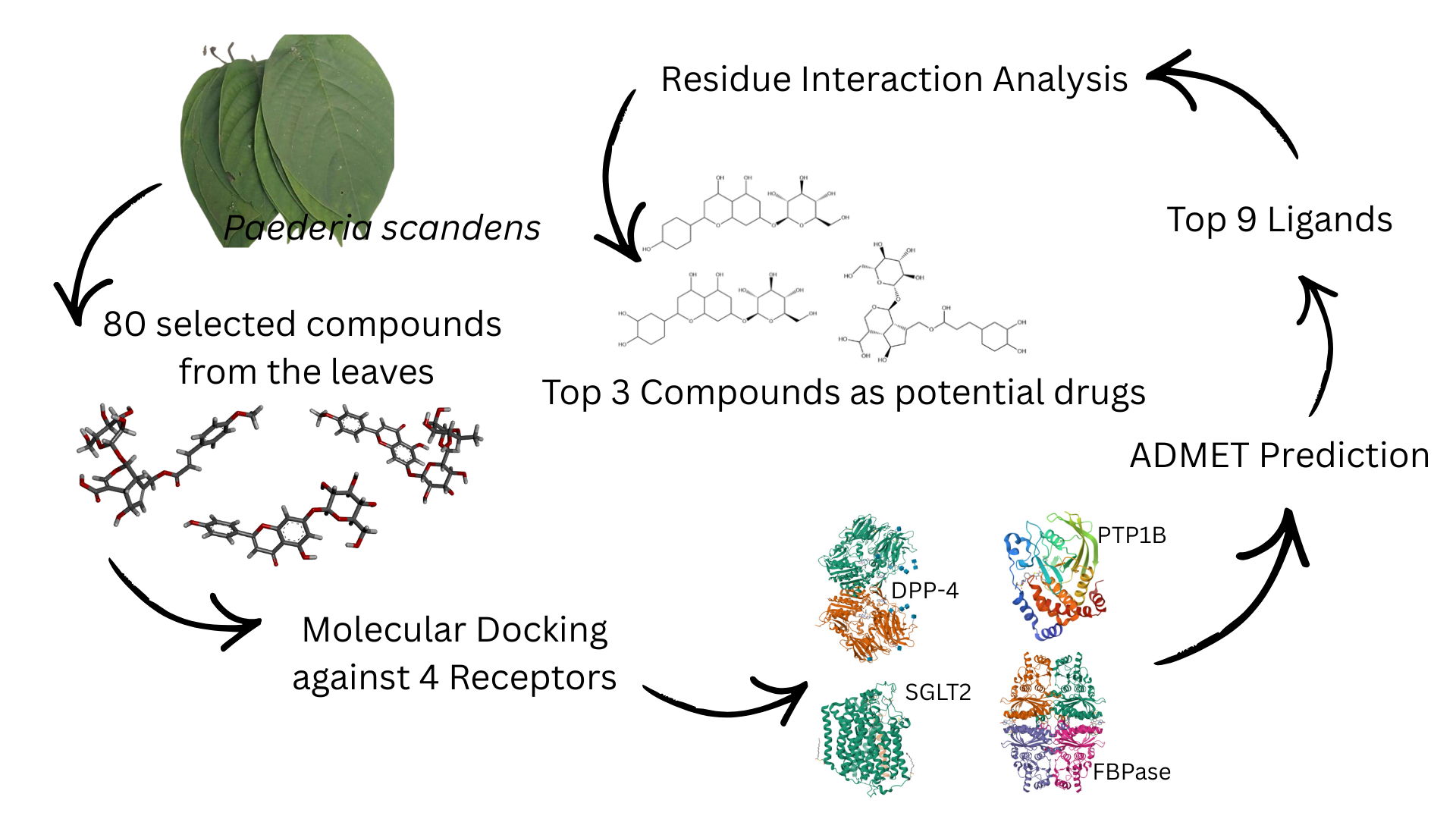
Chronic hyperglycemia is a metabolic disorder caused by insufficient insulin secretion, impaired insulin action, or a combination of both. Current oral hypoglycemic agents for managing Type 2 Diabetes (T2D) act through various mechanisms of action. Paederia scandens L. (commonly known as daun sembukan) is a perennial herb that grows in open fields, thickets and along riverbanks, with a long history of use in traditional medicine systems such as Chinese and Ayurvedic medicine for treating diverse ailments, including diabetes. In this study, we investigated the antidiabetic potential of compounds from P. scandens by evaluating their activity against four diabetes-related protein receptors: DPP-4, SGLT-2, PTP1B and FBPase. Among the tested ligands, three compounds — cosmetin, cynaroside and compound 39 — demonstrated superior pharmacological performance in both dynamic and kinetic evaluations. These ligands exhibited the highest binding affinities and more favorable pharmacokinetic profiles compared to other candidates, highlighting their potential as promising antidiabetic agents.
HIGHLIGHTS
- In silico research of Indonesian Sembukan plants secondary metabolites against four diabetes-related target protein
- In depth of ligand - residues analysis of potential ligand and the diabetes-related target proteins
- Phenolic compounds are the main candidates in the development of antidiabetic drugs
GRAPHICAL ABSTRACT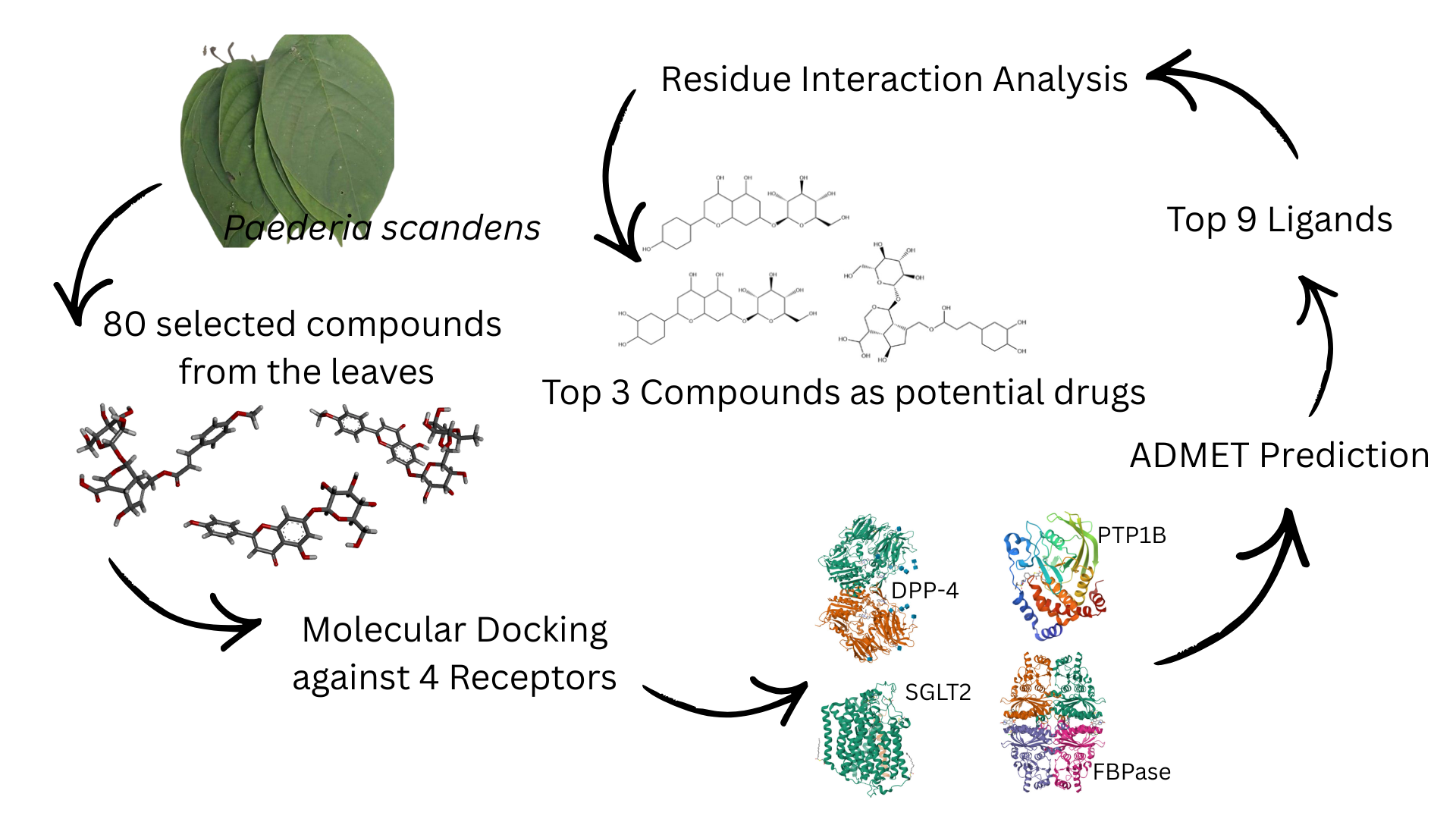
Downloads
References
WT Eden, N Solekah, I Nufus, MEP Lestari and PD Palupi. The effect of nanoencapsulation effervescent powder of jengkol peel (Pithecellobium jiringa) in the alloxan-induced diabetic mice. AIP Conference Proceedings 2023; 2614, 030018.
SA Antar, NA Ashour, M Sharaky, M Khattab, NA Ashour, RT Zaid, EJ Roh, A Elkamhawy and AA Al-Karmalawy. Diabetes mellitus: Classification, mediators, and complications; A gate to identify potential targets for the development of new effective treatments. Biomedicine & Pharmacotherapy = Biomedecine & Pharmacotherapie 2023; 168, 115734.
TM Belete. A recent achievement in the discovery and development of novel targets for the treatment of type-2 diabetes mellitus. Journal of Experimental Pharmacology 2020; 12, 1-15.
L Agius. New hepatic targets for glycaemic control in diabetes. Best Practice and Research in Clinical Endocrinology and Metabolism 2007; 21(4), 587-605.
G Charpentier. Oral combination therapy for type 2 diabetes. Diabetes/metabolism Research and Reviews 2002; 18, S70-S76.
J Lee, S Noh, S Lim and B Kim. Plant extracts for type 2 diabetes: From traditional medicine to modern drug discovery. Antioxidants 2021; 10(1), 81.
WT Eden, S Wahyuono, E Cahyono and P Astuti. Phytochemical, antioxidant, and cytotoxic activity of water hyacinth (eichhornia crassipes) ethanol extract. Tropical Journal of Natural Product Research 2023; 7(8), 3606-3612.
M Azam, WT Eden, AI Fibriana and SR Rahayu. Antioxidant properties of capsule dosage form from mixed extracts of garcinia mangostana rind and solanum lycopersicum fruit. Acta Pharmaceutica Sciencia 2021; 59(1), 69-80.
PP Dutta, K Marbaniang, S Sen, BK Dey and NC Talukdar. A review on phytochemistry of Paederia foetida Linn. Phytomedicine Plus 2023; 3(1), 100411.
MP Borgohain, L Chowdhury, S Ahmed, N Bolshette, K Devasani, TJ Das, A Mohapatra and M Lahkar. Renoprotective and antioxidative effects of methanolic Paederia foetida leaf extract on experimental diabetic nephropathy in rats. Journal of Ethnopharmacology 2017; 198, 451-459.
K Makrilakis. The role of dpp-4 inhibitors in the treatment algorithm of type 2 diabetes mellitus: When to select, what to expect. International Journal of Environmental Research and Public Health 2019; 16(15), 2720.
S Kalra. Sodium glucose Co-Transporter-2 (SGLT2) inhibitors: A review of their basic and clinical pharmacology. Diabetes Therapy: Research, Treatment and Education of Diabetes and Related Disorders 2014; 5(2), 355-366.
RD Bongard, M Lepley, K Thakur, MR Talipov, J Nayak, RAJ Lipinski, C Bohl, N Sweeney, R Ramchandran, R Rathore and DS Sem. Serendipitous discovery of light-induced (In Situ) formation of an Azo-bridged dimeric sulfonated naphthol as a potent PTP1B inhibitor. BMC Biochemistry 2017; 18(1), 10.
MAB Macalalad and AA Gonzales. In Silico screening and identification of antidiabetic inhibitors sourced from phytochemicals of philippine plants against four protein targets of diabetes (PTP1B, DPP-4, SGLT-2, and FBPase). Molecules 2023; 28(14), 5301.
Chemaxon. Marvin 2025. Chemaxon, Switzerland, 2025.
NO Boyle, M Banck, CA James, C Morley, T Vandermeersch and GR Hutchison. Open babel: An open chemical toolbox. Journal of Cheminformatics 2011; 3, 33.
GM Morris, R Huey, W Lindstrom, MF Sanner, RK Belew, DS Goodsell and AJ Olson. Software news and updates autodock4 and autodocktools4: Automated docking with selective receptor flexibility. Journal of Computational Chemistry 2009; 30(16), 2785-2791.
MRF Pratama and S Siswandono. Number of runs variations on autodock4 do not have a significant effect on RMSD from docking results. Pharmacy & Pharmacology 2020; 8(6), 476-480.
Y. Liu, X Hu, E Li, Y Fang, H Xue, J Zhang, R Jha and R Wang. Bioaffinity ultrafiltration combined with UPLC-ESI-QTrap-MS/MS for screening of xanthine oxidase inhibitors from Paederia foetida L. leaves. Arabian Journal of Chemistry 2024; 17(4), 105706.
G Xiong, Z Wu, J Yi, L Fu, Z Yang, C Hsieh, M Yin, X Zeng, C Wu, A Lu, X Chen, T Hou and D Cao. ADMETlab 2.0: An integrated online platform for accurate and comprehensive predictions of ADMET properties. Nucleic Acids Researchvol 2021; 49, W5-W14.
R Liu, C Mathieu, J Berthelet, W Zhang, JM Dupret and FR Lima. Human Protein Tyrosine Phosphatase 1B (PTP1B): From structure to clinical inhibitor perspectives. International Journal of Molecular Sciences 2022; 23(13), 7027.
PJ Ala, L Gonneville, M Hillman, M Becker-Pasha, EW Yue, B Douty, B Wayland, P Polam, ML Crawley, E McLaughlin, RB Sparks, B Glass, A Takvorian, AP Combs, TC Burn, GF Hollis and R Wynn. Structural insights into the design of nonpeptidic isothiazolidinone- containing inhibitors of protein-tyrosine phosphatase 1B. Journal of Biological Chemistry 2006; 281(49), 38013-38021
YA Puius, YU Zhao, M Sullivan, DS Lawrence, SC Almo and ZY Zhang. Identification of a second aryl phosphate-binding site in protein-tyrosine phosphatase 1B: A paradigm for inhibitor design. Proceedings of the National Academy of Sciences of the United States of America 1997; 94(25), 13420-13425.
SQ Pantaleão, EA Philot, PTD Resende-Lara, AN Lima, D Perahia, MA Miteva, AL Scott and KM Honorio. Structural dynamics of DPP-4 and its influence on the projection of bioactive ligands. Molecules 2018; 23(2), 490.
P Antony, B Baby, A Jobe and R Vijayan. Computational modeling of the interactions between DPP IV and hemorphins. International Journal of Molecular Sciences 2024; 25(5), 3059.
V Mathur, O Alam, N Siddiqui, M Jha, A Manaithiya, S Bawa, N Sharma, S Alshehri, P Alam and F Shakeel. Insight into structure activity relationship of DPP-4 inhibitors for development of antidiabetic agents. Molecules 2023; 28(15), 5860.
L Mojica and EGD Mejía. Optimization of enzymatic production of anti-diabetic peptides from black bean (Phaseolus vulgaris L.) proteins, their characterization and biological potential. Food & Function 2016; 7(2), 713-727.
H Mamoudou, AH Abdoulaye, NYO Ditchou, JN Olumasai, RMZK Adissa and MAM Mune. Computational investigation of Plectranthus neochilus essential oil phytochemicals interaction with dipeptidyl peptidase 4: A potential avenue for antidiabetic drug discovery. Current Pharmaceutical Analysis 2025; 21(3), 169-178.
R Grempler, L Thomas, M Eckhardt, F Himmelsbach, A Sauer, DE Sharp, RA Bakker, M Mark, T Klein and P Eickelmann. Empagliflozin, a novel selective sodium glucose cotransporter-2 (SGLT-2) inhibitor: Characterisation and comparison with other SGLT-2 inhibitors. Diabetes, Obesity & Metabolism 2012; 14(1), 83-90.
WH Abdulaal, MA Bakhrebah, MS Nassar, IA Almazni, WA Almutairi, ZS Natto and AK Khattab. Insights from the molecular docking analysis of SGLT2 and FIMH to combat uropathogenicity. Bioinformation 2022; 18(11), 1044-1049.
S Heng, KM Harris and ER Kantrowitz. Designing inhibitors against fructose 1,6-bisphosphatase: Exploring natural products for novel inhibitor scaffolds. European Journal of Medicinal Chemistry 2010; 45(4), 1478-1484.
M Yasir, J Park, ET Han, WS Park, JH Han, YS Kwon, HJ Lee, M Hassan, A Kloczkowski and W Chun. Investigation of flavonoid scaffolds as DAX1 inhibitors against ewing sarcoma through pharmacoinformatic and dynamic simulation studies International Journal of Molecular Sciences 2023; 24(11), 9332.
K Wu, SH Kwon, X Zhou, C Fuller, X Wang, J Vadgama and Y Wu. Overcoming challenges in small-molecule drug bioavailability: A review of key factors and approaches. International journal of molecular sciences 2024; 25(23), 13121.
JTS Coimbra, R Feghali, RP Ribeiro, MJ Ramos and PA Fernandes. The importance of intramolecular hydrogen bonds on the translocation of the small drug piracetam through a lipid bilayer. RSC Advances 2021; 11(2), 899-908.
D Iacopetta, J Ceramella, A Catalano, E Scali, D Scumaci, M Pellegrino, S Aquaro, C Saturnino and MS Sinicropi. Impact of cytochrome P450 enzymes on the phase i metabolism of drugs. Applied Sciences 2023; 13(10), 6045.
Published
How to Cite
Issue
Section
License
Copyright (c) 2025 Walailak University

This work is licensed under a Creative Commons Attribution-NonCommercial-NoDerivatives 4.0 International License.





