
In Vivo Analysis of Nuclear Factor Erythroid 2-Related Factor Modulation, Superoxide Dismutase, and Coronary Artery Histopathology by Allium ascalonicum L Extract in Rat Models of Atherosclerosis
DOI:
https://doi.org/10.48048/tis.2026.12499Keywords:
Atherosclerosis, Allium ascalonicum L, Nrf2, SOD, Coronary histopathologyAbstract
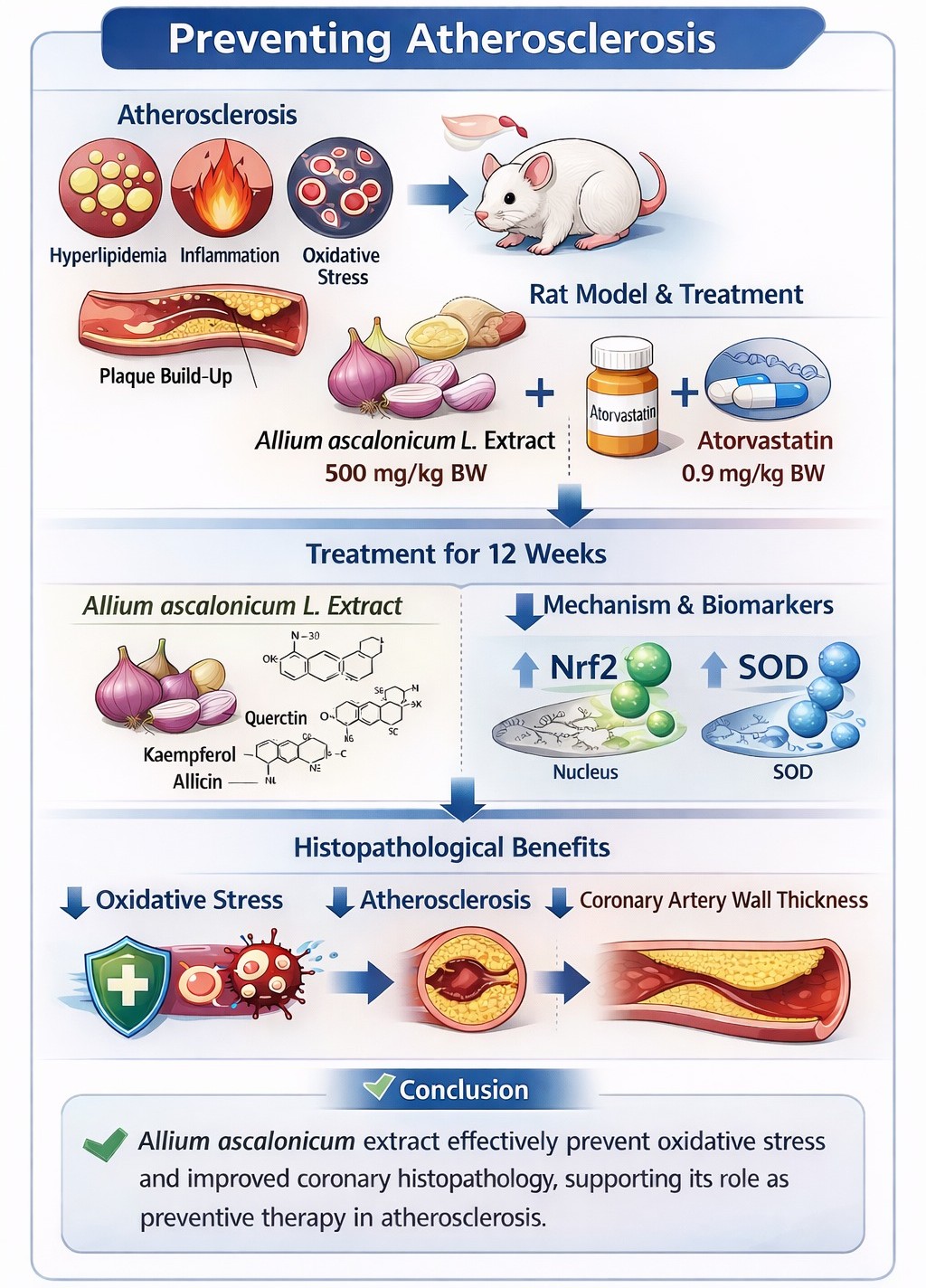
Atherosclerosis is a chronic inflammatory disease involving hyperlipidemia, inflammation, and oxidative stress as the main mechanisms. Standard therapies such as statins are not fully effective in preventing the development of atherosclerosis, so additional therapies are still needed. Allium ascalonicum L extract contains quercetin, kaempferol, and allicin, which have antioxidant potential. Objective: To analyze the therapy of Allium ascalonicum L extract variety Bima, sourced from local farmers in Brebes, Central Java, Indonesia combined with atorvastatin, which has not been specifically studied in a rat model of atherosclerosis, the duration of long-term therapy (12 weeks), and to analyze complete and integrated molecular variables. This study simultaneously analyzed oxidative stress and histopathology variables, including serum Nrf2, tissue Nrf2, SOD, and coronary artery histopathology, which are potential therapeutic targets in atherosclerosis, and assessed the correlation between serum Nrf2 and tissue Nrf2, which has not been done in previous studies. Methods: The in vivo experimental study was conducted using rat fed an atherogenic diet to induce atherosclerosis. Treatment groups received Allium ascalonicum L extract and/or atorvastatin for 12 weeks. Results: Allium ascalonicum L extract therapy significantly increased serum Nrf2, tissue Nrf2, and SOD levels (p < 0.05), and histopathology showed a decrease in the degree of atherosclerosis and coronary artery wall thickness. The best effect of Allium ascalonicum L extract was seen in group P3, which was induced with an atherogenic diet and given combination therapy with 500 mg/kgBW of Allium ascalonicum L extract and 0.9 mg/kgBW of atorvastatin. A very strong correlation was found between serum Nrf2 and tissue Nrf2 (r: 0.865). In conclusion, Allium ascalonicum L extract has been proven effective as a preventive therapy in reducing oxidative stress and improving coronary artery histopathology in rat models of atherosclerosis. Serum Nrf2 marker can be proposed as a marker for monitoring atherosclerosis therapy.
HIGHLIGHTS
- Allium ascalonicum L extract boosts serum and tissue Nrf2 levels in atherosclerosis.
- Combination therapy prevents oxidative stress and coronary artery damage in rat models of atherosclerosis.
- Strong correlation found between serum and tissue Nrf2, aiding non-invasive monitoring.
- Allium ascalonicum L extract improves SOD activity, enhancing antioxidant defense.
- Histopathology shows decreased atherosclerosis severity and vessel thickness post-treatment.
GRAPHICAL ABSTRACT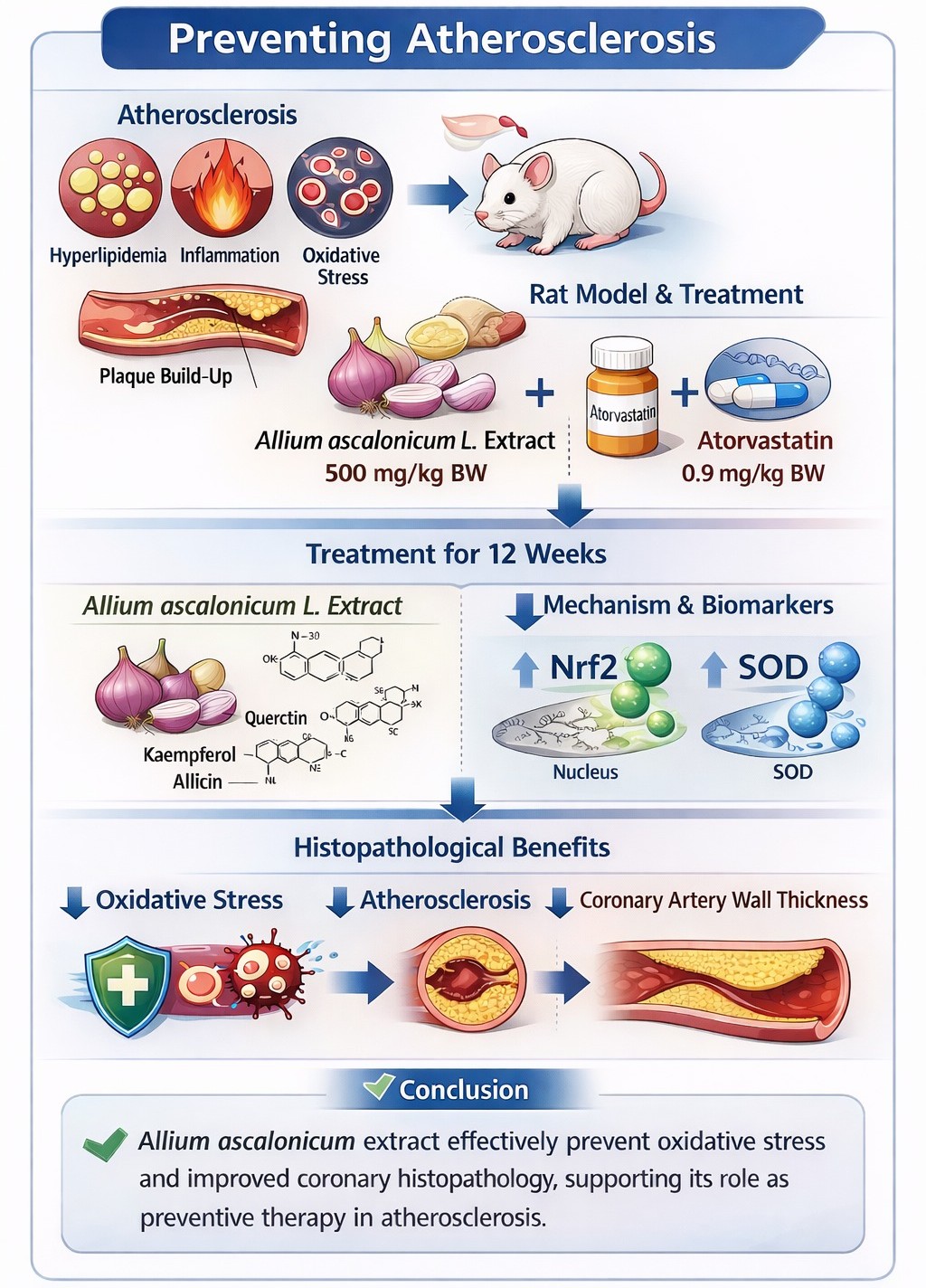
Downloads
References
W Frąk, A Wojtasińska, W Lisińska, E Młynarska, B Franczyk and J Rysz. Pathophysiology of cardiovascular diseases: New insights into molecular mechanisms of atherosclerosis, arterial hypertension, and coronary artery disease. Biomedicines 2022; 10(8), 1938.
A Poznyak, AV Grechko, P Poggio, VA Myasoedova, V Alfieri and AN Orekhov. The diabetes mellitus–atherosclerosis connection: The role of lipid and glucose metabolism and chronic inflammation. International Journal of Molecular Sciences 2020; 21(5), 1835.
TR Kıran, O Otlu and AB Karabulut. Oxidative stress and antioxidants in health and disease. Journal of Laboratory Medicine 2023; 47(1), 1-11.
Ismawati, I Romus and EA Utami. Efek inhibitor proteasom terhadap histopatologi arteri koronaria pada tikus model aterosklerosis. Jurnal Kedokteran dan Kesehatan Indonesia 2020; 16(2), 135-142.
Z Feng, C Wang, Y Jin, Q Meng, J Wu and H Sun. Kaempferol-induced GPER upregulation attenuates atherosclerosis via the PI3K/AKT/Nrf2 pathway. Pharmaceutical Biology 2021; 59(1), 1104-1114.
DS Liu, SL Wang, JM Li, ES Liang, MZ Yan and W Gao. Allicin improves carotid artery intima-media thickness in coronary artery disease patients with hyperhomocysteinemia. Experimental and Therapeutic Medicine 2017; 14(2), 1722-1726.
J Yang, H Si, B Dong and Q Qin. Allicin alleviates coronary atherosclerosis of rat via endothelial nitric oxide synthase(eNOS)/nuclear factor erythroid 2-related factor(Nrf2)/heme oxygenase-1(HO-1) signaling pathway. Applied Biological Chemistry 2023; 66, 28.
MA Mirza, S Mahmood, AR Hilles, A Ali, MZ Khan, SAA Zaidi, Z Iqbal and Y Ge. Quercetin as a therapeutic product: Evaluation of its pharmacological action and clinical applications: A review. Pharmaceuticals 2023; 16(11), 1631.
R Assempoor, MS Daneshvar, A Taghvaei, AS Abroy, A Azimi, JR Nelson and K Hosseini. Atherogenic index of plasma and coronary artery disease: A systematic review. Cardiovascular Diabetology 2025; 24, 35.
Y Jiang, W Wei, J Zhou, S Qiu, Q Yang, JH Huo and W Wang. Decoction derived from Allium ascalonicum L. bulbs and sojae semen praeparatum alleviates wind-cold-type common cold via Nrf2/HO-1 pathway and modulation of Lactobacillus murinus level. Frontiers in Pharmacology 2024; 15, 1364328.
H Yao, J Sun, J Wei, X Zhang, B Chen and Y Lin. Kaempferol protects blood vessels from damage induced by oxidative stress and inflammation in association with the Nrf2 / HO-1 signaling pathway. Frontiers in Pharmacology 2020; 11, 01118.
Y Gao, B Wang, G Qin, S Liang, J Yin, H Jiang, M Liu and X Li. Therapeutic potentials of allicin in cardiovascular disease: Advances and future directions. Chinese Medicine 2024; 19, 93.
RY Elkanawati, SA Sumiwi and J Levita. The effects of the ethanol extract of Allium Ascalonicum L. in High-Fat-High-Fructose-Induced insulin resistance swiss-webster male mice. Journal of Experimental Pharmacology 2025; 17, 207-221.
C Chalif and M Alauhdin. Analysis of the effect of sample mass, solvent volume, and sonication time on the extraction of red onion (Allium ascalonicum L) on quercetin content. Indonesian Journal of Mathematics and Natural Sciences 2024; 47, 37-48.
E Młynarska, J Hajdys, W Czarnik, P Fularski, K Leszto, G Majchrowicz, W Lisińska, J Rysz and B Franczyk. The role of antioxidants in the therapy of cardiovascular diseases: A literature review. Nutrients 2024; 16(16), 2587.
I Tusa, A Menconi, A Tubita and E Rovida. Pathophysiological impact of the MEK5/ERK5 pathway in oxidative stress. Cells 2023; 12(8), 1154.
JA Alonso-Piñeiro, A Gonzalez-Rovira, I Sánchez-Gomar, JA Moreno and MC Durán-Ruiz. Nrf2 and heme Oxygenase‐1 involvement in atherosclerosis related oxidative stress. Antioxidants 2021; 10(9), 1463.
F Li, J Liu, S Tang, J Yan, H Chen, D Li and X Yan. Quercetin regulates inflammation, oxidative stress, apoptosis, and mitochondrial structure and function in H9C2 cells by promoting PVT1 expression. Acta Histochemica 2021; 123(8), 151819.
FY Sun, K Xu, J Zhou, W Zhang, G Duan and M Lei. Allicin protects against LPS-induced cardiomyocyte injury by activating Nrf2-HO-1 and inhibiting NLRP3 pathways. BMC Cardiovascular Disorders 2023; 23(1), 410.
Q Zhang, J Liu, H Duan, R Li, W Peng and C Wu. Activation of Nrf2/HO-1 signaling: An important molecular mechanism of herbal medicine in the treatment of atherosclerosis via the protection of vascular endothelial cells from oxidative stress. Journal of Advanced Research 2021; 34, 43-63.
LE Neilson, JF Quinn and NE Gray. Peripheral blood NRF2 expression as a biomarker in human health and disease. Antioxidants 2021; 10(1), 28.
J Li, Q Guo, X Wei, Y Zhu, M Luo and P Luo. Association of serum Nrf2 protein levels with disease activity and renal impairment in lupus nephritis. Frontiers in Immunology 2024; 15, 1304167.
Z Huang, M Wu, L Zeng and D Wang. The beneficial role of Nrf2 in the endothelial dysfunction of atherosclerosis. Cardiology Research and Practice 2022; 2022, 4287711.
MVDMB Pimentel, A Bertolami, LP Fernandes, LP Barroso and IA Castro. Could a lipid oxidative biomarker be applied to improve risk stratification in the prevention of cardiovascular disease? Biomedicine & Pharmacotherapy 2023; 160, 114345.
CL Wang, XJ Yan, CL Zhang and YW Xu. Elevated serum nuclear factor erythroid 2-related factor 2 levels contribute to a poor prognosis after acute supratentorial intracerebral hemorrhage: A prospective cohort study. Frontiers in Aging Neuroscience 2022; 14, 1014472.
X Luo, X Weng, X Bao, X Bai, Y Lv, S Zhang, Y Chen, C Zhao, M Zeng, J Huang, B Xu, TW Johnson, SJ White, J Li, H Jia and B Yu. A novel anti-atherosclerotic mechanism of quercetin: Competitive binding to KEAP1 via Arg483 to inhibit macrophage pyroptosis. Redox Biology 2022; 57, 102511.
S Liang, J Zhang, R Ning, Z Du, J Liu, JW Batibawa, J Duan and Z Sun. The critical role of endothelial function in fine particulate matter-induced atherosclerosis. Particle and Fibre Toxicology 2020; 17, 61.
S Yu, SR Kim, K Jiang, M Ogrodnik, XY Zhu, CM Ferguson, T Tchkonia, A Lerman, JL Kirkland and LO Lerman. Quercetin reverses cardiac systolic dysfunction in Rat Fed with a High-fat diet: Role of angiogenesis. Oxidative Medicine and Cellular Longevity 2021; 2021, 8875729.
G Luo, L Xiang and L Xiao. Quercetin alleviates atherosclerosis by suppressing oxidized LDL-induced senescence in plaque macrophage via inhibiting the p38MAPK/p16 pathway. The Journal of Nutritional Biochemistry 2023; 116, 109314.
Z Huang, M Wu, L Zeng and D Wang. The beneficial role of Nrf2 in the endothelial dysfunction of atherosclerosis. Cardiology Research and Practice 2022; 2022(1), 4287711.
F Zhang, J Feng, J Zhang, X Kang and D Qian. Quercetin modulates AMPK/SIRT1/NF-κB signaling to inhibit inflammatory/oxidative stress responses in diabetic high fat diet‑induced atherosclerosis in the rat carotid artery. Experimental and Therapeutic Medicine 2020; 20(6), 280.
Published
How to Cite
Issue
Section
License
Copyright (c) 2025 Walailak University

This work is licensed under a Creative Commons Attribution-NonCommercial-NoDerivatives 4.0 International License.





