
Anthocyanin Identification in Miana Leaf (Coleus scutellarioides L. Benth) Extracts Using Different Solvents and Maceration Times for Application as a Poultry Feed Additive
DOI:
https://doi.org/10.48048/tis.2026.12496Keywords:
Coleus scutellarioides L. Benth, Feed additive, Anthocyanin, Cholesterol, Poultry, Solvent, Duration macerationAbstract
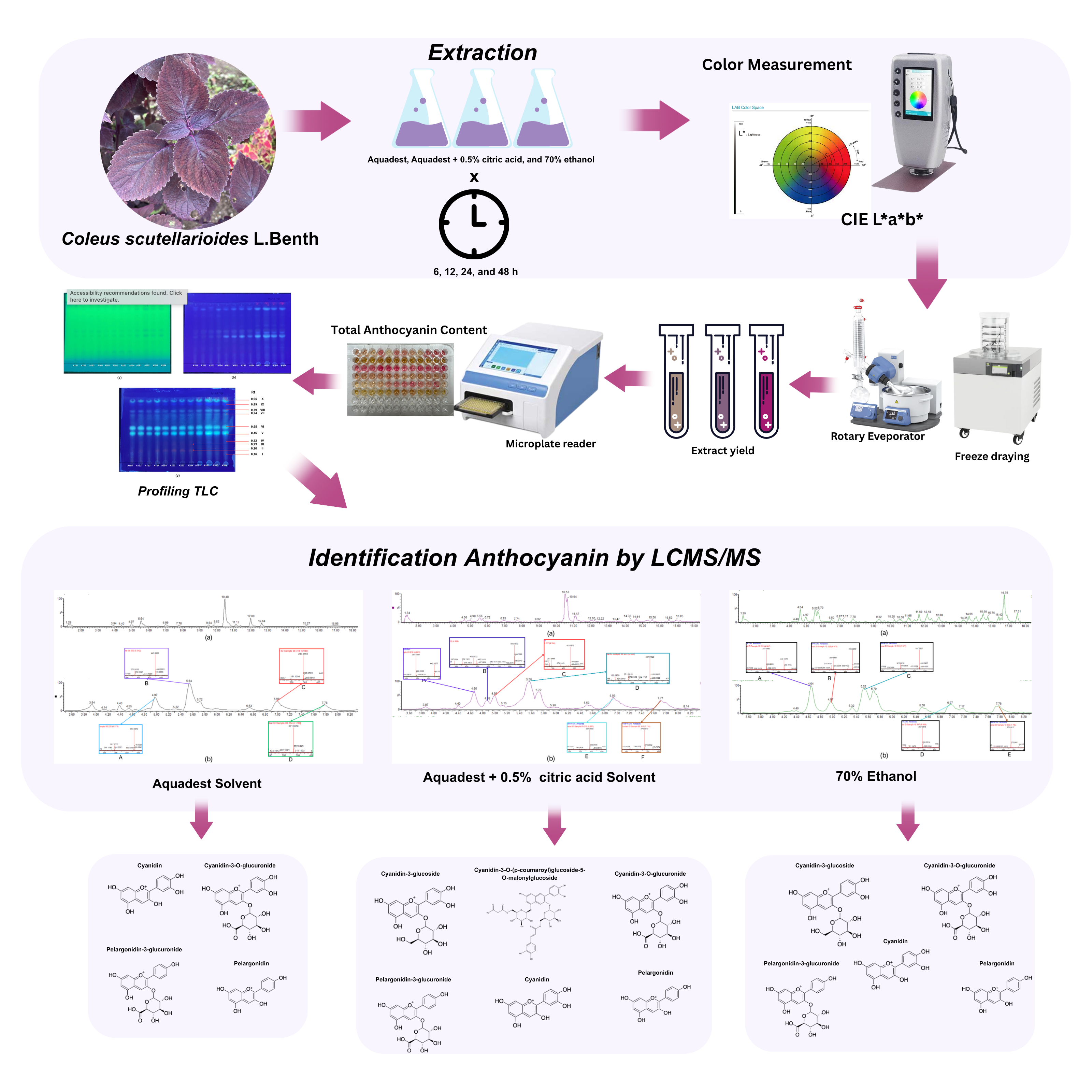
This study aims to identify the type of solvents and their maceration durations for the extraction of anthocyanins from Coleus scutellarioides L. Benth (C. scutellarioides) leaves using the maceration method. It also aims to characterize the anthocyanin profile, which could be utilized as a potential feed additive to reduce cholesterol levels in poultry meat. The study employed a completely randomized design with 2 factors. The first factor (A) was solvent: Aquadest, aquadest + 0.5% citric acid, and 70% ethanol. The second factor (B) was maceration durations: 6, 12, 24, and 48 h for C. scutellarioides leaves. Measured variables included color measurement, extract yield, total anthocyanin content (TAC), thin layer chromatography (TLC) extract-yield profile, and identification of anthocyanins by LC-MS/MS. Statistical analysis showed a significant interaction effect (p < 0.05) between solvent type and maceration duration on color measurement, extract yield, and TAC of C. scutellarioides extract. The TLC profile of C. scutellarioides extract using the citroborate reagent revealed 7 distinct spots with aquadest, 8 with aquadest with 0.5% citric acid, and 8 with 70% ethanol as solvents. Based on the highest TAC value obtained for each solvent type and maceration duration, LC-MS/MS analysis was conducted. The results identified 4 different anthocyanin compounds in the aquadest extract, 6 in the aquadest with 0.5% citric acid extract, and 5 in the 70% ethanol extract. It can be concluded that the optimal solvent type and maceration duration for anthocyanin extraction from C. scutellarioides are aquadest with 0.5% citric acid for 12 h. Under these conditions, 6 distinct anthocyanins were identified: cyanidin-3-glucoside, cyanidin 3-O-(p-coumaroyl) glucoside-5-O-malonyglucoside I, cyanidin-3-O-glucuronide, pelargonidin-3-glucuronide, cyanidin, and pelargonidin, with a total phenolic content of 72.14 mg GAE/g extract. Three of these (cyanidin-3-glucoside, cyanidin, and pelargonidin) have been reported to inhibit cholesterol synthesis.
HIGHLIGHTS
- This study optimized anthocyanin extraction from Coleus scutellarioides Benth leaves by varying solvents and maceration durations.
- A significant interaction (p < 0.05) between solvent type and maceration duration affected color parameters, extract yield, and total anthocyanin content (TAC).
- The combination of distilled water with 0.5% citric acid for 12 h produced the highest anthocyanin concentration (292.95 mg/L), with 6 types of anthocyanins identified.
- Six anthocyanin were identified in the extract obtained using distilled water with 0.5% citric acid through LC-MS/MS analysis: Cyanidin-3-glucoside, pelargonidin-3-glucuronide, and cyanidin 3-O-(p-coumaroyl) glucoside-5-O-malonylglucoside I.
- The compounds cyanidin-3-glucoside, cyanidin, and pelargonidin have each been associated with inhibition of HMG-CoA reductase. This association suggests that these specific compounds may serve as natural anti-cholesterol feed additives for poultry.
GRAPHICAL ABSTRACT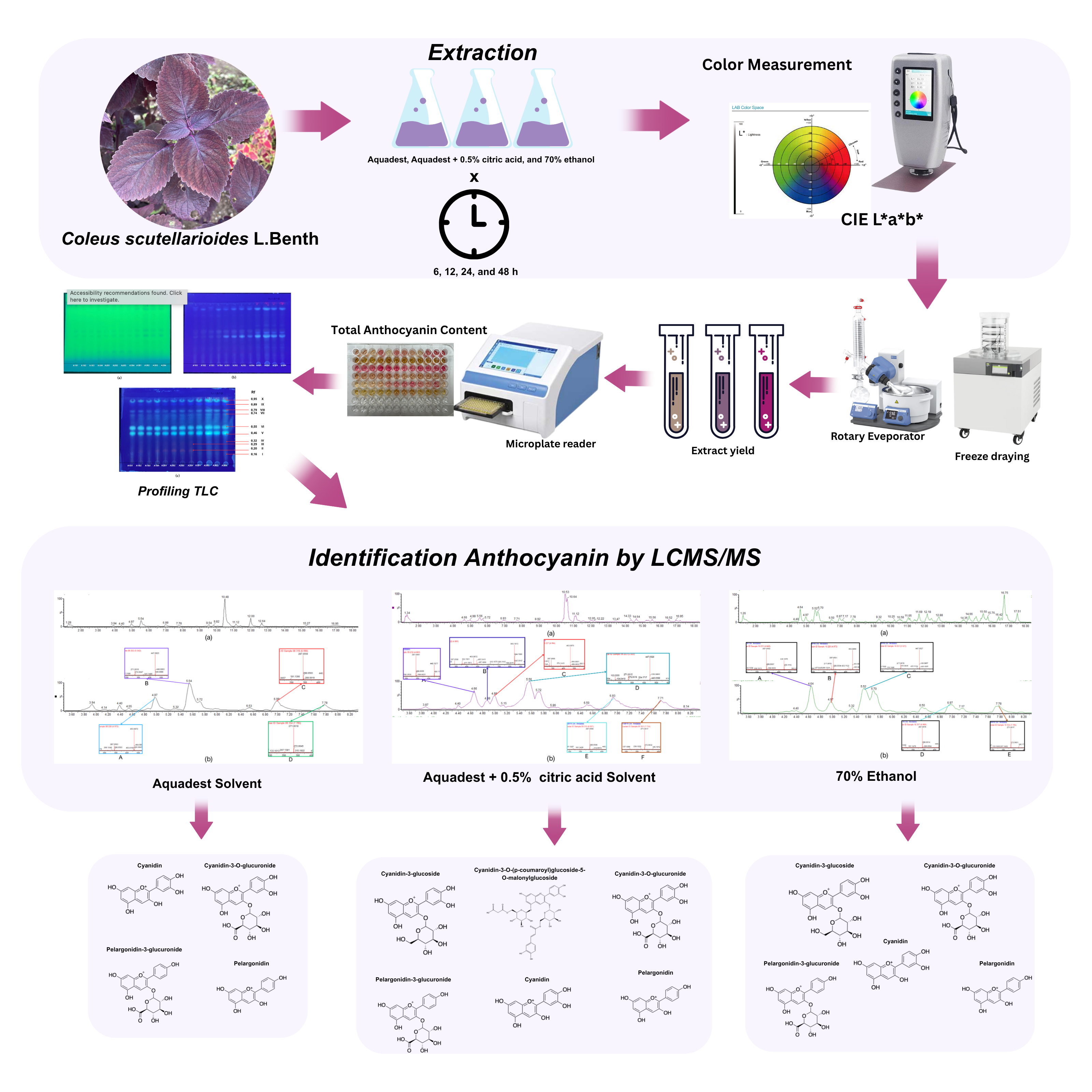
Downloads
References
Organisation for Economic Co-operation and De¬velopment and Food and Agriculture Organiza¬tion. OECD-FAO agricultural outlook 2024-2033, Available at: https://doi.org/10.1787/4c5d2cfb-en, accessed July 2025.
Directorate General of Livestock and Animal Health. Livestock and animal health statistics 2024, Available at: https://ditjenpkh.per-tanian.go.id/berita/2033-#!, accessed July 2025.
AG Ganeco, MM Boiago, JLM Mello, RA De Souza, FB Ferrari, PA De Souza and H Borba. Lipid assessment, cholesterol and fatty acid profile of meat from broilers raised in four different rearing systems. Anais da Academia Brasileira de Ciências 2020; 92(S1), e20190649.
WT Ismoyowati and T Widyastuti. Fat and cholesterol contents of breast and thigh meat in various local poultry species. Animal Production 2003; 5(2), 79-82.
MT Abdulwahid, DA Alobaidi and MF Hamood. Evaluation of some biochemical quality and bacterial load of local and imported chicken meat. International Journal of Science and Nature 2017; 8(2), 257-260.
M E Mahata, M Weni, Y Gusnanda, T Ohnuma and Y Rizal. The effects of dietary inclusion of miana plant flour (Plectranthus scutellarioides (L.) R. Br.) on serum lipid profile and organ weights of broiler chickens. World’s Veterinary Journal 2022; 12(1), 43-50.
AC Ayu, M Ida, M Moelyono and SG Fakhriati. Total anthocyanin content and identification of anthocyanidin from Plectranthus scutellarioides (L.) R. Br. leaves. Research Journal of Chemistry and Environment 2018; 22(1), 11-17.
H Yuniar. 2013, Extraction and antioxidant test of anthocyanin compounds from Coleus scutellarioides (L.) Benth. leaves and their application in beverages. Undergraduate Thesis. Universitas Andalas, Sumatera Barat, Indonesia.
D Wang, M Xia, S Gao, D Li, Y Zhang, T Jin and W Ling. Cyanidin-3-O-β-glucoside upregulates hepatic cholesterol 7α-hydroxylase expression and reduces hypercholesterolemia in mice. Molecular Nutrition & Food Research 2012; 56(4), 610-621.
M Takikawa, S Inoue, F Horio and T Tsuda. Dietary anthocyanin-rich bilberry extract ameliorates hyperglycemia and insulin sensitivity via activation of AMP-activated protein kinase in diabetic mice. The Journal of Nutrition 2010; 140(3), 527-533.
J M Lecerf and M De Lorgeril. Dietary cholesterol: From physiology to cardiovascular risk. British Journal of Nutrition 2011; 106(1), 6-14.
H Guo, G Liu, R Zhong, Y Wang, D Wang and M Xia. Cyanidin-3-O-β-glucoside regulates fatty acid metabolism via an AMP-activated protein kinase-dependent signaling pathway in human HepG2 cells. Lipids in Health and Disease 2012; 11, 1-13.
SA Amer, HS Al-Khalaifah, A Gouda, A Osman, NIA Goda, HA Mohammed, MIM Darwish, AM Hassan and SKA Mohamed. Potential effects of anthocyanin-rich roselle (Hibiscus sabdariffa L.) extract on the growth, intestinal histomorphology, blood biochemical parameters, and immune status of broiler chickens. Antioxidants 2022; 11(3), 544.
ME Mahata, DO Putri, Arif, T Ohnuma and Y Rizal. The performance of broiler chickens fed on miana plant flour (Plectranthus scutellarioides L.) R. Br. Journal of World’s Poultry Research 2021; 11(3), 332-337.
M Damdindorj, M Byambaa, O Munkhjargal and B Barkhuu. Stability of anthocyanin extracts from tall currant (Ribes altissimum) fruits. Mongolian Journal of Agricultural Sciences 2020; 30(2), 13-19.
T Taghavi, H Patel and R Rafie. Extraction solvents affect anthocyanin yield, color, and profile of strawberries. Plants 2023; 12(8), 1833.
LF Casassa and JF Harbertson. Extraction, evolution, and sensory impact of phenolic compounds during red wine maceration. Annual Review of Food Science and Technology 2014; 5, 83-109.
S Singh, OF Nwabor, DM Syukri and SP Voravuthikunchai. Chitosan-poly(vinyl alcohol) intelligent films fortified with anthocyanins isolated from Clitoria ternatea and Carissa carandas for monitoring beverage freshness. International Journal of Biological Macromolecules 2021; 182, 1015-1025.
S Polat, G Guclu, H Kelebek, M Keskin and S Selli. Comparative elucidation of colour, volatile and phenolic profiles of black carrot (Daucus carota L.) pomace and powders prepared by five different drying methods. Food Chemistry 2022; 369, 130941.
T Gonfa, S Teketle and T Kiros. Effect of extraction solvent on qualitative and quantitative analysis of major phyto-constituents and in-vitro antioxidant activity evaluation of Cadaba rotundifolia Forssk leaf extracts. Cogent Food & Agriculture 2020; 6(1), 1853867.
J Lee, RW Durst, RE Wrolstad, KW Barnes, T Eisele, MM Giusti, J Haché, H Hofsommer, S Koswig, DA Krueger, S Kupina, SK Martin, BK Martinsen, TC Miller, F Paquette, A Ryabkova, G Skrede, U Trenn and JD Wightman. Determination of total monomeric anthocyanin pigment content of fruit juices, beverages, natural colorants, and wines by the pH differential method: collaborative study. Journal of AOAC International 2005; 88(5), 1269-1278.
M Sampath and M Vasanthi. Isolation and structural elucidation of flavonoids from Polyalthia longifolia (Sonn.) Thwaites and evaluation of antibacterial, antioxidant and anticancer potential. International Journal of Pharmacy and Pharmaceutical Sciences 2013; 5(1), 336-341.
F Ismed, WN Desti, N Arifa, R Rustini and DP Putra. TLC-bioautographic and LC-MS/MS detection of antimicrobial compounds from four semipolar extracts of Cladonia species. Advances in Health Sciences Research 2021; 42, 49-59.
N Siddiqui, A Rauf, A Latif and Z Mahmood. Spectrophotometric determination of the total phenolic content, spectral and fluorescence study of the herbal Unani drug Gul-e-Zoofa (Nepeta bracteata Benth). Journal of Taibah University Medical Sciences 2017; 12(4), 360-363.
RGD Steel and JH Torrie. Prinsip dan prosedur statistika (Edisi ke-4) (in Indonesian). Penerbit Gramedia Pustaka Utama, Jakarta, Indonesia, 1995.
TK Koley, Z Khan, D Oulkar, BK Singh, A Maurya, B Singh and K Banerjee. High resolution LC-MS characterization of phenolic compounds and the evaluation of antioxidant properties of a tropical purple radish genotype. Arabian Journal of Chemistry 2020; 13(1), 1355-1366.
Y Zhang, Y Zhang, X Duan, X Liu, S Yuan, J Han and Y Cheng. Anthocyanins in tree peony (Paeonia suffruticosa) and their relationship with flower color. Horticultural Science and Technology 2020; 38(6), 776-784.
HNH Che, N Khairuddin and II Muhamad. Preparation and characterization of starch-based pH indicator films for anthocyanin release. Food Research 2024; 8(S3), 110-116.
ETA Kavela, L Szalóki-Dorkó and M Máté. The efficiency of selected green solvents and parameters for polyphenol extraction from chokeberry (Aronia melanocarpa (Michx)) pomace. Foods 2023; 12(19), 3639.
R Pramitasari and J Lim. Karakterisasi sifat fisikokimia ekstrak dan bubuk hasil pengeringan beku antosianin kelopak bunga telang (Clitoria ternatea L.) (in Indonesian). Agro Bali Agricultural Journal 2022; 5(2), 304-312.
HJ Kang, MJ Ko and MS Chung. Anthocyanin structure and pH dependent extraction characteristics from blueberries (Vaccinium corymbosum) and chokeberries (Aronia melanocarpa) in subcritical water state. Foods 2021; 10(3), 527.
M Yumas, J Loppies and A Barra. Stabilitas dan efektivitas antioksidan zat warna antosianin tepung kakao tanpa fermentasi (Theobroma cacao L.) secara in vivo (in Indonesian). Jurnal Industri Hasil Perkebunan 2020; 15(1), 61-68.
D Pratiwi and Y Hendrika. Antioxidant activity from spray gel formulation combination from ethyl acetate fraction turmeric rhizome and collagen from catfish (Pangasius hypopthalmus). Journal of Pharmacy and Science 2022; 6(1), 51-58.
H Nawaz, MA Shad, N Rehman, H Andaleeb and N Ullah. Effect of solvent polarity on extraction yield and antioxidant properties of phytochemicals from bean (Phaseolus vulgaris) seeds. Brazilian Journal of Pharmaceutical Sciences 2020; 56, e17129.
NE Masota, G Vogg, E Heller and U Holzgrabe. Comparison of extraction efficiency and selectivity between low-temperature pressurized microwave-assisted extraction and prolonged maceration. Archiv der Pharmazie 2020; 353(10), 2000147.
A Nizori and N Sihombing. Karakteristik ekstrak kulit buah naga merah (Hylocereus polyrhizus) dengan penambahan berbagai konsentrasi asam sitrat sebagai pewarna alami makanan (in Indonesian). Jurnal Teknologi Industri Pertanian 2020; 30(2), 228-233.
VI Deineka, EY Oleinits and YY Kul’chenko. Control of the selectivity of separation and the determination of anthocyanins of fruits of Vaccinium family plants using acetonitrile-formic acid-water eluents. Journal of Analytical Chemistry 2020; 75, 1443-1450.
S Joshi, J Appukuttan, J Chandrapala and M Majzoobi. Impact of conventional and advanced techniques on stability of natural food colourants. Foods 2025; 14(18), 3187.
HJ Kang, MJ Ko and MS Chung. Anthocyanin structure and pH dependent extraction characteristics from blueberries (Vaccinium corymbosum) and chokeberries (Aronia melanocarpa) in subcritical water state. Foods 2021; 10(3), 527.
S Oancea. A review of the current knowledge of thermal stability of anthocyanins and approaches to their stabilization to heat. Antioxidants 2021; 10(9), 1337.
X Zhao, X Zhang, X Chen, S Zhang and F He. Phenolics in wines II: Progress in research on copigmentation and bioactivities. Food Science 2019; 40(17), 284-294.
S Zahiruddin, A Parveen, W Khan, R Parveen and S Ahmad. TLC-based metabolite profiling and bioactivity-based scientific validation for use of water extracts in AYUSH formulations. Evidence-Based Complementary and Alternative Medicine 2021; 2021, 2847440.
A Dávila-Lara, M Reichelt, D Wang, H Vogel and A Mithöfer. Proof of anthocyanins in the carnivorous plant genus Nepenthes. FEBS Open Bio 2021; 11(9), 2576-2585.
K Banaszewski, E Park, I Edirisinghe, JC Cappozzo and BM Burton-Freeman. A pilot study to investigate bioavailability of strawberry anthocyanins and characterize postprandial plasma polyphenols absorption patterns by Q-TOF LC/MS in humans. Journal of Berry Research 2013; 3(2), 113-126.
Q Lou, L Wang, H Liu and Y Liu. Anthocyanin profiles in flowers of grape hyacinth. Molecules 2017; 22(5), 688.
MH Ikhsan, AWR Akili, A Hardianto, J Latip and T Herlina. Optimization of ultrasound-assisted extraction of anthocyanin from Erythrina crista-galli flowers. Trends in Sciences 2025; 22(7), 10076.
F Fatchiyah, HN Meidinna and E Suyanto. The cyanidin-3-O-glucoside of black rice inhibits the interaction of HMG-CoA and HMG-CoA reductase: Three- and two-dimension structure. Journal of Physics: Conference Series 2020; 1665(1), 012005.
H Cao, O Saroglu, A Karadag, Z Diaconeasa, G Zoccatelli, CA Conte‐Junior, GA Gonzalez-Aguilar, J Ou, W Bai, CM Zamarioli, LAP de Freitas, A Shpigelman, PH Campelo, E Capanoglu, CL Hii, SM Jafari, Y Qi, P Liao, M Wang, L Zou, P Bourke, J Simal-Gandara and J Xiao. Available technologies on improving the stability of polyphenols in food processing. Food Frontiers 2021; 2(2), 109-139.
B Enaru, G Drețcanu, TD Pop, A Stǎnilǎ and Z Diaconeasa. Anthocyanins: Factors affecting their stability and degradation. Antioxidants 2021; 10(12), 1967.
H Ayvaz, T Cabaroglu, A Akyildiz, CU Pala, R Temizkan, E Ağçam, Z Ayvaz, A Durazzo, M Lucarini, R Direito and Z Diaconeasa. Anthocyanins: Metabolic digestion, bioavailability, therapeutic effects, current pharmaceutical/industrial use, and innovation potential. Antioxidants 2022; 12(1), 48.
B Jayaprakasam, LK Olson, RE Schutzki, MH Tai and MG Nair. Amelioration of obesity and glucose intolerance in high-fat-fed C57BL/6 mice by anthocyanins and ursolic acid in Cornelian cherry (Cornus mas). Journal of Agricultural and Food Chemistry 2006; 54(1), 243-248.
XF Qi, L Zheng, KJ Lee, DH Kim, CS Kim, DQ Cai, Z Wu, JW Qin, YH Yu and SK Kim. HMG-CoA reductase inhibitors induce apoptosis of lymphoma cells by promoting ROS generation and regulating Akt, Erk and p38 signals via suppression of mevalonate pathway. Cell Death & Disease 2013; 4(2), e518-e518.
MH Grace, Xiong J, Esposito D, Ehlenfeldt M, Lila MA. Simultaneous LC–MS quantification of anthocyanins and non-anthocyanin phenolics from blueberries with widely divergent profiles and biological activities. Food Chemistry 2019; 277, 336–346.
R Zengin, Y Uğur, S Erdoğan, Ç Yavuz, H Hatterman-Valenti and O Kaya. Phytochemical and antioxidant variability in some black mulberry, chokeberry, and elderberry cultivars in relation to cultivar, plant part, and extraction solvent. Horticulturae 2025; 11(5), 455.
NV Valenzuela-Grijalva, A Pinelli-Saavedra, A Muhlia-Almazan, D Dominguez-Diaz and H Gonzalez-Rios. Dietary inclusion effects of phytochemicals as growth promoters in animal production. Journal of Animal Science and Technology 2017; 59, 8.
R Abdulkarimi, M Daneshyar and A Aghazadeh. Thyme (Thymus vulgaris) extract consumption darkens liver, lowers blood cholesterol, proportional liver and abdominal fat weights in broiler chickens. Italian Journal of Animal Science 2011; 10(2), e20.
SH Abu Hafsa and SA Ibrahim. Effect of dietary polyphenol-rich grape seed on growth performance, antioxidant capacity and ileal microflora in broiler chicks. Journal of Animal Physiology and Animal Nutrition 2018; 102(1), 268-275.
AA Kamboh and WY Zhu. Effect of increasing levels of bioflavonoids in broiler feed on plasma anti-oxidative potential, lipid metabolites, and fatty acid composition of meat. Poultry Science 2013; 92(2), 454-461.
Z Yan, Y Zhong, Y Duan, Q Chen and F Li. Antioxidant mechanism of tea polyphenols and its impact on health benefits. Animal Nutrition 2020; 6(2), 115-123.
Published
How to Cite
Issue
Section
License
Copyright (c) 2025 Walailak University

This work is licensed under a Creative Commons Attribution-NonCommercial-NoDerivatives 4.0 International License.





