
Patterns of Sexual and Spatial Morphometric Variation in Parasesarma eumolpe (De Man, 1895): Insights from A Tropical Delta Environment
DOI:
https://doi.org/10.48048/tis.2026.12381Keywords:
Carapace, Claw, Gamma–log regression, Morphometrics, Parasesarma eumolpeAbstract
This is the first fundamental morphometric study of Parasesarma eumolpe conducted in Vietnam. The study aimed to determine and compare key morphometric characteristics of P. eumolpe collected from two mangrove forest sites in the Mekong Delta, including Can Tho and Ca Mau. A total of 203 specimens (115 from Can Tho and 88 from Ca Mau) were collected monthly from August to October 2025. Six morphometric parameters, carapace width (CWLR, CWRL), smallest and biggest manus width (MW2, MW3), pollex width (PW5), and dactyl width (DW7), were analyzed using generalized linear mixed models (GLMM) and Gamma–log regression. The results revealed significant differences in morphometric traits by sex and site (p < 0.05), with males exhibiting larger carapace and claw dimensions than females. Geographic variation was also evident: CW and MW2 were higher in Can Tho, whereas MW3 and PW5 were greater in Ca Mau. Regression analyses showed strong positive correlations between carapace width and claw dimensions (R² > 0.60), particularly between MW2, MW3, PW5, and DW7, reflecting the integrated development of claw structures. The The Principal Component Analysis further supported these patterns by illustrating clear clustering trends by sex and sampling site. These findings provide fundamental morphometric data for taxonomy, sexual dimorphism, and ecological adaptation studies of P. eumolpe and contribute to a better understanding of morphological variation among sesarmid crabs inhabiting the Mekong Delta mangrove ecosystem.
HIGHLIGHTS
- Morphometric variation of Parasesarma eumolpe was examined across two mangrove sites within a tropical delta environment.
- Generalized Linear Mixed Models (GLMM) and Gamma–log regression were applied to assess the effects of sex and locality on six morphometric traits.
- Male crabs exhibited significantly larger carapace and claw dimensions than females, indicating evident sexual dimorphism.
- Morphometric differences between sites suggest local ecological influences on body and claw development.
- Strong correlations (R² > 0.60) among claw dimensions reflect coordinated allometric growth relevant to taxonomy and functional morphology.
GRAPHICAL ABSTRACT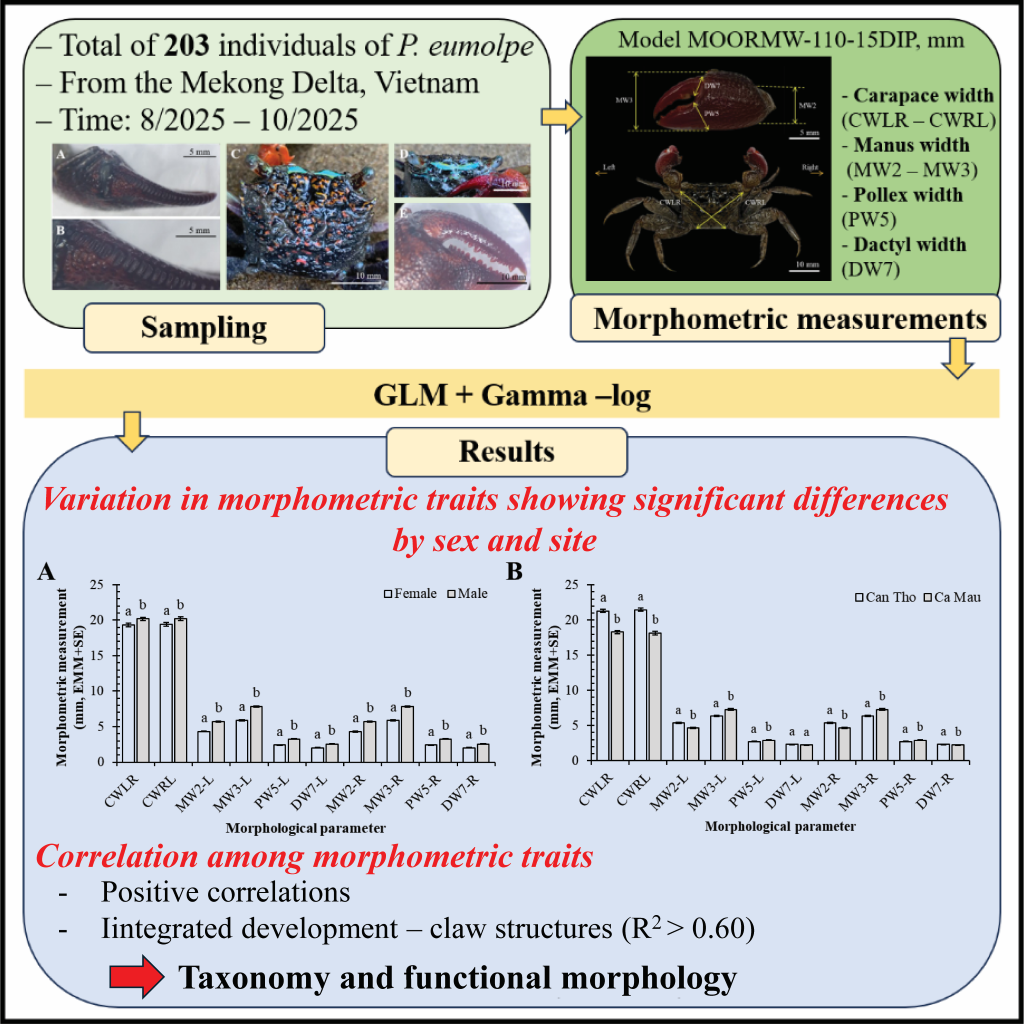
Downloads
References
PH Tinh, RA MacKenzie, TD Hung, TV Vinh, HT Ha, MH Lam, NTH Hanh, NX Tung, PM Hai and BT Huyen. Mangrove restoration in Vietnamese Mekong Delta during 2015-2020: Achievements and challenges. Frontiers in Marine Science 2022; 9, 1043943
CT Da, LT Phong, VD Thanh, TX Long, TT Dinh, NVX Phuong and M Landos. From Pristine to Polluted: How Chemicals and Pollutants Drive Fishery Declines and Ecosystem Collapse Case Study: Mekong River Vietnam. International Pollutants Elimination Network, Sweden, 2024.
DT Do, HQ Nguyen and XS Do. Sustainable development in Mekong Delta, Vietnam: Designing resilient cities based on landscape ecological principles. Journal of Asian Architecture and Building Engineering 2025; 24(4), 2948-2965.
IC Campbell. Biodiversity of the Mekong delta. Springer Environmental Science and Engineering. Springer Nature, New York, 2012, p. 293-313.
MZ Darnell and KM Darnell. Geographic variation in thermal tolerance and morphology in a fiddler crab sister-species pair. Marine Biology 2018; 165(2), 26.
BO Swanson, MN George, SP Anderson and JH Christy. Evolutionary variation in the mechanics of fiddler crab claws. BMC Evolutionary Biology 2013; 13, 137.
PKL Ng, HT Shih and S Cannicci. A new genus for Sesarma (Holometopus) tangi Rathbun, 1931 (Decapoda: Brachyura: Sesarmidae) from mangrove forests, with notes on its ecology and conservation. Journal of Crustacean Biology 2020; 40(1), 89-96.
A Shahdadi, S Fratini and CD Schubart. Taxonomic reassessment of Parasesarma (Crustacea: Brachyura: Decapoda: Sesarmidae) based on genetic and morphological comparisons, with the description of a new genus. Zoological Journal of the Linnean Society 2020; 190(4), 1123-1158.
G Guerao, K Anger, UWE Nettelmann and CD Schubart. Complete larval and early juvenile development of the mangrove crab Perisesarma fasciatum (Crustacea: Brachyura: Sesarmidae) from Singapore, with a larval comparison of Parasesarma and Perisesarma. Journal of Plankton Research 2004; 26(12), 1389-1408.
R Serène and C Soh. New Indo-Pacific genera allied to Sesarma Say 1817 (Brachyura, Decapoda, Crustacea). Treubia 1970; 27(4), 387-416.
PKL Ng, D Guinot and P Davie. Systema Brachyurorum: Part I. An annotated checklist of extant brachyuran crabs of the world. The Raffles Bulletin of Zoology 2008; 17(S17), 1-286.
S Fratini, S Cannicci, F Porri and G Innocenti. Revision of the Parasesarma guttatum species complex reveals a new pseudocryptic species in south-east African mangroves. Invertebrate Systematics 2019; 33(1), 208-224.
DL Rahayu and PKL NG. Two new species of Parasesarma De Man, 1895, from Southeast Asia (Crustacea: Decapoda: Brachyura: Sesarmidae). Zootaxa 2009; 1980(1), 29-40.
JJ Li, DL Rahayu and PKL Ng. Identity of the tree-spider crab, Parasesarma leptosoma (Hilgendorf, 1869 (Decapoda: Brachyura: Sesarmidae), with descriptions of seven new species from the Western Pacific. Zootaxa 2018; 4482(3), 451-490.
A Shahdadi, P Davie and CD Schubart. Perisesarma tuerkayi, a new species of mangrove crab from Vietnam (Decapoda, Brachyura, Sesarmidae), with an assessment of its phylogenetic relationships. Crustaceana 2017; 90(7-10), 1155-1175.
JD Man. Bericht über die von Herrn Schiffscapitän Storm zu Atjeh, an den westlichen Küsten von Malakka, Borneo und Celebes sowie in der Java-See gesammelten Decapoden und Stomatopoden. The Biodiversity Heritage Library 1895; 9, 75-218.
K Wada. Brachyuran species recorded from the coastal region of Vietnam in 1995 - 2007. Cancer 2019; 28, 138-143.
HT Shih, JW Hsu and JJ Li. Multigene phylogenies of the estuarine sesarmid Parasesarma bidens species complex (Decapoda: Brachyura: Sesarmidae), with description of three new species. Zoological Studies 2023; 62, 34.
TA Nguyen, CL Vu and PH Nguyen. Investigation of leaf litter consumption and the occurrence of the crab Parasesarma plicatum (Latreille, 1803) in different habitats of the Can Gio mangrove forest. The Journal of Agriculture and Development 2024; 23(1), 51-63.
V Le, NTM Huong, PD Dang, DMN Tran and Son Dang. Species diversity and distribution of brachyuran crabs(Crustacea: Decapoda: Brachyura) in the mangrove forest area in Cu Lao Dung district, Soc Trang province. Natural Sciences (Section B), Vietnam Journal of Science and Technology 2020; 62(6), 13-18.
HT Shih and J Poupin. A new fiddler crab of Austruca Bott, 1973, closely related to A. perplexa (H. Milne Edwards, 1852) (Crustacea: Brachyura: Ocypodidae), from the South Pacific Islands. Zoological Studies 2020; 59, 26.
Y Fukui, K Wada and CH Wang. Ocypodidae, Mictyridae and Grapsidae (Crustacea: Brachyura) from some coasts of Taiwan. Semantic Scholar 1989; 42(1), 225-238.
QM Dinh. Aspects of reproductive biology of the red goby Trypauchen vagina (Gobiidae) from the Mekong Delta. Journal of Applied Ichthyology 2018; 34(1), 103-110.
A Shahdadi, N Peter and CD Schubart. Morphological and phylogenetic evidence for a new species of Parasesarma De Man, 1895 (Crustacea: Decapoda: Brachyura: Sesarmidae) from the Malay Peninsula, previously referred to as Parasesarma indiarum (Tweedie, 1940). The Raffles Bulletin of Zoology 2018; 66, 739-762.
DV Tung, TN Anh and DM Quang. Variations in some morphological indicators of Tubuca rhizophorae regarding sex and site at Bac Lieu and Ca Mau. VNU Journal of Science: Natural Sciences and Technology 2024; 40(3), 107-115.
The Jamovi Project, Available at: https://www.jamovi.org, accessed July 2024.
P Vermeiren, C Lennard and C Trave. Habitat, sexual and allometric influences on morphological traits of intertidal crabs. Estuaries and Coasts 2021; 44, 1344-1362.
MZ Marochi, M Costa, RD Leite, IDCD Cruz and S Masunari. To grow or to reproduce? Sexual dimorphism and ontogenetic allometry in two Sesarmidae species (Crustacea: Brachyura). Journal of the Marine Biological Association of the UK 2018; 99(2), 473-486.
RA Pescinelli, TM Davanso and RCD Costa. Relative growth and morphological sexual maturity of the mangrove crab Aratus pisonii (H. Milne Edwards, 1837) (Decapoda, Brachyura, Sesarmidae) on the southern coast of the state of São Paulo, Brazil. Invertebrate Reproduction & Development 2015; 59(2), 55-60.
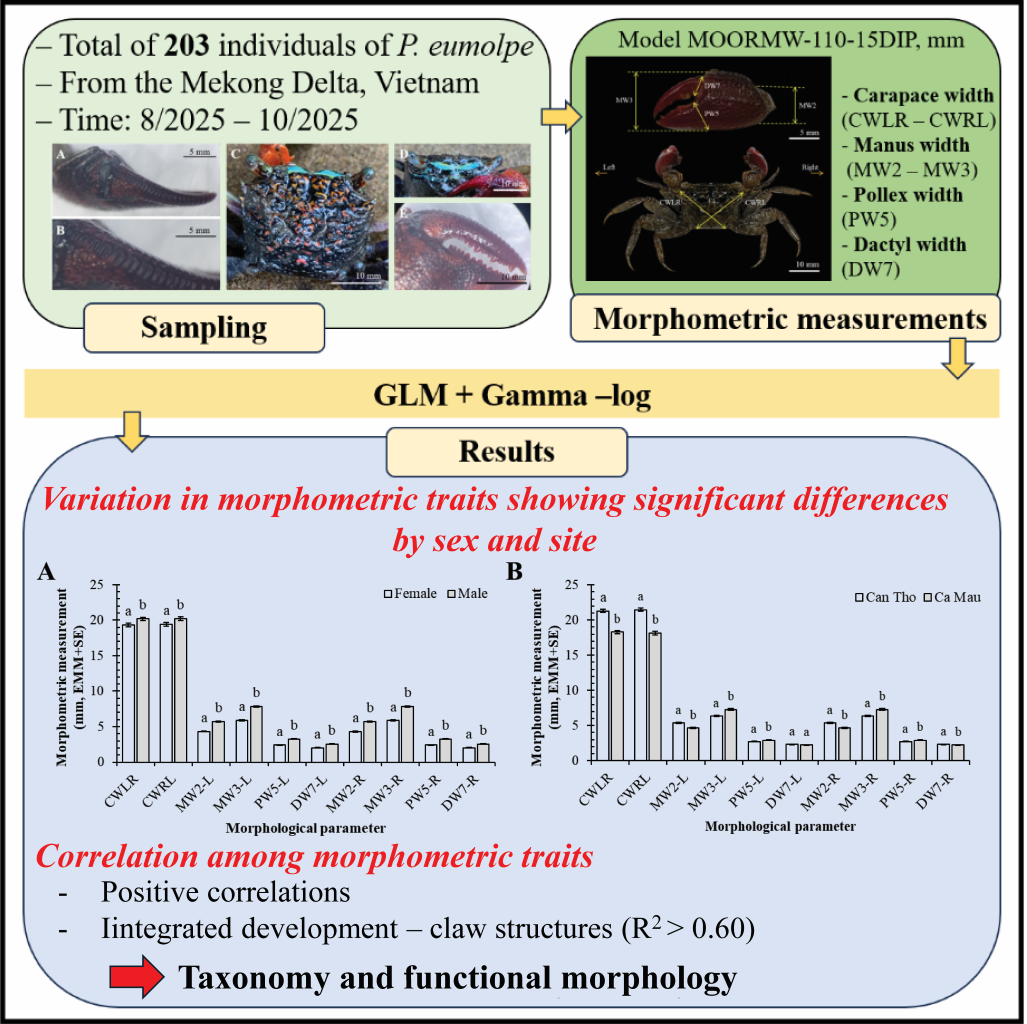
Published
How to Cite
Issue
Section
License
Copyright (c) 2025 Walailak University

This work is licensed under a Creative Commons Attribution-NonCommercial-NoDerivatives 4.0 International License.





