
Microstructural Characterization of Cassava Flour Biscuit: Effect of Cassava Cultivar and Flour Particle Size
DOI:
https://doi.org/10.48048/tis.2026.12137Keywords:
Cassava flour cultivar, Flour particle size, Biscuit microstructure, Surface roughness parameters, Granule and pore morphology, Element composition, Wheat flour substitutionAbstract
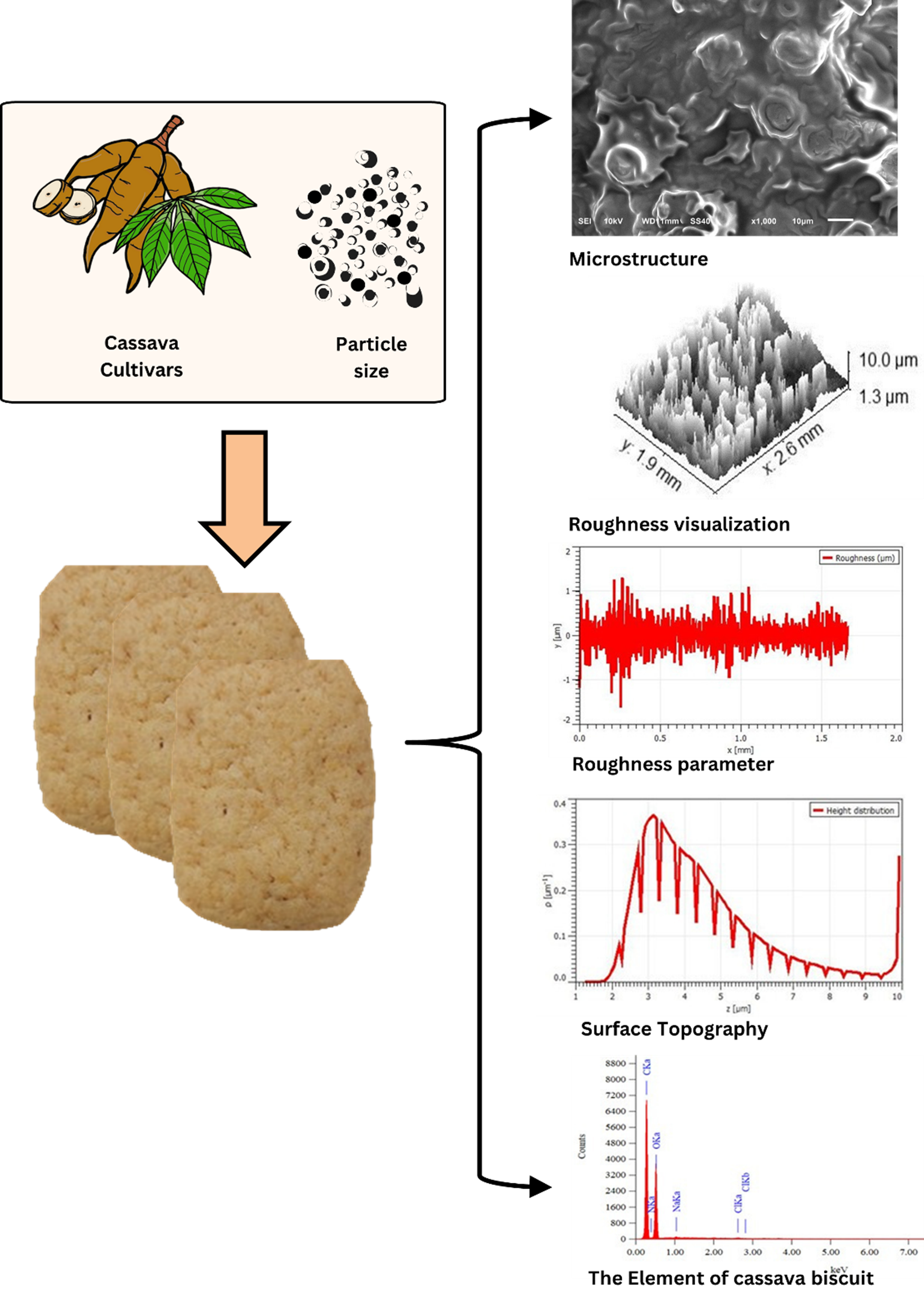
Cultivar and particle size of cassava flour are two important factors that greatly influence the characteristics of the resulting biscuits. This study proposes to evaluate the effect of cultivar and particle size of cassava flour on the microstructural characteristics of the biscuits it produces. Research was carried out using a 4×2 Factorial-Completely Randomized Design, with 4 cassava cultivars and 2 particle sizes. It was found that Kamling cultivar with 100-mesh sieve produced the smallest biscuit granules (18.99 µm), while Slenteng cultivar with 140-mesh sieve yielded the smallest biscuit pores (13.20 µm). Cassava cultivar, flour particle size, and their interaction significantly and distinctly affected biscuit granule diameter, pore diameter, surface roughness (Ra, Rq, Rz), topography (height distribution), and elemental content of carbon and oxygen, but showed no significant effect on nitrogen atom levels. The lowest roughness parameters were found in Slenteng cultivar with mesh 140, showing Ra (0.22), Rq (0.30) and Rz (2.52). The EDS analysis results of cassava biscuit indicated the presence of carbon (C) > oxygen (O) > nitrogen (N) in the majority of biscuit evaluated.
HIGHLIGHTS
- Modified cassava flour has enormous potential as a substitute ingredient in making biscuits
- Novel SEM and EDS analysis on biscuit microstructure and elemental composition
- Cultivar and mesh size significantly affect biscuit pore and granule diameter
- Surface roughness lower in finer mesh cassava flour
- Carbon > Oxygen > Nitrogen detected in cassava biscuit via EDS spectroscopy
GRAPHICAL ABSTRACT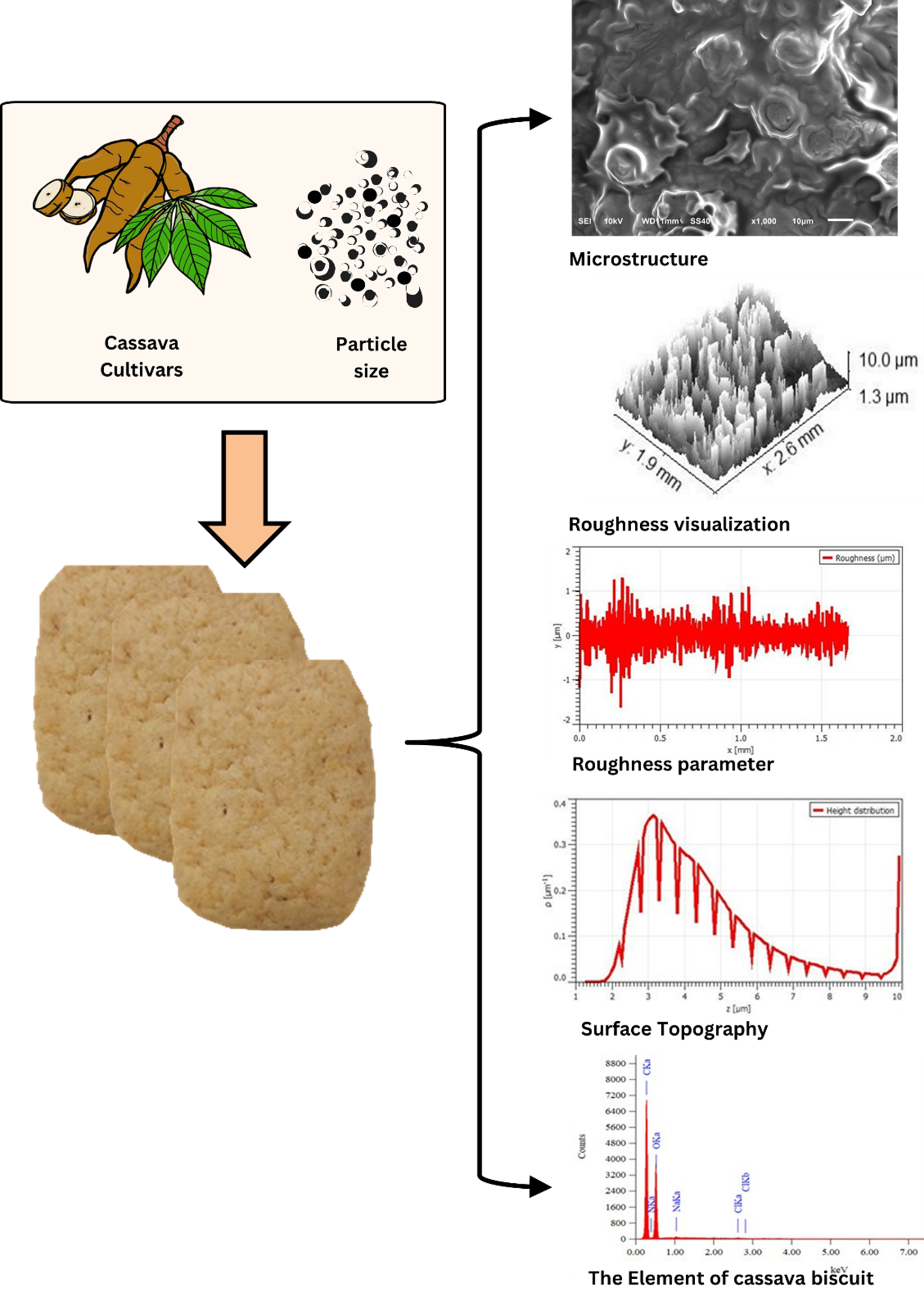
Downloads
References
M Hasmadi, L Harlina, L Jau-Shya, AH Mansoor, MHA Jahurul and MK Zainol. Physicochemical and functional properties of cassava flour grown in different locations in Sabah, Malaysia. Food Research 2020; 4(4), 991-999.
OA Otekunrin. Cassava (Manihot esculenta Crantz): A global scientific footprint—production, trade, and bibliometric insights. Discover Agriculture 2024; 2, 94.
PP Akhila, KV Sunooj, B Aaliya, M Navaf, C Sudheesh, DN Yadav, MA Khan, SA Mir and J George. Morphological, physicochemical, functional, pasting, thermal properties and digestibility of hausa potato (Plectranthus rotundifolius) flour and starch. Applied Food Research 2022; 2(2), 100193.
N Diniyah, A Subagio, RNL Sari, PG Vindy and AA Rofiah. Effect of fermentation time and cassava varieties on water content and the yield of starch from Modified Cassava Flour (MOCAF). Indonesian Journal of Pharmaceutical Science and Technology 2018; 5(2), 71-75.
R Sangpueak, C Saengchan, K Laemchiab, D Kiddeejing, S Siriwong, K Thumanu, NH Hoang, P Phansak and K Buensanteai. Flour on gluten-free muffins from different edible cassava varieties in Thailand. Foods 2022; 11(24), 4053.
I Burešová, L Červenka, R Šebestíková, M Augustová and A Jarošová. Applicability of flours from pigmented and glutinous rice in gluten-free bread baking. Foods 2023; 12(6), 1324.
H Lu, L Guo, L Zhang, C Xie, W Li, B Gu and K Li. Study on quality characteristics of cassava flour and cassava flour short biscuits. Food Science & Nutrition 2019; 8(1), 521-533.
H Marta, IL Anastasia, Y Cahyana, F Filianty, Fetriyuna and D Sondari. Evaluation of pasting and functional properties of composite flour from Indonesian local tubers and its application in gluten-free biscuits. Journal of Food Measurement and Characterization 2024; 18(8), 6782-6792.
N Diniyah, M Iguchi, M Nanto, T Yoshino and A Subagio. Dynamic rheological, thermal, and structural properties of starch from Modified Cassava Flour (MOCAF) with Two Cultivars of Cassava. Industria: Jurnal Teknologi dan Manajemen Agroindustri 2023; 12(1), 89-101.
SS Dewi and T Widyastuti. Effect of planting time and cassava variety to MOCAF (Modified Cassava Flour) quality level. IOP Conference Series: Earth and Environmental Science 2021; 752, 012054.
LD Kaale and M Eduardo. Development of value added cassava-based foods enriched with Irish potato peels and moringa leaves for sustainable food security and improved nutrition. Applied Food Research 2025; 5(1), 100762.
AS Subaşı and R Ercan. Technological characteristics of whole wheat bread: Effects of wheat varieties, sourdough treatments and sourdough levels. European Food Research and Technology 2024; 250, 2593-2608.
SA Oyeyinka and IAV Bassey. Composition, functionality, and baking quality of flour from four brands of wheat flour composition, functionality, and baking quality of flour from four brands of Wheat Flour. Journal of Culinary Science & Technology 2025; 23(1), 87-107.
K Bodor, J Szilágyi, B Salamon, O Szakács and Z Bodor. Physical – chemical analysis of different types of flours available in the Romanian market. Scientific Reports 2024; 14, 881.
AG Ikechukwu and SR Oyiza. Effects of different tuber crop flours and melon seed meal on the physicochemical and sensory properties of biscuits. Asian Journal of Applied Science and Technology 2021; 5(3), 196-212.
AA Memon, I Mahar, R Memon, S Soomro, J Harnly, N Memon, MI Bhangar and DL Luthria. Impact of flour particle size on nutrient and phenolic acid composition of commercial wheat varieties. Journal of Food Composition and Analysis 2020; 86, 103358.
NT Alzuwaid, CM Fellows, B Laddomada and M Sissons. Impact of wheat bran particle size on the technological and phytochemical properties of durum wheat pasta. Journal of Cereal Science 2020; 95, 103033.
D Dziki, A Krajewska and P Findura. Particle size as an indicator of wheat flour quality: A review. Processes 2024; 12(11), 2480.
A Cazzaniga, S Hase, MM Brousse and AR Linares. Properties of dehydrated cassava puree and wheat flour blends and its relationship with the texture of doughs. LWT 2021; 136(2), 110310.
DG Stevenson, JL Jane and GE Inglett. Structure and physicochemical properties of starches from sieve fractions of oat flour compared with whole and pin-milled flour. Cereal Chemistry 2007; 84(6), 533-539.
MJO de Almeida, BRSM da Wanderley, A de Francisco, ER Amante, CBF Freire, CV Helm and RDMC de Amboni. Effects of particle size on the physical, chemical, and technological properties of pre-gelatinized whole pinhão (Araucaria angustifolia) flour. Journal of Food Measurement and Characterization 2024; 18, 5695-5709.
WL Kerr, CDW Ward, KH McWatters and AVA Resurreccion. Milling and particle size of cowpea flour and snack chip quality. Food Research International 2001; 34(1), 39-45.
J Pang, E Guan, Y Yang, M Li and K Bian. Effects of wheat flour particle size on flour physicochemical properties and steamed bread quality. Food Science & Nutrition 2021; 9(9), 4691-4700.
F Cheng, K Ding, H Yin, M Tulbek, CM Chigwedere and Y Ai. Milling and differential sieving to diversify flour functionality: A comparison between pulses and cereals. Food Research International 2023; 163, 112223.
ID Mert, G Sumnu and S Sahin. Microstructure of gluten-free baked products. Imaging Technologies and Data Processing for Food Engineers 2016; 2016, 197-242.
I Demirkesen, G Sumnu and S Sahin. Image analysis of gluten-free Breads prepared with Chestnut and Rice Flour and baked in Different Ovens. Food and Bioprocess Technology 2013; 6, 1749-1758.
OA Adedara and JRN Taylor. Roles of protein, starch and sugar in the texture of sorghum biscuits. LWT 2021; 136(1), 110323.
IK AÇARI. Determination of the chemical structure of diet biscuits with modern enstrumental techniques. Cumhuriyet Science Journal 2021; 42(2), 299-309.
M Esrafil, S Akter, MJ Alam, MA Alim, MSA Reza, M Zubair, PR Joy, M Jahan and M Khatun. Development and quality evaluation of novel biscuits by utilizing fruits and vegetables seed. Food Research 2024; 8(1), 181-189.
Y Senaweera and BDR Prasantha. Structural and elemental analysis of Waraka and Wala Jackfruit seed flour samples by SEM-EDX method. Tropical Agricultural Research 2024; 35(2), 169-174.
F Kouhsari, F Saberi, PL Kowalczewski, JM Lorenzo and M Kieliszek. Effect of the various fats on the structural characteristics of the hard dough biscuit. LWT 2022; 159, 113227.
GH Bagheri, C Bonadonna, I Manzella and P Vonlanthen. On the characterization of size and shape of irregular particles. Powder Technology 2015; 270, 141-153.
HR Azarbad, MM Tehrani and H Rashidi. Optimization of gluten-free bread formulation using sorghum, rice, and millet flour by D-Optimal mixture design approach. Journal of Agricultural Science and Technology 2019; 21, 101-115.
SR Yadhuraj, GS Babu and MU Kumari. Measurement of thickness and roughness using gwyddion. In: Proceedings of the 2016 3rd International Conference on Advanced Computing and Communication Systems (ICACCS), Coimbatore, India. 2016.
AM Gatti, D Tossini, A Gambarelli, S Montanari and F Capitani. Investigation of the presence of inorganic micro- and nanosized contaminants in bread and biscuits by environmental scanning electron microscopy. Critical Reviews in Food Science and Nutrition 2009; 49(3), 275-282.
S Aghajanzadeh, A Sultana, AM Ziaiifar and S Khalloufi. Formation of pores and bubbles and their impacts on the quality attributes of processed foods: A review. Food Research International 2024; 188, 114494.
MT Molina, SM Vaz, A Leiva and P Bouchon. Rotary-moulded biscuits: Dough expansion, microstructure and sweetness perception as affected by sucrose: Flour ratio and sucrose particle size. Food Structure 2021; 29, 100199.
Y Dadmohammadi and AK Datta. Food as porous media: A review of the dynamics of porous properties during processing. Food Reviews International 2022; 38(5), 953-985.
S Barak, D Mudgil and BS Khatkar. Effect of flour particle size and damaged starch on the quality of cookies. Journal of Food Science and Technology 2014; 51(7), 1342-1348.
H Boz. Effect of flour and sugar particle size on the properties of cookie dough and cookie. Czech Journal of Food Sciences 2019; 37(2), 120-127.
M Jia, R Ma, C Liu, X Pan, W Shen and Y Tian. Insight into the relationship between cell wall, intracellular starch structure and physicochemical properties of cassava cells from cassava varieties. International Journal of Biological Macromolecules 2025; 288, 138728.
M Belorio, M Sahagún and M Gómez. Influence of flour particle size distribution on the quality of maize gluten-free cookies. Foods 2019; 8(2), 83.
S Romuli, A Abass and J Müller. Physical properties of cassava grits before and after pneumatic drying. Journal of Food Process Engineering 2016; 40(2), 12397.
NKO Ojijo and E Shimoni. Minimization of cassava paste flow properties using the “Farris effect”. LWT - Food Science and Technology 2008; 41(1), 51-57.
D Murayama, M Kasano, DM Santiago, H Yamauchi and H Koaze. Effect of pre-gelatinization on the physicochemical properties of dry flours produced from 5 cassava varieties of the Philippines. Food Science and Technology Research 2014; 20(6), 1131-1140.
J Dobes, JES Leal, J Profeta, MM de Sousa, FPL Neto, A Piratelli-Filho and RV Arencibia. Effect of mechanical vibration on Ra, Rq, Rz, and Rt roughness parameters. The International Journal of Advanced Manufacturing Technology 2017; 92, 393-406.
W Kapłonek, M Ungureanu, K Nadolny and P Sutowski. Stylus profilometry in surface roughness measurements of the vertical conical mixing unit used in a food industry. Journal of Mechanical Engineering 2017; 47(1), 1-8.
PSP de Herrmann, CMP Yoshida, AJ Antunes and JA Marcondes. Surface evaluation of whey protein films by atomic force microscopy and water vapour permeability analysis. Packaging Technology and Science 2004; 17(5), 267-273.
Y Yang, X Xie, R Huang, K Yan, M Wang, W Liu, X Zeng, X Ren and H Gong. Characterization of morphological and chemical changes using atomic force microscopy and metabolism assays: The relationship between surface wax and skin greasiness in apple fruit. Frontiers in Plant Science 2024; 15, 1489005.
V Briones, CA Brown and JM Aguilera. Scale-sensitive fractal analysis of the surface roughness of bloomed chocolate. Journal of the American Oil Chemists’ Society 2006; 83(3), 193-199.
P Narayan and BC Hancock. The influence of particle size on the surface roughness of pharmaceutical excipient compacts. Materials Science and Engineering: A 2005; 407(1-2), 226-233.
N Bulaha. Calculations of surface roughness 3D parameters for surfaces with irregular roughness. Engineering for Rural Development 2018; 2018, 1437-1444.
H Mamat, MOA Hardan and SE Hill. Physicochemical properties of commercial semi-sweet biscuit. Food Chemistry 2010; 121(4), 1029-1038.
B Filipčev, N Nedeljković, O Šimurina, M Sakač, M Pestorić, D Jambrec, B Šarić and P Jovanov. Partial replacement of fat with wheat bran in formulation of biscuits enriched with herbal blend. Hemijska Industrija 2017; 71(1), 61-67.
RB Edoura-Gaena, I Allais, G Trystram and JB Gros. Influence of aeration conditions on physical and sensory properties of aerated cake batter and biscuits. Journal of Food Engineering 2007; 79(3), 1020-1032.
C Lizhu, F Yiyi2, L Shiwei, W Yongxia, T Zhichao and D Shenglin. Optimization for baking process of sea-buckthorn biscuits based on sensory evaluation of fuzzy mathematics. Science and Technology of Food Industry 2021; 42(15), 163-169.
PA Conforti, DK Yamul and CE Lupano. Influence of milk, corn starch, and baking conditions on the starch digestibility, gelatinization, and fracture stress of biscuits. Cereal Chemistry 2012; 89(4), 205-210.
Q Zhou, X Li, J Yang, L Zhou, J Cai, X Wang, T Dai, W Cao and D Jiang. Spatial distribution patterns of protein and starch in wheat grain affect baking quality of bread and biscuit. Journal of Cereal Science 2018; 79, 362-369.
E Garcia-Armenta, G Gutierrez, S Anand and K Cronin. Analysis of the failure of cracked biscuits. Journal of Food Engineering 2017; 196, 52-64.
SH Li, W Zhao, PL Li, G Min, AX Zhang, JL Zhang, YY Liu and JK Liu. Effects of different cultivars and particle sizes of non-degermed millet flour fractions on the physical and texture properties of Chinese steamed bread. Cereal Chemistry 2020; 97(3), 661-669.
GC Dacanal. Particle size and morphology in food science and technology: A review. International Journal of Food Science & Technology 2024; 59(10), 6821-6833.
R Dariva, R Colet, A Manzoli, IA Fernandes, GS de Hassemer, RL Cansian, GT Backes and E Valduga. Structural and techno-functional properties of cassava starches and application on cheese bread. Biointerface Research in Applied Chemistry 2021; 11(1), 7400-7409.
WYN Syahfitri, S Kurniawati, N Adventini, E Damastuti and DD Lestiani. Macro elemental analysis of food samples by nuclear analytical technique. Journal of Physics: Conference Series 2017; 860, 012023.
O Nwaiwu and H Onyeaka. New model high temperature pasting analysis of fermented cassava granules. Fermentation 2022; 8(2), 89.
C Khongla, P Yuwang, T Yuwang and S Musika. Physicochemical, phytochemical and antioxidant properties of organic sweet potato flour and its application in breadstick. Trends in Sciences 2024; 21(10), 8162.
WD Niemeyer. SEM/EDS analysis for problem solving in the food industry. Volume 9636. In: Proceedings of the SPIE - The International Society for Optical Engineering, California. 2015.
P Zarzycki, A Wirkijowska and U Pankiewicz. Functional bakery products: Technological, chemical and nutritional modification. Applied Sciences 2024; 14(24), 12023.
I Djalovic, PVV Prasad, K Akhtar, A Paunović, M Riaz, M Dugalic, S Katanski and S Zaheer. Nitrogen fertilization and cultivar interactions determine maize yield and grain mineral composition in calcareous soil under semiarid conditions. Plants 2024; 13(6), 844.
Published
How to Cite
Issue
Section
License
Copyright (c) 2025 Walailak University

This work is licensed under a Creative Commons Attribution-NonCommercial-NoDerivatives 4.0 International License.





