
ZnO/Chitosan Nanoconjugates from Chlorella vulgaris as Nanostimulants Against Viral Nervous Necrosis in Grouper
DOI:
https://doi.org/10.48048/tis.2026.12105Keywords:
Grouper, Viral Nervous Necrosis, Chlorella vulgaris, ZnO/Chitosan nanoconjugates, NanostimulantsAbstract
Grouper farming underpins Indonesia’s coastal livelihoods and supplies both domestic and export markets, yet disease-especially Viral Nervous Necrosis (VNN) in juveniles-remains a major constraint. Conventional tools (antibiotics, standard vaccines) have delivered limited protection, motivating alternative approaches. Leveraging nanotechnology, we evaluated a ZnO-chitosan nanoconjugate carrying a recombinant Chlorella vulgaris antigen for antiviral protection in cantang grouper (E. fuscoguttatus×E. lanceolatus). In a 56-day randomized block trial, 160 fish were allocated to 5 treatments (T1 - T5) and two controls. Endpoints included growth (length, weight, survival rate, SR; relative percent survival, RPS), hematology (erythrocytes, leukocytes, hematocrit, hemoglobin), gill histopathology, and flow cytometry of CD4⁺/CD8⁺ T-cell markers. The 33 µL regimen (T3) was consistently superior: length rose from 9.94 → 12.73 cm and weight from 13.57 → 18.00 g, with SR = 95% and RPS = 92%. Hematological profiles improved across all indices; gill lesions were minimal (mild edema, hyperplasia, lamellar fusion); and immunophenotyping showed moderated CD4⁺ activation alongside a marked increase in CD8⁺ expression, indicating effective cellular immunity. While T1 and T4 performed well and T2/T5 yielded moderate responses, T3 delivered the most balanced protection and significantly lowered viral load. These results highlight the promise of recombinant Chlorella antigens formulated in ZnO-chitosan nanoconjugates to strengthen grouper health and bolster aquaculture sustainability.
HIGHLIGHTS
- Recombinant Chlorella vulgaris combined with ZnO/Chitosan nanoconjugates significantly enhanced grouper fish growth, immune response, and survival against Viral Nervous Necrosis (VNN).
- Optimal nanovaccine dose (33 µL) resulted in the highest Survival Rate (95%) and Relative Percent Survival (92%) compared to control groups.
- Nanostimulants improved hematological parameters (RBC, WBC, Hb, Hct), indicating better overall fish health and immune function.
- Histopathology showed reduced tissue damage in the gills (mild edema, hyperplasia, and lamella fusion), suggesting the nanovaccine mitigates viral-induced damage.
- Flow cytometry analysis revealed controlled T-cell activation, indicating a well-balanced immune response and avoiding excessive immune stimulation.
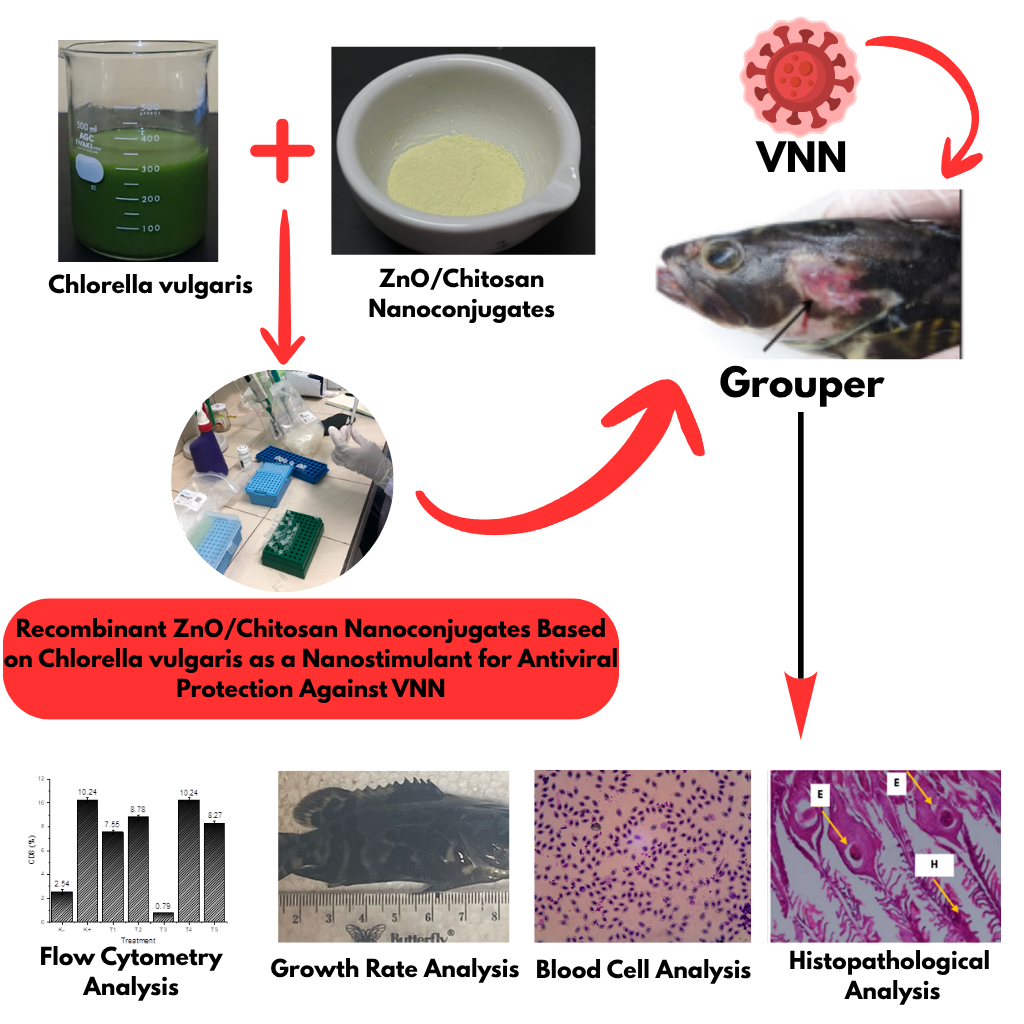
GRAPHICAL ABSTRACT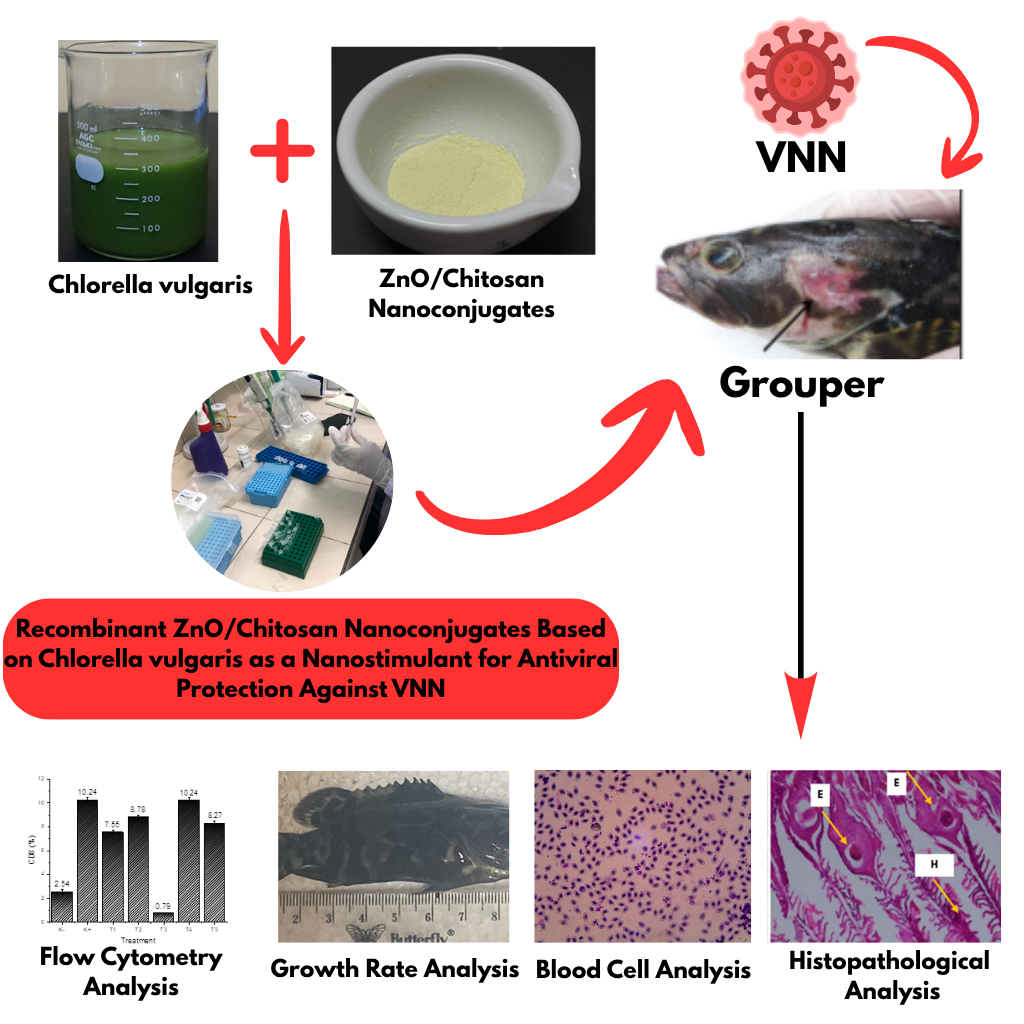
Downloads
References
FAO. The state of world fisheries and aquaculture 2020. FAO, Italy, 2020.
LMP and Valente. Viral nervous necrosis: An overview and update. Wiley Online Library, New Jersey, 2018.
LO Sikiru. Economic impact of viral nervous necrosis on aquaculture production. Wiley Online Library, New Jersey, 2020.
M Ghanbari. Antibiotic resistance in aquaculture: A global challenge. Frontiers in Microbiology, Switzerland, 2019.
MA Fernando. Nanoparticles in aquaculture: A new paradigm for immunostimulants. Elsevier, Brazil, 2021.
CC Chai. ZnO/Chitosan nanoconjugates as antimicrobial agents for fish vaccination. Elsevier, Brazil, 2019.
J Xie. Challenges in Nanoparticle-Based vaccines for aquaculture. Elsevier, Brazil, 2020.
A Fatoni, E Munarsih, K Asmadi and N Hidayati. Synthesis and characterization Chitosan-ZnO nanoparticles and Its application as antibacterial agent of Staphylococcus aureus. Science and Technology Indonesia 2020; 5(1), 1.
M Trovão, L Schüler, H Pedroso, A Reis, GE Santo, A Barros, N Correia, J Ribeiro, G Bombo, F Gama, C Viana, MM Costa, S Ferreira, H Cardoso, J Varela, J Silva, F Freitas and H Pereira. Isolation and selection of protein-rich mutants of Chlorella vulgaris by fluorescence-activated cell sorting with enhanced biostimulant activity to germinate garden cress seeds. Plants 2024; 13(17), 2441.
SN Gudid, LL Seng, AYS Kian, U Yanuhar, S Mustafa and R Shapawi. Growth Performance and Organoleptic Quality of hybrid grouper (Epinephelus fuscogutattus ♀ × Epinephelus lanceolatus ♂) fed palm-oil based diets at grow-out stage. Sains Malays 2020; 49(7), 1567-1576.
GB Khan, N Akhtar, MF Khan, Z Ullah, S Tabassum and Z Tedesse. Toxicological impact of Zinc Nano Particles on tilapia fish (Oreochromis mossambicus). Saudi Journal of Biological Sciences 2022; 29(2), 1221-1226.
A Rasheed, KJ Iqbal, A Safdar, A Nasir, R Jabeen, A sami, N Tara, S Ali, M Zeeshan, Shaista Abbas, SA Muhammad, A Pervaiz, M Adil, J Han, D Ali and MHA Almarzoug. Toxicological effects of zinc oxide nanoparticles on hemato-biochemical profile of common carp (Cyprinus carpio). Journal of King Saud University - Science 2023; 35(7), 102835.
U Yanuhar, H Nurcahyo, L Widiyanti, NS Junirahma, NR Caesar and S Sukoso. In vivo test of Vibrio alginolyticus and Vibrio harveyi infection in the humpback grouper (Cromileptes altivelis) from East Java Indonesia. Veterinary World 2022; 15(5), 1269-1282.
U Yanuhar, DT Rahayu, M Musa and D Arfiati. The identification of plankton, water quality, blood cell, and histology in culture pond of tilapia Oreochromis niloticus which infected by viral nervous necrosis (VNN). IOP Conference Series: Earth and Environmental Science 2018; 137, 012014.
S Won, A Hamidoghli, W Choi, J Bae, WJ Jang, S Lee and SC Bai. Evaluation of potential probiotics Bacillus Subtilis WB60, Pediococcus pentosaceus, and Lactococcus lactis on growth performance, immune response, gut histology and Immune-Related genes in whiteleg shrimp, Litopenaeus vannamei. Microorganisms 2020; 8(2), 281.
JG Arellano-Carrasco, R Martínez-García, A Asiain-Hoyos, JL Reta-Mendiola, P Díaz-Rivera, SA Frías-Gómez, T Martínez-Burguete, GG Asencio-Alcudia, LD Jiménez-Martínez, R Guerrero-Zarate,CA Sepúlveda-Quiroz and CA Álvarez-González. Effects of dietary sodium propionate on growth, digestive enzyme activity, and expression of immune system genes in juveniles of tropical gar (Atractosteus Tropicus). Aquaculture Journal 2023; 3(4), 227-237.
NN Gabriel, MR Wilhelm, HM Habte-Tsion, P Chimwamurombe, E Omoregie, LN Iipinge and K Shimooshili. Effect of dietary Aloe vera polysaccharides supplementation on growth performance, feed utilization, hemato-biochemical parameters, and survival at low ph in african catfish (Clarias gariepinus) fingerlings. International Aquatic Research 2019; 11, 57-72.
N Aini, DSYR Putri, DH Achhlam, F Fatimah, S Andriyono, D Hariani, HDK Do and SPA Wahyuningsih. Supplementation of Bacillus subtilis and Lactobacillus casei to increase growth performance and immune system of catfish (Clarias gariepinus) due to aeromonas Hydrophila infection. Veterinary World 2024; 17(3), 602-611.
M Elsabagh, R Mohamed, EM Moustafa, A Hamza, F Farrag, O Decamp, MAO Dawood and M Eltholth. Assessing the impact of Bacillus strains mixture probiotic on water quality, growth performance, blood profile and intestinal morphology of Nile Tilapia, Oreochromis niloticus. Aquaculture Nutrition 2018; 24(6), 1613-1622.
MJ Kim, SY Kim, KH Kim, SS Yoo, TK Lee and TJ Choi. High-Level expression of recombinant VHSV glycoprotein using transformed C. Vulgaris and verification of vaccine efficacy. Vaccines 2023; 11(7), 1205.
A Saputra, T Budiardi, R Samsudin and ND Rahmadya. Growth performance and survival of snakehead Channa striata juvenile with different stocking density reared in recirculation system. Jurnal Akuakultur Indonesia 2018; 17(2), 104.
CR de Magalhães, D Schrama, C Nakharutha, S Boonanuntanasarn, D Revets, S Planchon, A Kuehn, M Cerqueira, R Carrilho, AP Farinha and PM Rodrigues. Metabolic plasticity of gilthead seabream under different stressors: Analysis of the stress responsive hepatic proteome and gene expression. Frontiers in Marine Science 2021; 8, 676189.
R Syed, Z Masood, HU Hassan, W Khan, S Mushtaq, A Ali, Y Gul, H Jafari, A Habib, MIA Shah, K Gabol, H Gul and A Ullah. Growth performance, haematological assessment and chemical composition of Nile tilapia, Oreochromis niloticus (Linnaeus, 1758) fed different levels of aloe vera extract as feed additives in a closed aquaculture system. Saudi Journal of Biological Sciences 2022; 29(1), 296-303.
DR Causey, JH Kim, RH Devlin, SAM Martin and DJ Macqueen. The AMPK system of salmonid fishes was expanded through genome duplication and is regulated by growth and immune status in muscle. Scientific Reports 2019; 9, 9819.
J Ahmed, A Thakur and A Goyal. Industrial wastewater and its toxic effects. In: MP Shah (Ed.). Biological Treatment of Industrial Wastewater. The Royal Society of Chemistry, London, 2021.
HM Ali, OM Ibrahim, ASM Ali, MA Mohamed, RY Ghareeb, EE Hafez and MR El-Aassar. Cross-linked chitosan/gelatin beads loaded with Chlorella vulgaris Microalgae/Zinc oxide nanoparticles for adsorbing carcinogenic bisphenol-a pollutant from water. ACS Omega 2022; 7(31), 27239-27248.
X Jiang, J Wang, W Huang, H Ma, S Zhang, Z Cai, W Lin and J Zheng. Tumor Microenvironment Reprogrammed Bimetallic Hybrid Nanostimulator for Triggering Radio‐Cuproptosis‐Immunotherapy. Advanced Healthcare Materials 2024; 13(30), 2401902.
ME Natnan, CF Low, CM Chong, H Bunawan and SN Baharum. Oleic acid as potential immunostimulant in metabolism pathways of hybrid grouper fingerlings (Epinephelus Fuscoguttatus×Epinephelus Lanceolatus) infected with Vibrio vulnificus. Scientific Reports 2023; 13, 12830.
V Agustina and RC Mukti. Growth and survival of tilapia (Oreochromis niloticus) with starved periodically in bedeng munir village, south pagar alam. AQUASAINS 2022; 10(2), 1125-1130.
L Shi, L Zhao, Q Li, L Huang, Y Qin, Z Zhuang, X Wang, H Huang, J Zhang, J Zhang and Q Yan. Role of the pseudomonas plecoglossicida flil gene in immune response of infected hybrid groupers (epinephelus fuscoguttatus ♀×epinephelus lanceolatus ♂). Frontiers in Immunology 2024; 15, 1415744.
M Wu, X Wu, S Lu, Y Gao, W Yao, X Li, Y Dong and Zibo Jin. Dietary arginine affects growth, gut morphology, oxidation resistance and immunity of hybrid grouper (Epinephelus Fuscoguttatus ♀×Epinephelus Lanceolatus ♂) juveniles. British Journal of Nutrition 2018; 120(3), 269-282.
RE Ibrahim, SA Amer, SA Shahin, MIM Darwish, S Albogami, AA Abdelwarith, EM Younis, MH Abduljabbar, SJ Davies and GA Attia. Effect of fish meal substitution with dried bovine hemoglobin on the growth, blood hematology, antioxidant activity and related genes expression, and tissue histoarchitecture of Nile tilapia (Oreochromis niloticus). Aquaculture Reports 2022; 26, 101276.
Y Zhang, Y Li, X Xu, L Xu, W Li, Z Gan and Y Lu. Magnolia officinalis enhanced immune responses and the resistance to Vibrio harveyi infection in pearl gentian groupers. Frontiers in Veterinary Science 2025; 12, 1603997.
NM Alhazmi and EM Sharaf. Fungicidal activity of zinc oxide nanoparticles against azole-resistant Aspergillus flavus isolated from Yellow and White Maize. Molecules 2023; 28(2), 711.
P Bunlipatanon and KU Taynapun. Growth performance and disease resistance against Vibrio vulnificus infection of novel hybrid grouper (Epinephelus Lanceolatus×Epinephelus Fuscoguttatus). Aquaculture Research 2016; 51, 13008.
R Sukhsangchan, J Phaksopa, A Uchuwittayakul, CC Chou and P Srisapoome. Effects of zinc oxide nanoparticles (ZnO NPs) on growth, immune responses and histopathological alterations in Asian seabass (Lates calcarifer, Bloch 1790) under low-salinity conditions. Animals 2024; 14(18), 2737.
U Yanuhar, DKWP Raharjo, NR Caesar and NS Junirahma. Hematology response of catfish (Clarias sp.) as an indicator of fish health in tuban regency. IOP Conference Series: Earth and Environmental Science 2021; 718, 012059.
K Haile and A Timerga. Evaluation of hematological parameters of Helicobacter pylori-infected adult patients at southern ethiopia: A comparative cross-sectional study. Journal of Blood Medicine 2021; 12, 77-84.
Y Fu, YA Zhang, J Shen and J Tu. Immunogenicity study of OmpU subunit vaccine against Vibrio mimicus in yellow catfish, Pelteobagrus fulvidraco. Fish & Shellfish Immunology 2021; 108, 80-85.
J Wang, H Zhou, G Guo, J Tan, Q Wang, J Tang, W Liu, H Shen, J Li and X Zhang. Enhanced anti-infective efficacy of Zno nanoreservoirs through a combination of intrinsic anti-biofilm activity and reinforced innate defense. ACS Applied Materials & Interfaces 2017; 9(39), 33609-33623.
AS Mohamed, HE Ghannam, AA El-Lahamy and HA Soliman. The protective role of Vitamins (E + C) on Nile tilapia (Oreochromis niloticus) exposed to ZnO NPs and Zn Ions: Bioaccumulation and proximate chemical composition. Annals of Animal Science 2022; 22(2), 633-642.
R Harikrishnan, S Jawahar, S Thamizharasan, BA Paray, MK Al-Sadoon and C Balasundaram. Immune defense of emodin enriched diet in Clarias batrachus against Aeromonas hydrophila. Fish & Shellfish Immunology 2018; 76, 13-20.
S Gharpure, R Yadwade and B Ankamwar. Non-antimicrobial and Non-anticancer properties of ZnO nanoparticles biosynthesized using different plant parts of Bixa orellana. ACS Omega 2022; 7(2), 1914-1933.
I Bricknell and RA Dalmo. The use of immunostimulants in fish larval aquaculture. Fish & Shellfish Immunology 2005; 19(5), 457-472.
MGS Talukder, A Hossain, ABM Mohsin and RI Khan. Performances of bottom dwelling carpsin polyculture ponds under drought prone Barind area of Bangladesh. Journal of Aquaculture & Marine Biology 2018; 7(1), 13-20.
LJ Magnoni, JA Martos-Sitcha, A Queiroz, JA Calduch-Giner, JFM Gonçalves, CMR Rocha, HT Abreu, JW Schrama, ROA Ozorio and J Pérez-Sánchez. Dietary Supplementation of Heat-Treated gracilaria and ulva seaweeds enhanced acute hypoxia tolerance in gilthead seabream (Sparus Aurata). Biology Open 2017; 6(6), 897-908.
RR Borut, Sukenda, S Nuryati, K Nirmala, I Effendi and Widanarni. The health status of hybrid grouper Epinephelus Fuscoguttatus (♀)×E.lanceolatus (♂) cultured in floating-net cage at Kelapa Dua Island, Seribu Islands, Indonesia. Jurnal Akuakultur Indonesia 2023; 22(2), 106-114.
Y Kawato, T Ito, T Kamaishi, A Fujiwara, M Ototake, T Nakai and K Nakajima. Development of red sea bream iridovirus concentration method in seawater by iron flocculation. Aquaculture 2016; 450, 308-312.
SM Bergmann, Y Wang, Y Li, Q Wang, S Klafack, Y Jin, AC Hofmann, J Kielpinska, AM Becker and W Zeng. Occurrence of herpesvirus in fish. Journal of Veterinary Research 2024; 68(1), 73-78.
WM Adriyani, S Murtini and Alimuddin. Effication of viral nervous necrosis DNA as vaccines for Cromileptes altivelis. IJOTA 2020; 3(2), 78-86.
N Ariff, A Abdullah, MNA Azmai, N Musa and SC Zainathan. Risk factors associated with viral nervous necrosis in hybrid groupers in Malaysia and the high similarity of its causative agent nervous necrosis virus to reassortant red-spotted grouper nervous necrosis virus/striped jack nervous necrosis virus strains. Veterinary World 2019; 12(8), 1273-1284.
ZU Shah and S Parveen. Oxidative, biochemical and histopathological alterations in fishes from pesticide contaminated river Ganga, India. Scientific Reports 2022; 12, 3628.
D Avrilia, H Suprapto and BS Rahardja. Evaluation of histopathological changes in Cantang groupers’ brain and gill infected with Streptococcus iniae. World’s Veterinary Journal 2022; 12(1), 87-94.
T Dalzochio, MS de Souza, LAR Simões, GJH Silva, G Zimmermann, NB Andriguetti, LB da Silva and G Gehlen. Impact of anthropogenic activities on water quality of the paranhana river, Southern Brazil. Brazilian Archives of Biology and Technology 2019; 62(2), 19180523.
EA Ivon, NA Etangetuk, GM Ubi, CO Anyanwu, AN Nkang and AP Ekanem. Assessment of histopathological damages in african catfish (Clarias garienpinus) as influenced by nittol detergent aquatic pollution in Nigeria. Annual Research & Review in Biology 2020; 35(4), 1-11.
MA Aldoghachi, MS Azirun, I Yusoff and MA Ashraf. Ultrastructural effects on gill tissues induced in red tilapia Oreochromis sp. by a waterborne lead exposure. Saudi Journal of Biological Sciences 2016; 23(5), 634-641.
D Zielinski, J Fraczyk, M Debowski, M Zielinski, ZJ Kaminski, D Kregiel, C Jacob and B Kolesinska. Biological activity of hydrophilic extract of Chlorella vulgaris grown on post-fermentation leachate from a biogas plant supplied with stillage and maize silage. Molecules 2020; 25(8), 1790.
R Oliaei, Z Keshtmand and R Shabani. The effect of Lactobacillus casei and Bacillus coagulans probiotics on liver damage induced by silver nanoparticles and expression of Bax, Bcl2 and Caspase 3 genes in male rats. European Journal of Translational Myology 2022; 33(1), 10673.
SR Badran and A Hamed. Is the trend toward a sustainable green synthesis of copper oxide nanoparticles completely safe for Oreochromis niloticus when compared to chemical ones?: Using oxidative stress, bioaccumulation, and histological biomarkers. Environmental Science and Pollution Research 2024; 31, 9477-9494.
M Zhang, H Wang, Y Song, H Huang, M Shao, Y Liu, H Li and Z Kang. Pristine carbon dots boost the growth of Chlorella vulgaris by enhancing photosynthesis. ACS Applied Bio Materials 2018; 1(3), 894-902.
OO Ashade, RA Ladigbolu, AH Okubanjo and AE Akanbi. Oxidative stress potential, genotoxic and histopathological effects of ethanolic extract of alternanthera philoxeroides on clarias gariepinus (Cat fish). Asian Journal of Research in Zoology 2022; 5(4), 39-52.
MA Kakakhel, F Wu, W Sajjad, Q Zhang, I Khan, K Ullah and W Wang. Long-term exposure to high-concentration silver nanoparticles induced toxicity, fatality, bioaccumulation, and histological alteration in fish (Cyprinus carpio). Environmental Sciences Europe 2021; 33, 14.
J Xing, H Tian, XQ Tang, X Sheng and WB Zhan. Kinetics of T lymphocyte subsets and B lymphocytes in response to immunostimulants in flounder (Paralichthys olivaceus): Implications for CD4+ T lymphocyte differentiation. Scientific Reports 2020; 10(1), 13827.
JS Alrahimi, NS Alotaibi, AM Aldahlawi, FS Basingab and KA Zaher. Impact of chitosan nanoparticles-coated dendritic cell-based vaccine as cancer immunotherapy. Vaccines 2025; 13(5), 474.
Z Shen, LG vom Steeg, MV Patel, M Rodriguez-Garcia and CR Wira. Impact of aging on the frequency, phenotype, and function of CD4+ T cells in the human female reproductive tract. Frontiers in Immunology 2024; 15, 1465124.
H Ashfaq, H Soliman, M Saleh and M El-Matbouli. CD4: A vital player in the teleost fish immune system. Veterinary Research 2019; 50, 1.
E Muñoz-Atienza, P Díaz-Rosales and C Tafalla. Systemic and mucosal B and T cell responses upon mucosal vaccination of teleost fish. Frontiers in Immunology 2021; 11, 622377.
J Zhang, Y Xu, M Chen, S Wang, G Lin, Y Huang, C Yang, Yang and Y Song. Spatial engineering of heterotypic antigens on a DNA framework for the preparation of mosaic nanoparticle vaccines with enhanced immune activation against SARS‐CoV‐2 variants. Angewandte Chemie International Edition 2024; 63(46), 202412294.
X Jia, BY Chua, L Loh, M Koutsakos, L Kedzierski, M Olshansky, WR Heath, SY Chang, J Xu, Z Wang and K Kedzierska. High expression of CD38 and MHC class II on CD8+ T cells during severe influenza disease reflects bystander activation and trogocytosis. Clinical & Translational Immunology 2021, 10(9), 1336.
AL Guo, JF Zhao, L Gao, HH Huang, JY Zhang, C Zhang, JW Song, RN Xu, X Fan, M Shi, YM Jiao and FS Wang. HIV-1-Specific CD11c+ CD8+ T cells display low PD-1 expression and strong Anti-Hiv-1 activity. Frontiers in Immunology 2021; 12, 757457.
L Wang, A Kumar, JK Das, Y Ren, HY Peng, DJ Ballard, X Xiong, JR Davis, X Ren, JM Yang and J Song. Expression of NAC1 restrains the memory formation of CD8+ T cells during viral infection. Viruses 2022; 14(8), 1713.
Published
How to Cite
Issue
Section
License
Copyright (c) 2025 Walailak University

This work is licensed under a Creative Commons Attribution-NonCommercial-NoDerivatives 4.0 International License.





