
Development of ZnO-Chitosan-Based Nanovaccine with Chlorella vulgaris Recombinant Protein against VNN in Hybrid Grouper (Epinephelus fuscoguttatus × lanceolatus)
DOI:
https://doi.org/10.48048/tis.2026.11536Keywords:
Chlorella vulgaris, Hybrid grouper, Immunostimulant, Nanovaccine, ZnO/chitosanAbstract
Viral Nervous Necrosis (VNN), caused by Nervous Necrosis Virus (NNV), is a major constraint in hybrid grouper (Epinephelus spp.) aquaculture, with larval and juvenile mortality reaching nearly 100%. Effective prophylactic strategies are urgently required to ensure sustainable production. This study aimed to test the hypothesis that recombinant Chlorella vulgaris protein, delivered using ZnO-chitosan nanoparticles, enhances immune response, improves growth, and mitigates VNN-induced tissue damage in hybrid grouper. An in vivo challenge experiment was conducted with juvenile fish assigned to 5 groups: Negative control (K−), positive control (K+), and 3 nanovaccine dosages (P1 = 33 µL, P2 = 66 µL and P3 = 112 µL). Vaccination was administered twice via oral sonde, with a 14-day interval between the primary and booster doses prior to viral challenge. The 66 µL dose (P2) yielded the most consistent protective effects, including significant improvements in body length and weight (p < 0.05), as well as elevated antioxidant enzyme activities (SOD = 3.997 U/mL; CAT = 109.7 U/mL), indicating enhanced oxidative defense. Histological analyses further confirmed reduced tissue damage in vaccinated groups, with P2 exhibiting attenuated vacuolization in the gills. Interestingly, although P2 was superior in growth and antioxidant responses, the 33 µL dose (P1) demonstrated the lowest tissue damage, suggesting a more favorable safety profile. These findings highlight a dose-dependent trade-off, where P2 maximizes immune and growth benefits, while P1 minimizes histopathological alterations. While ZnO-chitosan nanoparticles are generally considered safe at sub-toxic concentrations reported in fish toxicology studies (< 100 mg/L waterborne exposure), further ecotoxicological and bioaccumulation assessments are required to substantiate their long-term environmental safety. Within the scope of this study, the 33 µL dosage represents the most balanced option between efficacy and safety, supporting its potential as a nanovaccine platform for VNN control in hybrid grouper aquaculture.
HIGHLIGHTS
- A novel nanovaccine was developed combining Chlorella vulgaris recombinant protein with ZnO-chitosan nanoparticles as an adjuvant to combat Viral Nervous Necrosis (VNN) in hybrid grouper.
- The nanovaccine significantly improved growth performance, with the 33 µL dose (P1) showing the highest increase in body length and weight during both vaccination and post-infection phases.
- Antioxidant enzyme activity (SOD and CAT) in gill tissue was enhanced, especially at the 66 µL dose (P2), indicating improved immune defense against oxidative stress caused by viral infection.
- Histopathological analysis revealed that vaccinated fish experienced less gill tissue damage, with P1 group showing only mild edema, hyperplasia, and lamellar fusion compared to severe lesions in the unvaccinated control group.
- The study demonstrates the potential of microalgae-based recombinant vaccines with nano-delivery systems as a sustainable and eco-friendly strategy for disease prevention in aquaculture.
GRAPHICAL ABSTRACT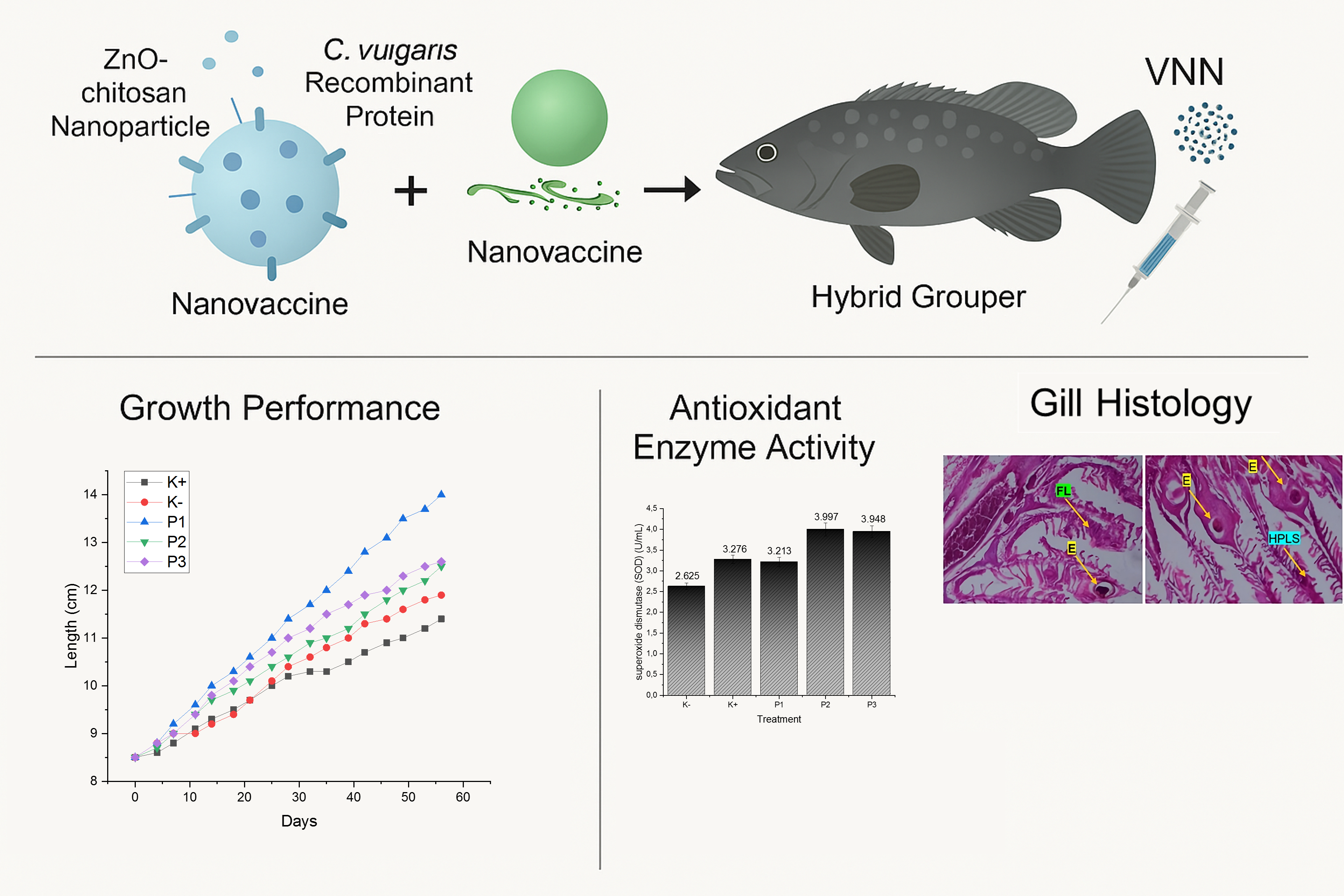
Downloads
References
ADB Tarihoran, M Hubeis, S Jahroh and N Zulbainarni. Building a sustainable institutional model for ornamental fish farming export villages in Indonesia. International Journal of Agricultural Sustainability 2024; 22(1), 2401203.
M Khasanah, N Nurdin, YS de Mitcheson and J Jompa. Management of the grouper export trade in Indonesia. Reviews in Fisheries Science & Aquaculture 2020; 28(1), 1-15.
B Astari, I Effendi, T Budiardi, Y Hadiroseyani, I Diatin and S Ismi. Financial analysis business of cantang (Epinephelus fuscoguttatus × E. lanceolatus) and cantik (E. fuscoguttatus × E. polyphekadion) hybrid groupers in hatcheries. Aquaculture Reports 2024; 39, 102364.
NS Anita and NN Dewi. Evaluation of hatching rate, growth performance, and survival rate of cantang grouper (Epinephelus fuscoguttatus × E. lanceolatus) in concrete pond at Situbondo, East Java, Indonesia. IOP Conference Series: Earth and Environmental Science 2020; 441, 012019.
XQ Zhou. Zinc oxide nanoparticles: Synthesis, characterization, modification, and applications in food and agriculture. Processes 2023; 11(4), 1193.
AB Rifai, T Wulandari, D Surastini and PDW Irawanto. Betanodavirus infection in barramundi in Riau Islands. Jurnal Medik Veteriner 2022; 5(1), 34-40.
A Saputra, M Maftuch, S Andayani and U Yanuhar. Pathogenicity of Vibrio parahaemolyticus causing acute hepatopancreatic necrosis disease (AHPND) in shrimp (Litopenaeus vannamei) in Serang, Banten, Indonesia. Biodiversitas 2023; 24(4), 2365-2373.
S Vali, G Mohammadi, KR Tavabe, F Moghadas and SS Naserabad. The effects of silver nanoparticles (Ag-NPs) sublethal concentrations on common carp (Cyprinus carpio): Bioaccumulation, hematology, serum biochemistry and immunology, antioxidant enzymes, and skin mucosal responses. Ecotoxicology and Environmental Safety 2020; 194, 110353.
SM El-Bahr and W El-Deeb. Oxidative stress and cardiac biomarkers in lambs affected with enzootic ataxia: The diagnostic and prognostic significance. Veterinarski Arhiv 2017; 87(3), 259-271.
M Mahjoubian, AS Naeemi, Z Moradi-Shoeili, CR Tyler and B Mansouri. Oxidative stress, genotoxic effects, and other damages caused by chronic exposure to silver nanoparticles (Ag NPs) and zinc oxide nanoparticles (ZnO NPs), and their mixtures in zebrafish (Danio rerio). Toxicology and Applied Pharmacology 2023; 472, 116569.
K Shahzad. Toxicity of zinc oxide nanoparticles (ZnO-NPs) in tilapia (Oreochromis mossambicus): Tissue accumulation, oxidative stress, histopathology and genotoxicity. International Journal of Environmental Science and Technology 2019; 16, 1973-1984.
MA Borysiewicz. ZnO as a functional material, a review. Crystals 2019; 9(10), 505.
S Tian. Effects of Chlorella extracts on growth of Capsicum annuum L. seedlings. Scientific Reports 2022; 12(1), 15455.
VA Senapati, A Kumar, GS Gupta, AK Pandey and A Dhawan. ZnO nanoparticles induced inflammatory response and genotoxicity in human blood cells: A mechanistic approach. Food and Chemical Toxicology 2015; 85, 61-70.
S Tang, J Wang, X Zhu and D Shen. Ecological risks of zinc oxide nanoparticles for early life stages of obscure puffer (Takifugu obscurus). Toxics 2024; 12(1), 48.
H Mirzaei and M Darroudi. Zinc oxide nanoparticles: Biological synthesis and biomedical applications. Ceramics International 2017; 43(1), 907-914.
H Dai, T Sun, T Han, Z Guo, X Wang and Y Chen. Aggregation behavior of zinc oxide nanoparticles and their biotoxicity to Daphnia magna: Influence of humic acid and sodium alginate. Environmental Research 2020; 191, 110086.
U Yanuhar, DT Rahayu, M Musa and D Arfiati. The identification of plankton, water quality, blood cell, and histology in culture pond of tilapia Oreochromis niloticus which infected by viral nervous necrosis (VNN). IOP Conference Series: Earth and Environmental Science 2018; 137(1), 012014.
AR Spence, GR Hopkins, LA Neuman-Lee, GD Smith, ED Brodie and SS French. Detrimental effects of zinc oxide nanoparticles on amphibian life stages. Journal of Experimental Zoology Part A: Ecological and Integrative Physiology 2016; 325(7), 415-424.
A Mittag. Cellular uptake and toxicological effects of differently sized zinc oxide nanoparticles in intestinal cells. Toxics 2021; 9(5), 96.
MI Almansour, S Alarifi, W Melhim and BM Jarrar. Nephron ultrastructural alterations induced by zinc oxide nanoparticles: An electron microscopic study. IET Nanobiotechnology 2019; 13(5), 515-521.
M Hamed, CJ Martyniuk, M Naguib, JS Lee and AE-DH Sayed. Neurotoxic effects of different sizes of plastics (nano, micro, and macro) on juvenile common carp (Cyprinus carpio). Frontiers in Molecular Neuroscience 2022; 15, 1028364.
G Rashidian. Chemically and green synthesized ZnO nanoparticles alter key immunological molecules in common carp (Cyprinus carpio) skin mucus. International Journal of Molecular Sciences 2021; 22(6), 3270.
I Sembratowicz and K Ognik. Redox status, hematological parameters as well liver and kidney function indicators in blood of chickens receiving gold nanoparticles. Annals of Animal Science 2019; 19(2), 453-468.
H Iqbal, A Fatima and HAA Khan. ZnO nanoparticles produced in the culture supernatant of Bacillus thuringiensis Ser. israelensis affect the demographic parameters of Musca domestica using the age-stage, 2-sex life table. Pest Management Science 2022; 78(4), 1640-1648.
S Bhoopathy, D Inbakandan, R Thirugnanasambandam, C Kumar, P Sampath, R Bethunaickan, V Raguraman and GK Vijayakumar. A comparative study on chitosan nanoparticle synthesis methodologies for application in aquaculture through toxicity studies. IET Nanobiotechnology 2021; 15(4), 418-426.
U Yanuhar, D Raharjo, NR Caesar and NS Junirahma. Hematology response of catfish (Clarias sp.) as an indicator of fish health in Tuban Regency. IOP Conference Series: Earth and Environmental Science 2021; 718(1), 012059.
C Castro, F Coutinho, P Iglesias, A Oliva-Teles and A Couto. Chlorella sp. and Nannochloropsis sp. inclusion in plant-based diets modulate the intestine and liver antioxidant mechanisms of European sea bass juveniles. Frontiers in Veterinary Science 2020; 7, 607575.
M Kim, S Kim, N Abdellaoui and T Choi. Isolation and characterization of a salt inducible promoter from Chlorella vulgaris PKVL7422. Journal of Microbiology and Biotechnology 2023; 33(7), 955-963.
AB Sikiru. Chlorella vulgaris supplementation effects on performances, oxidative stress and antioxidant genes expression in liver and ovaries of New Zealand White rabbits. Heliyon 2019; 5(9), e02470.
MJ Kim, SY Kim, KH Kim, SS Yoo, T Lee and T Choi. High-level expression of recombinant VHSV glycoprotein using transformed Chlorella vulgaris and verification of vaccine efficacy. Vaccines 2023; 11(7), 1205.
W Zhang. pH-controlled release of antigens using mesoporous silica nanoparticles delivery system for developing a fish oral vaccine. Frontiers in Immunology 2021; 12, 644396.
S Nooraei, AS Lotfabadi, M Akbarzadehmoallemkolaei and N Rezaei. Immunogenicity of different types of adjuvants and nano-adjuvants in veterinary vaccines: A comprehensive review. Vaccines 2023; 11(2), 453.
IM Alfagih, BN Aldosari, BT AlQuadeib, AS Almurshedi and MM Alfagih. Nanoparticles as adjuvants and nanodelivery systems for mRNA-based vaccines. Pharmaceutics 2020; 13(1), 45.
S Vyas, S Dhoble, V Ghodake and V Patravale. Xyloglucan based mucosal nanovaccine for immunological protection against brucellosis developed by supercritical fluid technology. International Journal of Pharmaceutics: X 2020; 2, 100053.
J Lee, K Choi, JE Min, H Kim, J Jee and BJ Park. Functionalized ZnO nanoparticles with gallic acid for antioxidant and antibacterial activity against methicillin-resistant Staphylococcus aureus. Nanomaterials 2017; 7(11), 365.
F Asma, WE Prasetyo, P Priyono and I Nurhasanah. Synthesize of cerium-doped ZnO nanoparticles as antioxidant agent. Journal of Physics: Conference Series 2022; 2190(1), 012045.
X Hu, J Zhou and B Liu. Effect of algal species and light intensity on the performance of an air-lift-type microbial carbon capture cell with an algae-assisted cathode. RSC Advances 2016; 6(30), 25094-25100.
AM Carmona-Ribeiro and Y Pérez-Betancourt. Emerging cationic nanovaccines. Pharmaceutics 2024; 16(11), 1362.
A Rasheed. Toxicological effects of zinc oxide nanoparticles on hemato-biochemical profile of common carp (Cyprinus carpio). Journal of King Saud University - Science 2023; 35(7), 102835.
U Yanuhar, D Arfiati, M Musa, NS Junirahma and NR Caesar. The status of VNN (Viral Nervous Necrosis)-infected grouper fish tissue with Chlorella vulgaris extract as anti-virus candidate. Conference Series: Journal of Physics 2020; 1529, 012036.
J Li. Utilizing decellularized bio-membranes to optimize histopathological embedding of small tissues. MethodsX 2024; 13, 102919.
A Grasso. Chemical characterization and quantification of titanium dioxide nanoparticles (TiO2-NPs) in seafood by single-particle ICP-MS: Assessment of dietary exposure. International Journal of Environmental Research and Public Health 2020; 17(24), 9547.
R Machrizal, K Khairul, J Nasution, RH Dimenta and A Harahap. Distribution and length-weight relationships of hilsa shad Tenualosa ilisha in the Bilah River, Labuhanbatu Regency, North Sumatera Province, Indonesia. Aceh Journal of Animal Science 2019; 4(1), 42-49.
APA Samad, N Fazillah, R Humairani, Ilhamdi and NF Hua. Biological aspects and feeding ecology of sembilang Plotosus canius in Langsa Estuary. Hayati 2022; 29(6), 782-788.
ZA Muchlisin, V Fransiska, AA Muhammadar, M Fauzi and AS Batubara. Length-weight relationships and condition factors of the 3 dominant species of marine fishes caught by traditional beach trawl in Ulelhee Bay, Banda Aceh City, Indonesia. Croatian Journal of Fisheries 2017; 75(4), 104-112.
ARM Mohamed and SM Al-Wan. Assessment of growth, reproduction, recruitment and virtual population analysis of invasive species, Coptodon zillii in Garmat Ali River, Iraq. International Journal of Applied Sciences & Development 2023; 2, 133-146.
OC Bakare. Length-weight relationships and condition factor of Parachanna obscura Günther 1861 in Epe Lagoon, Lagos, Nigeria. Pan African Journal of Life Sciences 2021; 5(2), 299-305.
AA Ramírez-Coronel. Dietary Chlorella vulgaris mitigated the adverse effects of imidacloprid on the growth performance, antioxidant, and immune responses of common carp (Cyprinus carpio). Annals of Animal Science 2023; 23(3), 845-857.
M Ahmad, M Shariff, FM Yusoff, YM Goh and S Banerjee. Applications of microalga Chlorella vulgaris in aquaculture. Reviews in Aquaculture 2018; 12(1), 328-346.
OK Agwa and GO Abu. Influence of various nitrogen sources on biomass and lipid production by Chlorella vulgaris. British Biotechnology Journal 2016; 15(2), 1-13.
SA Soto-Rodríguez, P Magallón-Servín, M López-Vela and M Nieves-Soto. Inhibitory effect of marine microalgae used in shrimp hatcheries on Vibrio parahaemolyticus responsible for acute hepatopancreatic necrosis disease. Aquaculture Research 2021; 53(4), 1337-1347.
U Yanuhar, H Nurcahyo, L Widiyanti, NS Junirahma, NR Caesar and S Sukoso. In vivo test of Vibrio alginolyticus and Vibrio harveyi infection in the humpback grouper (Cromileptes altivelis) from East Java Indonesia. Veterinary World 2022; 15(5), 1269.
A Köse, MO Ozen, M Elibol and ŞŞ Öncel. Investigation of in vitro digestibility of dietary microalga Chlorella vulgaris and cyanobacterium Spirulina platensis as a nutritional supplement. 3 Biotech 2017; 7(3), 170.
Y Chen, Y Ling, X Li, J Hu, C Cao and D He. Size-dependent cellular internalization and effects of polystyrene microplastics in microalgae Phaeodactylum helgolandica var. tsingtaoensis and Scenedesmus quadricauda. Journal of Hazardous Materials 2020; 399, 123092.
RE Ibrahim. Effect of fish meal substitution with dried bovine hemoglobin on the growth, blood hematology, antioxidant activity and related gene expression, and tissue histoarchitecture of Nile tilapia (Oreochromis niloticus). Aquaculture Reports 2022; 26, 101276.
N Kumar. Nano zinc enhances gene regulation of non specific immunity and antioxidative status to mitigate multiple stresses in fish. Scientific Reports 2023; 13(1), 5015.
S Rahimnejad, S Lee, H Park and J Choi. Effects of dietary inclusion of Chlorella vulgaris on growth, blood biochemical parameters, and antioxidant enzyme activity in olive flounder, Paralichthys olivaceus. Journal of the World Aquaculture Society 2016; 48(1), 103-112.
AS Vijayasree, S Jafar and A Franklin. Water-borne cadmium affects the genotoxicity, oxidative stress, and histopathology of the liver of the freshwater Nile tilapia, Oreochromis niloticus (Linnaeus, 1758). Ecology Environment and Conservation 2023; 29, 123-128.
MM El-Naggar. Applications of chitosan and chitosan nanoparticles in fish aquaculture. Egyptian Journal of Aquatic Biology and Fisheries 2022; 26(1), 23-43.
Rosidah and Y Mulyani. A mini-review: The role of chitosan in aquaculture fish health management. Asian Journal of Fisheries and Aquatic Research 2022; 17(3), 24-31.
MA Dawood. Marine-derived chitosan nanoparticles improved the intestinal histo-morphometrical features in association with the health and immune response of grey mullet (Liza ramada). Marine Drugs 2020; 18(12), 611.
Y Fu. Immunomodulatory and antioxidant effects of total flavonoids of Spatholobus suberectus Dunn on PCV2 infected mice. Scientific Reports 2017; 7(1), 58676.
I Celestino. Differential redox state contributes to sex disparities in the response to influenza virus infection in male and female mice. Frontiers in Immunology 2018; 9, 1747.
DN Kamel, A Abdel-Khalek and S Gabr. Effect of dietary zinc-oxide or nano-zinc oxide on growth performance, oxidative stress, and immunity of growing rabbits under hot climate conditions. Journal of Animal and Poultry Production 2020; 11(12), 565-571.
MS Asghar, NA Qureshi, F Jabeen, MS Khan, M Shakeel and AS Chaudhry. Ameliorative effects of selenium in ZnO NP-induced oxidative stress and hematological alterations in Catla catla. Biological Trace Element Research 2018; 186(1), 279-287.
SS Noorin, R Abbasalipourkabir, N Ziamajidi, A Nourian and M Bahmani. Protective effect of vitamins A, E, and C on the zinc oxide nanoparticles induced oxidative stress status in kidney of male Wistar rats. Bionanoscience 2024; 14(2), 880-891.
T Mirakhorli, ZO Ardebili, A Ladan-Moghadam and E Danaee. Bulk and nanoparticles of zinc oxide exerted their beneficial effects by conferring modifications in transcription factors, histone deacetylase, carbon and nitrogen assimilation, antioxidant biomarkers, and secondary metabolism in soybean. PLoS One 2021; 16(9), e0256905.
P Checconi. Redox-modulating agents in the treatment of viral infections. International Journal of Molecular Sciences 2020; 21(11), 4084.
G Rahimi. Zinc oxide nanoparticles synthesized using Hyssopus officinalis L. extract induced oxidative stress and changes the expression of key genes involved in inflammatory and antioxidant systems. Biological Research 2022; 55, 26.
E Jones and KD Cain. An introduction to relevant immunology principles with respect to oral vaccines in aquaculture. Microorganisms 2023; 11(12), 2917.
M Harshitha. Nanovaccines to combat Aeromonas hydrophila infections in warm-water aquaculture: Opportunities and challenges. Vaccines 2023; 11(10), 1555.
A Adams. Progress, challenges and opportunities in fish vaccine development. Fish & Shellfish Immunology 2019; 90, 210-214.
F Takizawa, S Magadán, D Parra, Z Xu, T Korytář, P Boudinot and J Sunyer. Novel teleost CD4-bearing cell populations provide insights into the evolutionary origins and primordial roles of CD4+ lymphocytes and CD4+ macrophages. The Journal of Immunology 2016; 196(11), 4522-4535.
AIS Luis, EVR Campos, JL d Oliveira and LF Fraceto. Trends in aquaculture sciences: From now to use of nanotechnology for disease control. Reviews in Aquaculture 2017; 11(1), 119-132.
M Hsieh, C Huang, H Yang, J Chen and C Hsu. Black soybean seed coat containing diet enhancing the growth performance of juvenile hybrid tilapia Oreochromis niloticus × O. aureus. Aquaculture Research 2016; 48(5), 2593-2601.
R Wulandari, S A’Malia, PDW Sari and S Subekti. Histopathological changes in the gills of Cyprinus carpio infested with ectoparasites. IOP Conference Series: Earth and Environmental Science 2024; 1392(1), 012019.
J Kaur, H Singh, S Puri and M Khatri. Assessing the chronic exposure of copper oxide and zinc oxide nanoparticles in zebrafish. Toxicological and Environmental Health Sciences 2024; 16(4), 491-502.
S Gheorghe. Oxidative stress and histopathological changes in gills and kidneys of Cyprinus carpio following exposure to benzethonium chloride, a cationic surfactant. Toxics 2022; 10(5), 227.
A Serradell. Functional additives in a selected European sea bass (Dicentrarchus labrax) genotype: Effects on the stress response and gill antioxidant response to hydrogen peroxide (H2O2) treatment. Animals 2023; 13(14), 2265.
TMM Ways, WM Lau and VV Khutoryanskiy. Chitosan and its derivatives for application in mucoadhesive drug delivery systems. Polymers 2018; 10(3), 267.
X Huang. Sustained zinc release in cooperation with CaP scaffold promoted bone regeneration via directing stem cell fate and triggering a pro-healing immune stimuli. Journal of Nanobiotechnology 2021; 19(1), 260.
TK Marwaha, A Madgulkar, MR Bhalekar and KD Asgaonkar. Molecular docking, synthesis, and characterization of chitosan-graft-2-mercaptobenzoic acid derivative as potential drug carrier. Journal of Applied Polymer Science 2020; 137(47), 49551.
X Shi, H Meng, X Geng, L Qu and Z Li. DNAzyme-metal-organic framework two-photon nanoprobe for in situ monitoring of apoptosis-associated Zn2+ in living cells and tissues. ACS Sensors 2020; 5(10), 3150-3157.
P Yang. Myeloid cell evolution uncovered by shrimp immune cell analysis at single-cell resolution. bioRxiv 2022; 5(17), 492277.

Published
How to Cite
Issue
Section
License
Copyright (c) 2025 Walailak University

This work is licensed under a Creative Commons Attribution-NonCommercial-NoDerivatives 4.0 International License.





