
Synthesis and Characterization of Polyaniline Thin Films by Electrodeposition as Functional Materials for Eucalyptus Oil Aroma Sensors from Various Commercial Brands
DOI:
https://doi.org/10.48048/tis.2026.11776Keywords:
Polyaniline, Sensitivity, Cajuput Oil, Eucalyptus Oil, Polyaniline, SensitivityAbstract
Eucalyptus oil has varying qualities due to differences in chemical compound content, requiring a simple and sensitive analysis method to distinguish its aroma. Polyaniline (PANI) is a stable conductive polymer that is easy to synthesize and has electrical properties that can be controlled through doping, making it a potential sensor material. In this study, a thin layer of PANI was synthesized on an ITO substrate through electrolysis using cyclic voltammetry. Its conductivity was then tested using a four-point probe method based on voltage changes and further characterized using Fourier Transform Infrared Spectroscopy (FTIR) and Scanning Electron Microscopy (SEM). The results showed a nanofiber morphology that supports high conductivity and contributes to sensor sensitivity. Testing showed significant voltage changes in response to variations in eucalyptus oil volume, with the highest sensitivity of 6% at a volume of 1.5 mL. In addition, this sensor was able to distinguish between three brands of eucalyptus oil based on differences in voltage response, demonstrating its selectivity. This study proves the potential of PANI as a flexible and effective sensor for analyzing the quality of eucalyptus oil.
HIGHLIGHTS
- A thin polyaniline (PANI) film was successfully synthesized using the electrodeposition method.
- Four points probe sensing was employed to evaluate different eucalyptus oil qualities from various brands.
- Voltage changes were monitored over time to investigate the sensing performance.
- The best result was observed with eucalyptus oil sample A, where PANI effectively distinguished between brands of different quality.
GRAPHICAL ABSTRACT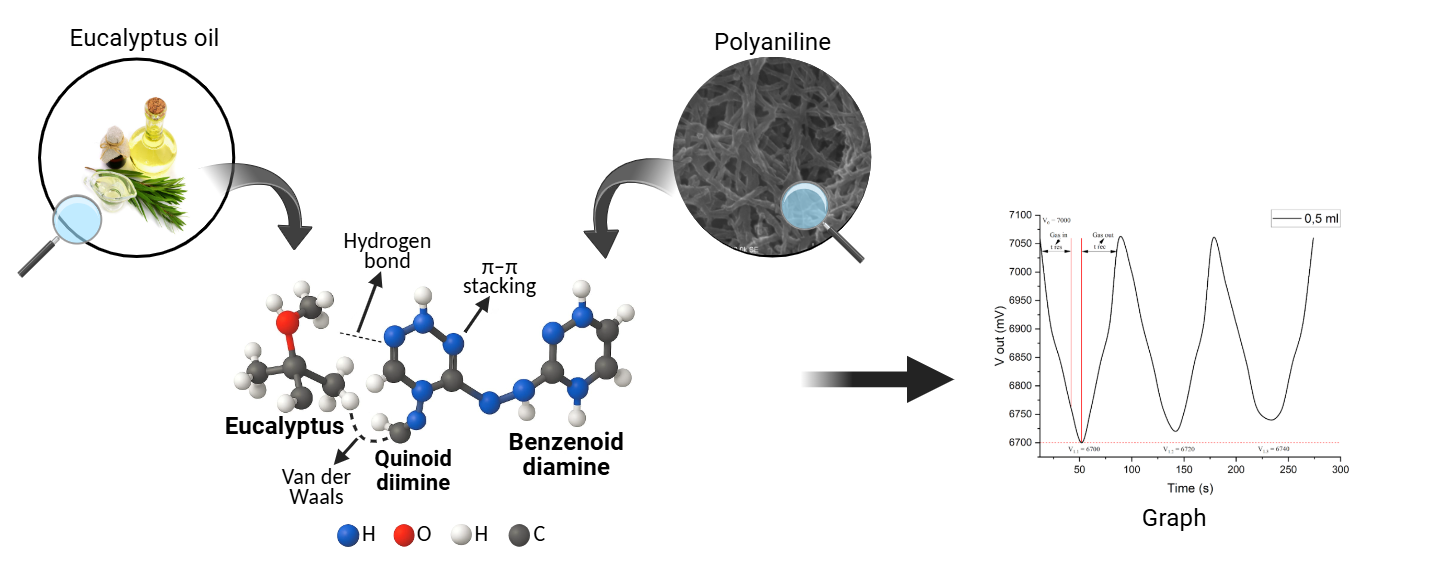
Downloads
References
J Wen, S Wang, J Feng, J Ma, H Zhang, P Wu, G Li, Z Wu, F Meng, L Li and Y Tian. Recent progress in polyaniline-based chemiresistive flexible gas sensors: Design, nanostructures and composite materials. Journal of Materials Chemistry A 2024; 12(11), 6190-6210.
M Saoudi, B Zaidi, AA Alotaibi, MG Althobaiti, EM Alosime and R Ajjel. Polyaniline: Doping and functionalization with single walled carbon nanotubes for photovoltaic and photocatalytic application. Polymers 2021; 13(16), 2595.
Y Yuan, H Wu, X Bu, Q Wu, X Wang, C Han, X Li, X Wang and W Liu. Improving ammonia detecting performance of polyaniline decorated rGO composite membrane with GO doping. Materials 2021; 14(11), 2829.
MR Chia, SW Phang and I Ahmad. Emerging applications of versatile polyaniline-based polymers in the food industry. Polymers 2022; 14(23), 5168.
W Kim, D Lee, G Wu, YL Cha, MS Moazzem, S Cho and DJ Kim. Molecularly imprinted chemiresistive sensor for specific recognition of furaneol as a biomarker of strawberry flavor conditions. ACS Sensors 2023; 8(4), 1542-1549.
T Itoh, Y Masuda, I Matsubara, J Arai and W Shin. Examination of VOC concentration of aroma essential oils and their major VOCs diffused in room air. International Journal of Environmental Research and Public Health 2022; 19(5), 2904.
AM Graboski, CA Zakrzevski, FM Shimizu, RT Paschoalin, AC Soares, J Steffens, N Paroul and C Steffens. Electronic nose based on carbon nanocomposite sensors for clove essential oil detection. ACS Sens 2020; 5(6), 1814-1821.
TQ Toan, LPP Thao, NQ Chien, NTH Van, DL Phuong, TT Huong, PM Quan, CT Inh, PTH Minh, HT Bich, TTK Ngan, VT Thai, NT Viet, LG Bach and PQ Long. Determination of chemical composition and antimicrobial activity of Melaleuca cajuputi essential oil from Quang Tri Province, Vietnam. Asian Journal of Chemistry 2020; 32(9), 2203-2207.
LPT Quoc. Physicochemical properties, chemical components and antibacterial activity of Melaleuca cajuputi powell essential oil leaves from Quang Tri province, Vietnam. Bulletin of the Chemical Society of Ethiopia 2021; 35(3), 677-683.
QN Al-Haidary, AM Al-Mokaram, FM Hussein and AH Ismail. Development of polyaniline for sensor applications: A review. Journal of Physics: Conference Series 2021; 1853(1), 012062.
A Korent, KZ Soderžnik, S Šturm, KZ Rožman, N Redon, JL Wojkiewicz and C Duc. Facile fabrication of an ammonia-gas sensor using electrochemically synthesised polyaniline on commercial screen-printed three-electrode systems. Sensors 2020; 21(1), 169.
A Sierra-Padilla, JJ García-Guzmán, D López-Iglesias, JM Palacios-Santander and L Cubillana-Aguilera. E-Tongues/noses based on conducting polymers and composite materials: Expanding the possibilities in complex analytical sensing. Sensors 2021; 21(15), 4976.
E Galvagni, AA Fritzen, AM Graboski, SC Ballen, J Steffens and C Steffens. Detection of volatiles in dark chocolate flavored with orange essential oil by electronic nose. Food Analytical Methods 2020; 13, 1421-1432.
AM Graboski, G Feltes, RT Paschoalin, J Steffens, N Paroul and C Steffens. Gas-sensing properties of polyaniline-based nanocomposites for d-limonene detection. Journal of Applied Polymer Science 2024; 141(35), e55878.
A Korent, KŽ Soderžnik, S Šturm and KŽ Rožman. A correlative study of polyaniline electropolymerization and its electrochromic behavior. Journal of The Electrochemical Society 2020; 167(10), 106504.
A Kayishaer, C Magnenet, IA Pavel, HB Halima, V Moutarlier, B Lakard, N Redon, C Duc and S Lakard. Influence of surfactant on conductivity, capacitance and doping of electrodeposited polyaniline films. Front Mater 2024; 11, 1358534.
DL Vu, TF Lin, TH Lin and MC Wu. Highly-sensitive detection of volatile organic compound vapors by electrospun PANI/P3TI/PMMA fibers. Polymers 2020; 12(2), 455.
SVJ Sury, A Ulianas and S Aini. Synthesis of conducting polyaniline with photopolymerization method and characterization. Journal of Physics: Conference Series 2021; 1788, 012004.
A Korent, KŽ Soderžnik and KŽ Rožman. In-situ spectroelectrochemical study of conductive polyaniline forms for sensor applications. Proceedings 2020; 56(1), 32.
R Farina, S Scalese, D Corso, GE Capuano, GA Screpis, MA Coniglio, GC Condorelli and S Libertino. Chronoamperometric ammonium ion detection in water via conductive polymers and gold nanoparticles. Molecules 2024; 29(13), 3028.
R Ismail, I Šeděnková, Z Černochová, I Romanenko, O Pop-Georgievski, M Hrubý and E Tomšík. Potentiometric performance of ion-selective electrodes based on polyaniline and chelating agents: detection of Fe2+ or Fe3+ ions. Biosensors 2022; 12(7), 446.
F Huerta, C Quijada, F Montilla and E Morallón. Revisiting the redox transitions of polyaniline. Semiquantitative interpretation of electrochemically induced IR bands. Journal of Electroanalytical Chemistry 2021; 897, 115593.
RM Silverstein, FX Webster, DJ Kiemle and DL Bryce. Spectrometric identification of organic compounds. Wiley, Hoboken, 2014.
C Rahayu. Identifikasi kandungan senyawa alfa-pinene pada minyak kayu putih menggunakan FTIR. Jurnal Multidisipliner Bharasumba 2023; 2(3), 165-168.
Published
How to Cite
Issue
Section
License
Copyright (c) 2025 Walailak University

This work is licensed under a Creative Commons Attribution-NonCommercial-NoDerivatives 4.0 International License.





