
Drying Kinetics and Quality Assessment of Thai Rice Noodles Using Hot-Air and 2-Stage Drying Methods
DOI:
https://doi.org/10.48048/tis.2026.11719Keywords:
Thai rice noodles drying, Effective diffusion coefficients, Mathematical modeling, Hot-air drying, Two-stage dryingAbstract
This study investigated the drying kinetics and quality attributes of Thai rice noodles subjected to hot air and 2-stage thin layer drying methods. Hot-air drying experiments were conducted at 40, 50, and 60 °C The 2-stage drying involved an initial infrared drying phase at 200, 400, and 600 W for 120, 90, and 30 min, respectively, followed by hot-air drying at temperatures of 40, 50 and 60 °C. Key quality parameters assessed included color metrics, rehydration ratio, surface morphology, and texture. Results showed that the moisture content during hot-air drying decreased exponentially, with the drying rates varying from 0.0119 to 0.0236 and drying times from 120 to 240 min. The effective diffusion coefficient ranged from 1.3378×10⁻¹¹ to 2.5796×10⁻¹¹ m2/s and, drying behavior was well described by Page’s drying model. In contrast, the two-stage drying exhibited a linear moisture decrease during the infrared phase and an exponential decrease during the subsequent hot-air drying. The drying rates ranged from 0.0096 to 0.0376 with drying times ranged between 75 and 300 min. Effective diffusion coefficients for the first and second stages ranged from 4.1045×10⁻¹² to 2.6461×10⁻¹¹ to 1.5668×10⁻¹¹ to 4.3220×10⁻¹¹ m2/s, respectively, with drying kinetics accurately predicted by Singh et al. drying model. Quality analysis revealed that prolonged drying time reduced brightness but increased redness and yellowness. Both drying techniques produced dried noodles exhibiting quality characteristics comparable to commercial products, along with a notably higher rehydration ratio.
HIGHLIGHTS
- The drying of Thai rice noodles was investigated using hot air and 2-stage thin layer drying methods.
- During hot-air drying, the moisture content dropped exponentially, and Page’s drying model accurately captured the drying behavior.
- Singh et al. drying model correctly anticipated the drying kinetics, which showed a linear moisture drop during the infrared phase and an exponential decrease during the subsequent hot-air drying.
- Longer drying times increased redness and yellowness while decreasing brightness, according to quality analysis. Both drying methods yielded dried noodles with a noticeably greater rehydration ratio and quality attributes on par with commercial items.
GRAPHICAL ABSTRACT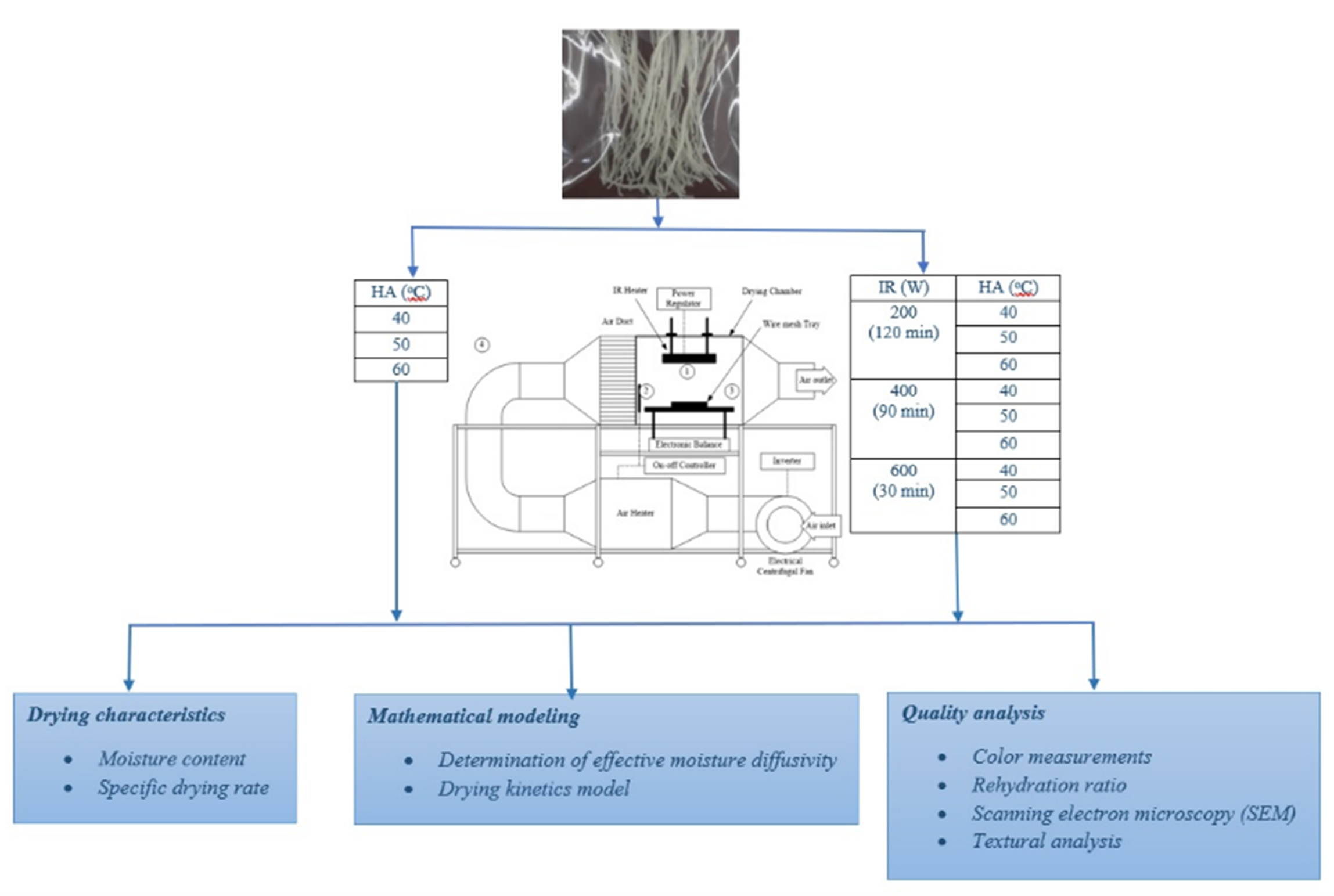
Downloads
References
P Muthukumar, DVN Lakshmi, P Koch, M Gupta and G Srinivasan. Effect of drying air temperature on the drying characteristics and quality aspects of black ginger. Journal of Stored Products Research 2022; 97, 101966.
T Wang, R Khir, Z Pan and Q Yuan. Simultaneous rough rice drying and rice bran stabilization using infrared radiation heating. LWT - Food Science and Technology 2017; 78, 281-288.
P Nuthong and T Somjai. Drying kinetics and quality evaluation of thai rice noodles using far-infrared radiation. Journal of Southwest Jiaotong University 2022; 57(1), 512-522.
WK Abdelbasset, SM Alrawaili, SM Elkholi, MM Eid, AA Abd-Elghany and MZ Mahmoud. The role of infrared waves in increasing the quality of food products. Food Science and Technology 2022; 42, e118421.
Q Chen, J Bi, X Wu, J Yi, L Zhou and Y Zhou. Drying kinetics and quality attributes of jujube (Zizyphus jujuba Miller) slices dried by hot-air and short- and medium-wave infrared radiation. LWT - Food Science and Technology 2015; 64, 759-766.
YX Wen, LY Chen, BS Li, Z Ruan and Q Pan. Effect of infrared radiation-hot-air (IR-HA) drying on kinetics and quality changes of star anise (Illicium verum.). Drying Technology 2020; 39(1), 90-103.
C Chen, C Venkitasamy, W Zhang, R Khir, S Upadhyaya and Z Pan. Effective moisture diffusivity and drying simulation of walnuts under hot-air. International Journal of Heat and Mass Transfer 2020; 150, 119283.
A Kumar, PKI Chakraborty and L Hangshing. Analysis of energy consumption, heat and mass transfer, drying kinetics and effective moisture diffusivity during foam-mat drying of mango in a convective hot-air dryer. Biosystems Engineering 2022; 219, 85-102.
AO Igbozulike, VIO Ndirika and KJ Simonyan. Influence of drying process variables on the effective moisture diffusivity and activation energy of African oil bean seed. Scientific African 2023; 22, e01895.
HS El-Mesery, M Qenawy, Z Hu and WG Alshaer. Evaluation of infrared drying for okra: Mathematical modelling, moisture diffusivity, energy activity and quality attributes. Case Studies in Thermal Engineering 2023; 50, 103451.
M Younis, D Abdelkarim and AZ El-Abdein. Kinetics and mathematical modeling of infrared thin-layer drying of garlic slices. Saudi Journal of Biological Sciences 2017; 25, 332-338.
SDF Mihindukulasuriya and HPW Jayasuriya. Drying of chilli in a combined infrared and hot-air rotary dryer. Journal of Food Science and Technology 2015; 52(8), 4895-4904.
DI Onwudea, N Hashima, K Abdana, R Janiusa and G Chend. The effectiveness of combined infrared and hot-air drying strategies for sweet potato. Journal of Food Engineering 2019; 241, 75-87.
Z Geng, M Torki, M Kaveh, M Beigi and X Yang. Characteristics and multi-objective optimization of carrot dehydration in a hybrid infrared /hot-air dryer. LWT-Food Science and Technology 2022; 172, 114229.
AOAC International. Official, method of analysis. 18th ed. AOAC Press, Maryland, USA, 2005.
S Sadaka. Impact of grain layer thickness on rough rice drying kinetics parameters. Case Studies in Thermal Engineering 2022; 35, 102026.
D Zhao, K An, S Ding, L Liu, Z Xu and Z Wang. Two-stage intermittent microwave coupled with hot-air drying of carrot slices: Drying kinetics and physical quality. Food and Bioprocess Technology2014; 7(8), 2308-2318.
DSA Delfiya, K Prashob, S Murali, PV Alfiya, MP Samuel and R Pandiselvam. Drying kinetics of food materials in infrared radiation drying: A review. Journal of Food Process Engineering 2021; 45(6), e13810.
W Xu, Y Pei, G Zhu, C Han, M Wu, T Wang, X Cao, Y Jiang, G Li, J Sun, J Tian, C Tang and Z Gao. Effect of far infrared and far infrared combined with hot-air drying on the drying kinetics, bioactives, aromas, physicochemical qualities of Anoectochilus roxburghii (Wall.) Lindl. LWT - Food Science and Technology 2022; 162, 113452.
Y Zhang, G Zhu, X Li, Y Zhao, D Lei, G Ding, K Ambrose and Y Liu. Combined medium- and short-wave infrared and hot-air impingement drying of sponge gourd (Luffa cylindrical) slices. Journal of Food Engineering 2020; 284, 110043.
DK Rabha, P Muthukumar and C Somayaji. Experimental investigation of thin layer drying kinetics of ghost chilli pepper (Capsicum Chinense Jacq.) dried in a forced convection solar tunnel dryer. Renewable Energy 2017; 105, 583-589.
J Wang, C Law, PK Nema, J Zhao, Z Liu, L Deng, Z Gao and H Xiao. Pulsed vacuum drying enhances drying kinetics and quality of lemon slices. Journal of Food Engineering 2018; 224, 129-138.
JVB de Souza, H Perazzini, RAB Lima-Correa and LDMS Borel. Combined infrared-convective drying of banana: Energy and quality considerations. Thermal Science and Engineering Progress 2024; 48, 102393.
Published
How to Cite
Issue
Section
License
Copyright (c) 2025 Walailak University

This work is licensed under a Creative Commons Attribution-NonCommercial-NoDerivatives 4.0 International License.





