
Green Multifunctional Cotton Fabrics Functionalized with Plant Extracts from Azadirachta Excelsa, Piper betle and Eucalyptus globulus: Antibacterial and UV-Resistant Properties for Sustainable Textile Applications
DOI:
https://doi.org/10.48048/tis.2026.11531Keywords:
Plant-based functionalization, Bioactive cotton fabrics, Antibacterial, UV protection, Green textile finishing, Phytochemical integrationAbstract
This study presents the fabrication of eco-friendly multifunctional cotton fabrics functionalized with bioactive plant extracts from Terminalia catappa, Piper betle and Eucalyptus globulus leaves. Extracts were obtained by Soxhlet or repeated boiling and applied to cotton via boiling impregnation under optimized conditions (25 - 30% concentration, 26 - 30 min treatment, 65 - 70 °C drying). FTIR and UV–Vis confirmed the presence of phenolic and flavonoid compounds on fiber surfaces. SEM revealed uniform coatings, while LC–MS/MS identified catechins, eugenol and gallic acid as dominant constituents. Treated fabrics showed excellent UV protection with UPF > 50, high hydrophobicity with water contact angles up to 122° and strong antibacterial activity against E. coli and S. aureus. Inhibition zones reached 17.4 mm (E. globulus), 15.3 mm (P. betle) and 14.6 mm (T. catappa). Thermal analysis (TGA–DTA) indicated enhanced stability, with onset degradation shifting from 295 °C (control) to 315 - 325 °C after treatment. Mechanical testing showed tensile strength retention with slight improvement, up to +7% in E. globulus-treated samples. Overall, this green treatment enhances cotton functionality by integrating natural bioactives, yielding fabrics with UV protection, antibacterial efficacy, hydrophobicity, and thermal stability. The approach offers a sustainable strategy for developing high-value textiles for healthcare, protective clothing and environmentally friendly smart fabrics.
HIGHLIGHTS
- Eco-friendly multifunctional cotton fabrics were developed using plant extracts from Terminalia catappa, Piper betle and Eucalyptus globulus.
- Box–Behnken Design (BBD) identified optimal extract concentration, treatment time and drying temperature for maximum antibacterial performance.
- Eucalyptus globulus extract exhibited the highest antibacterial and UV-protective performance among all plant extracts.
- Treated cotton fabrics demonstrated enhanced UV protection (UPF > 50), strong antibacterial effects (> 14 mm inhibition zones) and improved hydrophobicity.
- FTIR, SEM, UV–Vis and LC–MS/MS analyses confirmed successful phytochemical integration and stability after washing cycles.
GRAPHICAL ABSTRACT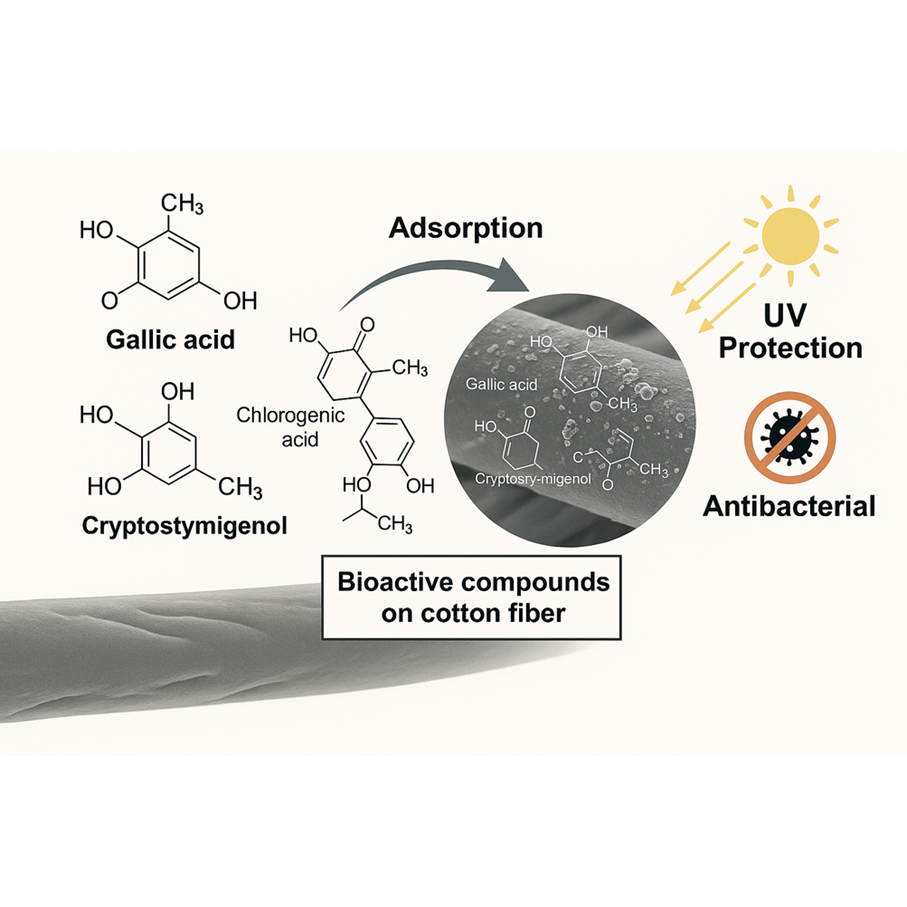
Downloads
References
AV Rao, B Ashok, MU Mahesh, GV Subbareddy, VC Sekhar, GV Ramanamurthy and AV Rajulu. Antibacterial cotton fabrics with in situ generated silver and copper bimetallic nanoparticles using red sanders powder extract as reducing agent. International Journal of Polymer Analysis and Characterization 2019; 24(4), 346-354.
N Čuk, M Sala and M Gorjanc. Development of antibacterial and UV protective cotton fabrics using plant food waste and alien invasive plant extracts as reducing agents for the in-situ synthesis of silver nanoparticles. Cellulose 2021; 28(5), 3215-3233.
KH Bulletin. Sustainable functionalization for cotton fabrics by printing with a mixture of chestnut shell extract and alginate. Polymer Bulletin 2023; 80, 6675-6692.
LE Román, ED Gomez, JL Solís and MM Gómez. Antibacterial cotton fabric functionalized with copper oxide nanoparticles. Molecules 2020; 25(24), 5802.
BN Bisso, RNE Nkwelle, RT Tchuenguem and JP Dzoyem. Phytochemical screening, antioxidant, and antimicrobial activities of seven underinvestigated medicinal plants against microbial pathogens. Advances in Pharmacological and Pharmaceutical Sciences 2022; 2022, 1998808.
J Hayat, M Akodad, A Moumen, M Baghour, A Skalli, S Ezrari and S Belmalha. Phytochemical screening, polyphenols, flavonoids and tannin content, antioxidant activities and FTIR characterization of Marrubium vulgare L. from two different localities of Northeast of Morocco. Heliyon 2020; 6(11), e05609.
BB Yimam and A Desalew. Phytochemical screening, antibacterial effect, and essential oil extract from the leaf of Artemisia afra against selected pathogens. Advances in Microbiology 2022; 12(7), 386-397.
GE Jung and JS Lee. Dyeability and functionality of bamboo extracts, characteristics of bamboo extracts and dyeing properties of cotton. Journal of the Korean Society of Clothing and Textiles 2011; 35(2), 206-217.
MMJ Moideen, MM Raffick, S Kumar and N Kishore. Antimicrobial activity and phytochemical analysis of Nelumbo nucifera leaves. Journal of Global Trends in Pharmaceutical Sciences 2011; 2(4), 404.
A Rehman, A Ahmad, A Hameed, S Kiran and T Farooq. Green dyeing of modified cotton fabric with acalypha wilkesiana leave extracts. Sustainable Chemistry and Pharmacy 2021; 21, 100432.
KK Bharadwaj, B Rabha, S Pati, BK Choudhury, T Sarkar, SK Gogoi, N Kakati, D Baishya, ZA Kari and HA Edinur. Green synthesis of silver nanoparticles using Diospyros malabarica fruit extract and assessments of their antimicrobial, anticancer and catalytic reduction of 4-Nitrophenol (4-NP). Nanomaterials 2021; 11(8), 1999.
N Lemita, D Samir, R Mansour, FML Rekbi and R Halimi. Characterization and analysis of novel natural cellulosic fiber extracted from Strelitzia reginae plant. Journal of Composite Materials 2022; 56(1), 99-144.
A Kamboj, S Jose and A Singh. Antimicrobial activity of natural dyes—a comprehensive review. Journal of Natural Fibers 2022; 19(13), 5380-5394.
NL Bhandari, B Pokhrel, U Bhandari, S Bhattarai, A Devkota and G Bhandari. An overview of research on plant based natural dyes in Nepal: Scope and challenges. Journal of Agriculture and Natural Resources 2020; 3(2), 45-66.
TA Nguyen, TH Do and TD Ha. Multifunctional biocomposite membrane of bacterial cellulose/chitosan incorporated with green tea leaf extract as a smart colorimetric sensor for sustainable packaging. Trends in Sciences 2023; 22(10), 10667.
MP Sathianarayanan, NV Bhat, SS Kokate and VE Walunj. Antibacterial finish for cotton fabric from herbal products. Indian Journal of Fibre & Textile Research 2010; 35, 50-58.
NS Latteef. Phytochemical, antibacterial and antioxidant activity of Camellia sinensis methanolic and aqueous extracts. Journal of Pharmaceutical and Biological Sciences 2016; 11(6), 113-119.
B Joshi, GP Sah, BB Basnet, MR Bhatt, D Sharma, K Subedi, J Pandey and R Malla. Phytochemical extraction and antimicrobial properties of different medicinal plants: Ocimum sanctum (Tulsi), Eugenia caryophyllata (Clove), Achyranthes bidentata (Datiwan) and Azadirachta indica (Neem). Journal of Microbiology and Antimicrobials 2011; 3(1), 1-7.
AM El-Shafei, S Sharaf, S Zaghloul and M Hashem. Development of softener containing metal nano-particle for multipurpose textile finishing. International Journal of PharmTech Research 2015; 8(10), 123-138.
Published
How to Cite
Issue
Section
License
Copyright (c) 2025 Walailak University

This work is licensed under a Creative Commons Attribution-NonCommercial-NoDerivatives 4.0 International License.





