
Aquilaria Crassna Pierre Ex Lecomte Leaf Extract Induces Apoptosis and Immunogenic Cell Death in Breast Cancer Cells, Enhancing Anti-Tumor Effects of Dendritic Cells
DOI:
https://doi.org/10.48048/tis.2026.11528Keywords:
Aquilaria crassna Pierre ex Lecompte leaf extract, Immunogenic cell death, Dendritic cell maturation/activation, Triple-negative breast cancer, Cancer immunotherapyAbstract
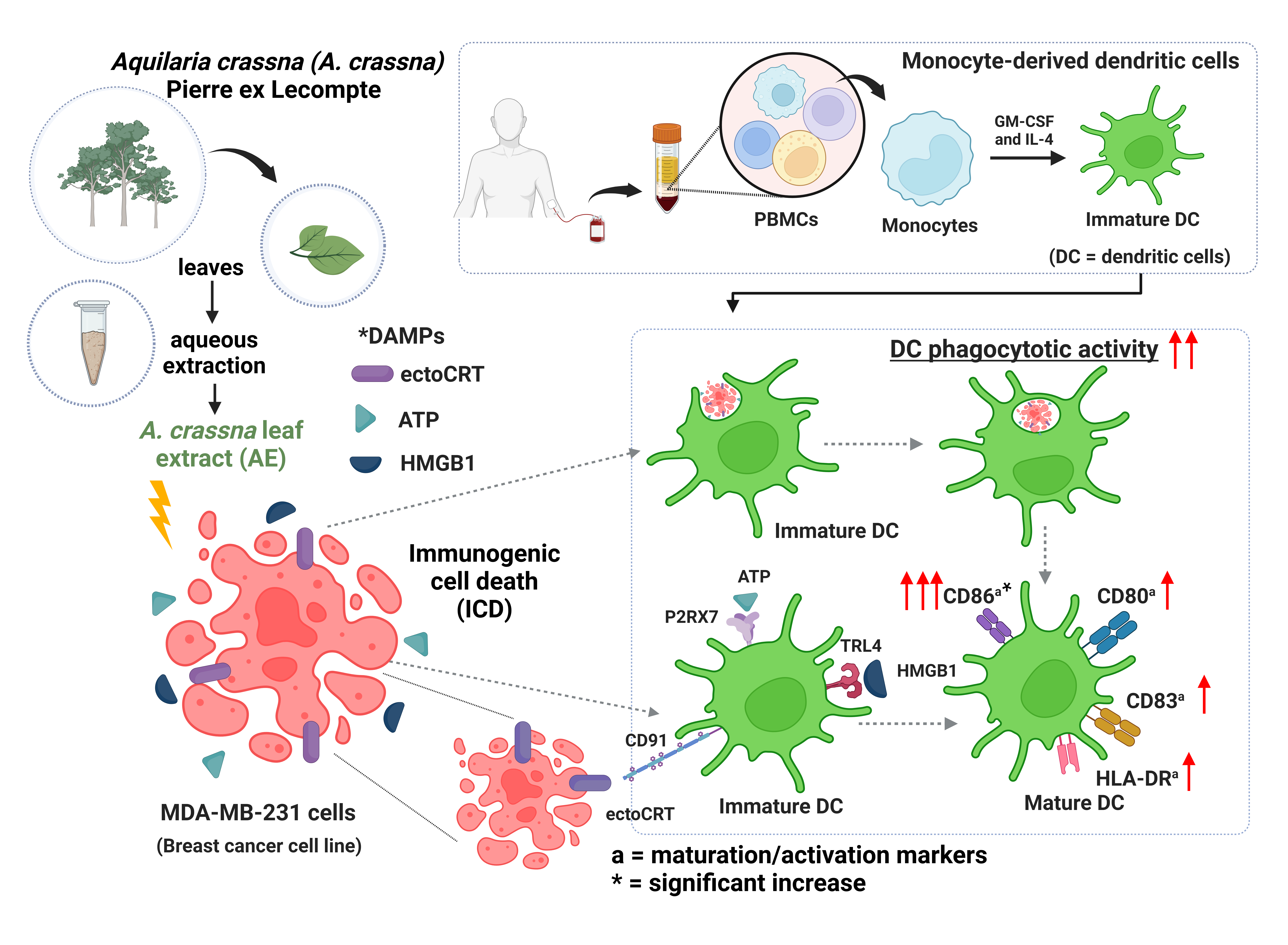
Aquilaria crassna (A. crassna) Pierre ex Lecomte, commonly known as agarwood, is traditionally used in medicinal preparations. Previous studies suggest anti-cancer properties in A. crassna leaf extract but the mechanisms and its involvement in immunogenic cell death (ICD) remain unexplored. This study investigates the impact of A. crassna Pierre ex Lecomte leaf extract (AE) on anti-cancer activity, specifically inducing ICD in triple-negative breast cancer (TNBC), and enhancing dendritic cell (DC) anti-tumor effects. A. crassna water extract underwent HPLC analysis. TNBC cells (MDA-MB-231) and non-tumorigenic epithelial cell lines, fibrocystic disease, (MCF-10A) were treated with different concentrations of AE for cytotoxicity testing by MTT assay. To assess ICD induction, danger-associated molecular patterns (DAMPs) including ectoCRT, secreted ATP, and HMGB1 were measured through staining, ATP bioluminescence, immunoblotting, and ELISA, respectively. AE-treated cells and DAMP-containing supernatants were administered to monocyte-derived DCs, evaluating impact on DC immunophenotype, maturation, and phagocytosis via flow cytometry. HPLC analysis identified AE compounds: iriflophenone 3,5-C-β-D-diglucoside, iriflophenone 3-C-β-D-glucoside, mangiferin, and genkwanin 5-O-β-primevoside (concentrations: 4.80, 1.04, 4.54 and 0.18 %w/w). MDA-MB-231 treated with AE exhibited ICD induction, evident in increased ectoCRT, secreted ATP, and HMGB1 levels. DCs exposed to AE-treated cells and DAMP-containing supernatant displayed enhanced phagocytic activity and maturation, with elevated CD86, CD80, CD83, and HLA-DR expression. In conclusion, AE exhibits immunomodulatory potential by inducing ICD in TNBC, suggesting therapeutic applications for its anti-cancer effects and a promising role in cancer immunotherapy.
HIGHLIGHTS
- The first study demonstrates the significance of AE in inducing immunogenic cell death (ICD), evidenced by the heightened expression of 3 key hallmarks of danger-associated molecule patterns (DAMPs): ectoCRT, secreted ATP, and HMGB1, in the TNBC model.
- AE-induced ICD or conditions expressing DAMPs enhance the maturation and phagocytic function of dendritic cells (DCs).
- This study provides the novel anti-tumor activity and immune-activating effect of AE and suggests the potential development of AE as a dietary complementary or alternative treatment for anti-tumor purposes in the future.
GRAPHICAL ABSTRACT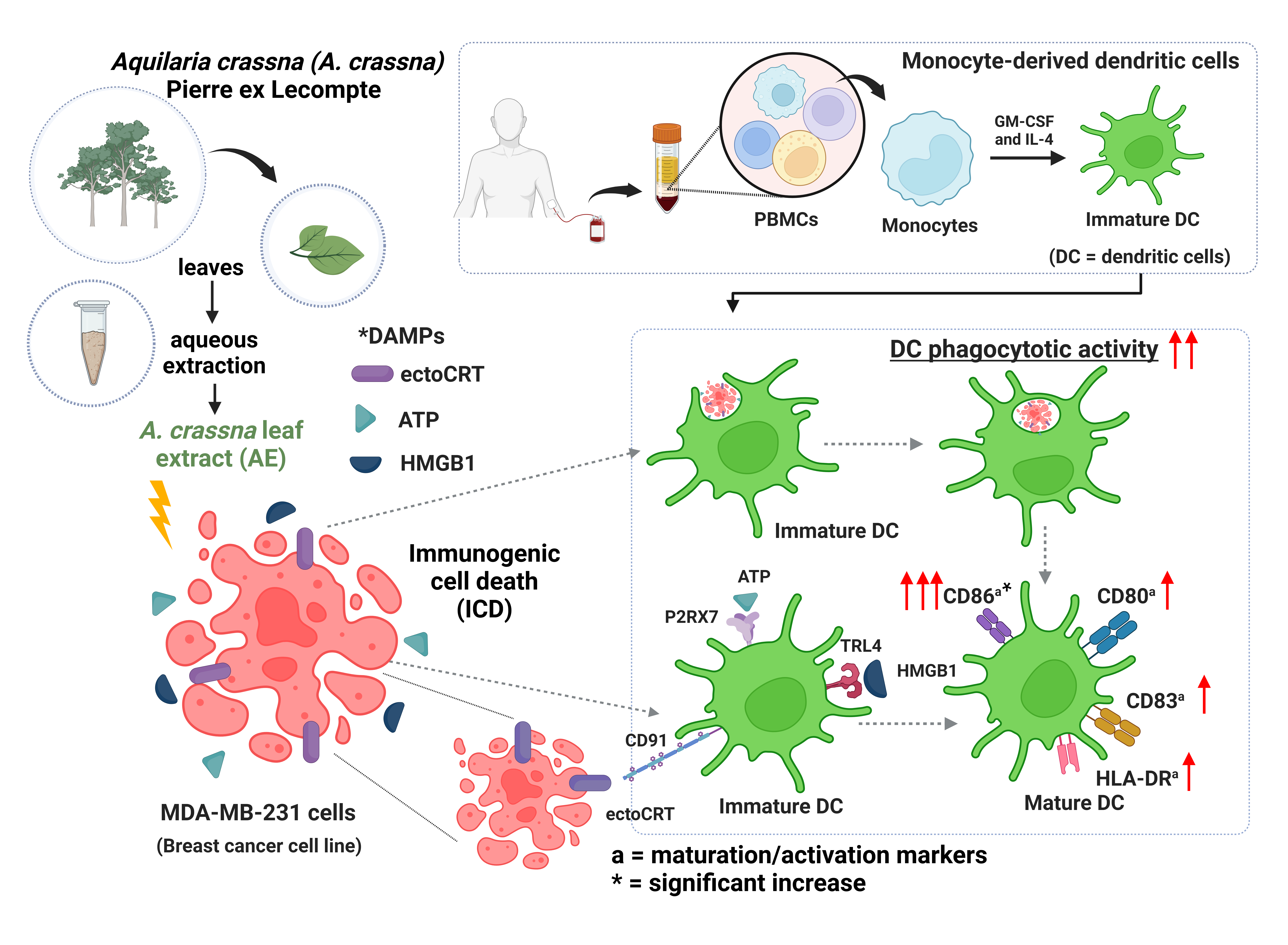
Downloads
References
S Kamonwannasit, N Nantapong, P Kumkrai, P Luecha, S Kupittayanant and N Chudapongse. Antibacterial activity of Aquilaria crassna leaf extract against Staphylococcus epidermidis by disruption of cell wall. Annals of Clinical Microbiology and Antimicrobials 2013; 12(1), 20.
H Okugawa, R Ueda, K Matsumoto, K Kawanishi and A Kato. Effects of agarwood extracts on the central nervous system in mice. Planta Medica 1993; 59(1), 32-36.
H Okugawa, R Ueda, K Matsumoto, K Kawanishi and A Kato. Effect of jinkoh-eremol and agarospirol from agarwood on the central nervous system in mice. Planta Medica 1996; 62(1), 2-6.
G Ray, W Leelamanit, P Sithisarn and W Jiratchariyakul. Anti-oxidative compounds from Aquilaria crassna leaf. Mahidol University Journal of Pharmaceutical Sciences 2014; 41, 54-58.
N Pattarachotanant, P Rangsinth, W Warayanon, GPH Leung, S Chuchawankul, A Prasansuklab and T Tencomnao. Protective effect of aquilaria crassna leaf extract against benzo[a]pyrene-induced toxicity in neuronal cells and Caenorhabditis elegans: Possible active constituent includes clionasterol. Nutrients 2023; 15(18), 3985.
S Wisutthathum, N Kamkaew, A Inchan, U Chatturong, TU Paracha, K Ingkaninan, E Wongwad and K Chootip. Extract of Aquilaria crassna leaves and mangiferin are vasodilators while showing no cytotoxicity. Journal of Traditional and Complementary Medicine 2019; 9(4), 237-242.
E Wongwad, C Pingyod, T Saesong, N Waranuch, W Wisuitiprot, B Sritularak, P Temkitthawon and K Ingkaninan. Assessment of the bioactive components, antioxidant, antiglycation and anti-inflammatory properties of Aquilaria crassna pierre ex lecomte leaves. Industrial Crops and Products. 2019; 138, 111448.
YZ Hashim, A Phirdaous and A Azura. Screening of anticancer activity from agarwood essential oil. Pharmacognosy Research 2014; 6(3), 191-194.
W Putalun, G Yusakul, P Saensom, B Sritularak and H Tanaka. Determination of iriflophenone 3-C-beta-d-glucoside from Aquilaria spp. by an indirect competitive enzyme-linked immunosorbent assay using a specific polyclonal antibody. Journal of Food Science 2013; 78(9), C1363-C1367.
SS Dahham, YM Tabana, LEA Hassan, MBK Ahamed, ASA Majid and AMSA Majid. In vitro antimetastatic activity of Agarwood (Aquilaria crassna) essential oils against pancreatic cancer cells. Alexandria Journal of Medicine 2016; 52(2), 141-150.
SS Dahham, YM Tabana, MA Iqbal, MBK Ahamed, MO Ezzat, ASA Majid and AMSA Majid. The anticancer, antioxidant and antimicrobial properties of the sesquiterpene beta-caryophyllene from the essential oil of aquilaria crassna. Molecules 2015; 20(7), 11808-11829.
HM Jang, JH Lee, JH Kim, G Park and JH Jeon. In vitro anticancer effect of Aquilaria crassna extract on human mammary gland cancer cells. International journal of Biosciences 2020; 16(4), 187-192.
L Galluzzi, E Guilbaud, D Schmidt, G Kroemer and FM Marincola. Targeting immunogenic cell stress and death for cancer therapy. Nature Reviews Drug Discovery 2024; 23(6), 445-460.
N Nagarsheth, MS Wicha and W Zou. Chemokines in the cancer microenvironment and their relevance in cancer immunotherapy. Nature Reviews Immunology 2017; 17(9), 559-572.
L Galluzzi, I Vitale, S Warren, S Adjemian, P Agostinis, AB Martinez, TA Chan, G Coukos, S Demaria, E Deutsch, D Draganov, RL Edelson, SC Formenti, J Fucikova, L Gabriele, US Gaipl, SR Gameiro, AD Garg, E Golden, …, KJ Harrington. Consensus guidelines for the definition, detection and interpretation of immunogenic cell death. The Journal for ImmunoTherapy of Cancer 2020; 8(1), e000337.
DR Green, T Ferguson, L Zitvogel and G Kroemer. Immunogenic and tolerogenic cell death. Nature Reviews Immunology 2009; 9(5), 353-363.
SN Morozkina, THN Vu, YE Generalova, PP Snetkov and MV Uspenskaya. Mangiferin as new potential anti-cancer agent and mangiferin-integrated polymer systems-a novel research direction. Biomolecules 2021; 11(1), 79.
S Muruganandan, J Lal and PK Gupta. Immunotherapeutic effects of mangiferin mediated by the inhibition of oxidative stress to activated lymphocytes, neutrophils and macrophages. Toxicology 2005; 215(1-2), 57-68.
E Wongwad, K Ingkaninan, W Wisuitiprot, B Sritularak and N Waranuch. Thermal degradation kinetics and pH-Rate profiles of iriflophenone 3,5-C-beta-d-diglucoside, iriflophenone 3-C-beta-d-glucoside and mangiferin in aquilaria crassna leaf extract. Molecules 2020; 25(21), 4898.
S Hurvitz and M Mead. Triple-negative breast cancer: Advancements in characterization and treatment approach. Current Opinion in Obstetrics and Gynecology 2016; 28(1), 59-69.
BD Lehmann, JA Bauer, X Chen, ME Sanders, AB Chakravarthy, Y Shyr and JA Pietenpol. Identification of human triple-negative breast cancer subtypes and preclinical models for selection of targeted therapies. Journal of Clinical Investigation 2011; 121(7), 2750-2767.
LB Kennedy and AKS Salama. A review of cancer immunotherapy toxicity. CA: A Cancer Journal for Clinicians 2020; 70(2), 86-104.
HL McArthur and DB Page. Immunotherapy for the treatment of breast cancer: checkpoint blockade, cancer vaccines, and future directions in combination immunotherapy. Clinical Advances in Hematology & Oncology 2016; 14(11), 922-933.
C Supasuteekul, S Tadtong, W Putalun, H Tanaka, K Likhitwitayawuid, P Tengamnuay and B Sritularak. Neuritogenic and neuroprotective constituents from Aquilaria crassna leaves. Journal of Food Biochemistry 2017; 41(3), e12365.
P Abbas, Y Hashim and HM Salleh. Uninfected agarwood branch extract possess cytotoxic and inhibitory effects on MCF-7 breast cancer cells. Journal of Research in Pharmacy 2019; 23(1), 120-129.
X Quan, BS Kwak, JY Lee, JH Park, A Lee, TH Kim and SG Park. Cordyceps militaris induces immunogenic cell death and enhances antitumor immunogenic response in breast cancer. Evidence-Based Complementary and Alternative Medicine 2020; 2020(6), 1-11.
A Jiraviriyakul, W Songjang, P Kaewthet, P Tanawatkitichai, P Bayan and S Pongcharoen. Honokiol-enhanced cytotoxic T lymphocyte activity against cholangiocarcinoma cells mediated by dendritic cells pulsed with damage-associated molecular patterns. World Journal of Gastroenterology 2019; 25(29), 3941-3955.
X Zhang, D Wang, Z Li, D Jiao, L Jin, J Cong, X Zheng and L Xu. Low-dose gemcitabine treatment enhances immunogenicity and natural killer cell-driven tumor immunity in lung cancer. Frontiers in Immunology 2020; 11, 331.
L Galluzzi, A Buqué, O Kepp, L Zitvogel and G Kroemer. Immunogenic cell death in cancer and infectious disease. Nature Reviews Immunology 2017; 17(2), 97-111.
DV Krysko, AD Garg, A Kaczmarek, O Krysko, P Agostinis and P Vandenabeele. Immunogenic cell death and DAMPs in cancer therapy. Nature Reviews Cancer 2012; 12(12), 860-875.
J Zhang, J Chen and K Lin. Immunogenic cell death-based oncolytic virus therapy: A sharp sword of tumor immunotherapy. European Journal of Pharmacology. 2024; 981, 176913.
MJ Smyth, SF Ngiow, A Ribas and MWL Teng. Combination cancer immunotherapies tailored to the tumour microenvironment. Nature Reviews Clinical Oncology 2016; 13(3), 143-158.
MJ Lamberti, A Nigro, FM Mentucci, NBR Vittar, V Casolaro and JD Col. Dendritic cells and immunogenic cancer cell death: A combination for improving antitumor immunity. Pharmaceutics 2020; 12(3), 256.
Z Asadzadeh, E Safarzadeh, S Safaei, A Baradaran, A Mohammadi, K Hajiasgharzadeh, A Derakhshani, A Argentiero, N Silvestris and B Baradaran. Current approaches for combination therapy of cancer: The role of immunogenic cell death. Cancers 2020; 12(4), 1047.
A Azami, N Suzuki, Y Azami, I Seto, A Sato, Y Takano, T Abe, Y Teranishi, K Tachibanan and T Ohtake. Abscopal effect following radiation monotherapy in breast cancer: A case report. Molecular and Clinical Oncology 2018; 9(3), 283-286.
J Banchereau and RM Steinman. Dendritic cells and the control of immunity. Nature 1998; 392(6673), 245-252.
O Kepp, M Semeraro, JMBS Pedro, N Bloy, A Buqué, X Huang, H Zhou, L Senovilla, G Kroemer and L Galluzzi. EIF2alpha phosphorylation as a biomarker of immunogenic cell death. Seminars in Cancer Biology 2015; 33, 86-92.
IE Dumitriu, P Baruah, B Valentinis, RE Voll, M Herrmann, PP Nawroth, B Arnold, ME Bianchi, AA Manfredi and P Rovere-Querini. Release of high mobility group box 1 by dendritic cells controls T cell activation via the receptor for advanced glycation end products. The Journal of Immunology 2005; 174(12), 7506-7515.
H Inoue and K Tani. Multimodal immunogenic cancer cell death as a consequence of anticancer cytotoxic treatments. Cell Death & Differentiation 2014; 21(1), 39-49.
J Zhou, G Wang, Y Chen, H Wang, Y Hua and Z Cai. Immunogenic cell death in cancer therapy: Present and emerging inducers. Journal of Cellular and Molecular Medicine 2019; 23(8), 4854-4865.
J Hou, D Zheng, W Xiao, D Li, J Ma and Y Hu. Mangiferin enhanced autophagy via inhibiting mTORC1 pathway to prevent high glucose-induced cardiomyocyte injury. Frontiers in Pharmacology 2018; 9, 383.
L Yu, M Chen, R Zhang and Z Jin. Inhibition of cancer cell growth in gemcitabine-resistant pancreatic carcinoma by mangiferin phytochemical involves induction of autophagy, endogenous ROS production, cell cycle disruption, mitochondrial mediated apoptosis and suppression of cancer cell migration and invasion. Journal of Balkan Union of Oncology 2019; 24(4), 1581-1586.
H Harizi. Reciprocal crosstalk between dendritic cells and natural killer cells under the effects of PGE2 in immunity and immunopathology. Cellular & Molecular Immunology 2013; 10(3), 213-221.
TK Hoffmann, J Müller-Berghaus, RL Ferris, JT Johnson, WJ Storkus and TL Whiteside. Alterations in the frequency of dendritic cell subsets in the peripheral circulation of patients with squamous cell carcinomas of the head and neck. Clinical Cancer Research 2002; 8(6), 1787-1793.
C Lenahan and D Avigan. Dendritic cell defects in patients with cancer: Mechanisms and significance. Breast Cancer Research 2006; 8(1), 101.
AJ Troy, KL Summers, PJ Davidson, CH Atkinson and DN Hart. Minimal recruitment and activation of dendritic cells within renal cell carcinoma. Clinical Cancer Research 1998; 4(3), 585-593.
MK Kim and J Kim. Properties of immature and mature dendritic cells: Phenotype, morphology, phagocytosis, and migration. RSC Advances 2019; 9(20), 11230-1138.
VD Turubanova, IV Balalaeva, TA Mishchenko, E Catanzaro, R Alzeibak, NN Peskova, I Efimova, C Bachert, EV Mitroshina, O Krysko, MV Vedunova and DV Krysko. Immunogenic cell death induced by a new photodynamic therapy based on photosens and photodithazine. Journal for ImmunoTherapy of Cancer 2019; 7(1), 350.
OG Donnelly, F Errington-Mais, L Steele, E Hadac, V Jennings, K Scott, H Peach, RM Phillips, J Bond, H Pandha, K Harrington, R Vile, S Russell, P Selby and AA Melcher. Measles virus causes immunogenic cell death in human melanoma. Gene Therapy volume 2013; 20(1), 7-15.
X Zhao, K Yang, R Zhao, T Ji, X Wang, X Yang, Y Zhang, K Cheng, S Liu, J Hao, H Ren, KW Leong and G Nie. Inducing enhanced immunogenic cell death with nanocarrier-based drug delivery systems for pancreatic cancer therapy. Biomaterials 2016; 102, 187-197.
Published
How to Cite
Issue
Section
License
Copyright (c) 2025 Walailak University

This work is licensed under a Creative Commons Attribution-NonCommercial-NoDerivatives 4.0 International License.





