
Formulation and Characterization of Analogue Rice from Rice, Arrowroot, and Porang Flours Using the Mixture Optimal Custom Design Method
DOI:
https://doi.org/10.48048/tis.2026.11350Keywords:
Analogue rice, Arrowroot flour, Porang flour, Rice flour, MOCD, Extrusion, eGIAbstract
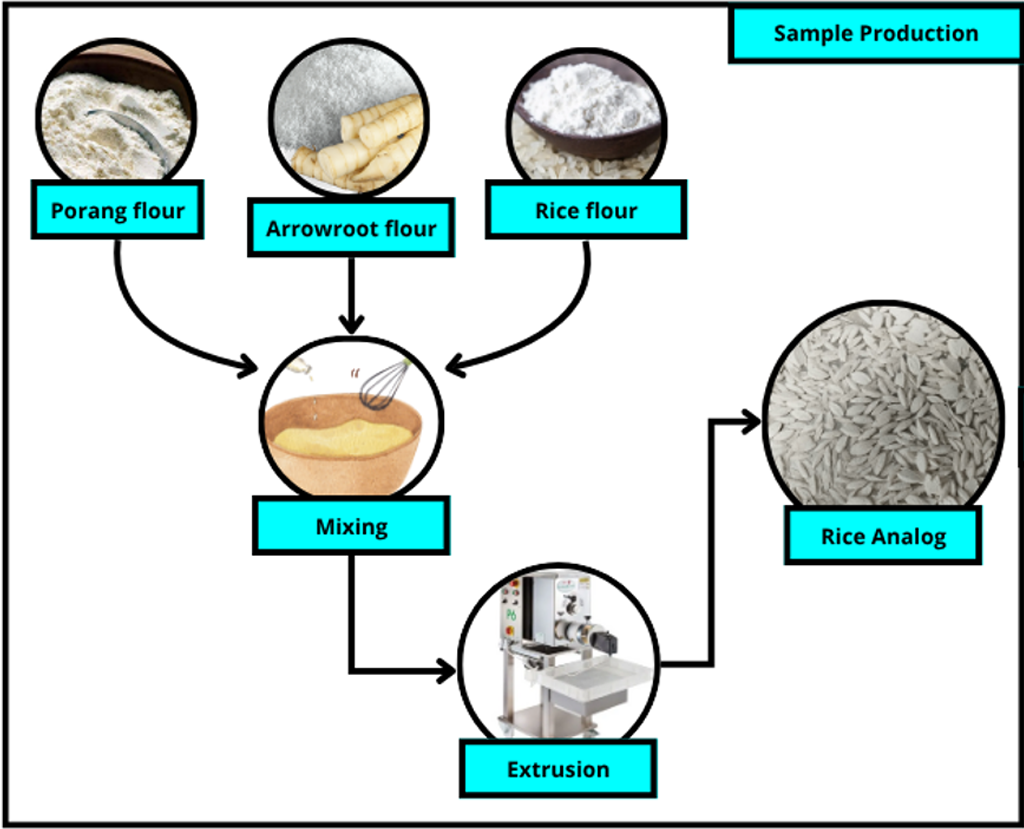
The increasing health concerns associated with the high glycemic index of white rice have encouraged the development of alternative staple foods. This study aimed to formulate and optimize an analogue rice using a composite of rice flour, arrowroot flour (Maranta arundinacea), and porang flour (Amorphophallus muelleri) using the Mixture Optimal Custom Design approach. The goal was to produce analogue rice with improved functional, physical, and nutritional properties. Fifteen formulations were generated and evaluated based on the water absorption index, water soluble index, swelling power, texture (hardness), and whiteness. The optimal formulation, comprising 58.1% rice flour, 39.3% arrowroot flour, and 2.6% porang flour, was identified using statistical modelling and confirmed through validation experiments. The optimized analogue rice demonstrated favorable hydration capacity, textural resilience, and high whiteness, which closely aligned with the quality benchmarks of conventional rice. Pasting behavior analysis revealed stable gelatinization and retrogradation properties suitable for household cooking applications. Notably, the product exhibited a significantly lower estimated glycemic index (40.93) than commercial analogue rice and conventional white rice, attributed to the glucomannan and resistant starch in porang flour. Comparative evaluation showed that this formulation outperformed the control and commercial samples across multiple quality indicators without compromising acceptability. These findings support the use of indigenous starch sources for developing functional analogue rice, contributing to dietary diversification, improved glycemic control, and local resource utilization. This study underscores the potential of optimized composite flours in addressing nutritional challenges and offers a scalable model for health-oriented staple food innovation.
HIGHLIGHTS
- Developed a low-glycemic index (GI), nutritious analog rice using a novel blend of rice, arrowroot, and porang flours to promote health and dietary diversity.
- The formulations were optimized through statistical modeling, resulting in the desired physicochemical properties and stable thickening behavior.
- This optimized analog rice formulation demonstrates superior cooking quality, texture, and health benefits compared to commercial and milled rice, making it a promising alternative staple food.
GRAPHICAL ABSTRACT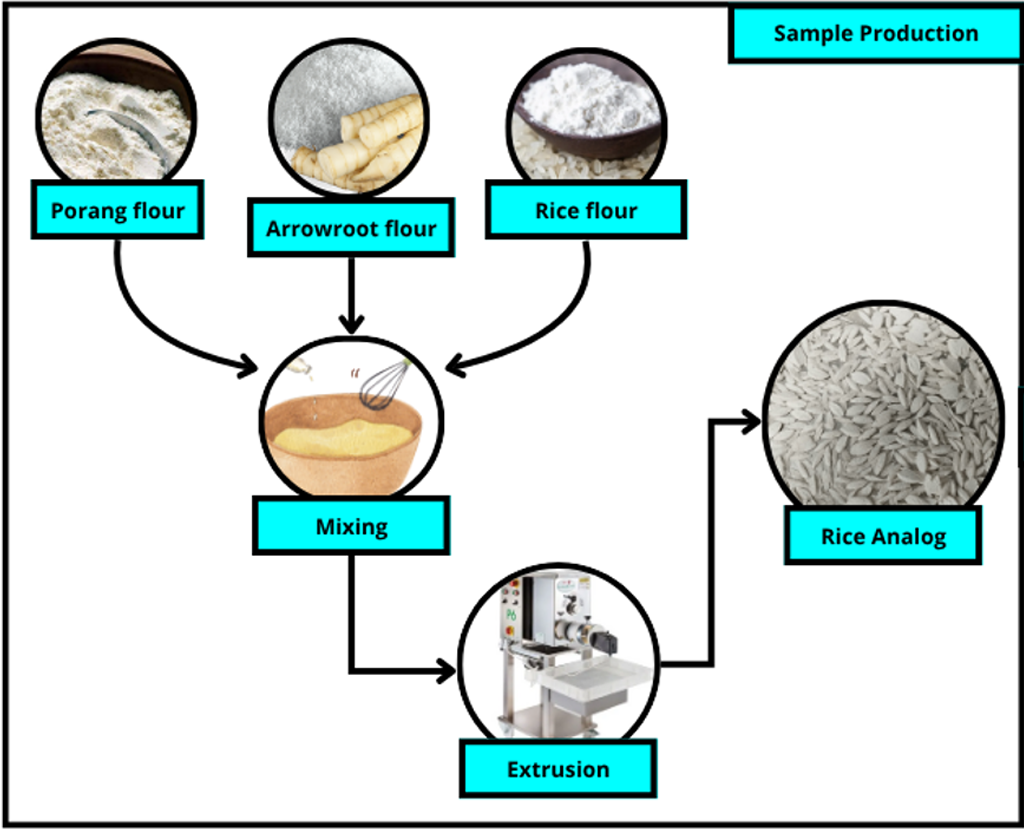
Downloads
References
DK Verma and PP Srivastav. Bioactive compounds of rice (Oryza sativa L.): Review on paradigm and itspotential benefit in human health. Trends in Food Science & Technology 2024; 97, 355-365.
M Nabilah. Konsumsi beras Indonesia terbanyak keempat dunia pada 2022/2023 (in Indonesian), Available at: https://databoks.katadata.co.id/datapublish/2023/07/13/konsumsi-beras-indonesia-terbanyak-keempat-di-dunia-pada-20222023, accessed June 2025.
VRM Dam. A global perspective on white rice consumption and risk of type 2 diabetes. Diabetes Care 2020; 43(11), 2625-2627.
S Budijanto and ND Yuliana. Development of rice analog as a food diversification vehicle in Indonesia. Journal of Developments in Sustainable Agriculture 2015; 10(1), 7-14.
H Zhuang, H An, H Chen, Z Xie, J Zhao, X Xu and Z Jin. Effect of extrusion parameters on physicochemical properties of hybrid indica rice (type 9718) extrudates. Journal of Food Processing and Preservation 2010; 34(6), 1080-1102.
EJ Dierings de Souza, AM Pereira, M Fontana, NL Vanier and MA Gularte. Quality of gluten-free cookies made with rice flour of different levels of amylose and cowpea beans. British Food Journal 2021; 123(5), 1810-1820.
SS Yuwono, K Febrianto and NS Dewi. Mocaf (modified cassava flour)-based artificial rice production: Study of mocaf and rice flour proportion with the addition of porang flour. Jurnal Teknologi Pertanian 2013; 14(3), 175-182.
HS Alysa and E Martati. 2024, Kukis bee pollen dari tepung garut dan tepung garut dan tepung kacang tunggak sebagai camilan fungsional berantioksidan dan bebas gluten (in Indonesian). Master Thesis. Universitas Brawijaya, Indonesia, 2024.
MJM Fari, D Rajapaksa and KKDS Ranaweera. Quality characteristics of noodles made from selected varieties of Sri Lankan rice with different physicochemical characteristics. Journal of the National Science Foundation of Sri Lanka 2011; 39(1), 53.
KA Adekola. Engineering review food extrusion technology and its applications. Journal of Food Science and Engineering 2016; 6(3), 149-168.
C Borompichaichartkul and G Srzednicki. Konjac glucomannan: Production, processing, and functional applications. CRC Press, Boca Roton, United Sataes, 2020.
D Damat, RH Setyobudi, AT Salsabila, E Andoko, DN Putri and R Harini. The characteristics of functional analog rice made from modified arrowroot starch and corn flour with seaweed. Jordan Journal of Biological Sciences 2022; 15(4), 709-716.
DG Patria, A Sutrisno, S Sukamto and J Lin. Process optimization in the development of porang glucomannan (Amorphophallus mulleri B.) incorporated into the restructured rice using a pasta extruder: Physicochemical properties, cooking characteristics, and an estimated glycemic index. Food Science and Technology 2022; 42, e03021.
M Reshi, F Shafiq, SZ Hussain, B Naseer and T Amin. Physicochemical properties of iron‐fortified, low glycemic index (GI) barley based extruded ready‐to‐eat snacks developed using twin‐screw extruder. Journal of Food Processing and Preservation 2020; 44(8), e14606.
S Nielsen. Food analysis. 3rd ed. Plenum Publishing, New York, 2003.
JP Wang, HZ An, ZY Jin, ZJ Xie, HN Zhuang and JM Kim. Emulsifiers and thickeners on extrusion-cooked instant rice product. Journal of Food Science and Technology 2013; 50(4), 655-666.
H Tao, JS Huang, QT Xie, YM Zou, HL Wang, XY Wu and XM Xu. Effect of multiple freezing-thawing cycles on structural and functional properties of starch granules isolated from soft and hard wheat. Food Chemistry 2018; 265, 18-22.
AOAC. Association of Official Analytical Chemists. AOAC, Washington, 2005.
J Kang, J Lee, M Choi, Y Jin, D Chang, YH Chang, M Kim, Y Jeong and Y Lee. Physicochemical and textural properties of noodles prepared from different potato varieties. Preventive nutrition and Food Science 2017; 22(3), 246-250.
N Singh, L Kaur, NS Sodhi and KS Sekhon. Physicochemical, cooking and textural properties of milled rice from different Indian rice cultivars. Food Chemistry 2005; 89(2), 253-259.
S Kraithong, S Lee and S Rawdkuen. Physicochemical and functional properties of Thai organic rice flour. Journal of Cereal Science 2018; 79, 259-266.
I Goñi, A Garcia-Alonso and F Saura-Calixto. A starch hydrolysis procedure to estimate glycemic index. Nutrition Research 1997; 17(3), 427-437.
L ul Marjan. Pembuatan dan karakterisasi beras analog berindeks glikemik rendah dari umbi garut (Maranta arundinaceae L.) dan tepung mocaf (modified cassava flour) sebagai alternatif pangan fungsional (in Indonesia). Universitas Hasanuddin, Makasar, Indonesia, 2021.
MW Ayatullah, A Arbin, S Mohi and GS Tansala. Potensi umbi porang sebagai bahan baku beras tiruan rendah kalori (in Indonesian). Jurnal Teknologi Pertanian 2025; 8(1), 703-708.
S Bahlawan, ZAAC Kumoro, M Megawati and SK Wahono. Physico-chemical characteristics of novel analog rice from fermented sorghum flour by rhizopus oligosporus and soybean flour. Current Research in Nutrition & Food Science 2023; 11(3), 1022.
N Nurlela, N Ariesta, E Santosa and T Mulandri. Physicochemical properties of glucomannan isolated from fresh tubers of Amorphophallus muelleri Blume by a multilevel extraction method. Food Research 2022; 6(4), 345-353.
I Caesarina and T Estiasih. Artificial rice from arrowroot (Maranta arundinaceae): A review. Jurnal Pangan dan Agroindustri 2016; 4(2), 498-504.
P Rakhmawati, RD Oktaviani and H Santosa. Pengaruh variabel operasi pada proses modifikasi pati garut dengan metode cross linking pengganti tepung terigu sebagai bahan baku pada industri bakery (in Indonesian). Teknik 2014; 35(1), 56-60.
GA Florie and H Kusumayanti. Production of analog rice from composite flour: Mocaf, corn, and porang flour. Journal of Vocational Studies on Applied Research 2014; 6(1), 12-16.
S Hur, S Cho, JS Kum, JW Park and DS Kim. Rice flour - A functional ingredient for premium crabstick. Food Science and Biotechnology 2011; 20(6), 1639-1647.
M Ciudad-Mulero, EN Vega, P García-Herrera, MM Pedrosa, C Arribas, JD Berrios, M Cámara, V Fernández-Ruiz and P Morales. Extrusion cooking effect on carbohydrate fraction in novel gluten-free flours based on chickpea and rice. Molecules 2022; 27(3), 1143.
CS Bernas, SP Kalahal, DG Patria and J Lin. Effect of die temperature and porang (Amorphophallus mulleri B.) flour on the physicochemical properties, nutritional value, estimated glycemic index, and sensory evaluation of brown rice snack by a collet extruder. Chiang Mai Journal of Science 2025; 52(1), 1-19.
K Liu, J Zheng and F Chen. Effect of domestic cooking on rice protein digestibility. Food Science & Nutrition 2019; 7(2), 608-616.
S Sumardiono, I Pudjihastuti, N Abyor Handayani and H Kusumayanti. Physicochemical characteristics of artificial rice from composite flour: Modified cassava starch, Canavalia ensiformis and Dioscorea esculenta. E3S Web of Conferences 2018; 31, 06005.
SH Anwar, S Noviasari, PS Assyifa, N Agustina and S Rohaya. Effects of flour, dye and binder types on the proximate properties of analog rice. IOP Conference Series: Earth and Environmental Science 2023; 1183(1), 012044.
RF Lubis, R Widyasaputra and N Ngatirah. Karakteristik beras analog porang (Amorphophallus muelleri Blume) dan tepung jagung dengan penambahan minyak kelapa sebagai pengikat (in Indonesian). Agroforetech 2024; 2(1), 444-460.
M Habib and H Kusumayanti. Pembuatan beras analog dari Pati Garut dengan penambahan bahan fungsional (in Indonesian). Jurnal Global Ilmiah 2024; 1(4), 248-258.
J Jariyah and A Vestra. Characteristics of rice analog from composite flour (mocaf: sago: soybean: moringa leaf) with addition of carrageenan. Jurnal Teknologi Hasil Pertanian 2023; 16(2), 94-103.
I Kurniasari, F Kusnandar and S Budijanto. Physical characteristics of corn-based instant analog rice with addition of κ-carrageenan and konjac. agriTECH 2020; 40(1), 64.
A Anggela, YS Nabila, R Ananda, EP Nainggolan, W Wahyu and A Asrul. Analysis of crude fiber content in porang flou. Jurnal Ilmu Tanaman, Sains Dan Teknologi Pertanian 2024; 1(1), 14-12.
S Noviasari, F Kusnandar and S Budijanto. Development of white corn-basedrice analogues. Jurnal Teknologi dan Industri Pangan 2013; 24(2), 194-200.
S Nurdjanah, F Nurainy and RD Revialdy. Sensory and functional properties of analog rice produced from fermented onggok and black waxy rice mixture. Jurnal Teknologi & Industri Hasil Pertanian 2014; 19(1), 28-41.
E Srihari, FS Lingganingrum, I Alvina and S Anastasia. Rekayasa beras analog berbahan dasar campuran tepung talas, tepung maizena dan ubi jalar (in Indonesian). Jurnal Teknik Kimia 2016; 11(1), 14-19.
ANA Ramadhani. Pengaruh penambahan glukomanan pada beras analog berbasis tepung pati sagu dan tepung mocaf terhadap sifat fisikokimia. Universitas Gajah Mada, Yogyakarta, Indonesia, 2023.
L Wang, Y Zhao, Y Wu and X Tian. Effects of konjac glucomannan on the quality characteristics of gluten-free rice pasta. International Journal of Food Engineering 2022; 18(4), 291-301.
T Anindita, Hermala, F Kusnandar and S Budijanto. Physicochemical and sensory characteristics of corn-based rice analogwith soybean flour addition. Jurnal Teknologi dan Industri Pangan 2020; 31(1), 29-37.
S Sumardiono, B Jos, MFZ Antoni, Y Nadila and NA Handayani. Physicochemical properties of novel artificial rice produced from sago, arrowroot, and mung bean flour using hot extrusion technology. Heliyon 2022; 8(2), e08969.
FS Budi, P Hariyadi, S Budijanto and IP Putra. Physical characteristic of rice analogousfrom corn with medium amylose content made by middle speed of screw extruder. Jurnal Mutu Pangan: Indonesian Journal of Food Quality 2024; 11(2), 107-113.
S Sukamto and DG Patria. The utilization of flour made of the non-milled rice as analog rice ingredients. Food Research 2020; 4(5), 1427-1434.
FM Khoirunnisah, AS Aji, S Saloko, V Aprilia, NV Sailendra, RT Djidin and S Rahmawati. The effect of cooking techniques on the texture and color of analog rice made from sorghum, mocaf, glucommanan, and moringa flour. Amerta Nutrition 2024; 8(4), 506-512.
RF Anggraini, S Budijanto and AB Sitanggang. Scientific review: Opportunity for fortified analog rice development from various local food to combat micronutrient deficiency. Jurnal Pangan 2022; 31(1), 83-94.
A Rumitasari, A Tawali, A Laga, J Langkong and M Mahendradatta. Formulation of analog rice made of white corn (Zea mays Ceratina) and mung beans (Vigna radiata L) flour as an alternative food in maintaning a complete nutrition. In: Proceedings of the Food Ingredient Asia Conference (FiAC), Bogor, Indonesia. 2020, p. 92-96.
S Sumardiono, B Budiyono, H Kusumayanti, N Silvia, VF Luthfiani and H Cahyono. Production and physicochemical characterization of analog rice obtained from sago flour, mung bean flour, and corn flour using hot extrusion technology. Foods 2021; 10(12), 3023.
R Nadhira and Y Cahyana. Functional and pasting properties of starch with phenolic compound addition: Review. Jurnal Penelitian Pangan 2023; 3(1), 14-19.
NAM Novikasari and I Muflihati. Physical and sensory properties of analog rice made from modified cassava flour and substituted by mung bean flour. IOP Conference Series: Earth and Environmental Science 2025; 1460(1), 012044.
S Rahman, S Salengke, AB Tawali and M Mahendradatta. Pasta starch gelatinization profile palado (Aglaia sp) modified seeds pra-gelatinization method, crosslinking, and asetilase. Jurnal Aplikasi Teknologi Pangan 2017; 6(4), 188-193.
A Widodo, N Aini and H Dwiyanti. Gelatinization properties of parboiled sirampog varieties black rice with variation of immersion time and sodium citrate concentration. Agrosaintek 2022; 6(2), 19-27.
PDP Riskia and R Hasbullah. The effects of soaking duration on parboiled rice quality of paddy cv IR 64. Jurnal Keteknikan Pertanian 2013; 27(1), 53-60.
SM Fiqtinovri, D Adriansyah and R Risnafaty. Structure, amylograph, and digestibility properties of adlay (Coix lacryma-jobi L.) seed starch. Jurnal Teknologi & Industri Hasil Pertanian 2023; 16(1), 29-40.
SN Kartikasari, P Sari and A Subagio. Characterization of chemical properties, amylograpic profiles (RVA) and granular morphology (SEM) of biologically modified cassava starch. Jurnal Agroteknologi 2016; 10(1), 12-24.
JH Lin, H Singh, YT Chang and YH Chang. Factor analysis of the functional properties of rice flours from mutant genotypes. Food Chemistry 2011; 3(1), 1108-1114.
R Santoso, G Jafar and SRM Belina. Pemanfaatan tepung porang (Amorphophallus oncophyllus Prain) dan tepung kelapa (Cocos nucifera L.) dalam formulasi sediaan pelet beras nasi uduk instan menggunakan metode ekstrusi-sferonisasi (in Indonesian). IKRA-ITH Teknologi 2023; 7(2), 58-73.
HN Choirunnisa. 2017, Identifikasi dan penentuan indeks hidrolisis amilum pada beberapa spesies bakteri amilolitik dalam wadi, makanan khas Kalimantan Tengah (in Indonesian). Diploma Thesis. Universitas Negeri Malang, Indonesia.
M Kurniawati, S Budijanto and ND Yuliana. Characteritation and glycemic index of rice analog form corn flour. Jurnal Gizi dan Pangan 2016; 11(3), 169-174.
Published
How to Cite
Issue
Section
License
Copyright (c) 2025 Walailak University

This work is licensed under a Creative Commons Attribution-NonCommercial-NoDerivatives 4.0 International License.





