
Pineapple Waste Cellulose Hydrogel: A Sustainable Absorbent for Drug Delivery System
DOI:
https://doi.org/10.48048/tis.2025.10778Keywords:
Hydrogel, Cellulose, Actinomycetes, Poly-acrylamide, Ascorbic acid, AmoxicillinAbstract
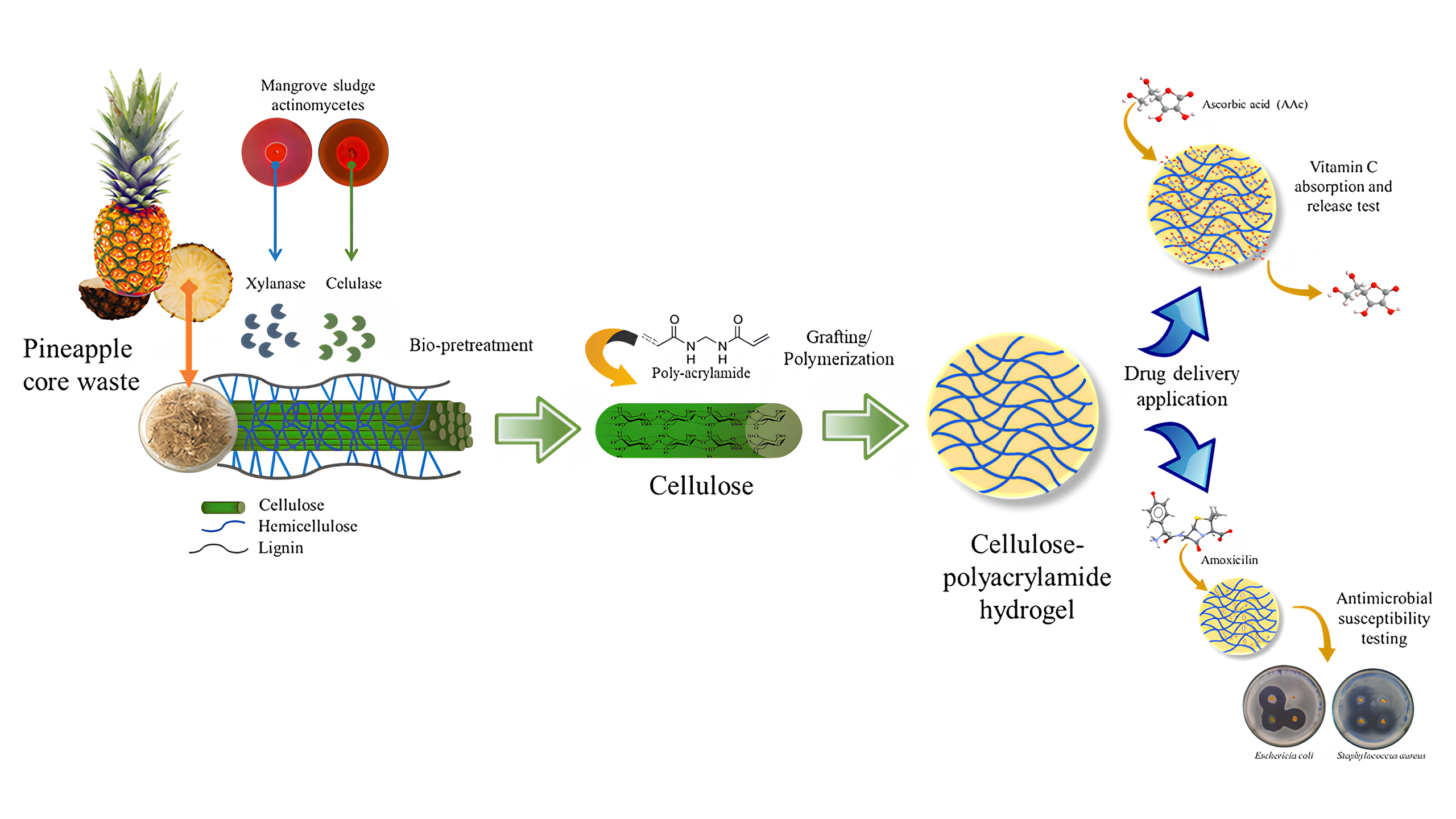
Cellulose-based hydrogels are valuable biomaterials used in drug delivery systems. Cellulose, a biopolymer found in sources like agricultural waste, is abundant in countries such as Indonesia. PT Bromelain Enzyme in Lampung Province generates roughly 20 tons of cellulose-rich pineapple core waste annually from bromelain extraction, providing significant raw material for hydrogel production. This study explored the feasibility of using this waste for synthesizing hydrogels and assessing their potential as drug-delivery agents through various experiments. TAPPI methods for composition analysis revealed 38.5% cellulose, 25.05% hemicellulose and 12.99% lignin in the waste. The isolation of mangrove actinomycetes on ISP 2 medium identified the ActM-DMB 7 isolate, which displays high xylanolytic activity. This isolate was utilized in bio-pretreatment to remove amorphous portions, yielding highly crystalline cellulose with an increased crystallinity index from 16.68 to 33.35. Cellulose resizing showed a bimodal distribution of particle diameters at 0.657 and 1.832 µm. Hydrogel production utilized grafting, confirmed by FTIR analysis with characteristic N-H (3,183.14 cm−1) and C=O (1,647.48 cm−1) amide bands. The product was examined for absorption and delivery potential of ascorbic acid and amoxicillin, exhibiting a high swelling ratio (plateauing at ~34 Sg/g) and significant water retention over 10 h. The hydrogels efficiently absorbed and released ascorbic acid and amoxicillin, with amoxicillin showing antibacterial effects against Escherichia coli and Staphylococcus aureus. This research emphasizes valuing pineapple processing waste for sustainable, economically viable functional hydrogels for biomedical applications, including drug delivery, aligning with circular economy principles by transforming an industrial byproduct into a high-value material.
HIGHLIGHTS
- Enzymatic cellulose isolation from pineapple core waste was achieved using novel xylanase- and cellulase- producing ActM-DMB 7 isolate sourced from mangrove sludge.
- This bio-derived cellulose was then expertly crafted into functional hydrogels through polyacrylamide grafting.
- The synthesized hydrogels were then rigorously tested and proven effective for absorbing and potentially delivering both vitamin C and amoxicillin.
GRAPHICAL ABSTRACT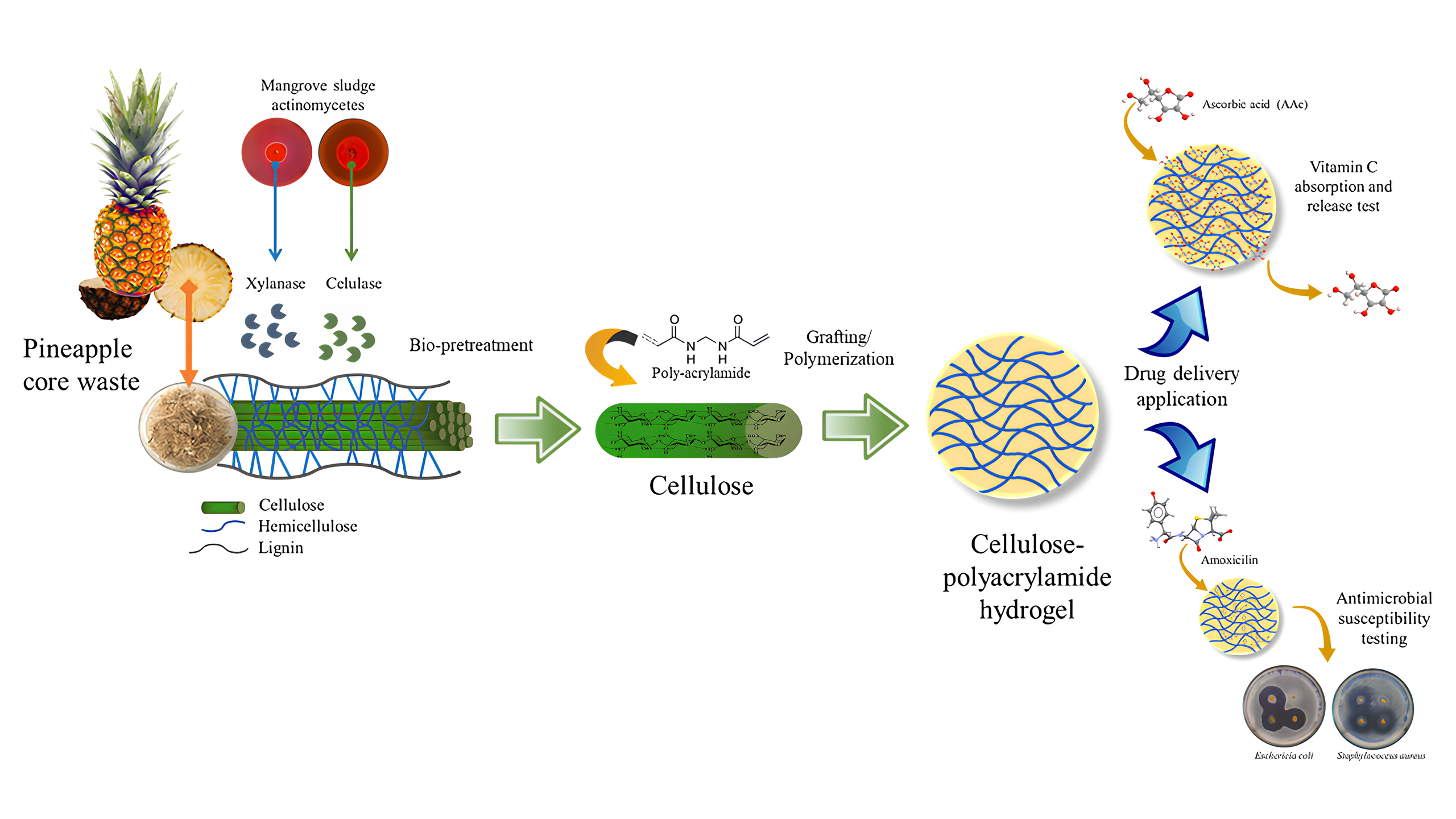
Downloads
References
MS Birajdar, H Joo, WG Koh and H Park. Natural bio-based monomers for biomedical applications: A review. Biomaterials Research 2021; 25, 8.
S Janjić, M Kostić, P Škundrić, B Lazić and J Praskalo. Antibacterial fibers based on cellulose and chitosan. Contemporary Materials 2013; 2(3), 207-218.
X Fan, Z Xiong, J Li, J Lin and X Li. A biodegradable cellulose fibrous membrane comprising cellulose microfibers and nanofibrils with enhanced interaction through crosslinking structure. Polymers for Advanced Technologies 2023; 34(9), 3022-3034.
J Zhang, Y Qi, Y Shen and H Li. Research progress on chemical modification and application of cellulose: A review. Materials Science - Medžiagotyra 2022; 28(1), 60-67.
V Miljković, I Gajić and L Nikolić. Waste materials as a resource for production of CMC superabsorbent hydrogel for sustainable agriculture. Polymers 2021; 13(23), 4115.
S Punyanunt, P Nanta and R Puttipan. Green-chemical nanofibrillated cellulose from pineapple cores using microfluidization. Trends in Sciences 2024; 22(2), 9085.
TLR Corrêa, AT Júnior, LD Wolf, MS Buckeridge, LVD Santos and MT Murakami. An actinobacteria lytic polysaccharide monooxygenase acts on both cellulose and xylan to boost biomass saccharification. Biotechnology for Biofuels 2019; 12, 117.
H Satria, Yandri, Nurhasanah, S Yuwono and D Herasari. Extracellular hydrolytic enzyme activities of indigenous actinomycetes on pretreated bagasse using choline acetate ionic liquid. Biocatalysis and Agricultural Biotechnology 2020; 24, 101503.
H Enawgaw, T Tesfaye, KT Yilma and D Limeneh. Synthesis of a cellulose-co-amps hydrogel for personal hygiene applications using cellulose extracted from corncobs. Gels 2021; 7(4), 236.
MO Haque and MIH Mondal. Synthesis and characterization of cellulose-based eco-friendly hydrogels. Rajshahi University Journal of Science and Engineering 2016; 44, 45-53.
H Abdelhamid and A Mathew. Cellulose-based nanomaterials advance biomedicine: A review. International Journal of Molecular Sciences 2022; 23(10), 5405.
Q Guan, H Yang, Z Han, Z Ling, C Yin, K Yang, Y Zhao and S Yu. Sustainable cellulose-nanofiber-based hydrogels. ACS Nano 2021; 15, 7889-7898.
H Jin, M Kettunen, A Laiho, H Pynnonen, J Paltakari, A Marmur, O Ikkala and R Ras. Superhydrophobic and superoleophobic nanocellulose aerogel membranes as bioinspired cargo carriers on water and oil. Langmuir 2011; 27(5), 1930-1934.
G Priya, B Madhan, U Narendrakumar, RK Suresh and I Manjubala. In vitro and in vivo evaluation of carboxymethyl cellulose scaffolds for bone tissue engineering applications. ACS Omega 2021; 6(2), 1246-1253.
H Risite, M Salim, B Oudinot, E Ablouh, H Joyeux, H Sehaqui, J Razafimahatratra, A Qaiss, ME Achaby and Z Kassab. Artemisia annua stems a new sustainable source for cellulosic materials: Production and characterization of cellulose microfibers and nanocrystals. Waste and Biomass Valorization 2022; 13(4), 2411-2423.
K Nakasone and T Kobayashi. Effect of pretreatment of sugarcane bagasse on the cellulose solution and application for the cellulose hydrogel films. Polymers for Advanced Technologies 2016; 27(7), 973-980.
TK Ghose. International union of pure and applied chemistry applied chemistry division commission on biotechnology measurement of cellulase activities. Pure and Applied Chemistry 1987; 59(2), 257-268.
MJ Bailey, P Biely and K Poutanen. Interlaboratory testing of methods for assay of xylanase activity. Journal of Biotechnology 1992; 23(3), 257-270.
GL Miller. Use of dinitrosalicylic acid reagent for determination of reducing sugar. Analytical Chemistry 1959; 31(3), 426-428.
H Dai and H Huang. Enhanced swelling and responsive properties of pineapple peel carboxymethyl cellulose-g-poly(acrylic acid-co-acrylamide) superabsorbent hydrogel by the introduction of carclazyte. Journal of Agricultural and Food Chemistry 2017; 65(3), 565-574.
L Abe-Matsumoto, YA de Araújo and MM Leite. Stability of vitamin C in enriched jelly. Brazilian Journal of Analytical Chemistry 2020; 7(27), 14-19.
Z Marjanović-Balaban, V Antunović and D Jelić. Determination of vitamin C content in dietary supplements. Quality of Life 2014; 5(3-4), 87-92.
V Friuli, S Pisani, B Conti, G Bruni and L Maggi. Tablet formulations of polymeric electrospun fibers for the controlled release of drugs with pH-dependent solubility. Polymers 2022; 14(10), 2127.
AVT Figueroa, CJP Martinez, TC Castro, EB Martinez, MAGC Madueno, AMG Alegria, TL Ceniceros and LA Villegas. Composite hydrogel of poly(acrylamide) and starch as potential system for controlled release of amoxicillin and inhibition of bacterial growth. Journal of Chemistry 2020; 2020(1), 860487.
ALT Benatti and MLTM Polizeli. Lignocellulolytic biocatalysts: The main players involved in multiple biotechnological processes for biomass valorization. Microorganisms 2023; 11(1), 162.
T Miyamoto, R Takada, Y Tobimatsu, Y Takeda, S Suzuki, M Yamamura, K Osakabe, Y Osakabe, M Sakamoto, and T Uzemawa. OsMYB108 loss-of-function enriches p-coumaroylated and tricin lignin units in rice cell walls. The Plant Journal 2019; 98(6), 975-987.
JS Poulsen, WV Macêdo, T Bonde and J Nielsen. Energetically exploiting lignocellulose-rich residues in anaerobic digestion technologies: From bioreactors to proteogenomics. Biotechnology for Biofuels and Bioproducts 2023; 16, 183.
E Schmitz, KE Nordberg and P Adlercreutz. Warming weather changes the chemical composition of oat hulls. Plant Biology 2020; 22(6), 1086-1091.
L Varriale, M Volkmar, J Weiermüller and R Ulber. Effects of pretreatment on the biocatalysis of renewable resources. Chemie Ingenieur Technik 2022; 94(11), 1818-1826.
L Fitri, Y Yurnita and S Suhartono. Isolation and cellulolytic activity assay of actinobacteria isolated from palm oil wastewater. Trends in Sciences 2023; 20(6), 6715.
X Cao, F Li, Y Li, S Chen, X Li and Y Lu. Preparation and application of cellulose-based hydrogels derived from bamboo. ChemRxiv 2022. https://doi.org/10.26434/chemrxiv-2022-134z8
AS Patri, R Mohan, Y Pu, C Yoo, A Ragauskas, R Kumar, D Kisailus, C Cai and C Wyman. THF co-solvent pretreatment prevents lignin redeposition from interfering with enzymes yielding prolonged cellulase activity. Biotechnology for Biofuels 2021; 14, 63.
J Wang, J Liang, Y Li, L Tian and Y Wei. Characterization of efficient xylanases from industrial-scale pulp and paper wastewater treatment microbiota. AMB Express 2021; 11, 19.
H Andaleeb, N Ullah, S Falke, M Perbandt, H Brognaro and C Betzel. High-resolution crystal structure and biochemical characterization of a GH11 endoxylanase from Nectria haematococca. Scientific Reports 2020; 10(1), 15658.
MS Mafa, S Malga, A Bhattacharya, K Rashamuse and BI Pletschke. The effects of alkaline pretreatment on agricultural biomasses (corn cob and sweet sorghum bagasse) and their hydrolysis by a termite-derived enzyme cocktail. Agronomy 2020; 10(8), 1211.
K Kojima, N Sunagawa, Y Yoshimi, T Tryfona, M Samejima, P Dupree and K Igarashi. Acetylated xylan degradation by glycoside hydrolase family 10 and 11 xylanases from the white-rot fungus: Phanerochaete chrysosporium. Journal of Applied Glycoscience 2022; 69(2), 35-43.
A Procentese, ME Russo, SI Di and A Marzocchella. Kinetic characterization of enzymatic hydrolysis of apple pomace as feedstock for a sugar-based biorefinery. Energies 2020; 13(5), 1051.
A Xia, C Zhang, T Zhu, K Lin, D Zhang, Y Huang, X Zhu and Q Liao. Nature-inspired bioreactor for enzymatic hydrolysis of non-newtonian biomass slurry: A numerical study. Industrial & Engineering Chemistry Research 2025; 64(5), 3004-3013.
GHD Tonoli, K Holtman, LE Silva, D Wood, L Torres, T Williams, J Oliveira, A Fonseca, A Klamczynki, G Glenn and W Orts. Changes on structural characteristics of cellulose pulp fiber incubated for different times in anaerobic digestate. Cerne 2021; 27, e-102647.
A Merlini, C Claumann, AW Zibetti, A Coirolo, T Rieg and R Machado. Kinetic study of the thermal decomposition of cellulose nanocrystals with different crystal structures and morphologies. Industrial & Engineering Chemistry Research 2020; 59(30), 13428-13439.
AL López, AS Hernández, MC Cruz, YG Huante, J Campos, JI Bustos, MR Marsch, RC Cano, CC Benitez and LM Hidalgo. TtCel7A: A native thermophilic bifunctional cellulose/xylanase exoglucanase from the thermophilic biomass-degrading fungus thielavia terrestris co3bag1 and its application in enzymatic hydrolysis of agroindustrial derivatives. Journal of Fungi 2023; 9(2), 152.
Y Zhou, P Zhan, D Tong, W Zhang, Y Qing, Y Huang, L Zhang and J Chen. Deconstruction of poplar wood using peracetic acid and FeCl3 in hot water. ChemistrySelect 2022; 7(3), e202104019.
MNL Flores, JJC Rodríguez, BA Tamayo, VJ Hernandez, PJ Chanona, CS Gallegos, HH Hernandez and EL Jarquin. Windmill grass (Chloris spp.) as a non‐wood source of cellulose for reinforcement of starch films. Polymer Composites 2024; 45(18), 16898-16915.
Q Wang, S Xiao and SQ Shi. The effect of hemicellulose content on mechanical strength, thermal stability and water resistance of cellulose-rich fiber material from poplar. BioResources 2019; 14(3), 5288-5300.
D Floudas, L Gentile, E Andersson, SG Kanellopoulos, A Tunlid, P Persson and U Olsson. X-Ray scattering reveals two mechanisms of cellulose microfibril degradation by filamentous fungi. Applied and Environmental Microbiology 2022; 88(17), e0099522.
M Ioelovich. Specific features of enzymatic hydrolysis of cellulose. World Journal of Advanced Research and Reviews 2024; 22(1), 381-392.
Z Yang and Q Chen. Enzymatic preparation and characterization of honey pomelo peel cellulose and its cellulose nanofibers. Industrial Crops and Products 2023; 206, 117655.
MH Ramirez, LM Valdez, GT Van and C Lutz. Continuous flow synthesis of zeolite FAU in an oscillatory baffled reactor. Journal of Advanced Manufacturing and Processing 2020; 2(2), e10038.
PA Larsson, AV Riazanova, CG Cinar, R Rojas, H Ovrebo, L Wagberg and L Berglund. Towards optimised size distribution in commercial microfibrillated cellulose: A fractionation approach. Cellulose 2019; 26(3), 1565-1575.
A Suo, J Qian, Y Yao and W Zhang. Synthesis and properties of carboxymethyl cellulose-graft-poly (acrylic acid-co-acrylamide) as a novel cellulose-based superabsorbent. Journal of Applied Polymer Science 2007; 103(3), 1382-1388.
H Wang, X Wang and D Wu. Recent advances of natural polysaccharide‐based double‐network hydrogels for tissue repair. Chemistry-An Asian Journal 2022; 17(17), e202200659.
S Buonvino, M Ciocci, D Seliktar and S Melino. Photo-polymerization damage protection by hydrogen sulfide donors for 3D-cell culture systems optimization. International Journal of Molecular Sciences 2021; 22(11), 6095.
S You, Z Zha, J Li, W Zhang, Z Bai, Y Hu, X Wang, Y Chen, J Wang and H luo. Improvement of XYL10C_∆ N catalytic performance through loop engineering for lignocellulosic biomass utilization in feed and fuel industries. Biotechnology for Biofuels 2021; 14, 195.
R Banat, M Al-Rawashdeh and M Aljnaid. Thermal properties of olive pomace filled linear low density polyethylene bio-composites. Journal of Macromolecular Science 2021; 60(11), 957-969.
GON Soares, RRL Machado, MM Diniz and AB Silva. Electrospun progesterone‐loaded cellulose acetate nanofibers and their drug sustained‐release profiles. Polymer Engineering and Science 2020; 60(12), 3231-3243.
X Liu, J Shen, Y Wang, M Li and S Fu. Photoinduced metal-free atom transfer radical polymerization for the modification of cellulose with poly(n-isopropylacrylamide) to create thermo-responsive injectable hydrogels. International Journal of Molecular Sciences 2024; 25(5), 2867.
Z Gao, Z Yu, C Huang, L Duan and G Gao. Carboxymethyl cellulose reinforced poly(vinyl alcohol) with trimethylol melamine as a chemical crosslinker. Journal of Applied Polymer Science 2017; 134(11), 44590.
E Pinho and G Soares. Cotton-hydrogel composite for improved wound healing: Synthesize optimization and physicochemical characterization-part 1. Polymers for Advanced Technologies 2018; 29(12), 3114-3124.
T Yang, X Li, N Xu, Y Guo, G Liu and J Zhao. Preparation of cellulose nanocrystals from commercial dissolving pulp using an engineered cellulase system. Bioresources and Bioprocessing 2023; 10, 42.
C Zhang, Y Qi and Z Zhang. Swelling behavior of polystyrene microsphere enhanced PEG-based hydrogels in seawater and evolution mechanism of their three-dimensional network microstructure. Materials 2022; 15(14), 4959.
N Sarvesh, K Afeeza, V Suresh and E Dilipan. Development of the antioxidant property of seagrass extract-based hydrogel for dental application. Cureus 2024; 16(2), e54544.
S Park, Y Son, J Park, S Lee, N Kim, S Jang, T Kang, J Song and G Khang. Polydeoxynucleotide-loaded visible light photo-crosslinked gelatin methacrylate hydrogel: Approach to accelerating cartilage regeneration. Gels 2025; 11(1), 42.
ES Santana, LB Leal, LA Silva, ICF Barbosa, CML Melo, DKDN Santos and JRC Vieira. Association of Rhizophora mangle and ascorbic acid in hydrogels: Evaluation of cytotoxic and immunomodulatory effects. Brazilian Journal of Pharmaceutical Sciences 2023; 59(2), e20179.
ME Trejo-Caballero, L Díaz-Patiño, M González-Reynac, G Molina, J Lopez-Miranda, R Esparza, B Espana-Sanchez, N Arjona and M Estevez. Biopolymeric hydrogel electrolytes obtained by using natural polysaccharide–poly(itaconic acid-co-2-hydroxyethyl methacrylate) in deep eutectic solvents for rechargeable Zn–air batteries. Green Chemistry 2023; 25(17), 6784-6796.
PM Rastegar, I Tahir, B Garcia-Bailo, K Lo, K Jarvi and AE Sohemy. Ascorbic acid is associated with favourable hormonal profiles among infertile males. Frontiers in Reproductive Health 2023; 5, 1143579.
AC Carr and S Rowe. Factors affecting vitamin C status and prevalence of deficiency: A global health perspective. Nutrients 2020; 12(7), 1963.
M Klučáková. Agarose hydrogels enriched by humic acids as the complexation agent. Polymers 2020; 12(3), 687.
M Bańkosz. Physicochemical characterization and kinetics study of polymer carriers with vitamin C for controlled release applications. Materials 2024; 17(22), 5502.
NC Silva, CJT Silva, MP Gonçalves and F Borsagli. Carboxymethyl-cellulose-based hydrogels incorporated with cellulose nanocrystals loaded with vitamin D for controlled drug delivery. Processes 2024; 12(7), 1437.
A Mir, WJ Fletcher, DK Taylor, J Alam and U Riaz. Sustained release studies of metformin hydrochloride drug using conducting polymer/gelatin-based composite hydrogels. ACS Omega 2024; 9, 18766-18776.
S Zhang, G Ge, Y Qin, W Li, J Dong, J Mei, R Ma, X Zhang, C Zhu, W Zhang and D Gang. Recent advances in responsive hydrogels for diabetic wound healing. Materials Today Bio 2023; 18, 100508.
HR Simancas, CA Fernández, BJ Aparicio, K Slowing, JR Rubio, CE Lopez and SA Torres. Controlled release of highly hydrophilic drugs from novel poly(magnesium acrylate) matrix tablets. Pharmaceutics 2020; 12(2), 174.
Z Tang, Y Yang, Y Pan, M Yu, X Lin and A Mondal. Biocompatible, injectable and self-healing poly(n-vinylpyrrolidone)/carboxymethyl cellulose hydrogel for drug release. ACS Omega 2024; 9(5), 5854-5861.
NR Karakuş, S Türk, EG Guney, M Syzdykbayev, N Appazov and M Ozacar. Investigation of tannic acid crosslinked PVA/PEI-based hydrogels as potential wound dressings with self-healing and high antibacterial properties. Gels 2024; 10(11), 682.
MUA Khan, I Iqbal, MNM Ansari, S Razak, M Raza, A Sajjad, F Jabeen, M Mohamad and N Jusoh. Development of antibacterial, degradable and pH-responsive chitosan/guar gum/polyvinyl alcohol blended hydrogels for wound dressing. Molecules 2021; 26(19), 5937.
Medha and S Sethi. Chitosan based hybrid superabsorbent for controlled drug delivery application. Biotechnology Progress 2024; 40(2), e3418.
Published
How to Cite
Issue
Section
License
Copyright (c) 2025 Walailak University

This work is licensed under a Creative Commons Attribution-NonCommercial-NoDerivatives 4.0 International License.





