
Cytotoxic Activity of Ethanolic Extract of Zanthoxylum acanthopodium DC. Fruit as Phytosomal System against MCF-7 Cell Line
DOI:
https://doi.org/10.48048/tis.2025.10536Keywords:
Zanthoxylum acanthopodium, Phytosomes, Cytotoxic, Apoptosis, MCF-7 cellAbstract
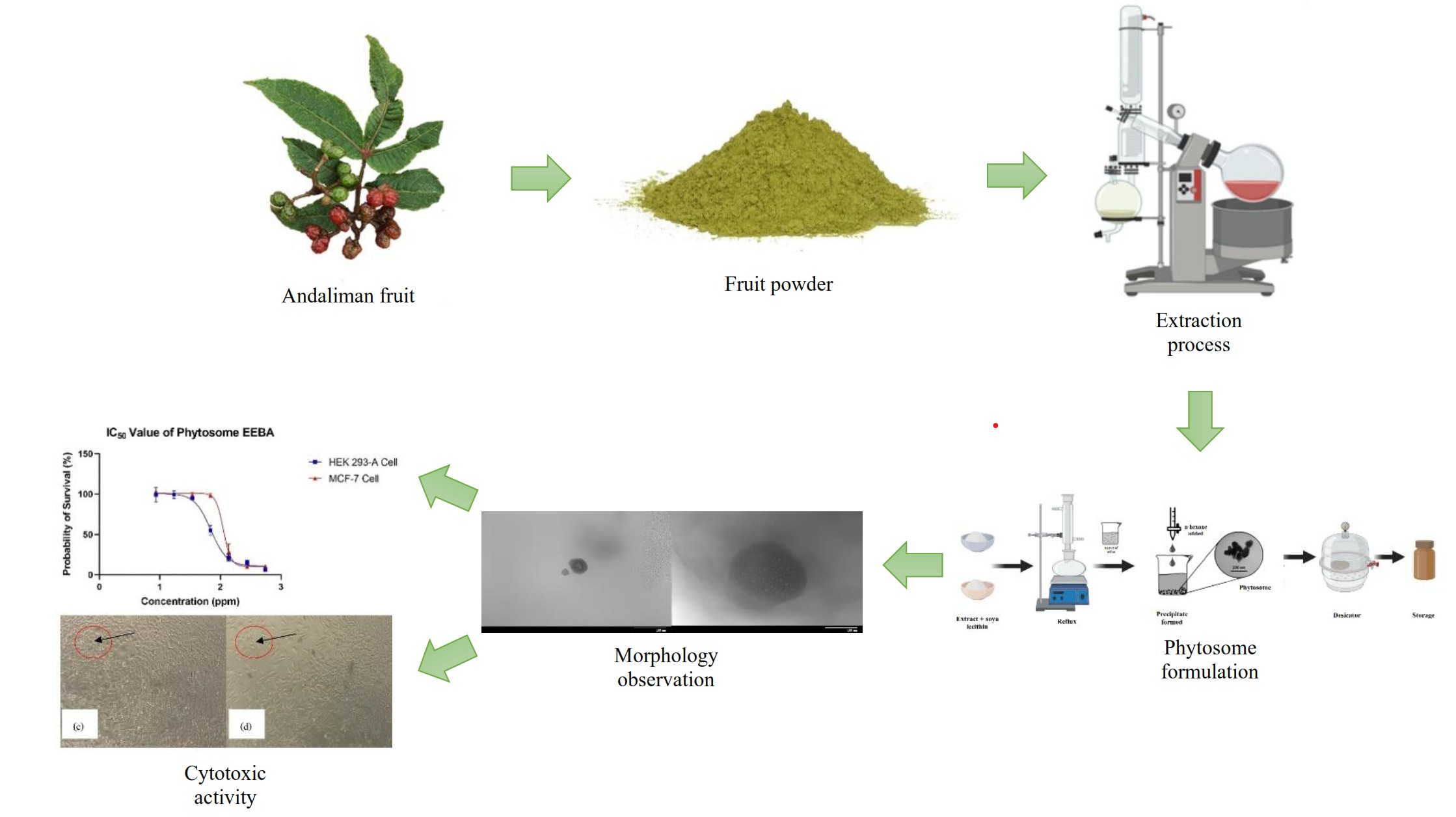
Zanthoxylum acanthopodium DC., known as andaliman, contains bioactive compounds with potential anticancer properties. This study investigated the cytotoxic activity of the ethanolic extract of Z. acanthopodium and its phytosomal formulation (Phytosome-EEA) against the MCF-7 breast cancer cell line. Phytosomes were prepared using antisolvent precipitation and optimized based on phospholipid ratios, reflux temperature, and n-hexane droplet rate. The phytosomes were characterized by particle size, polydispersity index, zeta potential, entrapment efficiency, stability tests, and morphology study by Transmittion Electron Microscopy (TEM). WST-1 assay at 450 nm was used to assess cytotoxicity against HEK 293A and MCF-7 cells, while apoptosis was evaluated using Annexin V-PI staining. The optimized phytosome formulation yielded nanoparticles with an average size of 192.4 nm, polydispersity index of 0.783, a zeta potential of −36.7 V, and an entrapment efficiency of 90.26%. When stored at 4, 25 and 40 °C for 14 days, there were no significant changes in particle size, zeta potential, or cytotoxicity, indicating high physical stability. Both the ethanolic extract and phytosomes exhibited cytotoxic activity against MCF-7 and HEK 293A cells, with IC₅₀ values of 100.2 and 109.2 µg/mL, respectively. The cell death induced by EEA occurred primarily via apoptosis, while Phytosome-EEA promoted increased late apoptosis. Although the selectivity index remained < 1, the phytosomal formulation maintained consistent cytotoxic activity and improved physicochemical characteristics compared to the crude extract.
HIGHLIGHTS
- The ethanolic extract of acanthopodium fruit contains bioactive compounds such as alkaloids, flavonoids, and tannins that contribute to the anticancer effect.
- The phytosome formulation produced stable particles with a particle size of 192.4 nm, zeta potential of -33.2 mV, and high entrapment efficiency of 90.26%.
- The andaliman extract showed cytotoxic activity against breast cancer cells (MCF-7), but less selective (SI < 1).
- IC50 value against MCF-7: 100.2 µg/mL (moderately active category)
- Phytosome formulation did not improve selectivity, but provided good physical stability and was stable during storage.
- Phytosomes have potential as an herbal-based anticancer delivery system, but further optimization is needed.
- Further considerations such as targeting modifications are needed to be more selective towards cancer cells
GRAPHICAL ABSTRACT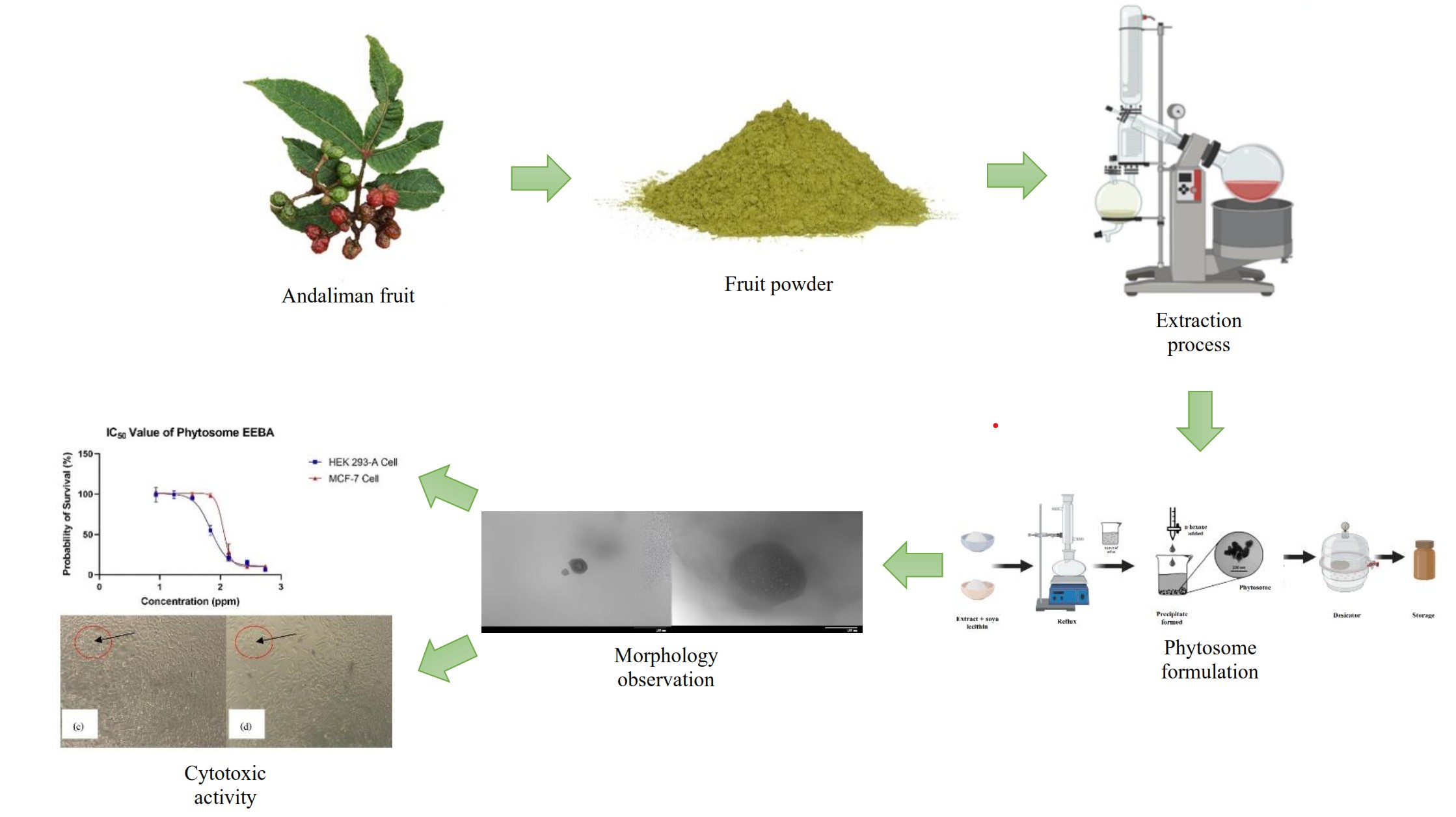
Downloads
References
ER Megawati, H Bangun, IB Putra, M Rusda, D Syahrizal, NK Jusuf, PC Eyanoer, RR Lubis and MM Amin. Phytochemical analysis by FTIR of Zanthoxylum Acanthopodium, DC Fruit Ethanol Extract, N-hexan, Ethyl Acetate and Water Fraction. Medical Archives 2023; 77(3), 183-188.
Adrian, RA Syahputra, NA Juwita, R Astyka and MF Lubis. Andaliman (Zanthoxylum acanthopodium DC.) a herbal medicine from North Sumatera, Indonesia: Phytochemical and pharmacological review. Heliyon 2023; 9(5), 16159.
EV Arsita, DE Saragih and K Aldrin. Anticancer potential from ethanol extract of Zanthoxylum acanthopodium DC. seed to against MCF-7 cell line. IOP Conference Series: Earth and Environmental Science 2019; 293, 012016.
H Sung, J Ferlay, RL Siegel, M Laversanne, I Soerjomataram, A Jemal and F Bray. Global cancer statistics 2020: GLOBOCAN estimates of incidence and mortality worldwide for 36 cancers in 185 countries. CA: A Cancer Journal for Clinicians 2021; 71(3), 209-249.
D Anjasari, R Sumarny, W Uun, K Kunci, K Payudara and G Soebroto. Evaluation of use of chemotherapy drug on breast cancer patients in RSPAD gatot soebroto January-December 2015 period. Social Clinical Pharmacy Indonesia Journal 2017; 2(2), 17-22.
Guenter Kahl. The dictionary of genomics, transcriptomics and proteomics. Vol III. Wiley-Blackwell, South Korea, 2015.
S Comsa, AM Cimpean and M Raica. The story of MCF-7 breast cancer cell line: 40 Years of experience in research. Anticancer Research 2015; 35(6), 3147-3154.
J Bhattacharya, A Lakshmi, S Ata and OS Sarma. Evaluation of cytotoxic activity of zanthoxylum acanthopodium in dalton’s lymphoma ascites cells induced european of biomedical AND pharmaceutical sciences. European Journal of Biomedical AND Pharmaceutical Sciences 2017; 4(10), 541-548.
L Panggabean, N Nurhamidah and D Handayani. Profil fitokimia dan uji sitotoksik ekstrak etanol tumbuhan Zanthoxylum acanthopodium DC (ANDALIMAN) menggunakan metode bslt. Allotropy 2020; 4(1), 59-68.
R Wusirika, A Kumari, N Rahman and P Mandave. Anticancer activities of plant secondary metabolites: Rice callus suspension culture as a new paradigm. Rice Science 2021; 28(1), 13-30.
Fauzi. Anticancer Activity Test of Ethanol Extract of Andaliman Fruit (Zanthoxylum acanthopodium DC.) Against Cervical Cancer Cells. Unpublished Final Thesis of Bachelor Program. Faculty of Pharmacy, Universitas Sumatera Utara 2015.
N Weerapreeyakul, A Nonpunya, S Barusrux, T Thitimetharoch and B Sripanidkulchai. Evaluation of the anticancer potential of six herbs against a hepatoma cell line. Chinese Medicine (United Kingdom) 2012; 7(1), 15.
TC Masyithah. Efek kombinasi ekstrak aktif buah andaliman (Zanthoxylum acanthopodium DC.) dan doxorubicin terhadap sel kanker payudara. Universitas Sumatera Utara 2013. http://repositori.usu.ac.id/handle/123456789/35915
A Berry, TC Guest and T Naved. Phytosomes: From herbal drug delivery to targeted clinical therapy. World Journal of Pharmaceutical Research 2016; 5, 582.
K Maiti, K Mukherjee, A Gantait, BP Saha and PK Mukherjee Curcumin-phospholipid complex: Preparation, therapeutic evaluation and pharmacokinetic study in rats. International Journal of Pharmaceutics 2007; 330(1-2), 155-163.
JJ Bhiseand, OG Bhusnure, SR Jagtap, SB Gholve and RR Wale. Phytosomes: A novel drug delivery for herbal extracts. Journal of Drug Delivery and Therapeutics 2019; 9(3), 924-930.
M Dewi, M Muhaimin, I Joni, F Hermanto and A Chaerunisaa. Fabrication of phytosome with enhanced activity of Sonneratia alba: Formulation modeling and in vivo antimalarial study. International Journal of Nanomedicine 2024; 19, 9411-9435.
AU Upase, OG Bhusnure, SB Gholve, PS Giram and PB Wattamwar. A review on Phytosome loaded with novel herbal drug and their formulation, standardization and applications. Journal of Drug Delivery and Therapeutics 2019; 9(3S), 765-769.
M Brgles, D Jurasin, MD Sikiric, R Frkanec and J Tomasic. Entrapment of ovalbumin into liposomes - Factors affecting entrapment efficiency, liposome size, and zeta potential. Journal of Liposome Research 2008; 18(3), 235-248.
AW Lim, PY Ng, N Chieng and SF Ng. Moringa oleifera leaf extract-loaded phytophospholipid complex for potential application as wound dressing. Journal of Drug Delivery Science and Technology 2019; 54, 101329.
M Deleanu, L Toma, GM Sanda, T Barbalata, LS Niculescu, AV Sima, C Deleanu, L Sacarescu, A Suciu, G Alexandru, I Crişan, M Popescu and CS Stancu. Formulation of phytosomes with extracts of ginger rhizomes and rosehips with Improved Bioavailability, Antioxidant and Anti-Inflammatory effects in vivo. Pharmaceutics 2023; 15(4), 1066.
NA Alhakamy, UA Fahmy, SM Badr-Eldin, OAA Ahmed, HZ Asfour, HM Aldawsari, MM Algandaby, BG Eid, AB Abdel-Naim, ZA Awan, NK Alruwaili and AI Mohamed. Optimized icariin phytosomes exhibit enhanced cytotoxicity and apoptosis-inducing activities in ovarian cancer cells. Pharmaceutics 2020; 12(4), 346.
RR Mendonça-Filho. Bioactive phytocompounds: New approaches in the phytosciences. Modern Phytomedicine: Turning Medicinal Plants into Drugs 2006; 1, 1-24.
VJ Mohanraj and Y Chen. Nanoparticles-a review. Tropical Journal of Pharmaceutical Research 2006; 5(1), 561-573.
SS Guterres, MP Alves and AR Pohlmann. Polymeric Nanoparticles, Nanospheres and Nanocapsules, for cutaneous applications. Drug Target Insights 2007; 2, 147-157.
S Ojha. In vitro and In vivo neuroprotective study of solid lipid nanoparticles loaded with dimethyl fumarate. Asian Journal of Pharmaceutics 2018; 12(1), S81-S86.
M Barani, E Sangiovanni, M Angarano, MA Rajizadeh, M Mehrabani, S Piazza, HV Gangadharappa, A Pardakhty, M Mehrbani, M DellʼAgli and MH Nematollahi. Phytosomes as innovative delivery systems for phytochemicals: A comprehensive review of literature. International Journal of Nanomedicine 2021; 16, 6983-7022.
L Mardiana, T Milanda, YE Hadisaputri and AY Chaerunisaa. Phytosome-enhanced secondary metabolites for improved anticancer efficacy: Mechanisms and bioavailability review. Drug Design, Development and Therapy 2025; 19, 201-218.
K Gnananath, KS Nataraj and BG Rao. Phospholipid complex technique for superior bioavailability of phytoconstituents. Advanced Pharmaceutical Bulletin 2017; 7(1), 35-42.
SS Gaikwad, YY Morade, AM Kothule, SJ Kshirsagar, UD Laddha and KS Salunkhe. Overview of phytosomes in treating cancer: Advancement, Challenges, and future outlook. Heliyon 2023; 9(6), 16561.
S Bhattacharya. Phytosomes: The new technology for enhancement of bioavailability of botanicals and nutraceuticals. International Journal of Health Research 2009; 2(3), 225-232.
Y Dutt, RP Pandey, M Dutt, A Gupta, A Vibhuti, VS Raj, CM Chang and A Priyadarshini. Liposomes and phytosomes: Nanocarrier systems and their applications for the delivery of phytoconstituents. Coordination Chemistry Reviews 2023; 491, 215251.
WS Alharbi, FA Almughem, AM Almehmady, SJ Jarallah, WK Alsharif, NM Alzahrani and AA Alshehri. Phytosomes as an emerging nanotechnology platform for the topical delivery of bioactive phytochemicals. Pharmaceutics 2021; 13(9), 1475.
D Matias, P Rijo and CP Reis. Phytosomes as biocompatible carriers of natural drugs. Current Medicinal Chemistry 2017; 24(6), 568-589.
A Kumar, Prasanth, Padmasri, M Krishna and Jagadeeswari. A comprehensive literature review on solid lipid nanoparticles. International Journal of Biology, Pharmacy and Allied Sciences 2024; 13(12), 6616-6640.
BV Bonifacio, PB da Silva, MADS Ramos, KMS Negri, TM Bauab and M Chorilli. Nanotechnology-based drug delivery systems and herbal medicines: A review. International Journal of Nanomedicine 2014; 9, 1-15.
AP Ranjan, A Mukerjee, L Helson and JK Vishwanatha. Scale up, optimization and stability analysis of curcumin C3 complex-loaded nanoparticles for cancer therapy. Journal of Nanobiotechnology 2012; 10(38), 1-18.
Z Ahmad, R Pandey, S Sharma and GK Khuller. Alginate nanoparticles as antituberculosis drug carriers: Formulation development, pharmacokinetics and therapeutic potential. Indian Journal of Chest Diseases and Allied Sciences 2006; 48(3), 171-176.
C Cheng, Z Wu, DJ McClements, L Zou, S Peng, W Zhou and W Liu. Improvement on stability, loading capacity and sustained release of rhamnolipids modified curcumin liposomes. Colloids and Surfaces B: Biointerfaces 2019; 183, 110460.
MJ Stoddart. Mammalian cell viability: Methods and protocols. Springer, New York, 2011.
S Machana, N Weerapreeyakul, S Barusrux, A Nonpunya, B Sripanidkulchai and T Thitimetharoch. Cytotoxic and apoptotic effects of six herbal plants against the human hepatocarcinoma (HepG2) cell line. Chinese Medicine 2011; 6(1), 39.
J Silalahi. Makanan fungsional (in indonesian). Kanisius, Jakarta, Indonesia, 2006.
W Ren, Z Qiao, H Wang, L Zhu and L Zhang. Flavonoids: Promising anticancer agents. Medicinal Research Reviews 2003; 23(4), 519-534.
AQ Khan, K Rashid, AA AlAmodi, MV Agha, S Akhtar, I Hakeem, SS Raza and S Uddin. Reactive oxygen species (ROS) in cancer pathogenesis and therapy: An update on the role of ROS in anticancer action of benzophenanthridine alkaloids. Biomedicine and Pharmacotherapy 2021; 143, 112142.
K Macakova, R Afonso, L Saso and P Mladenka. The influence of alkaloids on oxidative stress and related signaling pathways. Free Radical Biology and Medicine 2019; 134, 429-444.
M Hariono, R Rollando, J Karamoy, P Hariyono, M Atmono, M Djohan, W Wiwy, R Nuwarda, C Kurniawan, N Salin and H Wahab. Bioguided fractionation of local plants against matrix metalloproteinase9 and its cytotoxicity against breast cancer cell models: In silico and in vitro study (part II). Molecules 2020; 25(20), 4691.
NH Nguyen, QTH Ta, QT Pham, TNH Luong, VT Phung, TH Duong and VG Vo. Anticancer activity of novel plant extracts and compounds from Adenosma Bracteosum (Bonati) in human lung and liver cancer cells. Molecules 2020; 25(12), 2912.
LK Caesar and NB Cech. Synergy and antagonism in natural product extracts: When 1 + 1 does not equal 2. Natural Product Reports 2019; 36(6), 869-888.
A Kadriya and M Falah. Nanoscale phytosomes as an emerging modality for cancer therapy. Cells 2023; 12(15), 1999.
N Raouf, ZE Darwish, O Ramadan, HS Barakat, SA Elbanna and MM Essawy. The anticancer potential of tetrahydrocurcumin-phytosomes against oral carcinoma progression. BMC Oral Health 2024; 24(1), 1126.
MN Javed, ES Dahiya, AM Ibrahim, MS Alam, FA Khan and FH Pottoo. Recent advancement in clinical application of nanotechnological approached targeted delivery of herbal drugs. Nanophytomedicine 2020; 1, 151-172.
M Allaw, ML Manca, I Castangia and M Manconi. From plants to phospholipid vesicles: A comprehensive review on the incorporation of phytochemicals into phospholipid vesicles designed for skin applications with special focus on scalability and in vitro and in vivo efficacy. The Journal of Drug Delivery Science and Technology 2022; 67, 103049.
AL Thakur and KS Patil. Formulation of alkaloid loaded phytosomes from tinospora cordifolia and ex-vivo intestinal permeability study. Indian Journal of Pharmaceutical Education and Research 2021; 55(2), 474-482.
A Babazadeh, M Zeinali and H Hamishehkar. Nano-phytosome: A developing platform for herbal anti-cancer agents in cancer therapy. Current Drug Targets 2018; 19(2), 170-180.
TA Ahmed, GA Milibary, AM Almehmady, AA Alahmadi, EMM Ali and KM El-Say. Improving the cytotoxic activity of hinokitiol from drug-loaded phytosomal formulation against breast cancer cell lines. International Journal of Nanomedicine 2024; 19, 10321-10339.
D Casares, PV Escriba and CA Rossell. Membrane lipid composition: Effect on membrane and organelle structure, function and compartmentalization and therapeutic avenues. International Journal of Molecular Sciences 2019; 20(9), 2167.
W Szlasa, I Zendran, A Zalesinska, M Tarek and J Kulbacka. Lipid composition of the cancer cell membrane. Journal of Bioenergetics and Biomembranes 2020; 52(5), 321-342.
S Zalba and TLM ten Hagen. Cell membrane modulation as adjuvant in cancer therapy. Cancer Treatment Reviews 2017; 52, 48-57.
Y Pu, X Zhang, Q Zhang, B Wang, Y Chen, C Zang, Y Wang, TTX Dong and T Zhang. 20 (S)-Protopanaxadiol phospholipid complex: Process optimization, characterization, in vitro dissolution and molecular docking studies. Molecules 2016; 21(10), 1396.
SD Demo, E Masuda, AB Rossi, BT Throndset, AL Gerard, EH Chan, RJ Armstrong, BP Fox, JB Lorens, DG Payan, RH Scheller and JM Fisher. Quantitative measurement of mast cell degranulation using a novel flow cytometric annexin-V binding assay. Cytometry 1999; 36(4), 340-348.
CP Brussaard, D Marie and G Bratbak. Flow cytometric detection of viruses. Journal of Virological Methods 2000; 85(1-2), 175-182.
LM Mooney, KA Al-Sakkaf, BL Brown and PRM Dobson. Apoptotic mechanisms in T47D and MCF-7 human breast cancer cells. British Journal of Cancer 2002; 87(8), 909-917.
M Zimmermann and N Meyer. Annexin V/7-AAD staining in keratinocytes. Mammalian Cell Viability: Methods and Protocols 2011; 740, 57-63.
Published
How to Cite
Issue
Section
License
Copyright (c) 2025 Walailak University

This work is licensed under a Creative Commons Attribution-NonCommercial-NoDerivatives 4.0 International License.





