
Metabolite Profiling and Anti-Multidrug-Resistant Activity of Streptomyces anulatus ACSAN21-05 Isolated from Indonesian Mangrove Rhizosphere
DOI:
https://doi.org/10.48048/tis.2025.10533Keywords:
Broad-spectrum, S. anulatus ACSAN21-05, Polyphasic identification, MDR, Perpendicular streak, Volatile bioactive compounds, 16S rDNAAbstract
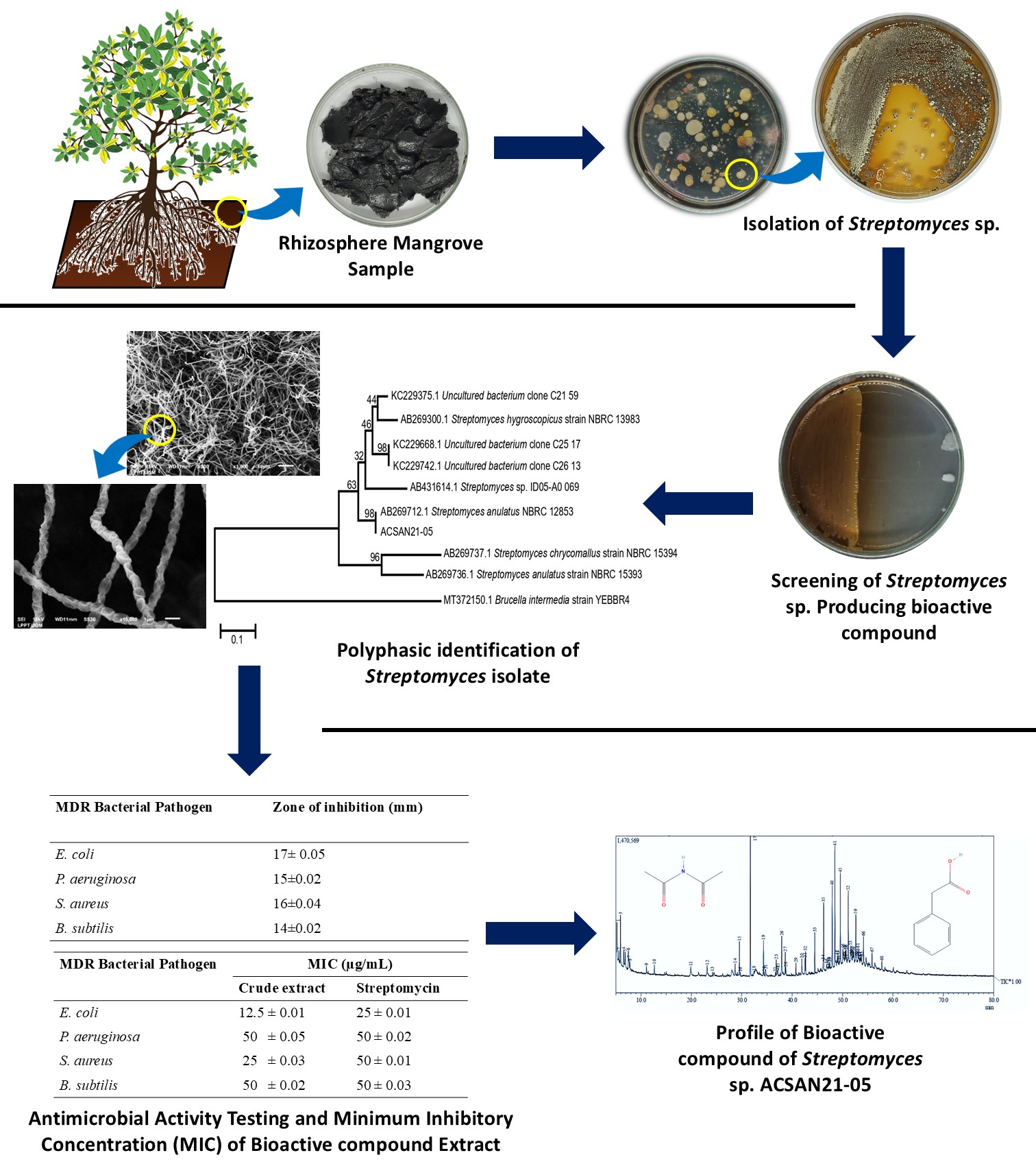
Streptomyces isolated from the rhizosphere of Rhizopora apiculata in Baros Mangrove Forest, Yogyakarta, Indonesia, has the potential to produce bioactive compounds with distinct structures and activities. This study aimed to screen Streptomyces-strains for bioactive compound production, identify the selected Streptomyces using a polyphasic approach, evaluate the antibacterial activity and minimum inhibitory concentration (MIC) of the bioactive compounds produced by the selected strain against multidrug-resistant (MDR) pathogens, and determine the bioactive compound profile. Based on a perpendicular streak method test, Streptomyces sp. ACSAN21-05 was selected as a strain producing bioactive compounds with a broad-spectrum antibacterial effect, inhibiting MDR Staphylococcus aureus, Bacillus subtilis, Escherichia coli, and Pseudomonas aeruginosa with inhibition zones of 44, 43, 41 and 42 mm, respectively. Phenotypic and genotypic characterization using the 16S rDNA gene identified strain ACSAN21-05 as S. anulatus. The ethyl acetate extract of strain ACSAN21-05 exhibited MIC values of 12.5 and 25 µg/mL against MDR E. coli and MDR S. aureus, respectively, and 50 µg/mL against both MDR P. aeruginosa and MDR B. subtilis. Gas Chromatography-Mass Spectrometry (GC-MS) analysis identified 68 volatile bioactive compounds. Among them, 6 compounds, including eugenol, eucalyptol (1,8-cineole), diacetamide, n-tridecanoic acid, n-hexadecanoic acid, and pyrazoline, had antibacterial potential against MDR E. coli, Staphylococcus aureus, and Pseudomonas aeruginosa. The Streptomyces anulatus ACSAN21-05 strain shows promise for development as a producer of novel antibiotics with potential health benefits.
HIGHLIGHTS
- First report of Streptomyces anulatus ACSAN21-05 isolated from the rhizosphere of Rhizopora apiculata in the Baros Mangrove Forest, Yogyakarta, Indonesia.
- The broth extract of S. anulatus ACSAN21-05 showed strong antibacterial activity against multidrug-resistant pathogens and several volatile compounds were detected.
- S. anulatus ACSAN21-05 is a promising microbe for producing novel antimicrobial compounds, especially in the context of increasing antibiotic resistance.
GRAPHICAL ABSTRACT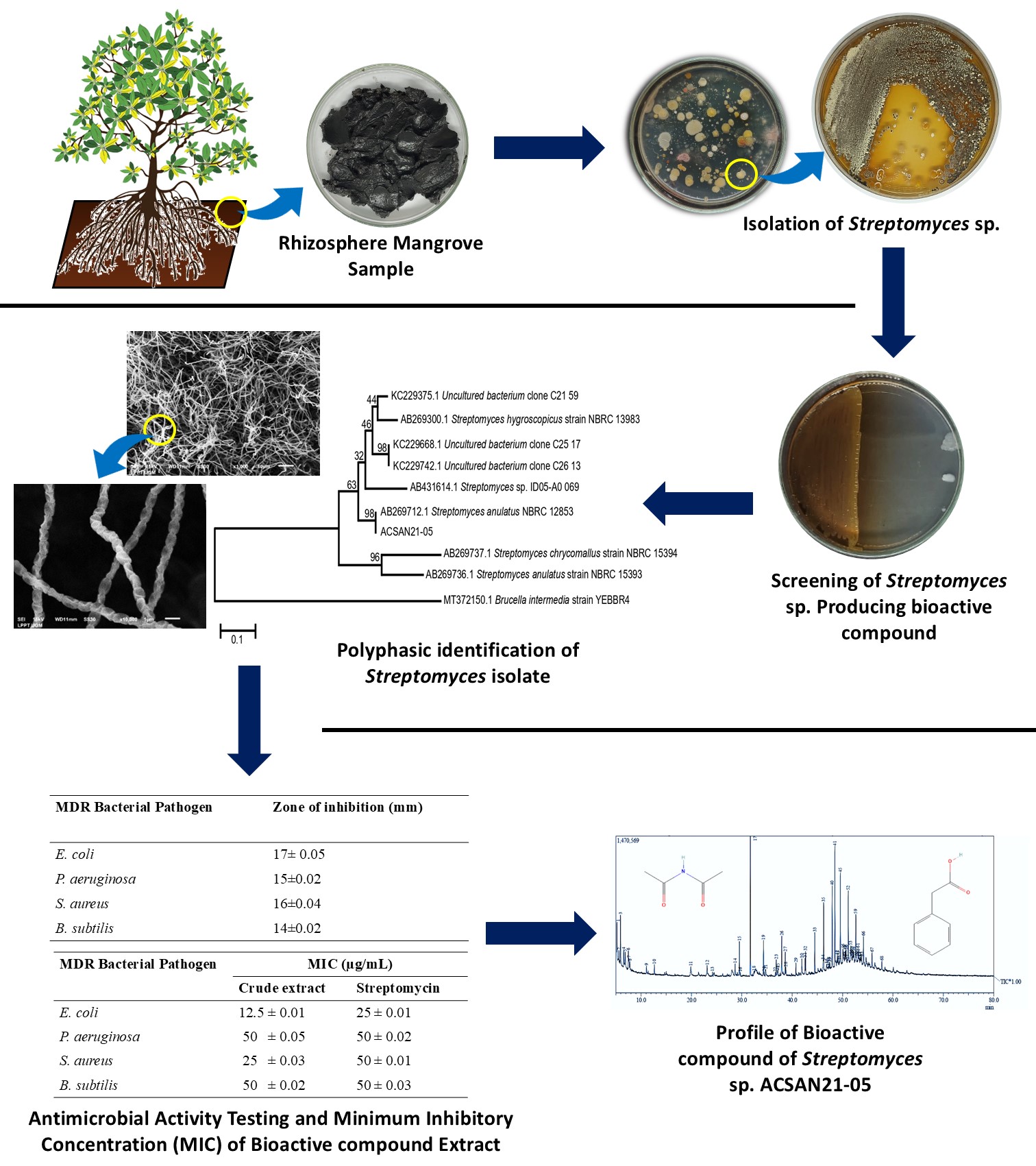
Downloads
References
CA Demeke, GM Adinew, TB Abebe, AT Gelaye, H Gemeda and DK Yimenu. Comparative analysis of the effectiveness of narrow-spectrum versus broad-spectrum antibiotics for the treatment of childhood pneumonia. SAGE Open Medicine 2021; 21(5), 19-24.
HA Khan, FK Baig and R Mehboob. Nosocomial infections: Epidemiology, prevention, control and surveillance. Asian Pacific Journal of Tropical Biomedicine 2017; 7(5), 478-482.
EM Mlugu, JA Mohamedi, RZ Sangeda and KD Mwambete. Prevalence of urinary tract infection and antimicrobial resistance patterns of uropathogens with biofilm forming capacity among outpatients in Morogoro, Tanzania: A cross-sectional study. BMC Infectious Diseases 2023; 23(1), 660.
S Samancı, M Çelik and M Köşker. Antibiotic resistance in childhood urinary tract infections: A single-center experience. Turkish Archives of Pediatrics 2020; 55(4), 386.
MP Freire, ATW Song, ICV Oshiro, W Andraus, LAC D’Albuquerque and E Abdala. Surgical site infection after liver transplantation in the era of multidrugresistant bacteria: What new risks should be considered? Diagnostic Microbiology and Infectious Disease 2021; 99,115220.
T Kim, HJ Yeo, JH Jang, D Kim, D Jeon, YS Kim and WH Cho. Prognostic impact of preoperative respiratory colonization on early-onset pneumonia after lung transplantation. Journal of Thoracic Disease 2022; 14(6), 1900-1908.
MA Hassan, SA El-Aziz, HM Elbadry, SA El-Aassar and TM Tamer. Prevalence, antimicrobial resistance profile, and characterization of multi-drug resistant bacteria from various infected wounds in North Egypt. Saudi Journal of Biological Sciences 2022; 29(4), 2978-2988.
I Islam, B Mubashshira, SM Mondol, O Saha, MS Rahman, A Khan, Amiruzzaman and MM Rahaman. Epidemiological pattern and genomic insights into multidrug-resistant ST491 Acinetobacter baumannii BD20 isolated from an infected wound in Bangladesh: Concerning co-occurrence of 3 classes of beta lactamase genes. Journal of Global Antimicrobial Resistance 2024; 38, 327-331.
S Ghosh, N Kuisiene and N Cheeptham. The cave microbiome as a source for drug discovery: Reality or pipe dream? Biochemical Pharmacology 2017; 134, 18-34.
EA Barka, P Vatsa, L Sanchez, N Gaveau-Vaillant, C Jacquard, HP Klenk, C Clémentm, Y Ouhdouch and GP van Wezel. Taxonomy, physiology and natural products of Actinobacteria. Microbiology and Molecular Biology Reviews 2015; 80(1), 1-43.
NA Al-Dhabi, A-KM Ghilan, GA Esmail, MV Arasu, V Duraipandiyan and K Ponmurugan. Bioactivity assessment of the Saudi Arabian Marine Streptomyces sp. Al-Dhabi-90, metabolic profiling and its in vitro inhibitory property against multidrug resistant and extended-spectrum beta-lactamase clinical bacterial pathogens. Journal of Infection and Public Health 2019; 12, 549-556.
PK Maiti, S Das, P Sahoo and S Mandal. Streptomyces sp. SM01 isolated from Indian soil produces a novel antibiotic picolinamycin effective against multi drug resistant bacterial strain. Scientific Report 2020; 10, 192-203.
P Amimanan, W Ouancharee, N Muangsue, S Lasom and N Charoensri. Antibacterial compounds and draft genome sequence of Streptomyces sp. PA5.6 isolated from deciduous dipterocarp forest soils, University of Phayao, Thailand. Trends in Sciences 2024; 21(10), 8234-3248.
NRAM Azmin, NIM Sarmin, HBSG Khan and M Zainal. Identification of endophytic Actinomycetes isolated from Hopea ferrea and its antibacterial activity against cariogenic bacterium. Malaysian Applied Biology 2024; 53(2), 37-46.
Z Xuefeng. Mangrove soil-derived Streptomyces: an important resource of pharmaceutical active natural products. Journal of Holistic Integrative Pharmacy 2022; 3(3), 300-314.
N Khakhim, MA Marfai, A Wicaksono, W Lazuardi, Z Isnaen and T Walinono. Mangrove ecosystem data inventory using unmanned aerial vehicles (UAVs) in Yogyakarta coastal area. In: Proceedings of the 6th Geoinformation Science Symposium, Yogyakarta, Indonesia. 2019.
S Srikanth, SKY Lum and Z Chen. Mangrove root: Adaptations and ecological importance. Trees 2016; 30, 451-465.
W Zhuang, X Yu, R Hu, Z Luo, X Liu, X Zheng and Z He. Diversity, function and assembly of mangrove root-associated microbial communities at a continuous fine-scale. Biofilms and Microbiomes 2020; 6, 52.
FZ Djebbah, NA Al-Dhabi, MV Arasu, L Belyagoubi, F Kherbouche, DE Abdelouahid and B Ravindran. Isolation and characterisation of Streptomyces sp. Strain GLD25 with antimicrobial and antioxidant effects from Gueldaman cave (GLD1), Akbou-Algeria. 2022. Journal of King Saud University - Science 2022; 34, 101719.
PP Kumar, JPP Raj, IVSN Christhudas, RS Jansi, N Murugan, P Agastian, C Arunachalam and SA Alharbi. Screening of Actinomycetes for enzyme and antimicrobial activities from the soil sediments of Northern Tamil Nadu, South India. Journal of Biologically Active Products from Nature 2015; 5, 58-70.
M Benhadj, DG-Kirane, T Menasria, K Guebla and Z Ahmane. Screening of rare actinomycetes isolated from natural wetland ecosystem (Fetzara Lake, northeastern Algeria) for hydrolytic enzymes and antimicrobial activities. Journal of King Saud University - Science 2019; 31(4), 706-712.
Q Li, X Chen and Y Jiang. Morphological identification of actinobacteria. In: D Dhanasekaran and Y Jiang (Eds.). Actinobacteria-basics and biotechnological applications. Intech Open, London, 2016, p. 87-93.
S Chanadech, D Ruen-ngam, C Intaraudom, P Pittayakhajonwut, S Chongruchiroj, J Pratuangdejkul and C Thawai. Isolation of manumycin-type derivatives and genome characterization of a marine Streptomyces sp. C1-2. Research in Microbiology 2021; 172, 103812.
MI Hossain, MFR Mizan, M Ashrafudoulla, S Nahar, HJ Joo, IK Jahid, SH Park, KS Kim and SD Ha. Inhibitory effects of probiotic potential lactic acid bacteria isolated from kimchi against Listeria monocytogenes biofilm on lettuce, stainless-steel surfaces, and MBEC™ biofilm device. LWT - Food Science and Technology 2020; 118, 108864.
UK Mangamuri, V Muvva S Poda and SKamma. Isolation, identification and molecular characterization of rare actinomycetes from mangrove ecosystem of Nizampatnam. Malaysian Journal of Microbiology 2012; 8(2), 83-91.
SA Ashraf, E Al-Shammari, T Hussain, S Tajuddin and BP Panda. In-vitro antimicrobial activity and identification of bioactive components using GC-MS of commercially available essential oils in Saudi Arabia. Journal of Food Science and Technology 2017; 54(12), 3948-3958.
W Ludwig, JP Euzéby and WB Whitman. Bergey’s Manual of Systematics of Archaea and Bacteria. John Wiley & Sons, New Jersey, United States, 2015.
FZ Djebbah, L Belyagoubi, DE Abdelouahid, F Kherbouche, NA Al-Dhabi, MV Arasu and B Ravindran. Isolation and characterization of novel Streptomyces strain from Algeria and its in-vitro antimicrobial properties against microbial pathogens. Journal of Infection and Public Health 2021; 14(11), 1671-1678.
LP Yunnikova, TA Akent’eva, GA Aleksandrova, LA Mikhailova and SL Eliseev. Synthesis and antimicrobial activity of anilines with 1,3,5-cycloheptatriene and 5h-dibenzo[a,d]annulene fragments. Pharmaceutical Chemistry Journal 2014; 48(1), 22-25.
MP Freitas. Regio- and stereochemical behavior of cyclooctane and cyclodecane derivatives containing CF2 moieties. Journal of Fluorine Chemistry 2025; 282, 110397.
K Nithya, C Muthukumar, B Biswas, NS Alharbi, S Kadaikunnan, JM Khaled and D Dhanasekaran. Desert actinobacteria as a source of bioactive compounds production with a special emphases on pyridine-2,5- diacetamide a new pyridine alkaloid produced by Streptomyces sp. DA3-7. Microbiological Research 2018; 207, 116-133.
X Jin, J Zhou, G Richey, M Wang, SMC Hong and SH Hong. Undecanoic acid, lauric acid, and n-tridecanoic acid inhibit Escherichia coli persistence and biofilm formation. Journal of Microbiology and Biotechnology 2021; 31(1), 130-136.
Y Wang, Y Zhang, X Song, C Fang, R Xing, L Liu, X Zhao, Y Zou, L Li, R Jia, G Ye, F Shi, X Zhou, Y Zhang, H Wan, Q Wei and Z Yin. 1,8-Cineole inhibits biofilm formation and bacterial pathogenicity by suppressing luxS gene expression in Escherichia coli. Front Pharmacology 2022; 14, 236-244.
NA Al-Shabib, FM Husain, I Ahmad and MH Baig. Eugenol inhibits quorum sensing, and biofilm of toxigenic MRSA strains isolated from food handlers employed in Saudi Arabia. Biotechnology and Biotechnological Equipment 2017; 31(2), 387-396.
V Jayapal. Antimicrobial activity of eugenol against human pathogenic bacteria by minimal inhibitory concentration, minimal bactericidal concentration and disc-diffusion methods. International Journal of Pharmaceutical Sciences and Research 2021; 12(1), 330-335.
J Kong, Y Wang, Z Yao, Y Lin, Y Zhang, Y Han, T Zhou, J Ye, J Cao and S Pagliara. Eugenol works synergistically with colistin against colistin-resistant Pseudomonas aeruginosa and Klebsiella pneumoniae isolates by enhancing membrane permeability. Microbiology Spectrum 2023; 11(5), e03666-22.
L Zhou. Antimicrobial and antioxidant activities and effect of 1-hexadecene addition on palmarumycin C2 and C3 yields in liquid culture of endophytic fungus Berkleasmium sp. Dzf12. Molecules 2013; 18(12), 15587-15599.
MK Kuppuswamy, B Jonnalagadda and S Arockiasamy. GC-MS analysis of chloroform extract of croton bonplandianum. International Journal of Pharmacology and Biological Sciences 2013; 4(4), 613-617.
BE Aksöz, SS Gürpinar and M Eryilmaz. Antimicrobial activities of some pyrazoline and hydrazone derivatives. Turkish Journal of Pharmaceutical Sciences 2020; 17(5), 500-505.
T Al-Warhi, ME Diaaeldin, ME Zainab, MM Abdel-Aziz, RM Maklad, AA Al-Karmalawy, K Afarinkia, MAS Abourehab, HA Abdel-Aziz and WM Eldehna. Development of novel isatin thiazolyl-pyrazoline hybrids as promising antimicrobials in MDR pathogens. Royal Society of Chemistry Advances. 2022; 12(48), 31466-31477.
N Padmini, N Rashiya, N Sivakumar, ND Kannan, R Manjuladevi, P Rajasekar, NM Prabhu and G Selvakumar. In vitro and in vivo efficacy of methyl oleate and palmitic acid against ESBL producing MDR Escherichia coli and Klebsiella pneumoniae. Microbial Pathogenesis 2020; 148, 104446.
T Ganesan, M Subban and DBC Leslee. Structural characterization of n-hexadecanoic acid from the leaves of Ipomoea eriocarpa and its antioxidant and antibacterial activities. Biomass Conversion and Biorefinery 2022; 3(5), 321-326.
A Sajayan, A Ravindran, J Selvin, P Ragothaman and G Seghal Kiran. An antimicrobial metabolite n- hexadecenoic acid from marine sponge-associated bacteria Bacillus subtilis effectively inhibited biofilm forming multidrug-resistant P. aeruginosa. Biofouling 2023; 39(5), 502-515.
MM Juárez-Rodríguez, H Cortes-López, R García-Contreras, B González-Pedrajo, M Díaz-Guerrero, M Martínez-Vázquez, JA Rivera-Chávez, RM Soto-Hernández and I Castillo-Juárez. Tetradecanoic acids with anti-virulence properties increase the pathogenicity of Pseudomonas aeruginosa in a murine cutaneous infection model. Frontiers in Cellular and Infection Microbiology 2021; 10, 597517.
DS Helal, H El-khawas and TR Elsayed. Bioactive secondary metabolites extracted from the plant growth promoting bacteria Paraburkholderia tropica. Egyptian Journal of Chemistry 2022; 65(6), 611-620.
BM Atallah, SA Haroun and E El-Mohsnawy. Antibacterial activity of 2 actinomycetes species isolated from black sand in North Egypt. South African Journal of Science 2023; 119(11/12), 2-8.
R Kawuri and BG Darmayasa. Bioactive compound of Streptomyces capoamus as biocontrol of bacterial wilt disease on banana plant. In: Proceedings of the IOP Conference Series: Earth and Environmental Science, 6th International Conference on Sustainable Agriculture, Food and Energy, Manila, Philippines. 2018.
LS Rouis-Soussi, N Boughelleb-M’Hamdi, A El Ayeb-Zakhama, G Flamini, HB Jannet and F Harzallah-Skhiri. Phytochemicals, antioxidant and antifungal activities of Allium roseum var. grandiflorum subvar. typicum Regel. South African Journal of Botany 2014; 91, 63-70.
NA Kamaruding, N Ismail and N Sokry. Identification of antibacterial activity with bioactive compounds from selected marine sponges. Pharmacognosy Journal 2020; 12(3), 493-502.
S Soosairaj and T Dons. Bio-active compounds analysis and characterization in ethanolic plant extracts of Justicia tranquebariensis L. (Acanthaceae) using GC-MS. International Journal ChemTech Research 2016; 9(7), 260-265.
V Vanitha, S Vijayakumar, M Nilavukkarasi, VN Punitha, E Vidhya and PK Praseetha. Heneicosane - A novel microbicidal bioactive alkane identified from Plumbago zeylanica L. Industrial Crops and Products 2020; 154, 112748.
ES Fondjo, AS Njoya, JDE Tamokou, G Doungmo, BN Lenta, PFW Simon, A Tsopmo and JR Kuiate. Synthesis, characterization and antimicrobial properties of 2 derivatives of pyrrolidine-2,5-dione fused at positions-3,4 to a dibenzobarrelene backbone. BCM Chemistry 2022; 16(1), 8.
Published
How to Cite
Issue
Section
License
Copyright (c) 2025 Walailak University

This work is licensed under a Creative Commons Attribution-NonCommercial-NoDerivatives 4.0 International License.





