
Synthesis, Characterization, Cyclic Voltammetry (CV), Theoretical Molecular Docking against Breast Cancer and Computational Study to Determine the Energy Gap of a Newly Series of Organotillium Compounds Based on N-(4-Benzoylphenyl)–2–Tellerocyanatoacetamide
DOI:
https://doi.org/10.48048/tis.2025.10416Keywords:
Organotllurium, Cyclic voltammetry cyclic voltammetry, Molecular docking, Burst cancer, DFT, HOMO, LUMOAbstract
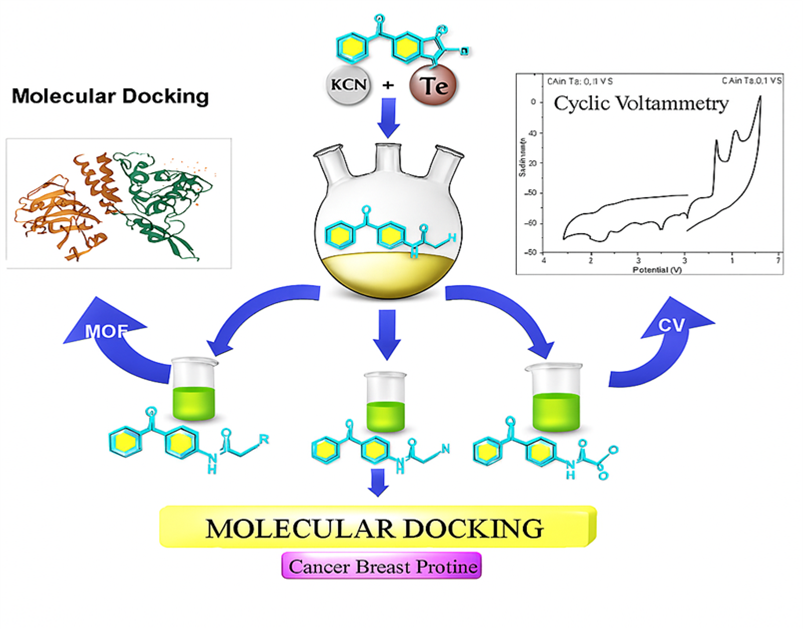
The purposes of the present study, scale up a new series of tellurium compounds based on N-(4-benzoylphenyl)-2-chloroacetamide (4-CAP), Tellurium metal (Te), potassium cyanide (KCN) & dimethyl sulfoxide (DMSO) as a solvent. This reaction is carried out in an inert atmosphere in the argon gas (Ar) is needed to get N-(4-benzoylphenyl)-2-Tellerocyanatoacetamide; beyond this, derivatives are synthesized, and organyl tellurium trihaleds. All synthesized compounds were characterized by (FT-IR), (1H-NMR) & mass spectroscopies. The spectroscopic data were in good agreement with the proposed chemical structures of the synthesized compounds. The cyclic voltammetry of all synthesized and characterized compounds was scanned at 0.1 and 0.3 v/s. To track the number of redox states in each compound, determine the required potential for each reaction, find the potential difference and get the anodic/cathodic current ratio. To generate 3D structures of the newly compounds for molecular docking, Chemdraw software files were converted and used after energy minimization. The files were preoptimized with semiempirical AM1 method using Hyperchem 8.08 software files. The files were optimized using density functional theory (DFT) method with the B3LYP/6-31G basis set which is well proven for describing the most stable conformation and used to calculate global reactivity descriptors through Gaussian 09 also. All of these have some default values before achieving “YES”. Density functional theory (DFT) calculations were used to study the molecular structures of the synthesized organotellurium compounds. The geometry, HOMO, LUMO, and energy gap were generated from calculations of optimized structures. Comparing the HOMO energies, it was possible to study the donor and acceptor properties of the prepared organotillurium compounds. Finally, several important chemical properties such as electronegativity, electrophilicity, ionization potential, and electron affinity were calculated and discussed.
HIGHLIGHTS
- Synthesis of a new series of organotillium compounds R-Te-CN, R-Te-X3 (X=Cl, Br, I).
- Characterization of the prepared compounds using FT-IR, 1H NMR, 13C NMR and mass spectrometry.
- cyclic voltammetry (CV) study.
- Theoretical study of molecular docking against breast cancer cells.
- Theoretical study of the determination of HOMO, LUMO, and energy gap using Gaussian.
GRAPHICAL ABSTRACT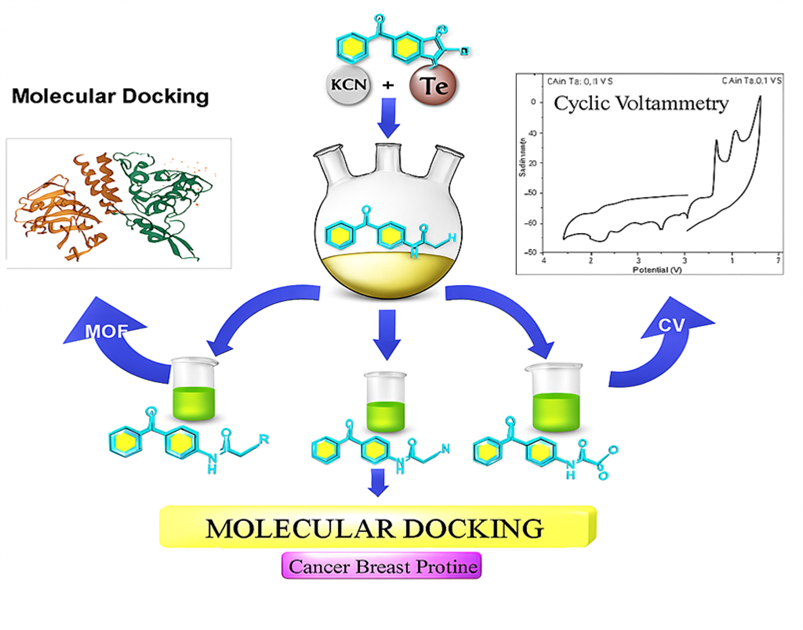
Downloads
References
C Niu, G Qiu, Y Wang, P Tan, M Wang, J Jian, H Wang, W Wu and PD Ye. Tunable chirality-dependent nonlinear electrical responses in 2D tellurium. Nano Letters 2023; 23(18), 8445-8453.
J Hader, SC Liebscher, JV Moloney and SW Koch. Microscopic analysis of linear and nonlinear electro-optical properties of tellurium. Nonlinear Frequency Generation and Conversion: Materials and Devices XXII. In: Proceedings of the SPIE LASE Conference, San Francisco, California. 2023, p. 124050D.
A Das and BK Banik. Semiconductor characteristics of tellurium and its implementations. Physical Sciences Reviews 2023; 8(12), 4659-4687.
B Huang, Z Lei, X Cao, A Wei, L Tao, Y Yang, J Liu, Z Zheng and Y Zhao. High-quality two-dimensional tellurium flakes grown by high-temperature vapor deposition. Journal of Materials Chemistry C 2021; 9(40), 14394-14400.
AH Sheaa, AA Al-Fregi, and HK Mousa. Convenient methods for the synthesis organotellurium compounds derived from pyrazole derivatives: Synthesis and antimicrobial evaluation. Phosphorus, Sulfur, and Silicon and the Related Elements 2022; 197(8), 867-875.
YS Panwar, M Aynyas, J Pataiya and SP Sanyal. Structural and electronic properties of thulium compounds. Journal of Metastable and Nanocrystalline Materials 2017; 28, 59-64.
AJ Scheen. Dulaglutide (Trulicity®) : A new once-weekly agonist of glucagon-like peptide-1 receptors for type 2 diabetes. Revue Médicale de Liège 2016; 71(3), 154-160.
M Hanias, A Anagnostopoulos, K Kambas and J Spyridelis. On the non-linear properties of TlInX2 (X = S, Se, Te) ternary compounds. Physica B: Condensed Matter 1989; 160(2), 154-160.
DMA Murad, AZ Al-Rubaie and AA Al-Najar. Conductametric studies of some organotellurium (IV) trihalides. Journal of Physics Conference Series 2019; 1279, 012079.
J Pietikainen, A Maaninen, RS Laitinen and M Nissinen. Novel tellurium halides. Phosphorus, Sulfur, and Silicon and the Related Elements 2001; 169(1), 129-132.
E Faoro, GM Oliveira and ES Lang. Synthesis and structural characterization of the novel T‐shaped Organotellurium (II) Dihalides (PyH) [mesTeClBr] and (PyH) [mesTeX2] (Py = pyridine; mes = mesityl; X = Cl, Br). Zeitschrift für Anorganische und Allgemeine Chemie 2006; 632(12‐13), 2049-2052.
R Kniep and A Rabenau. Subhalides of tellurium: In physical and inorganic chemistry. Springer 1983; 111, 145-192.
WM Ahmed, N Al-Saadawy and MI Abowd. Synthesis and characterization of a new organoselenium and organotellurium compounds depending on 9-chloro-10-nitro-9, 10-dihydroanthracene. Annals of the Romanian Society for Cell Biology 2021; 25(4), 11035-11043.
A Yousefi and A Caticha. Entropic Density Functional Theory. Entropy 2023; 26(1), 10.
A Singh, HP Gogoi and P Barman. Computational chemistry. In: P Barman and A Singh (Eds.). Schiff base metal complexes: Synthesis and applications. John Wiley & Sons, New Jersey, 2023, p. 113-118.
B Huang, GF Rudorff and OA Lilienfeld. Towards self-driving laboratories: The central role of density functional theory in the AI age. ArXiv preprint 2023. https://arxiv.org/abs/2304.03272
H Jiang and HY Sun. Density-functional theory. Quantum chemistry in the age of machine learning ed. PO Dral, Elsevier, 2023, p. 27-65.
HM Ajeel, ZT Hussain, AHK Elttayef and KM Thajeel. Study of structural, optical and electrical properties of cadmium telluride thin films. University of Thi-Qar Journal of Science 2014; 4(4), 50-55.
TT Yang and WA Saidi. Simple approach for reconciling cyclic voltammetry with hydrogen adsorption energy for hydrogen evolution exchange current. The Journal of Physical Chemistry Letters 2023; 14(18), 4164-4171.
Q Song, H Li, J Liu and S Hu. Electrodeposition of Se on carbon-supported Pt nanoparticles by cyclic voltammetry. Journal of Solid State Electrochemistry 2021; 25, 2471-2478.
Y Lin, C Lian, MU Berrueta, H Liu and R Roij. Microscopic model for cyclic voltammetry of porous electrodes. Physical Review Letters 2022; 128(20), 206001.
K Vaddi and O Wodo. Active knowledge extraction from cyclic voltammetry. Energies: Open Access Journal of Energy Research, Engineering and Policy 2022; 15(13), 4575.
S Pluczyk, M Vasylieva and P Data. Using cyclic voltammetry, UV-Vis-NIR, and EPR spectroelectrochemistry to analyze organic compounds. Journal of Visualized Experiments 2018; 140, 56656.
A Ali and N Toama. DFT/TD-DFT study of D–π–A dyes explore the NLO properties. University of Thi-Qar Journal of Science 2023; 10(1), 36-41.
P Uppathi, S Rajakumari and KV Saritha. Molecular docking: An emerging tool for target-based cancer therapy. Critical Reviews in Oncogenesis 2025; 30(1), 1-13.
Nico Martarelli, M Capurro, G Mansour, RV Jahromi, A Stella, R Rossi, E Longetti, B Bigerna, M Gentili, A Rosseto, R Rossi, C Cencini, C Emiliani, S Martino, M Beeg, M Gobbi, E Tiacci, B Falini, F Morena and VM Perriello. Artificial intelligence-powered molecular docking and steered molecular dynamics for accurate scFv selection of anti-CD30 chimeric antigen receptors. International Journal of Molecular Sciences 2024; 25(13), 7231.
NK Borah, Y Tripathi, A Tanwar, D Tiwari, A Sinha, S Sharma, N Jabalia, RJ Mani, S Santoshi and H Bansal. Artificial Intelligence‐Powered Molecular Docking: A Promising Tool for Rational Drug Design. In: A Khanna, M El Barachi, S Jain, M Kumar and A Nayyar (Eds.). Artificial Intelligence and Machine Learning in Drug Design and Development. Wiley & Sons, New Jersey, 2023, p. 157-188.
A Dighe and AE Tajamulhaq. An Overview of Molecular Docking. Asian Journal of Pharmaceutical Research 2024; 14(3), 336-340.
SK Nayak and B Ray, Molecular Docking: Concept and Application. Novel Aspects on Pharmaceutical Research 2023; 1, 35-48.
E Thejeel and AH Mekky. Synthesis, absorption, distribution, metabolism, excretion, toxicology (ADMET) and molecular docking studies of some pyridin-2 (1H)-one derived from a apocynin in Thi-Qar Governorate. University of Thi-Qar Journal of Science 2023; 10(2), 73-80.
S Kanwar and S Sharma. Thienopyrimidines as hetryl moiety in 2-azetidinones: Synthesis of 4-hetryl-2-azetidinones. ChemInform: Selected Abstracts in Chemistry 2005; 44, 2367-2371.
R Iwamoto. FT-IR/NIR spectroscopic study of interactions between water and alkylamines. Bulletin of the Chemical Society of Japan 2019; 92(6), 1117-1126.
JR Sohn and JT Kim. Infrared study of alkyl ketones adsorbed on the interlamellar surface of montmorillonite. Langmuir: The ACS Journal of Surfaces and Colloids 2000; 16(12), 5430-5434.
A Mukherjee, S Tothadi, S Chakraborty, S Ganguly and GR Desiraju. Synthon identification in co-crystals and polymorphs with IR spectroscopy: Primary amides as a case study. CrystEngComm 2013; 15(23), 4640-4654.
MR Mucalo, RP Cooney and GA Wright. Fourier-transform infrared studies of the corrosion of nickel in aqueous cyanide media. Journal of the Chemical Society, Faraday Transactions 1990; 86(7), 1083-1086.
F Cataldo. 13C NMR and FT-IR spectra of thiocyanogen, S2 (CN) 2, selenocyanogen, Se2 (CN) 2, and related compounds. Polyhedron 2000; 19(6), 681-688.
AM Daoud and HA Mahdi. Synthesis, characterization and evaluation biological activity of new schiff base compounds and their complexes with some transition elements. University of Thi-Qar Journal of Science 2017; 6(2), 81-90.
DL Joo, DJ Clouthier and R Judge. Experimental proof of the case (ab) coupling hypothesis in the first excited triplet state of selenoformaldehyde (H 2 C= Se). The Journal of Chemical Physics 2000; 112(5), 2285-2291.
Y Cao, F Lei, Y Li, S Qiu, Yan Wang, W Zhang and Z Zhan. A MOF-derived carbon host associated with Fe and Co single atoms for Li–Se batteries. Journal of Materials Chemistry A: Materials for Energy and Sustainability 2021; 9(29), 16196-16207.
AK Rashid, RB Yahya and PS Wai. Synthesis of spectral, thermal and electrochemical properties of new thermally stable: Blue light emitting materials based aromatic polyamide. Asian Journal of Chemistry 2014; 26(13), 3854.
D Leitz, A Virmani, Y Morgenstern, F Zischka and AJ Kornath. Preparation and structure of protonated selenourea. European Journal of Inorganic Chemistry 2018; 2018(47), 5053-5057.
M Aja, M Jaya , KV Nair and IH Joe. FT-IR spectroscopy as a sentinel technology in earthworm toxicology. Spectrochimica Acta Part A: Molecular and Biomolecular Spectroscopy 2014; 120, 534-541.
LA Naser, AF Nasir and ZM Mahdi. Synthesis, characterization, antimicrobial activity and computational study of new 3-(1-methyl-2-((1E, 2E)-3-phenylallylidene) hydrazinyl)-5-phenyl-4H-1, 2, 4-triazole with some transition metal ions. University of Thi-Qar Journal of Science 2023; 10(1), 144-149.
NG Salih and HR Obayes. Theoretical study of [N]-Helicene structure (N= 6, 12, 18, 24, 30, 36, 42, 48, 54) using DFT. Solid State Technology 2021; 64(2), 3909-3919.
X Wang and TC Berkelbach. Excitons in solids from periodic equation-of-motion coupled-cluster theory. Journal of Chemical Theory and Computation 2020; 16(5), 3095-3103.
AM Khuodhair, FN Ajeel and MO Oleiwi. Density functional theory investigations for the electronic and vibrational properties of donor-acceptor system. Journal of Applied Physical Science International 2016; 6(4), 202-209.
RM Kubba and MA Mohammed. Theoretical and experimental study of corrosion behavior of carbon steel surface in 3.5% NaCl and 0.5 M HCl with different concentrations of quinolin-2-one derivative. Baghdad Science Journal 2022; 19(1), 105-120.
RM Kubba, MA Mohammed and LS Ahamed. DFT calculations and experimental study to inhibit carbon steel corrosion in saline solution by quinoline-2-one derivative: Carbon steel corrosion. Baghdad Science Journal 2021; 18(1), 0113.
S Sowlati-Hashjin, M Karttunen and CF Matta. Manipulation of diatomic molecules with oriented external electric fields: linear correlations in atomic properties lead to nonlinear molecular responses. The Journal of Physical Chemistry A 2020; 124(23), 4720-4731.
AS Alwan, SK Ajeel and ML Jabbar. Theoretical study for Coronene and Coronene-Al, B, C, Ga, In and Coronene-O interactions by using density functional theory. University of Thi-Qar Journal of Science 2019; 14(4), 1-14.
HM El-Lateef, S Shaaban, MM Khalaf, A Toghan and K Shalabi. Synthesis, experimental, and computational studies of water soluble anthranilic organoselenium compounds as safe corrosion inhibitors for J55 pipeline steel in acidic oilfield formation water. Colloids and Surfaces A: Physicochemical and Engineering Aspects 2021; 625, 126894.
S Millefiori and A Alparone. Second hyperpolarisability of furan homologues C4H4X (X= O, S, Se, Te): Ab initio HF and DFT study. Chemical Physics Letters 2000; 332(1-2), 175-180.
ML Jabbar. Theoretical study for the interactions of Coronene-Y interactions by using Density functional theory with hybrid function. University of Thi-Qar Journal 2018; 13(3), 28-41.
FH Hanoon, ML Jabbar and AS Alwan. Effect of thickness on the fractal optical modulator for MgF 2, LiF, AL 2 O 3 materials by testing modulation transfer function (MTF). Journal of College of Education for Pure Science 2017; 7(4), 168-182.
V Coropceanu, O Kwon, B Wex, BR Kaafarani, NE Gruhn, JC Durivage, DC Neckers and JL Brédas. Vibronic coupling in organic semiconductors: The case of fused polycyclic benzene-thiophene structures. Chemistry–A European Journal 2006; 12(7), 2073-2080.
H.S Mohammed and NH Al-Saadawy. Synthesis, characterization, and theoretical study of novel charge-transfer complexes derived from 3, 4-selenadiazobenzophenone. Indonesian Journal of Chemistry 2022; 22(6), 1663-1672.
M Panhans, S Hutsch, J Benduhn, KS Schellhammer, VC Nikolis, T Vangerven, K Vandewal and F Ortmann. Molecular vibrations reduce the maximum achievable photovoltage in organic solar cells. Nature Communications 2020; 11(1), 1488.
AJ Hameed, M Ibrahim and H ElHaes. Computational notes on structural, electronic and QSAR properties of [C60] fulleropyrrolidine-1-carbodithioic acid 2; 3 and 4-substituted-benzyl esters. Journal of Molecular Structure: THEOCHEM 2007; 809(1-3), 131-136.
AB Ahmed. Studying the electronic characteristics and physisorption of OTS on the pure silver surfaces (Ag10), (Ag15) and (Ag18). University of Thi-Qar Journal of Science 2023; 10(2), 151-159.
MJ Sani. Spin-orbit coupling effect on the electrophilicity index, chemical potential, hardness and softness of neutral gold clusters: A relativistic ab-initio study. HighTech and Innovation Journal 2021; 2(1), 38-50.
HG Kim and HJ Choi. Thickness dependence of work function, ionization energy, and electron affinity of Mo and W dichalcogenides from DFT and GW calculations. Physical Review B: Condensed Matter and Materials Physics 2021; 103(8), 085404.
KA Al-ali. Theoretical study of the structural and electronic properties of the phenol, phenoxy. University of Thi-Qar Journal of Science 2011; 3(1), 89-88.
J Sadlej, JC Dobrowolski and JE Rode. VCD spectroscopy as a novel probe for chirality transfer in molecular interactions. Chemical Society Reviews 2010; 39(5), 1478-1488.
Published
How to Cite
Issue
Section
License
Copyright (c) 2025 Walailak University

This work is licensed under a Creative Commons Attribution-NonCommercial-NoDerivatives 4.0 International License.





