
Synthesis, Structural Analysis, and Theoretical Study of Amino Acid-Copper (II) Complexes via XRD and DFT
DOI:
https://doi.org/10.48048/tis.2025.10405Keywords:
Amino acid, Cu complexes, X-ray, Density Functional Theory, HOMO, LUMO, Electronic structure, Computational chemistry, Copper, Alanine, Histidine, LysineAbstract
New amino acid derivatives were synthesized to create copper (II) complexes, with the binding site influenced by pH levels. These complexes, derived from amino acids like alanine, histidine, tryptophan, and lysine, were characterized using various spectroscopic techniques, including IR, UV-Vis, and X-ray diffraction, which confirmed their expected crystal forms. Density functional theory (DFT) calculations were employed to analyze the electronic structures and stability of the complexes, revealing a correlation between the highest occupied molecular orbital (HOMO), lowest unoccupied molecular orbital (LUMO), energy gaps and their reactivity, thus aiding in the rational design of these compounds for applications in catalysis and biomimetic chemistry.
HIGHLIGHTS
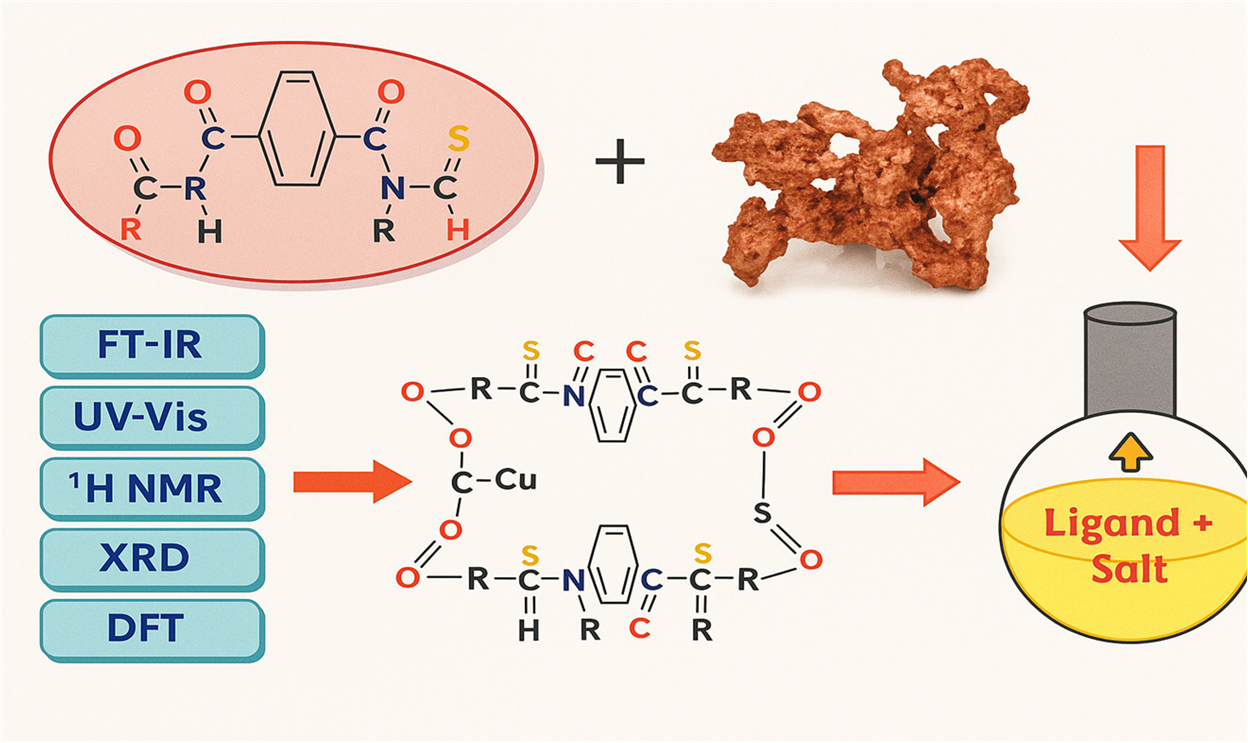
- New complexes were successfully prepared by reacting amino acids with terephthaloyl isothiocyanate (TPI).
- Study the reactivity of the isothiocyanate group (–N=C=S) of TPI with the amino (–NH₂) and carboxyl (–COOH) functional groups in amino acids.
- FT-IR: Confirm bond formation (e.g., C=O, C=S, N–H stretching vibrations) and peak shifts due to complexation.
- NMR (1H): Identify chemical shift changes indicative of coordination or hydrogen bonding.
- X-ray diffraction (XRD): Determine crystallinity or amorphous nature.
- Optimized geometry, HOMO-LUMO energies, and global reactivity descriptors (e.g., hardness, electrophilicity).
GRAPHICAL ABSTRACT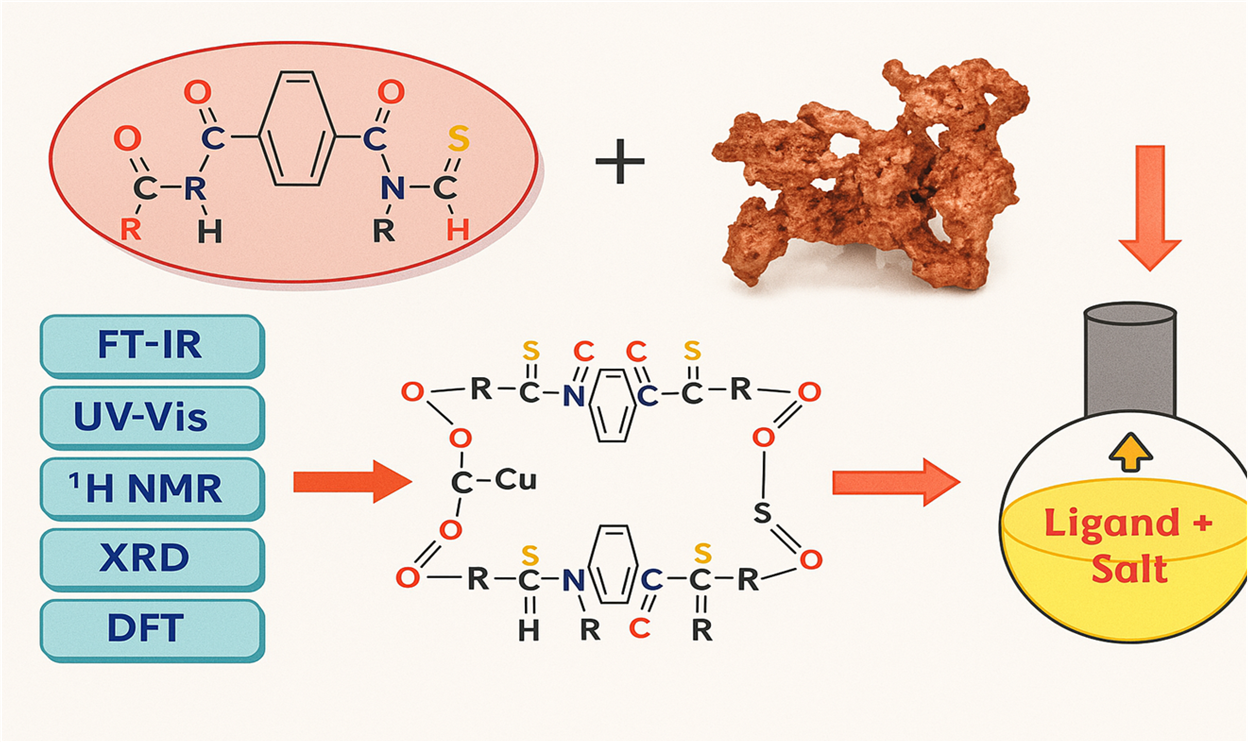
Downloads
References
SA Aly, SS Hassan, HA El-Boraey, A Eldourghamy, EM Abdalla, FM Alminderej and HH Elganzory. Synthesis, biological activity, and the effect of ionization radiation on the spectral, XRD, and TGA analysis of Cu (I), Cu (II), Zn (II), and Cd (II) complexes. Arabian Journal for Science and Engineering 2024; 49(1), 361-379.
A Ashraf, MG El-Desouky and M El-Afify. Thermal and spectroscopic studies of some prepared metal complexes and investigation of their potential anticancer and antiviral drug activity against SARS-CoV-2 by molecular docking simulation. Biointerface Resarch in Applied Chemistry 2021; 12, 1053-1075.
L Peng, H Wang and C Guo. Copper-catalyzed enantioselective difluoromethylation of amino acids via difluorocarbene. Journal of the American Chemical Society 2021; 143(17), 6376-6381.
S Zehra, T Roisnel and F Arjmand. Enantiomeric amino acid schiff base copper (II) complexes as a new class of RNA-targeted metallo-intercalators: Single X-ray crystal structural details, comparative in vitro DNA/RNA binding profile, cleavage, and cytotoxicity. ACS Omega 2019; 4(4), 7691-7705.
MS Refat, Q Mohsen, AMA Adam, and HH Eldaroti. Synthesis and characterization of complexes formed by Fe (III), Cr (III), Co (II), Cu (II), Cd (II), and Ag (I) ions with the drug captopril and the amino acid glycine. Bulletin of the Chemical Society of Ethiopia 2025; 39(6), 1137-1152.
L Wei, Q Zhu, SM Xu, X Chang and CJ Wang. Stereodivergent synthesis of α, α-disubstituted α-amino acids via synergistic Cu/Ir catalysis. Journal of the American Chemical Society 2018; 140(4), 1508-1513.
E Pahonțu, CED Pîrvu, DC Vișan, LI Socea, TV Apostol, C Oprean, V Păunescu, A Ungurianu, DM Margină, I Codiță, S Dumitrescu, D Drăgănescu and G Lupașcu. Evaluation of antimicrobial, antitumor, antioxidant activities, and molecular docking studies of some Co (II), Cu (II), Mn (II), Ni (II), Pd (II), and Pt (II) complexes with a schiff base derived from 2‐chloro‐5‐(trifluoromethyl) aniline. Applied Organometallic Chemistry 2025; 39(2), 7829.
Y Aimene, 2019. Synthèse et étude physico-chimique des complexes de rhénium (I) avec des ligands contenant le pharmacophore sulfonamide: Approche expérimentale et théorique. Ph. D. Disserttation. University of Guelma, Guelme, Algeria.
D Loreto, G Ferraro and A Merlino. Protein-metallodrugs interactions: Effects on the overall protein structure and characterization of Au, Ru and Pt binding sites. International Journal of Biological Macromolecules 2020; 163, 970-976.
A Merlino. Recent advances in protein metalation: Structural studies. Chemical Communications 2021; 57(11), 1295-1307.
ME Cucciolito, A D’Amora, GD Feo, G Ferraro, A Giorgio, G Petruk, DM Monti, A Merlino and F Ruffo. Five-coordinate platinum (II) compounds containing sugar ligands: Synthesis, characterization, cytotoxic activity, and interaction with biological macromolecules. Inorganic Chemistry 2018; 57(6), 3133-3143.
N Asadi, M Ramezanzadeh, G Bahlakeh and B Ramezanzadeh. Theoretical MD/DFT computer explorations and surface-electrochemical investigations of the zinc/iron metal cations interactions with highly active molecules from Lemon balm extract toward the steel corrosion retardation in saline solution. Journal of Molecular Liquids 2020; 310, 113220.
RA Shaw. The completeness properties of Gaussian‐type orbitals in quantum chemistry. International Journal of Quantum Chemistry 2020; 120(17), 26264.
J McClain, Q Sun, GKL Chan and TC Berkelbach. Gaussian-based coupled-cluster theory for the ground-state and band structure of solids. Journal of Chemical Theory and Computation 2017; 13(3),1209-1218.
F Pereira, K Xiao, DA Latino, C Wu, Q Zhang and JA Sousa. Machine learning methods to predict density functional theory B3LYP energies of HOMO and LUMO orbitals. Journal of Chemical Information and Modeling 2017; 57(1), 11-21.
FN Ajeel, AM Khudhair and AA Mohammed. Density functional theory investigation of the physical properties of dicyano pyridazine molecules. International Journal of Science and Research 2015; 4(4), 2334-2339.
FN Ajeel. Analytical insight into the effect of electric field on molecular properties of Homonuclear Diatomic Molecules. Current Smart Materials 2017; 2(2), 53-61.
AS Alwan, SK Ajeel and ML Jabbar. Theoretical study for Coronene and Coronene-Al, B, C, Ga, In and Coronene-O interactions by using Density Functional theory. Univesity of Thi-Qar Journal 2019; 14(4), 1-14.
AH Al-Taher, HK Mejbel, LF Al-Badry and WS Abdul-Hassan. Influence of end groups (4F, 4Br, 4CF3, and 4CBr3) of non-fullerene acceptor molecules on the performance of organic solar cells. The Journal of Nanoparticle Research 2025; 27(4), 96.
FH Hanoon, ML Jabbar and AS Alwan. Effect of thickness on the fractal optical modulator for MgF2, LiF, AL2O3 materials by testing modulation transfer function (MTF). Journal of Education for Pure Science 2017; 7(4), 168-182.
EK Hamd, AS Alwan and IK Irthiea. Study the effect of welding heat input on the microstructure, hardness, and impact toughness of AISI 1015 steel. Al-Khwarizmi Engineering Journal 2018; 14(1), 118-27.
AS Alwan. Density functional theory investigation of (C4H2N2) 3 nanocluster and (C4H2N2) 3--P, Al, As, B, C and in nanoclusters. AIP Conference Proceedings 2020; 2292(1), 030013.
M Pervaiz, I Ahmad, M Yousaf, S Kirn, A Munawar, Z Saeed, A Adnan, T Gulzar, T Kamal, A Ahmad and A Rashid. Synthesis, spectral and antimicrobial studies of amino acid derivative schiff base metal (Co, Mn, Cu, and Cd) complexes. Spectrochimica Acta Part A: Molecular and Biomolecular Spectroscopy 2019; 206, 642-649.
A Wojciechowska, J Janczak, W Zierkiewicz, P Rytlewski, T Rojek and M Duczmal. Copper (II) complex with L-arginine–crystal structure, DFT calculations, spectroscopic, thermal and magnetic properties. Materials Chemistry and Physics 2019; 228, 272-284.
N Chetry, TG Devi and T Karlo. Synthesis and characterization of metal complex amino acid using spectroscopic methods and theoretical calculation. Journal of Molecular Structure 2022; 1250, 131670.
GV Gurskaya. The molecular structure of amino acids: Determination by X-ray diffraction analysis. Springer Science & Business Media, Academy of Sciences of the USSR, Moscow, Russia, 2012.
W Nbili, M Runde, RA Timothy, F Lefebvre, W Kamisky, CB Nasr and K Kaabi. Investigation on X-ray diffraction, IR, UV-visible, fluorescence, thermogravimetric, DFT studies, and molecular docking approach of a new C6H17·16Cl3CuN3O0.58 complex. Journal of Molecular Structure 2025; 1326, 141049.
Published
How to Cite
Issue
Section
License
Copyright (c) 2025 Walailak University

This work is licensed under a Creative Commons Attribution-NonCommercial-NoDerivatives 4.0 International License.





