
Enhancing Supercapacitor Performance with Multilayered Tungsten (VI) Oxide Nanoparticles/Reduced Graphene Oxide and Activated Carbon
DOI:
https://doi.org/10.48048/tis.2025.10377Keywords:
Hybrid graphene-metal oxide materials, Tungsten Oxide (WO3), Reduced Graphene Oxide (rGO), Activated carbon, Supercapacitor performanceAbstract
Developing hybrid graphene-metal oxide materials is crucial for advancing high-performance supercapacitor electrodes due to their unique pseudocapacitive properties and scalability. This study presents a cost-effective approach to fabricating multilayer supercapacitor electrodes by integrating tungsten (VI) oxide (WO₃) nanoparticles with reduced graphene oxide (rGO) sheets (18.20 ± 0.12 mm). WO₃ nanoparticles (21.56 ± 1.83 nm) were deposited onto rGO sheets to enhance pseudocapacitive behavior, forming a WO3/rGO nanocomposite. Additionally, activated carbon (6.36 ± 0.32 mm) derived from durian peels and carbon from durian peel ash were incorporated as composite layers, providing a sustainable alternative for electrode fabrication. A screen-printed electrode with an approximately 500 µm-thick WO₃/rGO layer achieved an impressive specific capacitance of 733.30 F·g⁻¹ at a current density of 1 A·g⁻¹ and exhibited excellent cyclic stability, retaining 95 % of its capacitance after 5,000 charge-discharge cycles. This innovative approach offers a sustainable and efficient strategy for enhancing supercapacitor performance, with promising implications for enhancing energy storage capacity in next-generation technologies.
HIGHLIGHTS
- Developed a low-cost multilayer supercapacitor using WO₃/rGO nanocomposites.
- Incorporated activated carbon from durian peels for sustainable electrode layers.
- Achieved a specific capacitance of 733.30 F·g⁻¹ at 1 A·g⁻¹.
- Retained 95% capacitance after 5,000 charge-discharge cycles.
- Provides an efficient and eco-friendly solution for energy storage systems.
GRAPHICAL ABSTRACT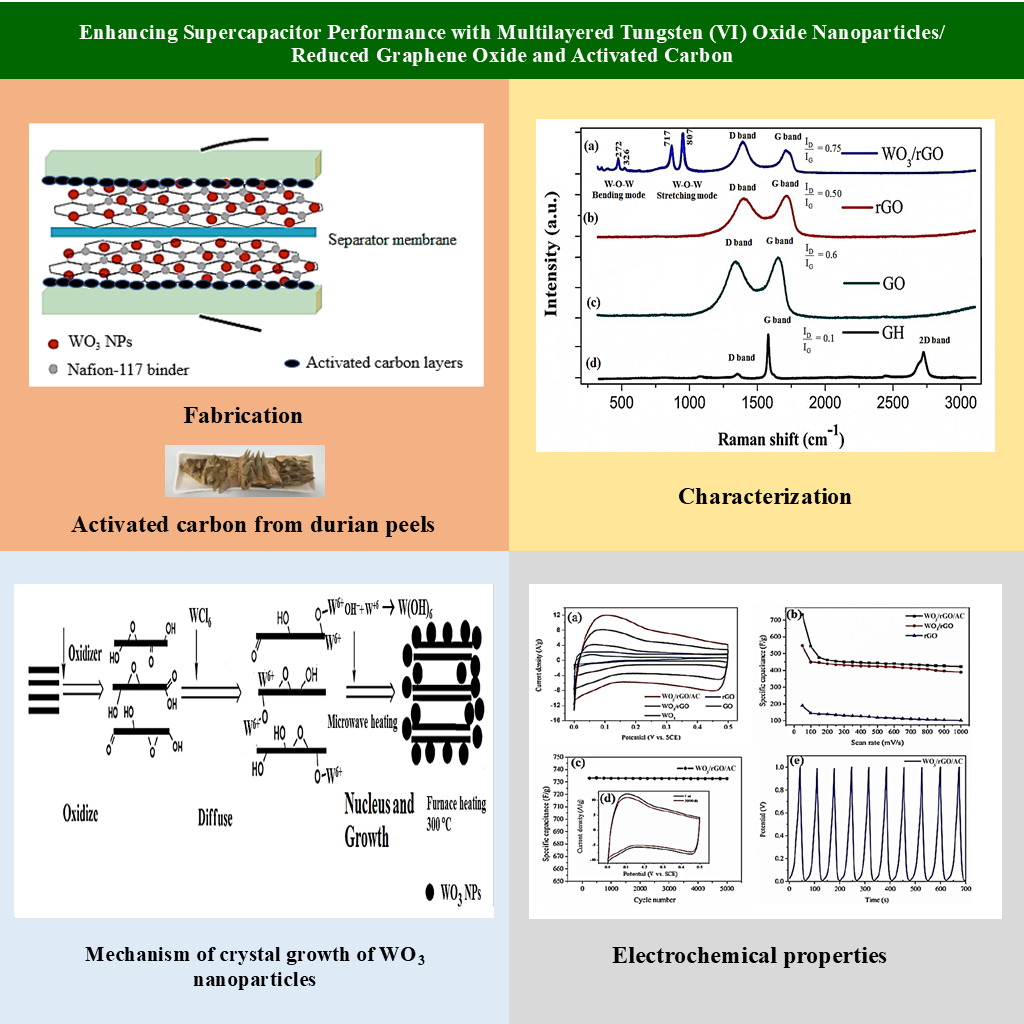
Downloads
References
M Khan, MN Tahir, SF Adil, HU Khan, MRH Siddiqui, AA Al-warthan and W Treme. Graphene-based metal and metal oxide nanocomposites: Synthesis, properties, and their applications. J. Mater. Chem. A 2015; 3(37), 18753-18808.
DC Marcano, DV Kosynkin, JM Berlin, A Sinitskii, Z Sun, A Slesarev, LB Alemany, W Lu and JM Tour. Improved synthesis of graphene oxide. ACS Nano 2010; 4(8), 4806-4814.
J Wei, T Vo and F Inam. Epoxy/graphene nanocomposites-processing and properties: A review. RSC Advances 2015; 5(90), 73510-73524.
SD Dabhi, SD Gupta and PK Jha. Structural, electronic, mechanical, and dynamical properties of graphene oxides: A first-principles study. J. Appl. Phys. 2014; 115(20), 203517.
J Li, X Zeng, T Ren and EV der Heide. The preparation of graphene oxide and its derivatives and their application in bio-tribological systems. Lubricants 2014; 2(3), 137-161.
S Pei and HM Cheng. The reduction of graphene oxide. Carbon 2012; 50(9), 3210-3228.
MTH Aunkor, IM Mahbubul, R Saidurb and HSC Metselaar. The green reduction of graphene oxide. RSC Advances 2016; 6(33), 27807-27828.
HJ Shin, KK Kim, A Benayad, SM Yoon, HK Park, IS Jung, MH Jin, HK Jeong, JM Kim, JY Choi and YH Lee. Efficient reduction of graphite oxide by sodium borohydride and its effect on electrical conductance. Adv. Funct. Mater. 2009; 19(12), 1987-1992.
B Gurzęda, P Florczak, M Wiesner, M Kempinski, S Jurgabe and P Krawczyk. Graphene material prepared by thermal reduction of the electrochemically synthesized graphite oxide. RSC Advances 2016; 6(67), 63058-63063.
D Voiry, J Yang, J Kupferberg, R Fullon, C Lee, HY Jeong, HS Shin and M Chhowalla. High-quality graphene via microwave reduction of solution-exfoliated graphene oxide. Science 2016; 353(6306), 1413-1416.
H Yoo, Y Kim, J Lee, H Lee, Y Yoon, G Kim and H Lee. n-Type reduced graphene oxide field-effect transistors (FETs) from photoactive metal oxides. Chem. Euro. J. 2012; 18(16), 4923-4929.
RYN Gengler, DS Badali, D Zhang, K Dimos, K Spyrou, D Gournis and RJD Miller. Revealing the ultrafast process behind the photoreduction of graphene oxide. Nature Communications 2013; 4, 2560.
M Toselli, D Fabiani, P Mancinelli, M Frechette, T Heid, E David and A Saccani. In situ thermal reduction of graphene oxide forming epoxy nanocomposites and their dielectric properties. Polymer Composites 2015; 36(2),
-301.
S Wu, Q Jia and W Dai. Synthesis of RGO/TiO2 hybrid as a high-performance photocatalyst. Ceram. Int. 2017; 43(1), 1530-1535.
Y Wang, H Guan, C Dong, X Xiao, S Du and Y Wang. Reduced graphene oxide (RGO)/Mn3O4 nanocomposites for dielectric loss properties and electromagnetic interference shielding effectiveness at high frequency. Ceram. Int. 2016; 42(1), 936-942.
K Anand, O Singh, MP Singh, J Kaur and RC Singh. Hydrogen sensor based on graphene/ZnO nanocomposite. Sens. Actuators B Chem. 2014; 195, 409-415.
S Kumar, AK Ojha and B Walkenfort. Cadmium oxide nanoparticles grown in situ on reduced graphene oxide for enhanced photocatalytic degradation of methylene blue dye under ultraviolet irradiation. J. Photochem. Photobiol. B 2016; 159, 111-119.
L Khandare and DJ Late. MoO3-rGO nanocomposites for electrochemical energy storage. Appl. Surf. Sci. 2017; 418, 2-8.
Z Ji, X Shen, M Li, H Zhou, G Zhu and K Chen. Synthesis of reduced graphene oxide/CeO2 nanocomposites and their photocatalytic properties. Nanotechnology 2013; 24(11), 115603.
Y Yang, ZA Hu, ZY Zhang, FH Zhang, YJ Zhang, PJ Liang, HY Zhang and HY Wu. Reduced graphene oxide-nickel oxide composites with high electrochemical capacitive performance. Mater. Chem. Phys. 2012; 133(1), 363-368.
C Xiang, M Li, M Zhi, A Manivannan and N Wu. A reduced graphene oxide/Co3O4 composite for supercapacitor electrode. J. Power Sources 2013; 226, 65-70.
R Bhargava and S Khan. Superior dielectric properties and bandgap modulation in hydrothermally grown Gr/MgO nanocomposite. Phys. Lett. A 2019; 383(14), 1671-1676.
D Sanchez-Martinez, AMDL Cruz and E Lopez-Cuellar. Synthesis of WO3 nanoparticles by citric acid-assisted precipitation and evaluation of their photocatalytic properties. Mater. Res. Bull. 2013; 48(2), 691-697.
Q Xiang, GF Meng, HB Zhao, Y Zhang, H Li, WJ Ma and JQ Xu. Au nanoparticle modified WO3 nanorods with their enhanced properties for photocatalysis and gas sensing. J. Phys. Chem. 2010; 114(5), 2049-2055.
L Santos, CM Silveira, E Elangovan, JP Neto, D Nunes, L Pereira, R Martins, J Viegas, JJG Moura, S Todorovic, MG Almeida and E Fortunato. Synthesis of WO3 nanoparticles for biosensing applications. Sens. Actuators B Chem. 2016; 223, 186-194.
D Shao, M Yu, J Lian and S Sawyer. Ultraviolet photodetector fabricated from 3D WO3 nanowires/reduced graphene oxide composite material. MRS Proc. 2014; 1659, 193-198.
D Mao, S Zhang, Y Wang, X Gan, W Zhang, T Mei, Y Wang, Y Wang, H Zeng and J Zhao. WS2 saturable absorber for dissipative soliton mode locking at 1.06 and 1.55 µm. Opt. Express 2015; 23(21), 27509-27519.
J Chu, D Lu, X Wang, X Wang and S Xiong. WO3 nanoflower coated with graphene nanosheet: Synergetic energy storage composite electrode for supercapacitor application. J. Alloys Compd. 2017; 702(1), 568-572.
DR Dreyer, S Park, CW Bielawski and RS Ruoff. The chemistry of graphene oxide. Chem. Soc. Rev. 2010; 39, 228-240.
S Rattanaveeranon, K Jiamwattanapong and N Jandee. Effect of durian peel ash added in zinc oxide/reduced graphene oxide composites used as a chemical sensor for hydrazine detection. Mater. Sci. Appl. 2021; 12(2), 111-120.
S Hilaire, MJ Suess, N Kranzlin, K Bienkowski, R Solarska, J Augustynski and M Niederberger. Microwave-assisted nonaqueous synthesis of WO₃ nanoparticles for crystallographically oriented photoanodes for water splitting. J. Mater. Chem. A 2014; 2(48), 20530-20537.
BS Rodrigues, M Niederberger and JS Souza. Exploring the effects of synthesis parameters on the properties and photoactivity of WO3-graphene oxide synthesized via a microwave route. Mater. Adv. 2024; 5(11), 4889-4901.
S Rattanaveeranon, K Jiamwattanapong and R Suntako. Enhancement of specific capacitance using a mixture of sweet potato ash and zinc oxide nanoparticles on reduced graphene oxide sheets. Russ. J. Appl. Chem. 2024; 97(11), 827-836.
R Bhargava and S Khan. Superior dielectric properties and bandgap modulation in hydrothermally grown Gr/MgO nanocomposite. J. Mater. Sci. 2021; 56(5), 1671–1676.
H Yang, F Li, C Shan, D Han, Q Zhang, L Niu and A Ivaska. Covalent functionalization of chemically converted graphene sheets viasilane and its reinforcement. J. Mater. Chem. 2009; 19(26), 4632-4638.
Q Zheng, G Fang, F Cheng, H Lei, W Wang, P Qin and H Zhou. Hybrid graphene-ZnO nanocomposites as electron acceptor in polymer-based bulk-heterojunction organic photovoltaics. J. Phys. D: Appl. Phys. 2012; 45(45), 455103.
B Ma, E Huang, G Wu, W Dai, N Guan and L Li. Fabrication of WO2.72/RGO nano-composites for enhanced photocatalysis. RSC Advances 2017; 7(5), 2606-2614.
N Huo, S Yang, Z Wei and J Li. Synthesis of WO3 nanostructures and their ultraviolet photoresponse properties. J. Mater. Chem. C 2013; 1(25), 3999-4007.
Y Gu, Q Zhuo and D Wu. Large-mesopore hierarchical tungsten trioxide hydrate with exposed high-energy facets: Facile synthesis and enhanced photocatalysis. Mater. Sci. Semicond. Process. 2016; 53, 18-27.
N Ahmad, S Khan, MMN Ansari and R Bhargava. A comprehensive study of structural and electrical properties of SnO2 and Sn0.95Mn0.05O2. AIP Conf. Proc. 2018, 1942(1), 050007.
M Huang, Y Wu and W Hu. A facile synthesis of reduced graphene oxide-wrapped WO3 nanowire composite and its enhanced electrochemical catalysis properties. Ceram. Int. 2014; 40(5), 7219-7225.
X An, CY Jimmy, Y Wang, Y Hu, X Yu and G Zhang. WO3 nanorods-graphene nanocomposites for high-efficiency visible-light-driven photocatalysis and NO2 gas sensing. J. Mater. Chem. 2012; 22(17), 8525-8531.
BE Turkaslan, AK Çelik, A Dalbeyler and N Fantuzzi. The effect of different morphologies of WO₃/GO nanocomposite on photocatalytic performance. Materials 2022; 15(22), 8019.
P Nagaraju, A Alsalme, AM Alkathiri and R Jayavel. Rapid synthesis of WO3-graphene nanocomposite via in-situ microwave method with improved electrochemical properties. J. Phys. Chem. Solids 2018; 120, 250-260.
A Baserga, V Russo, FD Fonzo, A Bailini, D Cattaneo, CS Casari, A Li Bassi and CE Bottani. Nanostructured tungsten oxide with controlled properties: Synthesis and Raman characterization. Thin Solid Films 2007; 515(16), 6465-6469
SH Mujawar, SB Ambade, T Battumur, RB Ambade and SH Lee. Electropolymerization of polyaniline on titanium oxide nanotubes for supercapacitor application. Electrochim. Acta 2011; 56(12), 4462-4466.
Y Yang, Y Liang, Y Zhang, Z Zhang, Z Li and Z Hu. Three-dimensional graphene hydrogel supported ultrafine RuO2 nanoparticles for supercapacitor electrodes. New J. Chem. 2015; 39(5), 4035-4040.
M Rethinasabapathy, SM Kang, SC Jang and YS Huh. Three-dimensional porous graphene materials for environmental applications. Carbon Lett. 2017; 22(1), 1-13.
CPP Wong, CW Lai, KM Lee, JC Juan and SBA Hamid. Synthesis of reduced graphene oxide/tungsten trioxide nanocomposite electrode for high electrochemical performance. Ceram. Int. 2016; 42(11), 13128-13135.
AR Ravindran, C Feng, S Huang, Y Wang, Z Zhao and J Yang. Effects of graphene nanoplatelet size and surface area on the AC electrical conductivity and dielectric constant of epoxy nanocomposites. Polymers 2018; 10(5), 477.

Published
How to Cite
Issue
Section
License
Copyright (c) 2025 Walailak University

This work is licensed under a Creative Commons Attribution-NonCommercial-NoDerivatives 4.0 International License.





