
Determination of Mercury Ions Level in River Water Using an Arduino Uno-Based TCS3200 Color Sensor with Silver Nanoparticle Indicators Synthesized from Moringa Oleifera Leaf Extract
DOI:
https://doi.org/10.48048/tis.2025.10089Keywords:
Silver nanoparticles, Color sensor TCS3200, Arduino uno, Mercury ions, Moringa oleifera leaf extract, River water, Environmental monitoringAbstract
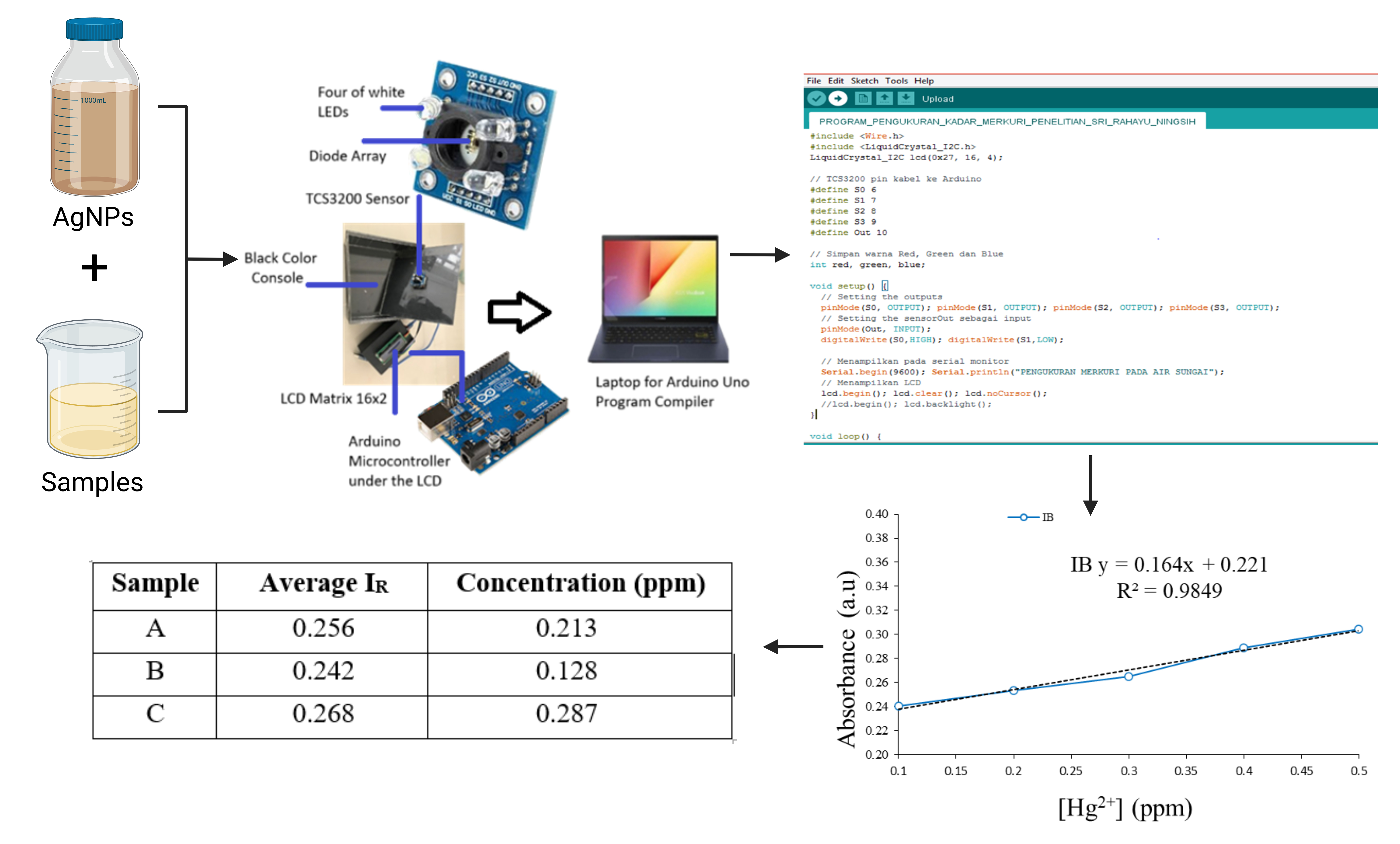
Mercury ions (Hg2+) are highly toxic due to their neurotoxic properties. They pose significant risks to organisms and humans, especially when they accumulate in the body and frequently contaminate water. An Arduino Uno-based TCS3200 color sensor utilizing silver nanoparticles (AgNPs) as indicators offer a promising alternative for detecting Hg2+. This approach is characterized by its simplicity, cost-effectiveness, environmental friendliness, and effectiveness for real-time detection in resource-limited areas. This study synthesized AgNPs from the ethyl acetate extract of Moringa oleifera leaves. These AgNPs were tested for selectivity against various metals commonly found in aquatic environments. Once the selective metals were identified, sensitivity and selectivity tests were conducted to confirm that the sensor accurately measures specific analytes, even in the presence of other components within a sample. The results showed that the synthesized AgNPs are highly selective and specific for Hg2+ ions, achieving an accuracy range of 89.3 - 110 %. The sensor can detect Hg2+ ions with a detection limit (DL) of 0.069 ppm. Analysis of river water samples revealed Hg2+ concentrations ranging from 0.128 to 0.287 ppm. Hg2+ concentration was measured using a TCS3200 color sensor and validated against UV-Vis spectrophotometry. This confirmed its comparable results and effectiveness for accurate Hg2+ detection in real-world water samples and resource-limited areas.
HIGHLIGHTS
- Silver nanoparticles (AgNPs) were synthesized from Moringa oleifera leaf extract for mercury detection using a TCS3200 color sensor.
- High selectivity and sensitivity for Hg2+ ions were achieved, with a detection limit of 0.069 ppm and accuracy of 89.3 - 110 %.
- The sensor’s performance was validated against UV-Vis spectrophotometry, showing comparable results.
- The method was applied to river water samples, with Hg2+ concentrations detected between 0.128 and 0.287 ppm, and applicable for real-time monitoring for resource-limited areas.
GRAPHICAL ABSTRACT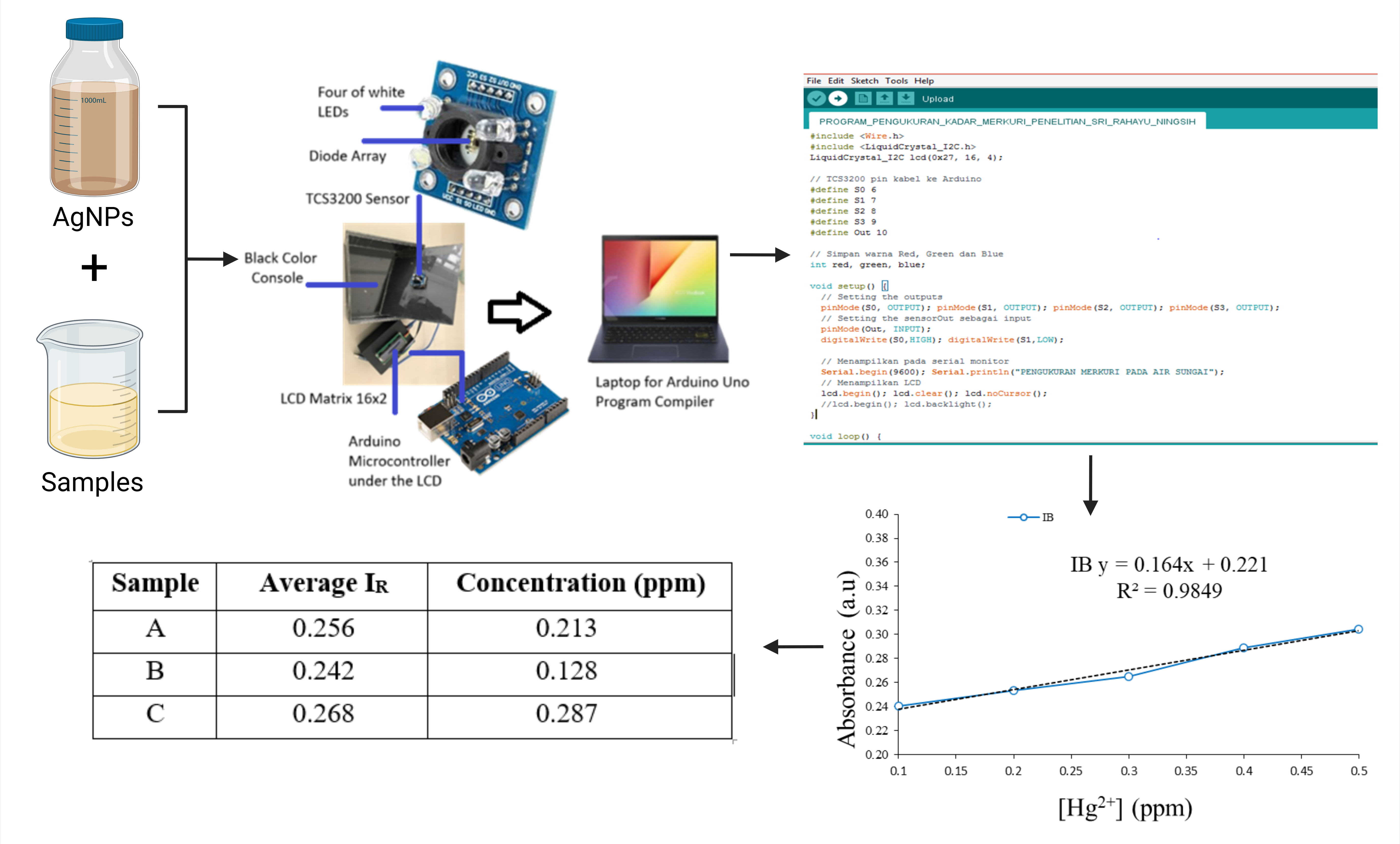
Downloads
References
S Song, Y Li, QS Liu, H Wang, P Li, J Shi, L Hu, H Zhang, Y Liu, K Li, X Zhao and Z Cai. Interaction of mercury ion (Hg²⁺) with blood and cytotoxicity attenuation by serum albumin binding. Journal of Hazardous Materials 2021; 412, 125158.
PB Tchounwou, CG Yedjou, AK Patlolla and DJ Sutton. Heavy metal toxicity and the environment. In: A Luch (Ed.). Molecular, clinical and environmental toxicology. Springer Basel, Basel, Switzerland, 2012.
S Singh, A Numan, Y Zhan, V Singh, TV Hung and ND Nam. A novel highly efficient and ultrasensitive electrochemical detection of toxic mercury (II) ions in canned tuna fish and tap water based on a copper metal-organic framework. Journal of Hazardous Materials 2020; 399, 123042.
Y Wang, L Zhang, X Han, L Zhang, X Wang and L Chen. Fluorescent probe for mercury ion imaging analysis: Strategies and applications. Chemical Engineering Journal 2021; 406, 127166.
F Huisa-Mamani, A Arizaca-Avalos and OE Llanque-Maquera. Mercury pollution in water, soil, and biota induced by artisanal gold mining: A case study from Ananea District, Puno, Peru. Journal of Degraded and Mining Lands Management 2025; 12(2), 7159-7171.
P Prema, V Veeramanikandan, K Rameshkumar, MK Gatasheh, AA Hatamleh, R Balasubramani and P Balaji. Statistical optimization of silver nanoparticle synthesis by green tea extract and its efficacy on colorimetric detection of mercury from industrial wastewater. Environmental Research 2022; 204, 111915.
S Balasurya, A Syed, AM Thomas, N Marraiki, S Al-Rashed, AM Elgorban, LL Raju, A Das and SS Khan. Colorimetric detection of mercury ions from environmental water sample by using 3-(Trimethoxysilyl)propyl methacrylate functionalized Ag NPs-tryptophan nanoconjugate. Journal of Photochemistry and Photobiology B: Biology 2020; 207, 111888.
D King, M Watts, E Hamilton, R Mortimer, M Coffey, O Osano and MD Bonito. Mercury speciation in environmental samples associated with artisanal small-scale gold mines using a novel solid-phase extraction approach to sample collection and preservation. Environmental Geochemistry and Health 2024; 46(11), 481.
J Słowik and H Ćwirko. The impact of mercury on human health. Medical Science Pulse 2024; 18(4), 39-52.
AA Lysenko. Hygienic and biochemical aspects of the effect of mercury on the human body (literature review). Hygiene and Sanitation 2024; 103(11), 1447-1451.
FH Narouei, L Livernois, D Andreescu and S Andreescu. Highly sensitive mercury detection using electroactive gold-decorated polymer nanofibers. Sensors and Actuators B: Chemical 2021; 329, 129267.
World Health Organization. Mercury and human health: Educational course. World Health Organization, Geneva, Switzerland, 2021.
E Mohammed, T Mohammed and A Mohammed. Optimization of instrument conditions for the analysis of mercury, arsenic, antimony and selenium by atomic absorption spectroscopy. MethodsX 2018; 5, 824-833.
Z Wittmann. Determination of mercury by atomic-absorption spectrophotometry. Talanta 1981; 28(4), 271-273.
HI Qudus, P Purwadi, I Holilah and S Hadi. Analysis of mercury in skin lightening cream by microwave plasma atomic emission spectroscopy (MP-AES). Molecules 2021; 26(11), 3130.
V Balaram. Microwave plasma atomic emission spectrometry (MP-AES) and its applications - a critical review. Microchemical Journal 2020; 159(1997), 105483.
B Passariello, M Barbaro, S Quaresima, A Casciello and A Marabini. Determination of mercury by inductively coupled plasma-mass spectrometry. Microchemical Journal 1996; 54(4), 348-354.
SC Wilschefski and MR Baxter. Inductively coupled plasma mass spectrometry: Introduction to analytical aspects. Clinical Biochemistry Reviews 2019; 40(3), 115-133.
M Winter, F Lessmann and V Harth. A method for reliable quantification of mercury in occupational and environmental medical urine samples by inductively coupled plasma mass spectrometry. Analytical Methods 2023; 15(16), 2030-2038.
A Jabbar, A Abbas, N Assad, M Naeem-Ul-Hassan, HA Alhazmi, A Najmi, K Zoghebi, MA Bratty, A Hanbashi and HMA Amin. A highly selective Hg²⁺ colorimetric sensor and antimicrobial agent based on green synthesized silver nanoparticles using Equisetum diffusum extract. RSC Advances 2023; 13(41), 28666-28675.
E Alzahrani. Colorimetric detection based on localized surface plasmon resonance optical characteristics for sensing of mercury using green-synthesized silver nanoparticles. Journal of Analytical Methods in Chemistry 2020; 2020(4), 1-14.
D Demirezen Yılmaz, D Aksu Demirezen and H Mıhçıokur. Colorimetric detection of mercury ion using chlorophyll functionalized green silver nanoparticles in aqueous medium. Surfaces and Interfaces 2021; 22(25), 100840.
R Kataria, K Sethuraman, D Vashisht, A Vashisht, SK Mehta and A Gupta. Colorimetric detection of mercury ions based on anti-aggregation of gold nanoparticles using 3,5-dimethyl-1-thiocarboxamidepyrazole. Microchemical Journal 2019; 148, 299-305.
P Saha, MM Billah, ABMN Islam, MA Habib and M Mahiuddin. Green synthesized silver nanoparticles: A potential antibacterial agent, antioxidant, and colorimetric nanoprobe for the detection of Hg²⁺ ions. Global Challenges 2023; 7(8), e202300072.
M Ismail, W Xiangke, AA Khan and Q Khan. Amomum subalatum leaf extract-derived silver nanoparticles for eco-friendly spectrophotometric detection of Hg²⁺ ions in water. Chemical Physics Impact 2023; 6, 100148.
C Pechyen, B Tangnorawich, S Toommee, R Marks and Y Parcharoen. Green synthesis of metal nanoparticles, characterization, and biosensing applications. Sensors International 2024; 5(4), 100287.
R Memon, AA Memon, Siraj Uddin, A Balouch, K Memon, STH Sherazi, AA Chandio and R Kumar. Ultrasensitive colorimetric detection of Hg²⁺ in aqueous media via green synthesis by Ziziphus mauritiana leaf extract-based silver nanoparticles. International Journal of Environmental Analytical Chemistry 2022; 102(18), 7046-7061.
HM Mehwish, MSR Rajoka, Y Xiong, H Cai, RM Aadil, Q Mahmood, Z He and Q Zhu. Green synthesis of a silver nanoparticle using Moringa oleifera seed and its applications for antimicrobial and sun-light mediated photocatalytic water detoxification. Journal of Environmental Chemical Engineering 2021; 9(4), 105290.
ABA Mohammed, A Mohamed, NEA El-Naggar, H Mahrous, GM Nasr, A Abdella, RH Ahmed, S Irmak, MSA Elsayed, S Selim, A Elkelish, DHM Alkhalifah, WN Hozzein and AS Ali. Antioxidant and antibacterial activities of silver nanoparticles biosynthesized by Moringa oleifera through response surface methodology. Journal of Nanomaterials 2022; 2022, 9984308.
K Suganandam, A Jeevalatha, C Kandeepan, N Kavitha, N Senthilkumar, S Sutha, MA Seyed, S Gandhi, S Ramya, GGL Pushpalatha, GC Abraham and R Jayakumararaj. Profile of phytochemicals and GC-MS analysis of bioactive compounds in natural dried-seed removed ripened pods methanolic extracts of Moringa oleifera. Journal of Drug Delivery and Therapeutics 2022; 12(5-S), 133-141.
MR Bindhu, M Umadevi, GA Esmail, NA Al-Dhabi and MV Arasu. Green synthesis and characterization of silver nanoparticles from Moringa oleifera flower and assessment of antimicrobial and sensing properties. Journal of Photochemistry and Photobiology B: Biology 2020; 205, 111836.
A Pareek, M Pant, MM Gupta, P Kashania, Y Ratan, V Jain, A Pareek and AA Chuturgoon. Moringa oleifera: An updated comprehensive review of its pharmacological activities, ethnomedicinal, phytopharmaceutical formulation, clinical, phytochemical, and toxicological aspects. International Journal of Molecular Sciences 2023; 24(3), 2098.
B Padayachee and H Baijnath. An updated comprehensive review of the medicinal, phytochemical and pharmacological properties of Moringa oleifera. South African Journal of Botany 2020; 129, 304-316.
H Alkan, İH Ciğerci, MM Ali, O Hazman, R Liman, F Colă and E Bonciu. Cytotoxic and genotoxic evaluation of biosynthesized silver nanoparticles using Moringa oleifera on MCF-7 and HUVEC cell lines. Plants 2022; 11(10), 1293.
K Suhud, Z Ula, M Dayanti, MS Surbakti, MD Hadistya, S Saleha, S Saiful, AA Kacaribu and MRF Damanik. Measurement of tartrazine levels in children’s snacks in Banda Aceh using an Arduino Uno-based TCS3200 color sensor. International Journal of Design & Nature and Ecodynamics 2025; 20(1), 169-177.
MS Surbakti, M Farhan, Z Zakaria, M Isa, E Sufriadi, S Alva, E Yusibani, L Heliawati, M Iqhrammullah and K Suhud. Development of Arduino Uno-based TCS3200 color sensor and its application on the determination of Rhodamine B level in syrup. Indonesian Journal of Chemistry 2022; 22(3), 630.
K Suhud, S Sukoma, S Saleha and MS Surbakti. Development of TCS3200 color sensor based on Arduino Uno and its application in determining borax levels in food. Indonesian Journal of Fundamental and Applied Chemistry 2024, 9(2), 74-81.
K Suhud, D Utari, MS Surbakti, S Alva, AF Omar, S Saiful, L Heliawati, P Ningsih, MD Hadistya, TZ Gunana, R Idroes and AA Kacaribu. Development of TCS3200 color sensor based on Arduino Uno microcontroller for determination of capsaicin level in sauces. Sains Malaysiana 2024; 53(12), 3339-3348.
Z Fitri, M Adlim, MS Surbakti, AF Omar, FA Sijabat and S Syahreza. Mercury (II) ions assessment as a toxic waste hazard in solution based on imagery data for a part of environmental disaster management. IOP Conference Series: Earth and Environmental Science 2019; 273, 012052.
K Suhud, R Amalia, MS Surbakti, R Idroes, L Lelifajri, S Alva, H Ritonga, M Mazwan, MD Hadistya and AA Kacaribu. Arduino uno-based colorimetric sensor traction control system 3200 with AgNPs/PVP for Hg²⁺ detection in river water of Aceh Selatan Regency. Indonesia, Journal of Ecological Engineering 2025; 26(4), 45-58.
M Dayanti, S Alva, Lelifajri, Nazaruddin, Julinawati, Sukoma, S Fonna, AK Arifin, SA Hasbullah, AA Kacaribu, M Said and K Suhud. Development of a mercury sensor using voltammetry techniques based on waste tire carbon electrodes modified with Zinc Oxide doped ion imprinted polypyrrole. Sains Malaysiana 2025; 54(4), 1063-1076.
A Ogundipe, B Adetuyi, F Iheagwam, K Adefoyeke, J Olugbuyiro, O Ogunlana and O Ogunlana. In vitro experimental assessment of ethanolic extract of Moringa oleifera leaves as an α-amylase and α-lipase inhibitor. Biochemistry Research International 2022; 2022, 4613109.
G Bagheri, M Martorell, K Ramí¬rez-Alarcón, B Salehi and J Sharifi-Rad. Phytochemical screening of Moringa oleifera leaf extracts and their antimicrobial activities. Cellular and Molecular Biology 2020; 66(1), 20-26.
S Dubale, D Kebebe, A Zeynudin, N Abdissa and S Suleman. Phytochemical screening and antimicrobial activity evaluation of selected medicinal plants in Ethiopia. Journal of Experimental Pharmacology 2023; 15, 51-62.
I Maulana, B Ginting and K Azizah. Green synthesis of copper nanoparticles employing Annona squamosa L extract as antimicrobial and anticancer agents. South African Journal of Chemical Engineering 2023; 46(1), 65-71.
R Yusnaini, R Nasution, N Saidi, T Arabia, R Idroes, I Ikhsan, R Bahtiar and M Iqhrammullah. Ethanolic extract from Limonia acidissima L. fruit attenuates serum uric acid level via URAT1 in potassium oxonate-induced hyperuricemic rats. Pharmaceuticals 2023; 16(3), 419.
GM Mohammed and SN Hawar. Green biosynthesis of silver nanoparticles from Moringa oleifera leaves and its antimicrobial and cytotoxicity activities. International Journal of Biomaterials 2022; 2022, 1-10.
EA Shalaby, SMM Shanab, WMA El-Raheem and EA Hanafy. Biological activities and antioxidant potential of different biosynthesized nanoparticles of Moringa oleifera. Scientific Reports 2022; 12(1), 18400.
M Valcárcel, A Gómez-Hens and S Rubio. Selectivity in analytical chemistry revisited. Trends in Analytical Chemistry 2001; 20(8), 386-393.
P Kemala, R Idroes, K Khairan, M Ramli, B Ginting, Z Helwani, R Aulia, GM Idroes, Y Yusuf and R Efendi. Eco-friendly synthesis of silver nanoparticles: Enhancing optimization reaction, characterization, and antimicrobial properties with Lantana camara from geothermal area. South African Journal of Chemical Engineering 2025; 51(1), 57-67.
DY Lestari, A Syoufian, PL Hariani, AJ Saviola, WC Oh, AK Amin, RA Pratika and K Wijaya. Facile green synthesis of silver nanoparticles decorated on sulfonated graphene oxide by rambutan (Nephelium lappaceum) leaf extract and application as a catalyst for converting benzene into nitrobenzene. Results in Engineering 2025; 25, 104321.
S Sysak, B Czarczynska-Goslinska, P Szyk, T Koczorowski, DT Mlynarczyk, W Szczolko, R Lesyk and T Goslinski. Metal nanoparticle-flavonoid connections: Synthesis, physicochemical and biological properties, as well as potential applications in medicine. Nanomaterials 2023; 13(9), 1531.
T Hou, Y Guo, W Han, Y Zhou, VR Netala, H Li, H Li and Z Zhang. Exploring the biomedical applications of biosynthesized silver nanoparticles using Perilla frutescens flavonoid extract: Antibacterial, antioxidant, and cell toxicity properties against colon cancer cells. Molecules 2023; 28(17), 6431.
N Genc, I Yildiz, R Chaoui, R Erenler, C Temiz and M Elmastas. Biosynthesis, characterization and antioxidant activity of oleuropein-mediated silver nanoparticles. Inorganic and Nano-Metal Chemistry 2021; 51(3), 411-419.
PV Nagime, S Singh, VR Chidrawar, A Rajput, DM Syukri, NT Marwan and S Shafi. Moringa oleifera: A plethora of bioactive reservoirs with tremendous opportunity for green synthesis of silver nanoparticles enabled with multifaceted applications. Nano-Structures & Nano-Objects 2024; 40, 101404.
R Erenler and EN Gecer. Synthesis of silver nanoparticles using Sideritis montana L. leaf extract: Characterization, catalytic degradation of methylene blue and antioxidant activity. Journal of Nano Research 2022; 75, 17-28.
A Seçme, BM Bozer, A Yıldırım Kocaman, R Erenler and MH Calimli. Synthesis, characterization, and anticancer properties of Ag nanoparticles derived from walnut leaves tested on cells of L929, MCF-7 and H1299. Journal of Drug Delivery Science and Technology 2024; 94, 105478.
M Dubey, S Bhadauria and BS Kushwah. Green synthesis of nanosilver particles from extract of Eucalyptus hybrida (Safeda) leaf. Digest Journal of Nanomaterials and Biostructures 2009; 4(3), 537-543.
JM Ashraf, MA Ansari, HM Khan, MA Alzohairy and I Choi. Green synthesis of silver nanoparticles and characterization of their inhibitory effects on AGEs formation using biophysical techniques. Scientific Reports 2016; 6, 20414.
M Asif, R Yasmin, R Asif, A Ambreen, M Mustafa and S Umbreen. Green synthesis of silver nanoparticles (AgNPs), structural characterization, and their antibacterial potential. Dose-Response 2022; 20(2), 1-11.
HK Sanjeevappa, P Nilogal, R Rayaraddy, LJ Martis, SM Osman, N Badiadka and S Yallappa. Biosynthesized unmodified silver nanoparticles: A colorimetric optical sensor for detection of Hg2+ ions in aqueous solution. Results in Chemistry 2022; 4(1-11), 100507.
NM Abbasi, MU Hameed, N Nasim, F Ahmed, F Altaf, S Shahida, S Fayyaz, SM Sabir and P Bocchetta. Plasmonic nano silver: An efficient colorimetric sensor for the selective detection of Hg2+ ions in real samples. Coatings 2022; 12(6), 763.
L Burratti, I Venditti, C Battocchio, S Casciardi and P Prosposito. Silver nanoparticles with different thiol functionalization: an opposite optical behaviour in presence of Hg(II). Materials Research Proceeding 2020; 16, 6-15.
AS Rini, A Fitrisia, Y Rati, L Umar and Y Soerbakti. Bio-colloidal silver nanoparticles prepared via green synthesis using sandoricum koetjape peel extract for selective colorimetry-based mercury ions detection. Karbala International Journal of Modern Science 2023; 9(2), 280-288.
SD Chavan and DM Desai. Analytical method validation: A brief review. World Journal of Advanced Research and Reviews 2022; 16(2), 389-402.
SM Ghurghure, MS Dyawarkonda and S Yanjane. Development and validation of UV-visible spectrophotometric method for estimation of tadalafil in bulk and formulation. International Journal of Current Pharmaceutical Research 2020; 12(3), 74-77.
R Rina, M Baile and A Jain. A multifaceted review journal in the field of pharmacy a review: Analytical method development and validation. Systematic Reviews in Pharmacy 2021; 12(8), 450-454.
F Dhanshri. A review on analytical method development. International Journal of Creative Research Thoughts 2022; 10(6), 840-854.
MS Patil, RR Patil, SS Chalikwar, S Surana and S Firke. Analytical method development and validation: A review. International Journal of Pharmaceutical and Biological Science Archive 2019; 7(3), 70-81.
V Swetha and Y Pooja. A review on analytical method development and validation. World Journal of Pharmaceutical Research 2020; 10(1), 745-768.
S Zhang, H Xiong, L Zhou, W Ju, Z Yang, K Yan, B Yan and H Qu. Development and validation of in-line near-infrared spectroscopy based analytical method for commercial production of a botanical drug product. Journal of Pharmaceutical and Biomedical Analysis 2019; 174, 674-682.
B Marson, V Concentino, A Junkert, M Fachi, R Vilhena and R Pontarolo. Validation of analytical methods in a pharmaceutical quality system: An overview focused on HPLC methods. Química Nova 2020; 43(8), 1190-1203.
Published
How to Cite
Issue
Section
License
Copyright (c) 2025 Walailak University

This work is licensed under a Creative Commons Attribution-NonCommercial-NoDerivatives 4.0 International License.





