
Study of The Encapsulation of Local Anaesthetic Drugs in Β-Cyclodextrin in Solid and Liquid States
DOI:
https://doi.org/10.48048/tis.2025.9978Keywords:
Cyclodextrin, Anaesthetic drug, UV-Vis spectrophotometry, Procaine hydrochloride, Molecular encapsulation, Differential scanning calorimetry, Isothermal titration calorimetryAbstract
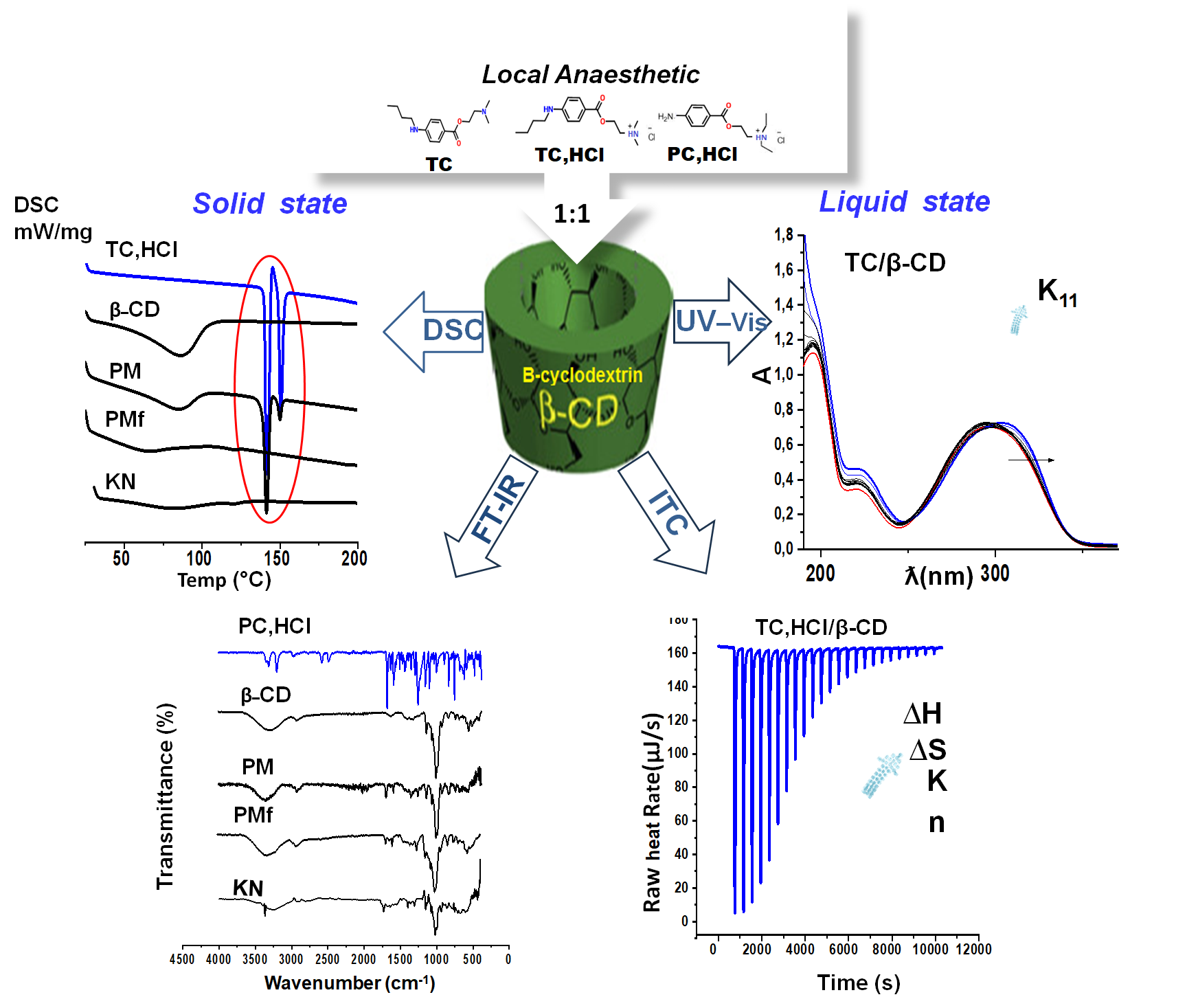
Local anesthetics (LAs) are widely used in medical practice, but their efficacy and stability can be improved through molecular complexation with cyclodextrins (CDs). Beta-cyclodextrin (β-CD), in particular, is known for its ability to form inclusion complexes, enhancing drug solubility and bioavailability. This study explores the molecular interactions between β-CD and three Las - tetracaine (TC), tetracaine hydrochloride (TC·HCl), and procaine hydrochloride (PC·HCl) - using complementary analytical techniques. Since these complexed drugs can be delivered either as liquid-like injections or as solid-like paste and to gain a thorough understanding of the complexation behavior, analyses in both liquid-state (aqueous solution) and solid-state were conducted. Techniques such as ultraviolet-visible spectroscopy (UV-Vis) and isothermal titration calorimetry (ITC) in aqueous solution and differential scanning calorimetry (DSC) and Fourier transform infrared spectroscopy (FT-IR) in solid state were used. The UV-Vis and ITC methods gave comparable results regarding the complex formation constants for TC, HCl and PC, HCl complexes but seemed to diverge in the case of basic tetracaine. The ITC data indicated that the 1 site model fits well for TC, HCl/β-CD complex and moderately for PC, HCl/β-CD complex but it was not adapted to the basic tetracaine. The binding process of β-CD with hydrochloride type drugs in liquid state is exothermic, enthalpy controlled and entropy driven since the values of the corresponding binding enthalpies ∆H are negative, fairly lower than of T∆S terms at 298.15 K The solid state characterization of the LA/β-CD complexes by DSC and IR methods showed that the complexation of the hydrochloride LAs into β-CD cavity occurred during both physical mixture and kneading preparations. The IR spectra analysis suggested that the inclusion of hydrochloride type drugs into CD cavity is not exclusively hydrophobic effect driven which probably explains the divergent behavior observed from ITC experiments for the basic tetracaine. IR results supported and completed the conclusions drawn from liquid state investigation.
HIGHLIGHTS
- Host-guest interaction between three anaesthetic drugs and β -cyclodextrin in liquid and solid states
- Complexation studied by spectrophotometry and Isothermal calorimetry in liquid state
- Complexation studied by differential scanning calorimetry and Infra-red spectroscopy for physical mixture and samples obtained by kneading preparation in solid state
- Equilibrium constant (K), enthalpy of complex formation (∆H), the Gibbs energy of complex formation (∆G) and the entropy of complex formation (∆S) have been calculated.
GRAPHICAL ABSTRACT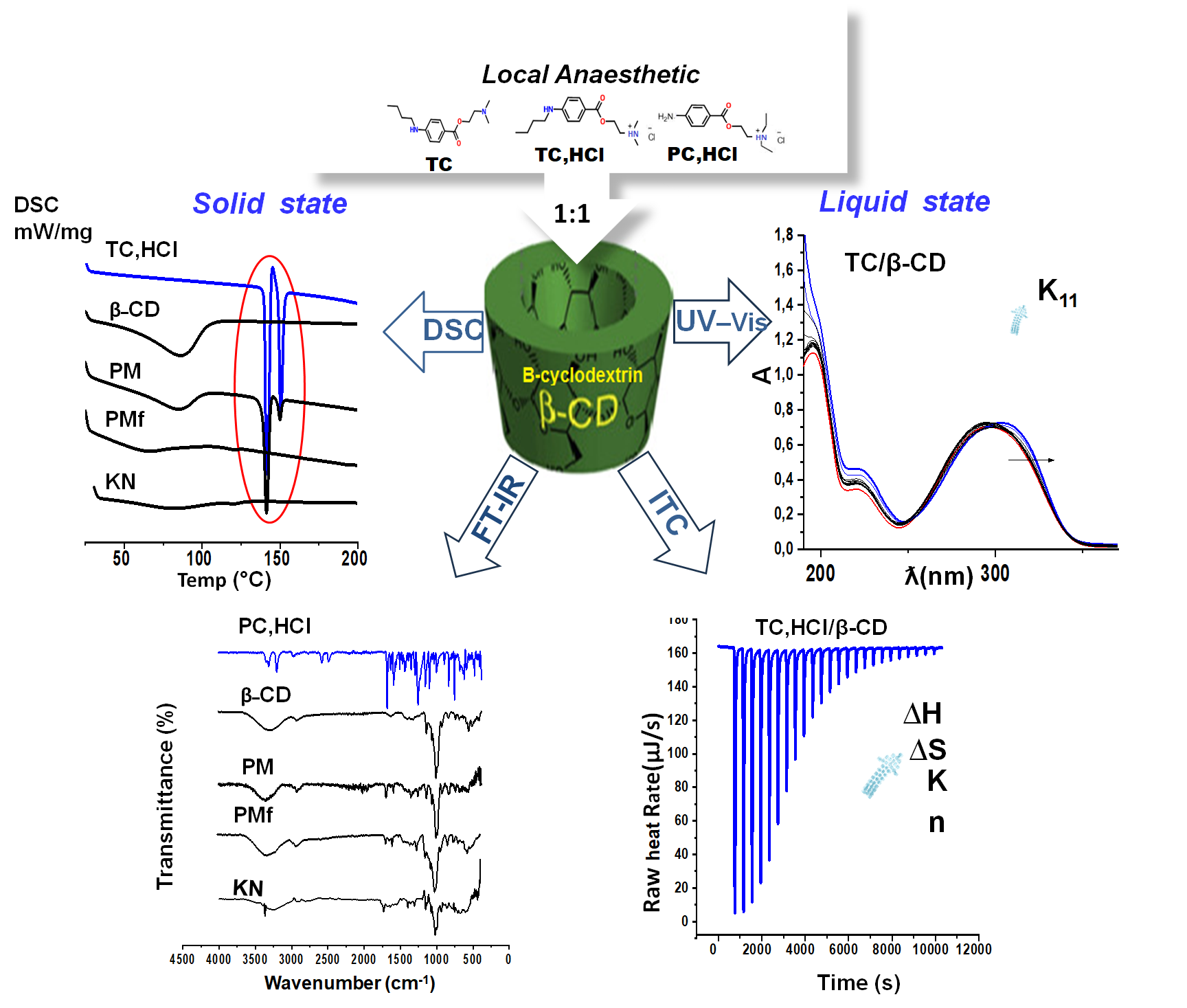
Downloads
References
H Fozzard, P Lee and G Lipkind. Mechanism of local anesthetic drug action on voltage-gated Sodium channels. Current Pharmaceutical Design 2005; 11(21), 2671-2686.
S Hannongbua, W Treesuwan and W Boonyarat. Advanced molecular modeling techniques applied to ion channels and their inhibitors. In: SP Gupta (Ed.). Ion channels their inhib. Springer Berlin, Heidelberg, Germany, 2011, p. 53-78.
SA Fernandes, LF Cabeça, AJ Marsaioli and ED Paula. Investigation of tetracaine complexation with beta-cyclodextrins and p-sulphonic acid calix arenes by nOe and PGSE NMR. Journal of Inclusion Phenomena and Macrocyclic Chemistry 2007; 57, 395-401.
BJ Drakulić, C Zalaru and M Iovu. Acutetoxicity of substituted 2-(1H-pyrazol-1-yl) acetanilides and related commercially available local anesthetics toward mice. A grind/almond-based 3-D QSAR study. QSAR & Combinatorial Science 2009; 28(2), 206-217.
N Kaboudi, SG Asl, N Nourani and A Shayanfar. Solubilization of drugs using beta-cyclodextrin: Experimental data and modeling. Annales Pharmaceutiques Françaises 2024; 82(4), 663-672.
OE Nicolaescu, I Belu, AG Mocanu VC, Manda, G Rău, AS Pîrvu, C Ionescu F, Ciulu-Costinescu, M Popescu and MV Ciocîlteu. Cyclodextrins: Enhancing drug delivery, solubility and bioavailability for modern therapeutics. Pharmaceutics 2025; 17(3), 288.
GA Gonzalez, C Betbeze, R Wills, A Eddy, C Mochal-King and RL Fontenot. Effects of subconjunctival ropivacaine, liposomal bupivacaine, and mepivacaine on corneal sensitivity in healthy horses. Veterinary Surgery 2023; 52(7), 1041-1049.
TA Bauer, NK Horvat, O Marques and S Chocarro, C Mertens, S Colucci, S Schmitt, LM Carrella, S Morsbach, K Koynov, F Fenaroli, P Blümler, M Jung, R Sotillo, MW Hentze, MU Muckenthaler and M Barz. Core cross-linked polymeric micelles for specific iron delivery: Inducing sterile inflammation in macrophages. Advanced Healthcare Materials 2021; 10(19), 2100385.
N Azum, MM Alotaibi, M Ali, MA Rub, HM Marwani, KA Alamry and AM Asiri. Investigation of an anaesthetic drug (tetracaine hydrochloride) in the presence of ionic fluid and surfactant: Mixed micellization & spectroscopic studies. Journal of Molecular Liquids 2023; 370, 121057.
C Kappel, C Seidl, C Medina-Montano, M Schinnerer, I Alberg, C Leps, J Sohl, AK Hartmann, M Fichter, M Kuske, J Schunke, G Kuhn, I Tubbe, D Paßlick, D Hobernik, R Bent, K Haas, E Montermann, K Walzer, M Diken, …, and S Grabbe. Density of conjugated antibody determines the extent of Fc receptor dependent capture of nanoparticles by liver sinusoidal endothelial cells. ACS Nano 2021; 15(9), 15191-15209.
RAFD Lima, MBD Jesus, S Cereda, CM Tofoli, GR Cabeça, LF Mazzaro and E Paula. Improvement of tetracaine antinociceptive effect by inclusion in cyclodextrins. Journal of Drug Targeting 2012; 20(1), 85-96.
RS Teixeira, FJ Veiga, RS Oliveira, SA Jones, SM Silva, RA Carvalhoand and AJ Valente. Effect of cyclodextrins and pH on the permeation of tetracaine: Supramolecular assemblies and release behavior. International Journal of Pharmaceutics 2014; 466(1-2), 349-358.
W Sansanayudh, T Phansucharitthai and Sansanayudh. The effect of cold tetracaine on the severity of burning sensation upon instillation. Clinical Ophthalmology 2018; 12, 2377-2382.
T Ayuse, S Kurata and T Ayuse. Successful dental treatments using procaine hydrochloride in a patient afraid of local anesthesia but consenting for allergic testing with lidocaine: A case report. Local and Regional Anesthesia 2020; 13, 99-103.
SA Zahavi, Y Ouanounou, PL Carlen and A Ouanounou. Local anaesthetic-induced seizures: A review. Frontiers of Oral and Maxillofacial Medicine 2025; 7, 1-8.
PB Dias, MD AR Parchen and D Wasilewski. Comparison of proparacaine, tetracaine, and oxybuprocaine in corneal sensitivity measurement. Journal of Ocular Pharmacology and Therapeutics 2024; 40(4), 215-221.
AH Jeske. Local anesthetics. In: AH Jeske (Ed.). Contemporary dental pharmacology. Springer Cham, Germany, 2024, p. 9-23.
W Rosenkrantz. Practical applications of topical therapy for allergic, infectious, and seborrheic disorders. Clinical Techniques in Small Animal Practice 2006; 21(3), 106-116.
H Faghihi, SM Rajaei, H Ostadhasan and HE Alagha. Effect of topical 0.5 % tetracaine hydrochloride on intraocular pressure in ophthalmologically normal cats. Journal of Feline Medicine and Surgery 2022; 24(2),185-188.
C Margeti, C Kostakis, V Tsioli, K Karagianni and E Flouraki. Local anaesthesia techniques in dogs and cats: A review study. Pets 2024; 1(2), 88-119.
T Kovacs, P Nagy, G Panyi, L Szente, Z Varga and F Zakany. Cyclodextrins: Only pharmaceutical excipients or full-fledged drug candidates? Pharmaceutics 2022; 14(12), 2559.
B Ramos-Martínez, C Dávila-Pousa, V Merino-Bohórquez, M García-Palomo and MP Flox-Benítez. Use of cyclodextrins as excipients in pharmaceutical products: why not in extemporaneous preparations? Farmacia Hospitalaria 2022; 46(1), 31-39.
G Kali, S Haddadzadegan and AB Schnürch. Cyclodextrins and derivatives in drug delivery: New developments, relevant clinical trials, and advanced products. Carbohydrate Polymers 2023; 324(1), 121500.
H Liu, S Guo, S Wei, J Liu and B Tian. Pharmacokinetics and pharmacodynamics of cyclodextrin-based oral drug delivery formulations for disease therapy. Carbohydrate Polymers 2023; 329, 121763.
JY Liu, X Zhang and T Bıngren. Selective modifications at the different positions of cyclodextrins: A review of strategies. Turkish Journal of Chemistry 2020; 44(2), 261-278.
A Haroun, A Osman, S Ahmed and AH Elghandour. Synthesis and characterization of ibuprofen delivery system based on β -cyclodextrin. Trends in Science 2022; 19(19), 5825.
CM Santamaria, A Woodruff, R Yang and DS Kohane. Drug delivery systems for prolonged duration local anesthesia. Materials Today 2017; 20(1), 22-31.
KVB Pharm, MRB Pharm and MM Patel. Insight on nano drug delivery systems with targeted therapy in treatment of oral cancer. Nanomedicine: Nanotechnology, Biology and Medicine 2023; 49(9), 102662.
S Prabu, K Sivakumar, SK Nayaki and R Rajamohan. Host-guest interaction of cytidine in β -cyclodextrin microcavity: Characterization and docking study. Journal of Molecular Liquids 2016; 219, 967-974.
C Merino, E Junquera, J Jime and E Aicart. Effect of the presence of cyclodextrin on the solution behavior of procaine hydrochloride spectroscopic and thermodynamic studies. Langmuir 2000; 16(14), 1557-1565.
P Fini, M Castagnolo, L Catucci, P Cosmaa and A Agostiano. Inclusion complexes of rose bengal and cyclodextrins. Thermochimica Acta 2004; 418(1-2), 33-38.
H Boudjoras, T Fergoug, M Azayaz, Y Bouhadda, NM Araibi and C Zelmat. Temperature effect on the encapsulation of the drug tetracaine hydrochloride in different cyclodextrins. Malaysian Journal of Analytical Sciences 2022; 26(1), 164-175.
BN Nalluri, KPR Chowdary, RV Kolapalli, AR Hayman and G Becket. Physicochemical characterization and dissolution properties of nimesulide-cyclodextrin binary systems. AAPS PharmSciTech 2003; 4(1), E2.
GA Holdgate and WHJ Ward. Measurements of binding thermodynamics in drug discovery. Drug Discovery Today 2005; 10(22), 1543-1550.
D Jakšić, MŠ Klarić, H Rimac, R Kerep and I Piantanida. Cyclodextrin-based displacement strategy of sterigmatocystin from serum albumin as a novel approach for acute poisoning detoxification. International Journal of Molecular Sciences 2023; 24(5), 4485.
H Li, X Xu, M Liu, D Sun and L Li. Microcalorimetric and spectrographic studies on host-guest interactions of α-, β-, γ- And Mβ-cyclodextrin with resveratrol. Thermochimica Acta 2010; 510(1-2), 168-172.
K Bouchemal and S Mazzaferro. How to conduct and interpret ITC experiments accurately for cyclodextrin-guest interactions. Drug Discovery Today 2012; 17(11-12), 623-629.
A Pîrnǎu, M Mic, M Bogdan and I Turcu. Characterization of β-cyclodextrin inclusion complex with procaine hydrochloride by 1H NMR and ITC. Journal of Inclusion Phenomena and Macrocyclic Chemistry 2014; 79, 283-289.
MM Doile, KA Fortunato, IC Schmücker, SK Schucko, MAS Silva and PO Rodrigues. Silva and PO Rodrigues. Physicochemical properties and dissolution studies of dexamethasone acetate-β-cyclodextin inclusion complexes produced by different methods. AAPS PharmSciTech 2008; 9(1), 314-321.
U Gala, MC Chuong, R Varanasi and H Chauhan. Characterization and comparison of lidocaine-tetracaine and lidocaine-camphor eutectic mixtures based on their crystallization and hydrogen-bonding abilities. AAPS PharmSciTech 2015; 16(3), 528-536.
D Giron, M Draghi, C Goldbronn, S Pfeffer and P Piechon. Study of the polymorphic behaviour of some local anesthetic drugs. Journal of Thermal Analysis 1997; 49(2), 913-927.
A Abou-Okeil, M Rehan, SM El-Sawy, MK El-bisi, OA Ahmed-Farid and FA Abdel-Mohdy. Lidocaine/β-cyclodextrin inclusion complex as drug delivery system. European Polymer Journal 2018; 108, 304-310.
KO Eshchanov and MM Baltaeva. Study of the interaction of sorbed silver, gold and copper ions with functional groups on hydrolyzed fibroin using Charmm 22 force field calculations. Chemical Review & Letter 2022; 5, 161-168.
NY Rahim, FH Samad, AM Rohisham. Spectroscopic studies of inclusion complex glipizide and β -cyclodextrin. Malaysian Journal of Analytical Sciences 2019; 23(5), 789-798.
Published
How to Cite
Issue
Section
License
Copyright (c) 2025 Walailak University

This work is licensed under a Creative Commons Attribution-NonCommercial-NoDerivatives 4.0 International License.





