
Hyaluronic Acid-Astaxanthin Gel: Anti-Inflammatory Effects in Oral Ulcer Diabetes Mellitus Rats
DOI:
https://doi.org/10.48048/tis.2025.9955Keywords:
Hyaluronic acid, Astaxanthin, Anti-inflammation, Oral ulcer, Diabetes mellitusAbstract
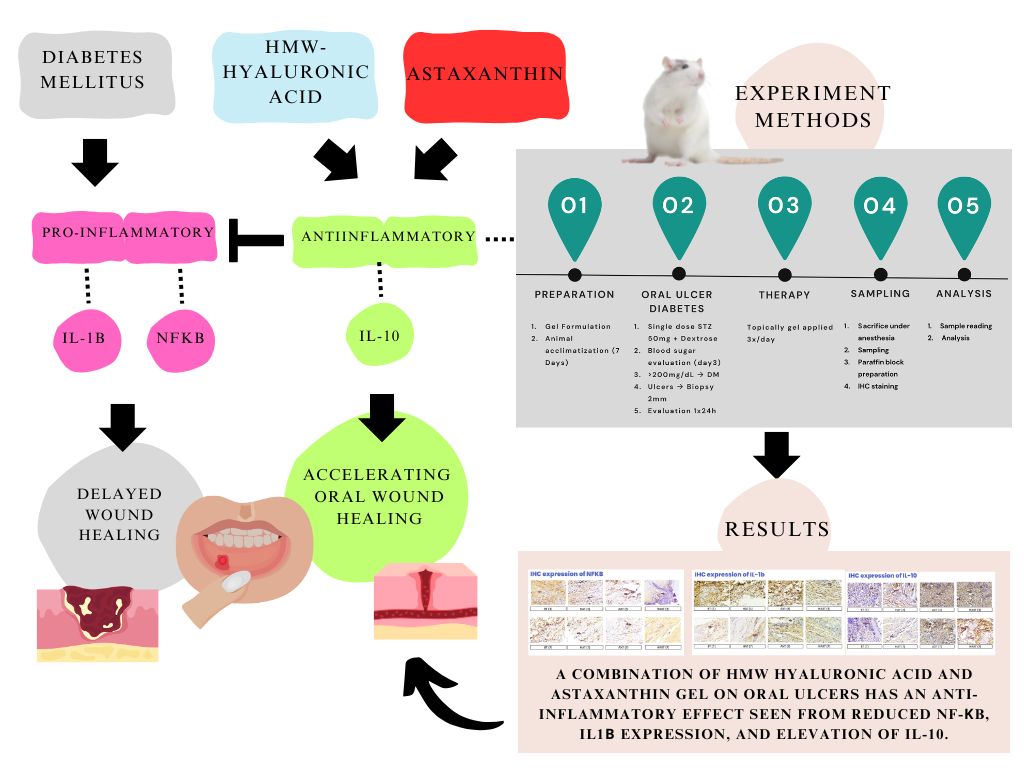
This study was designed to determine the anti-inflammatory effect of a combination of high-molecular-weight hyaluronic acid (HMW-HA) and astaxanthin gel on oral ulcers in diabetes mellitus rats through NF-κB, IL1β, and IL-10 expression. Forty oral ulcer diabetic rats were used as experimental animals and divided randomly into 4 large groups (basic gel treatment (BT); HMW-HA 0.2 % gel treatment (HAT), astaxanthin 1 % gel treatment (AXT), and HMW hyaluronic acid 0.2 % and astaxanthin 1 % gel treatment (HAXT)). They were treated for 3 and 7 days (5 rats per group). The anti-inflammatory effect was measured by immunohistochemical examination of NF-κB, IL1β, and IL-10 expression. The Kruskal-Wallis test was used to analyze the data, followed by a post hoc Mann-Whitney test (p < 0.05). The NF-κB expression on day 3 showed a significant difference between BT (5 ± 0.50). and HAXT (3 ± 0.50) (p < 0.05); IL1β expression showed no significant differences between BT (4 ± 1.00) with all groups (p > 0.05); IL-10 expression showed a significant difference between BT (2 ± 1.00) with AXT (3 ± 0,50) and HAXT (5 ± 1,00) (p < 0.05). The NF-κB expression on day 7 showed a significant difference between BT (5 ± 0,50) with HAXT (2 ± 1,00) (p < 0.05); IL1β expression showed a significant difference between BT (3 ± 1.00) with HAXT (1 ± 0.50); HAXT (1 ± 0.50) with HAT (2 ± 0.50) and AXT (2 ± 0.50) (p < 0.05); IL-10 expression was significantly different between BT (3 ± 1.00) with AXT (4 ± 0.50) and HAXT (7 ± 0.50); AXT (4 ± 0.50) and HAXT (7 ± 0.50) (p < 0.05). A combination of HMW hyaluronic acid and astaxanthin gel on oral ulcers has an anti-inflammatory effect seen from reduced NF-κB, IL1β expression, and elevation of IL-10.
HIGHLIGHTS
- This study evaluated the effects of adding astaxanthin to high-molecular-weight hyaluronic acid on oral cavity wounds in a diabetic rat model.
- The anti-inflammatory effects of the hyaluronic acid-astaxanthin gel combination were a result of the reduction in pro-inflammatory marker expression (NF-κB and IL1β) and an increase in an anti-inflammatory marker (IL-10).
- The combination of hyaluronic acid-astaxanthin gels has the potential to accelerate wound healing in diabetes mellitus.
GRAPHICAL ABSTRACT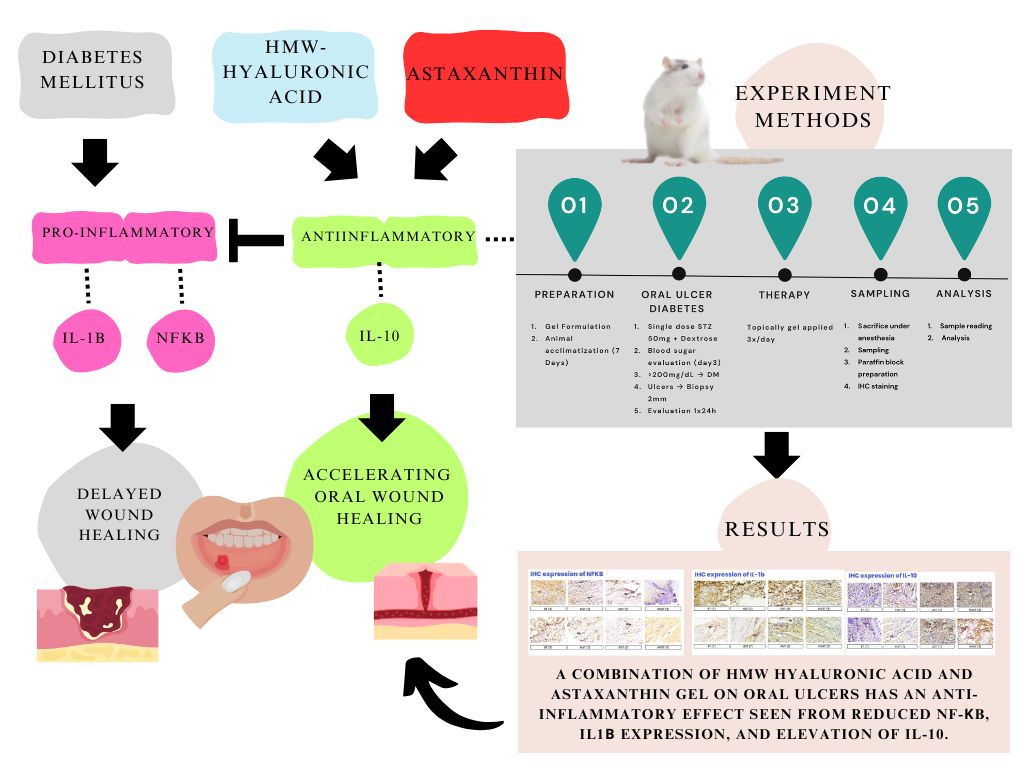
Downloads
References
SA Antar, NA Ashour, M Sharaky, M Khattab, NA Ashour, RT Zaid, EJ Roh, A Elkamhawy and AA Al-Karmalawy. Diabetes mellitus: Classification, mediators, and complications; A gate to identify potential targets for the development of new effective treatments. Biomedicine & Pharmacotherapy 2023; 168(5), 115734.
SF Spampinato, GI Caruso, RD Pasquale, MA Sortino and S Merlo. The treatment of impaired wound healing in diabetes: Looking among old drugs. Pharmaceuticals 2020; 13(4), 60.
N Hendrijantini, RM Sitalaksmi, MD Ari, TJ Hidayat, PA Putri and D Sukandar. The expression of TNF-α, IL-1β, and IL-10 in the diabetes mellitus condition induced by the combination of spirulina and chitosan. Bali Medical Journal 2020; 9(1), 22-26.
S Nirenjen, J Narayanan, T Tamilanban, V Subramaniyan, V Chitra, NK Fuloria, LS Wong, G Ramachawolran, M Sekar, G Gupta, S Fuloria, SV Chinni and S Selvaraj. Exploring the contribution of pro-inflammatory cytokines to impaired wound healing in diabetes. Frontiers in Immunology 2023; 27(14), 1216321.
LA Brizeno, AM Assreuy, AP Alves, FB Sousa, PG Silva, SCD Sousa, NA Lascane, JS Evangelista and MR Mota. Delayed healing of oral mucosa in a diabetic rat model: Implication of TNF-α, IL-1β and FGF-2. Life Sciences 2016; 155(26), 36-47.
R Tripathi and K Tripathi. Management of non healing oral ulcer in diabetic patient using topical application of epidermal growth factor: A case report. Scholars Academic Journal of Biosciences 2015; 3(8), 640-643.
MF Silva, KG Barbosa, JV Pereira, PM Bento, GP Godoy and DQDC Gomes. Prevalence of oral mucosal lesions among patients with diabetes mellitus types 1 and 2. Anais Brasileiros de Dermatologia 2015; 90(1), 49-53.
A Sinha, NK Sharma, SK Verma and P Sarkar. Occurrence of oral mucosal lesions in type 2 diabetes mellitus patients: A hospital based study. International Journal of Health Sciences 2020; 6(S1), 4821-4830.
SD Wen, E Sans-Serramitjana, JF Santander, MR Sánchez, P Salazar-Aguilar, AB Zepeda, SI Alvarado and IB Miranda. Effects of natural extracts in the treatment of oral ulcers: A systematic review of evidence from experimental studies in animals. Journal of Clinical and Experimental Dentistry 2021; 13(10), e1038-e1048.
FD Francesco, A Saparov and M Riccio. Hyaluronic acid accelerates re-epithelialization and healing of acute cutaneous wounds. European Review for Medical & Pharmacological Sciences 2023; 27(S3), 37-45.
M Koray, D Ofluoglu, A Senemtasi, H İşsever and M Yaltirik. The efficacy of hyaluronic acid gel in pain control of recurrent Aphthous stomatitis. International Journal of Dentistry and Oral Science 2016; 13(3), 273-275.
AM Juncan, DG Moisă, A Santini, C Morgovan, LL Rus, AL Vonica-Țincu and F Loghin. Advantages of hyaluronic acid and its combination with other bioactive ingredients in cosmeceuticals. Molecules 2021; 26(15), 4429.
R Landon, V Gueguen, H Petite, D Letourneur, G Pavon-Djavid and F Anagnostou. Impact of astaxanthin on diabetes pathogenesis and chronic complications. Marine Drugs 2020; 18(7), 357.
RR Ambati, SM Phang, S Ravi and RG Aswathanarayana. Astaxanthin: Sources, extraction, stability, biological activities and its commercial applications-A review. Marine Drugs 2014; 12(1), 128-152.
MX Chang and F Xiong. Astaxanthin and its effects in inflammatory responses and inflammation-associated diseases: recent advances and future directions. Molecules 2020; 25(22), 5342.
C Farruggia, MB Kim, M Bae, Y Lee, TX Pham, Y Yang, MJ Han, YK Park and JY Lee. Astaxanthin exerts anti-inflammatory and antioxidant effects in macrophages in NRF2-dependent and independent manners. The Journal of Nutritional Biochemistry 2018; 62, 202-209.
Z Kohandel, T Farkhondeh, M Aschner and S Samarghandian. Nrf2 a molecular therapeutic target for Astaxanthin. Biomedicine & Pharmacotherapy 2021; 137, 111374.
D Andriani, AF Pargaputri, S Revianti, K Parisihni and MN Ashrin. Potency astaxanthin (Haematococcus pluvialis) as anti-inflammatory gel to oral traumatic ulcer. Malaysian Journal of Medicine & Health Sciences 2024; 20, 1-6.
SK Sharma, SK Mudgal, K Thakur and R Gaur. How to calculate sample size for observational and experimental nursing research studies. National Journal of Physiology, Pharmacy and Pharmacology 2020; 10(1), 1-8.
N Shahare, S Chouhan and GN Darwhekar. Herbs used in treatment of mouth ulcer-a review. International Journal of Pharmacognosy and Chemistry 2021; 29(3), 68-74.
HB Tribhuvan, SS Mhaske, VG Wayal, PR Pawar and K Walunj. Formulation and evaluation of pharmaceutical aqueous gel for mouth ulcer treatment. International Journal of Scientific Research in Science and Technology 2022: 9(4), 34-40.
G Furlan, JBD Silva and ML Bruschi. Improvement of the mechanical, rheological and bioadhesive properties of environmentally responsive systems containing different cellulose derivatives for quercetin topical application. Materials Today Communications 2025; 42, 111420.
K Parisihni, D Mulawarmanti and K Widowati. Potency of hyperbaric oxygen therapy on oral candidiasis diabetes mellitus. European Journal of Dentistry 2024; 18(04), 1062-1068.
TD Santi, TN Siregar, A Sutriana, R Andini and A Candra. Wound healing activity of transdermal patches of carica papaya, chromolaena odorata, and averrhoa bilimbi leaves on incision wounds of hyperglycemic rat. Trends in Sciences 2023; 20(12), 6944.
K Raziyeva, Y Kim, Z Zharkinbekov, K Kassymbek, S Jimi and A Saparov. Immunology of acute and chronic wound healing. Biomolecules 2021; 11(5), 700.
CDS Leite, OC Pires, PH Avi, MLM Soto, AR Martins and T Rocha. Molecular mediators involved in skin healing: A narrative review. F1000Research 2022; 11, 465.
Q Guo, Y Jin, X Chen, X Ye, X Shen, M Lin, C Zeng, T Zhou and J Zhang. NF-κB in biology and targeted therapy: new insights and translational implications. Signal Transduction and Targeted Therapy 2024; 9(1), 53.
BM Lee, SJ Park, I Noh and CH Kim. The effects of the molecular weights of hyaluronic acid on the immune responses. Biomaterials Research 2021; 25(1), 27.
A Lierova, J Kasparova, A Filipova, J Cizkova, L Pekarova, L Korecka, N Mannova, Z Bilkova and Z Sinkorova. Hyaluronic acid: Known for almost a century, but still in vogue. Pharmaceutics 2022; 14(4), 838.
X Wen, L Xiao, Z Zhong, L Wang, Z Li, X Pan and Z Liu. Astaxanthin acts via LRP-1 to inhibit inflammation and reverse lipopolysaccharide-induced M1/M2 polarization of microglial cells. Oncotarget 2017; 8(41), 69370-69385.
AH Abdelazeem, AS Abuelsaad, A Abdel-Moniem and M Abdel-Gabbar. Association of metabolic syndrome components with alterations in oxidative stress and cytokines expression. Journal of Taibah University for Science 2021; 15(1), 928-940.
D Andriani, RI Roestamadji and RP Rahayu. Astaxanthin is a promising therapy for wound healing in diabetic conditions: A review. Journal of International Dental and Medical Research 2023; 16(4), 1824-1829.
Y Kawano, V Patrulea, E Sublet, G Borchard, T Iyoda, R Kageyama, A Morita, S Seino, H Yoshida, O Jordan and T Hanawa. Wound healing promotion by hyaluronic acid: Effect of molecular weight on gene expression and in vivo wound closure. Pharmaceuticals 2021; 14(4), 301.
X Pan, K Zhang, C Shen, X Wang, L Wang and YY Huang. Astaxanthin promotes M2 macrophages and attenuates cardiac remodeling after myocardial infarction by suppression inflammation in rats. Chinese Medical Journal 2020; 133(15), 1786-1797.
T Liu, L Zhang, D Joo and SC Sun. NF-κB signaling in inflammation. Signal Transduction and Targeted Therapy 2017; 2(1), 17023.
JP Yadav, A Verma, P Pathak, AR Dwivedi, AK Singh, P Kumar, H Khalilullah, M Jaremko, AH Emwas and DK Patel. Phytoconstituents as modulators of NF-κB signalling: Investigating therapeutic potential for diabetic wound healing. Biomedicine & Pharmacotherapy 2024; 177, 117058.
Published
How to Cite
Issue
Section
License
Copyright (c) 2025 Walailak University

This work is licensed under a Creative Commons Attribution-NonCommercial-NoDerivatives 4.0 International License.





