
Occurrence of Microplastics across Seasonal Variations in a Municipal Wastewater Treatment Plant in Thailand
DOI:
https://doi.org/10.48048/tis.2025.9931Keywords:
FT-IR microscope, Microplastic, Microplastic removal, Seasonality, Stabilization pond, Wastewater treatment plantAbstract
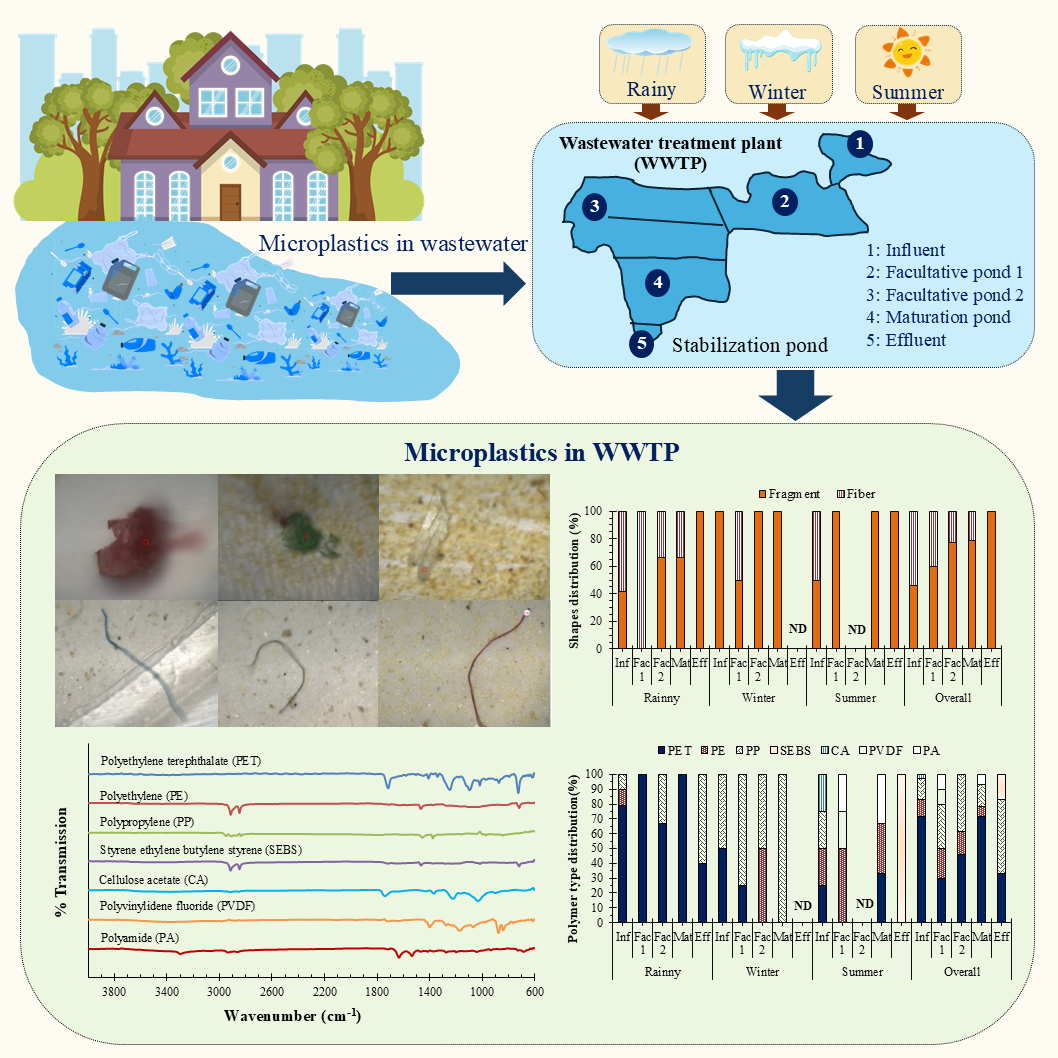
The behavior of microplastics (MPs) in aquatic environments is influenced by a variety of factors; however, the impact of seasonal variations and meteorological conditions on MPs remains insufficiently explored and understood. This research investigates the impact of seasonality on the presence, transfer, and removal efficiency of MPs at a wastewater treatment plant (WWTP) in Lampang, Thailand. The study monitored the fate and transport of MPs across the rainy, winter, and summer seasons of 2023 - 2024. The results indicated that the average MP concentration was highest during the rainy season, at 1.20 ± 1.27 particles/L, compared to 0.27 ± 0.50 particles/L and 0.27 ± 0.54 particles/L during the winter and summer seasons, respectively. Statistical analysis using ANOVA confirmed a statistically significant difference in MP abundance among the 3 seasons (p < 0.05). Across all seasons, most MPs detected in the WWTP processes were characterized by sizes of 151 - 350 µm, gray coloration, and fragment shapes. The chemical composition of MPs primarily included polyethylene terephthalate (PET), polypropylene (PP), and polyethylene (PE). Despite these findings, seasonal trends in MP abundance within the secondary treatment processes were inconsistent. These inconsistencies underscore the necessity for further investigation into the fate and transport of MPs under varying conditions, including overflow scenarios. Furthermore, the design and implementation of effective wastewater management strategies, specifically tailored to seasonal variations, are crucial for improving MPs removal efficiency and minimizing their discharge into natural bodies of water.
HIGHLIGHTS
- Most common microplastics (MPs) detected in the wastewater treatment plant (WWTP) were polyethylene terephthalate (PET), polyethylene (PE), and polypropylene (PP).
- The number of MPs in the WWTP during the rainy season was greater than in the winter and summer seasons.
- Rainfall affects the mobility and transport of MPs to the WWTP during rainy seasons.
GRAPHICAL ABSTRACT
Downloads
References
S Kittipongvises, A Phetrak, N Hongprasith and J Lohwacharin. Unravelling capability of municipal wastewater treatment plant in Thailand for microplastics: Effects of seasonality on detection, fate and transport. Journal of Environmental Management 2022; 302(Part A), 113990.
RC Thompson, Y Olson, RP Mitchell, A Davis, SJ Rowland, AWG John, D McGonigle and AE Russell. Lost at sea: Where is all the plastic? Science 2004; 304(5672), 838.
AL Andrady. Microplastics in the marine environment. Marine Pollution Bulletin 2011; 62(8), 1596-1605.
SL Wright and FJ Kelly. Plastic and human health: A micro issue? Environmental Science & Technology 2017; 51(12), 6634-6647.
S Estahbanati and NL Fahrenfeld. Influence of wastewater treatment plant discharges on microplastic concentrations in surface water. Chemosphere 2016; 162, 277-284.
Z Long, Z Pan, W Wang, J Ren, X Yu, L Lin, H Lin, H Chen and X Jin. Microplastic abundance, characteristics, and removal in wastewater treatment plants in a coastal city of China. Water Research 2019; 155, 255-265.
SM Mintenig, I Int-Veen, MGJ Loder, S Primpke and G Gerdts. Identification of microplastic in effluents of wastewater treatment plants using focal plane array based micro-Fourier-transform infrared imaging. Water Research 2017; 108, 365-372.
J Talvitie, A Mikola, A Koistinen and O Setala. Solutions to microplastic pollution - removal of microplastics from wastewater effluent with advanced wastewater treatment technologies. Water Research 2017; 123, 401-407.
S Ziajahromi, PA Neale, L Rintoul and FDL Leusch, Wastewater treatment plants as a pathway for microplastics: Development of a new approach to sample wastewater-based microplastics. Water Research 2017; 112, 93-99.
M Simon, NV Alst and J Vollertsen. Quantification of microplastic mass and removal rates at wastewater treatment plants applying focal plane array (FPA)-based fourier transform infrared (FT-IR) imaging. Water Research 2018; 142, 1-9.
PL Ngo, BK Pramanik, K Shah and R Roychand. Pathway, classification and removal efficiency of microplastics in wastewater treatment plants. Environmental Pollution 2019; 255(2), 113326.
C Lassen, SF Hansen, K Magnusson, NB Hartmann, P Rehne Jensen, TG Nielsen and A Brinch. Microplastics - Occurrence, Effects and Sources of Releases to the Environment in Denmark. Danish Environmental Protection Agency, Copenhagen, Denmark, 2015.
RC Thompson. Microplastics in the marine environment: Sources, consequences and solutions. Springer International Publishing, Massachusetts, 2015.
PK Cheung, LTO Cheung and L Fok. Seasonal variation in the abundance of marine plastic debris in the estuary of a subtropical macro-scale drainage basin in South China. Science of the Total Environment 2016; 562, 658-665.
Pollution Control Department. Handbook of Community wastewater treatment system. Ministry of Natural Resources and Environment, Bangkok, Thailand, 2017.
Z Wang, Y Qin, W Li, W Yang, Q Meng and J Yang. Microplastic contamination in freshwater: First observation in lake ulansuhai, yellow river basin, China. Environmental Chemistry Letters 2019; 17(4), 1821-1830.
SA Carr, J Liu and AG Tesoro. Transport and fate of microplastic particles in wastewater treatment plants. Water Research 2016; 91, 174-182.
Guidelines for community wastewater management along the Wang River through Lampang Municipality, Available at: https://epo02.pcd.go.th/th/information/more/228/page/5, accessed December 2024.
J Masura, J Baker, G Foster and C Arthur. Laboratory methods for the analysis of microplastics in the marine environment: recommendations for quantifying synthetic particles in waters and sediments. NOAA Marine Debris Division, Maryland.
HC Ruffell. 2019, Wastewater treatment plants as a source of microplastics to the environment, Master’s Thesis. University of Canterbury, Christchurch, New Zealand.
X Liu, W Yuan, M Di, Z Li and J Wang. Transfer and fate of microplastics during the conventional activated sludge process in one wastewater treatment plant of China. Chemical Engineering Journal 2019; 362, 176-182.
T Dalu, T Banda, T Mutshekwa, LF Munyai and RN Cuthbert. Effects of urbanisation and a wastewater treatment plant on microplastic densities along a subtropical river system. Environmental Science and Pollution Research 2021; 28, 36102-36111.
C Chen, Y Ju, YC Lim, C Chen and CD Dong. Seasonal variation of diversity, weathering, and inventory of microplastics in coast and harbor sediments. Science of the Total Environment 2021; 781, 146610.
N Hongprasith, C Kittimethawong, R Lertluksanaporn, T Eamchotchawalit, S Kittipongvises and J Lohwacharin. IR microspectroscopic identification of microplastics in municipal wastewater treatment plants. Environmental Science and Pollution Research International 2020; 27(15), 18557-18564.
M Fauzi, P Soewondo, M Handajani, T Tedjakusuma, A Nur and M Qadafi. Characteristics and removal of microplastics in urban domestic WWTP system: A case study in Bandung city, Indonesia. Case Studies in Chemical and Environmental Engineering 2024; 10, 100999.
J Talvitie, A Mikola, O Setala, M Heinonen and A Koistinen. How well is microlitter purified from wastewater? - A detailed study on the stepwise removal of microlitter in a tertiary level wastewater treatment plant. Water Research 2017; 109, 164-172.
KJ Kapp and E Yeatman. Microplastic hotspots in the snake and lower columbia rivers: A journey from the greater yellowstone ecosystem to the Pacific Ocean. Environmental Pollution 2018; 241, 1082-1090.
X Zhang, J Chen and J Li. The removal of microplastics in the wastewater treatment process and their potential impact on anaerobic digestion due to pollutants association. Chemosphere 2020; 251, 126360.
S Acarer. Microplastics in wastewater treatment plants: Sources, properties, removal efficiency, removal mechanisms, and interactions with pollutants. Water Science & Technology 2023; 87(3), 685-710.
Scientific Polymer Products, Available at: https://scipoly.com/shop/styreneethylene-butylene-aba-block-copolymers-2/, accessed December 2024.
AJDJ Silva, MM Contreras, CR Nascimento and MFD Costa. Kinetics of thermal degradation and lifetime study of poly (vinylidene fluoride) (PVDF) subjected to bioethanol fuel accelerated aging. Heliyon 2020; 6(7), e04573.
SC Teixeira, TVD Oliveira, RR Assis Silva, ARC Ribeiro, PC Stringheta, TCB Rigolon, MRMR Pinto and NDFF Soares. Colorimetric indicators of acai anthocyanin extract in the biodegradable polymer matrix to indicate fresh shrimp. Food Bioscience 2022; 48, 101808.
Styrene Ethylene Butadiene Styrene, Available at: https://www.cjpsales.co.uk/products/downloads/26/sebs%20data.pdf, accessed December 2024.
J Sun, X Dai, Q Wang, MCMV Loosdrecht and BJ Ni. Microplastics in wastewater treatment plants: Detection, occurrence and removal. Water Research 2019; 152, 21-37.
DH Kwak, HJ Jung, SJ Kim, CH Won and JW Lee. Separation characteristics of inorganic particles from rainfalls in dissolved air flotation: A Korean perspective. Separation Science and Technology 2005; 40(14), 3001-3015.
J Talvitie, M Heinonen, JP Paakkonen, E Vahtera, A Mikola, O Setala and R Vahala. Do wastewater treatment plants act as a potential point source of microplastics? preliminary study in the coastal gulf of finland, baltic sea. Water Science & Technology 2015; 72(9), 1495-1504.
S Wei, H Luo, J Zou, J Chen, X Pan, DPL Rousseau and J Li. Characteristics and removal of microplastics in rural domestic wastewater treatment facilities of China. Science of The Total Environment 2020; 739, 139935.
S Yoshida, K Hiraga, T Takehana, I Taniguchi, H Yamaji, Y Maeda, K Toyohara, K Miyamoto, Y Kimura and K Oda. A bacterium that degrades and assimilates poly(ethylene terephthalate). Science 2016; 351(6278), 1196-1199.
S Magni, A Binelli, L Pittura, CG Avio, CD Torre, CC Parenti, S Gorbi and F Regoli. The fate of microplastics in an Italian wastewater treatment plant. Science of The Total Environment 2019; 652, 602-610.
L Yang, K Li, S Cui, Y Kang, L An and K Lei. Removal of microplastics in municipal sewage from China’s largest water reclamation plant. Water Research 2019; 155, 175-181.
EA Gies, JL Lenoble, M Noel, A Etemadifar, F Bishay, ER Hall and PS Ross. Retention of microplastics in a major secondary wastewater treatment plant in Vancouver, Canada. Marine Pollution Bulletin 2018; 133, 553-561.
HA Leslie, SH Brandsma, MJMV Velzen and AD Vethaak. Microplastics en route: Field measurements in the Dutch river delta and Amsterdam canals, wastewater treatment plants, North Sea sediments and biota. Environment International 2017; 101, 133-142.
F Murphy, C Ewins, F Carbonnier and B Quinn. Wastewater treatment works (WWTW) as a source of microplastics in the aquatic environment. Environmental Science & Technology 2016; 50(11), 5800-5808.
T Paisanpong, S Laowansiri and J Kaewsuk. Microplastic contamination of aerated lagoon wastewater treatment and stabilization pond wastewater treatment. The Public Health Journal of Burapha University 2022; 17(1), 1-14.
T Mani, A Hauk, U Walter and P Burkhardt-Holm. Microplastics profile along the Rhine Rive. Environmental Science & Technology 2015; 5, 3345-3457.
D Eerkes-Medrano, RC Thompson and DC Aldridge. Microplastics in freshwater systems: A review of the emerging threats, identification of knowledge gaps and prioritization of research needs. Water Research 2015; 75, 63-82.
S Klein, E Worch and TP Knepper. Occurrence and spatial distribution of microplastics in river shore sediments of the rhine–main area in Germany. Environmental Science & Technology 2015; 49(10), 6070-6076.
E Winijkul, KZ Latt, K Limsiriwong, T Pussayanavin and T Prapaspongsa. Depositions of airborne microplastics during the wet and dry seasons in Pathum Thani, Thailand. Atmospheric Pollution Research 2024; 15(10), 102242.
MR Michielssen, ER Michielssen, J Ni and MB Duhaime. Fate of microplastics and other small anthropogenic litter (SAL) in wastewater treatment plants depends on unit processes employed. Environmental Science: Water Research & Technology 2016; 2(6), 1064-1073.
M Lares, MC Ncibi and M Sillanpaa. Occurrence, identification and removal of microplastic particles and fibers in conventional activated sludge process and advanced MBR technology. Water Research 2018; 133, 236-246.
R Dris, J Gasperi, C Mirande, C Mandin, M Guerrouache, V Langlois and B Tassin. A first overview of textile fibers, including microplastics, in indoor and outdoor environments. Environmental Pollution 2017; 221, 453-458.
Published
How to Cite
Issue
Section
License
Copyright (c) 2025 Walailak University

This work is licensed under a Creative Commons Attribution-NonCommercial-NoDerivatives 4.0 International License.





